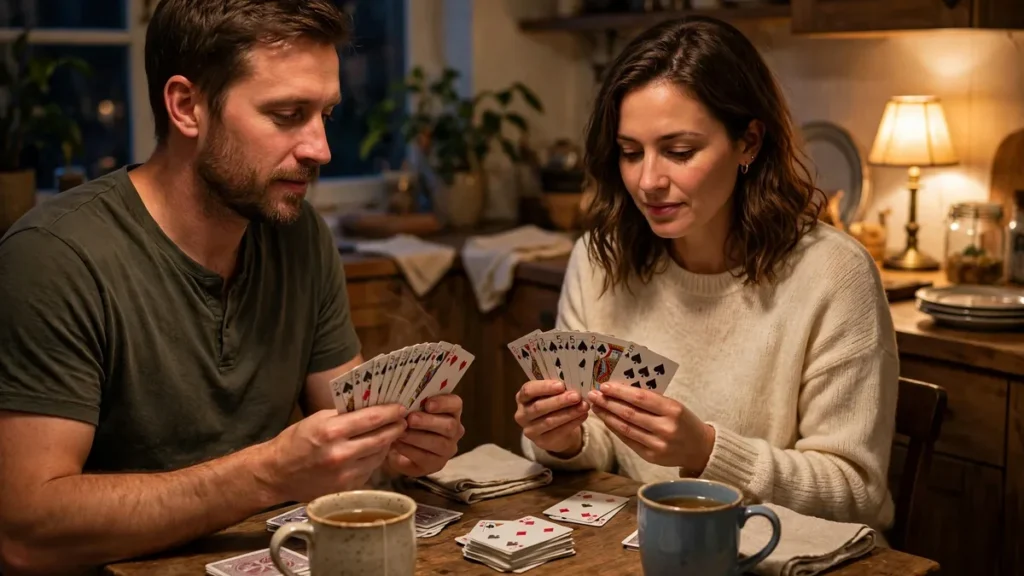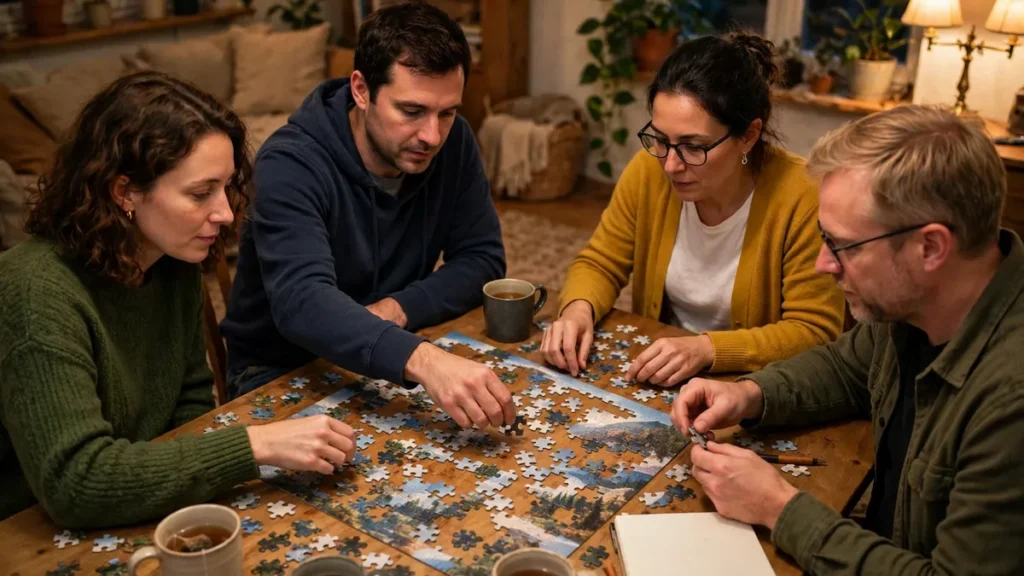
Somewhere in the second year of our marriage, my wife and I hit a quiet patch. Nothing was wrong, exactly. We were polite, we were busy, we were tired. Evenings followed the same shape: dinner, dishes, then two people on opposite ends of the sofa, each scrolling a different feed in the same room. We were together and apart at the same time, and neither of us could name what was missing. Then a friend left a board game at our house after dinner one night, a simple two-player card game, and out of boredom more than romance we tried it the following Friday. She beat me twice. I accused her of hiding cards. She laughed so hard she nearly knocked the table over. We played again the next night, and the night after that. It was not a miracle. It was a table, two chairs, and an hour in which we actually looked at each other.
That is the honest shape of the answer. Board games can be genuinely good for couples, and not in a vague, feel-good way. They give two people something to do together that is neither a screen nor a chore, they demand a kind of attention that modern evenings rarely ask for, and they reveal things about a partner that years of small talk never will. They can also go wrong, sometimes badly, when competition curdles into scorekeeping or when one person treats every game as a contest that must be won. So the verdict is a conditional yes: board games help a relationship when the game suits the pair playing it, when both people actually want to be at the table, and when the evening matters more than the score. The rest of this piece is about how to tell the difference before you buy the box or clear the table.
The verdict in one paragraph
Start with what board games reliably deliver for two people. First, they create shared attention. A game asks both players to watch the same board, track the same pieces, and react to the same surprises. That sounds trivial until you compare it with the usual couple’s evening, where attention is split between a television, two phones, and whatever is left over for each other. A game narrows the world to the table, and for an hour that narrowness is a gift.
Second, they give a couple a low-cost ritual. A board game costs less than a single restaurant meal and can be played fifty times. A regular game night becomes a fixed point in the week, a small appointment the two of you keep with each other. Rituals matter in long relationships precisely because they are small and repeatable. Grand gestures are rare; a Friday game is not.
Third, they teach you about each other in a way that conversation alone does not. You learn how your partner handles a bad run of luck, whether they take risks or play safe, whether they plan ahead or improvise, and whether they can lose without the evening turning sour. These are not trivial observations. They are the same qualities that show up in money decisions, holiday planning, and every argument about whose turn it is to do anything.
None of this is automatic, and the honest version of the claim has limits. A board game will not fix a relationship that is already in trouble, and it will not replace a real conversation that two people have been avoiding. What it does, when the foundations are sound, is give a good relationship a better evening. That is a smaller promise than the one on the back of the box, but it is one a game can actually keep.
What a game does that a film night cannot
Think about the last time you and your partner watched something together. You sat side by side, faced the same direction, and barely spoke for two hours. Afterwards you may have exchanged a few opinions, but the evening itself asked almost nothing of either of you. A film is a fine way to rest. It is a poor way to connect.
A board game reverses the geometry. You sit opposite each other, face to face, and the game will not proceed unless you both take part. Every turn is a small decision that the other person watches, reacts to, and remembers. A clever move earns a raised eyebrow. A blunder earns laughter. A risky play that pays off becomes a story you will retell at breakfast. The game supplies a steady stream of things to talk about, which is exactly what couples who have run out of small talk need most. You do not have to manufacture conversation; the board manufactures it for you.
The low-screen evening, without the lecture
Everyone knows that couples spend too much time on their phones. Everyone has also heard the lectures about it, and the lectures do not work. Telling two tired people to put their screens away and talk to each other is a recipe for a silent room and two resentful partners. A board game solves the problem sideways. It does not ask you to give up your phone for the sake of virtue. It gives you something better to do with your hands and your attention, and because the board is more interesting than the feed for once. If you want a plan for shaping the night itself, our guide to planning a game night for couples walks through the practical side, from timing to snacks to winding down.
Communication, disguised as play
Here is the part that surprises most couples: the best thing a board game does for communication has nothing to do with talking. Many games, especially cooperative ones, require the two players to plan together, divide tasks, and agree on a course of action while the situation keeps changing. That is negotiation in miniature. You practise stating a preference clearly, listening to a counter-proposal, compromising without sulking, and changing the plan when it fails. Those are the same moves a couple makes when deciding where to live, how to spend money, or whose family to visit for the holidays.
The sore loser problem, honestly faced
Now the other side, because any verdict that ignores it is not honest. Board games can make a good evening go bad, and the usual culprit is competition taken too seriously. Some people cannot lose gracefully. Some cannot win gracefully either, and the gloating is worse than the losing. If one partner treats every game as a referendum on intelligence, or keeps a running tally of wins across the month, the table stops being fun and starts being a courtroom.
This is not a rare problem. Ask any couple who plays regularly and they will have a story: the game that ended in a slammed door, the partner who flipped the board, the evening that went quiet after a lucky draw. Luck is the usual trigger. A game decided by dice or shuffled cards can hand a win to the weaker player, and the stronger player’s pride does the rest. Skill gaps make it worse. If one partner wins nine games out of ten, the tenth game is not a contest; it is a chore for the person who already knows the outcome.
The fix is not to stop playing. The fix is to choose games and habits that take the sting out of losing. Short games help enormously, because a loss that lasts fifteen minutes is easy to laugh off and easy to avenge in a rematch. Playing a short series instead of a single long game softens one unlucky result. Cooperative games remove the problem entirely, since both players win or lose together. And the simplest rule of all is the most effective: if a game has ended an evening badly twice, retire it. No box is worth a bad night, and there are always other games.
Cooperative or competitive: which suits the two of you?
This is the choice that shapes the whole experience, and it deserves more thought than most couples give it. Cooperative games, where the two of you team up against the board, are the safer starting point. You share the planning, you share the blame when a plan collapses, and you share the relief when a desperate final move works. They build the feeling of being on the same side, which is, after all, the point of the relationship. For couples who argue easily, or for evenings when both people are tired and short-tempered, a cooperative game is almost always the better call.
Competitive games have their own charm, and for the right pair they are the better choice. A head-to-head duel gives you a safe, low-stakes way to be rivals for an hour. It lets you be sharp, cunning, and a little bit ruthless in a setting where none of it counts. Couples who enjoy friendly rivalry often say the competitive game is the one that makes them laugh hardest, because the teasing is part of the affection. The key word is friendly. If the rivalry stays playful, a competitive game is wonderful. If it stops being playful, switch to something cooperative and come back another night.

If you want a sense of how those types compare, our two-player games compared side by side lays out the differences in length, depth, and difficulty.
Picking the right game for your dynamic
The single biggest mistake couples make is buying the game with the highest rating instead of the game that fits them. A brilliant strategy game is useless if one of you hates long, silent thinking. A hilarious party game is useless if it needs six people and there are two of you. The right game is the one that matches how the two of you actually spend an evening, not how you wish you spent it.
Think about energy before you think about ratings. A demanding strategy game is a poor pick for a tired Tuesday, however well reviewed it is, and a loud party game is a poor pick for a quiet pair who prefer thinking to shouting. One short card game, one two-player board with a bit of depth, one cooperative game, and one light word game will cover almost any evening between you. For ideas on what those first few games might be, our couples game picks are grouped by the sort of evening you want, which beats a ranked list of titles.
When board games are not the answer
Fairness demands a section on the limits. Board games are not good for couples when they are used as a substitute for talking about something real. If the two of you have a problem that needs a conversation, a game will not solve it, and it may delay the conversation by giving you both something easier to do. Games are a complement to honest talk, not a replacement for it.
Small rules that keep the table happy
A few habits, learned the hard way by many couples, make the difference between a game night that lasts and one that fizzles out after a month. First, rotate who chooses the game. If one person always picks, the other slowly becomes a guest at their own table. Taking turns keeps the shelf balanced and keeps both people invested.
Agree on a finish time before you start. An open-ended evening invites the slow creep of tiredness, and tired players make careless moves, take losses badly, and remember the evening as a slog. Ninety minutes is plenty for a first night: a couple of short games, time to talk, and a clear stopping point. When the time is up, stop, even mid-game if you must. The game will still be there tomorrow.
The verdict
Does all of this make board games good for couples? Yes, with the conditions this piece has kept returning to. They are good when both people want to play, when the game fits the pair rather than the shelf, when losing is allowed to be funny, and when the evening matters more than the score. Under those conditions, a board game does something few other activities manage: it gives two busy people a cheap, repeatable, screen-free hour in which they pay attention to each other, learn how each other thinks, and build a small private world of jokes and stories that belongs only to them.
The test is simple, and it takes one evening. Clear the table, leave the phones charging in the kitchen, open a short game, and play it properly. If the hour passes quickly and you both want a rematch, you have your answer. If it drags and you are both relieved when it ends, you also have your answer, and it costs you nothing to have found it out. Either way, you will have spent an evening actually looking at the person across the table, and in a long relationship, that is rarely a wasted hour.