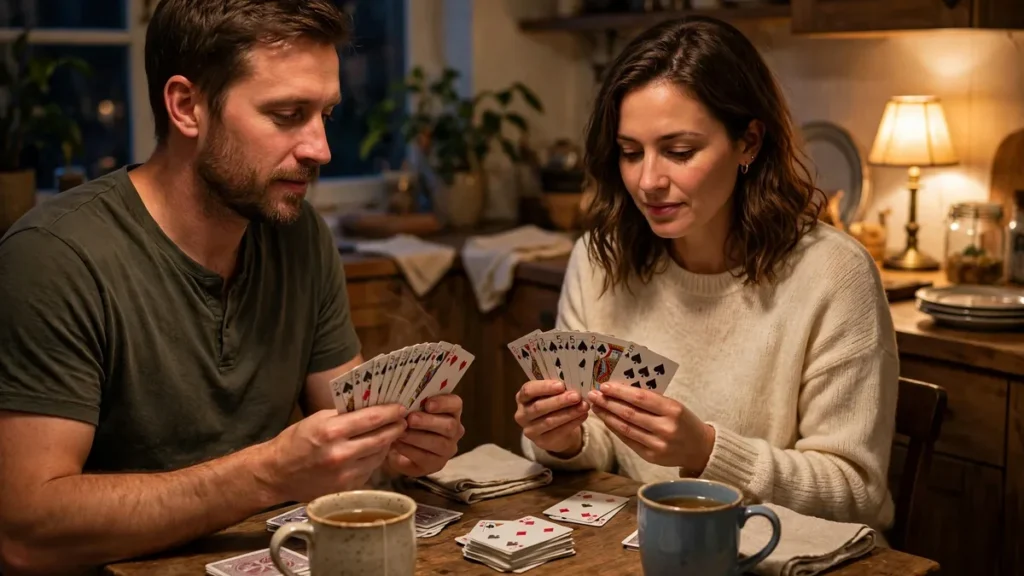
A deck of cards is the cheapest game night you will ever buy, and one of the most honest. You sit close, watch faces, make a choice, and the table reacts at once. That closeness is why card games suit grown-ups: a good one gives adults something to chew on without turning the evening into homework.
Here are twelve card games that earn their place at an adult table. Each entry names its player count, a realistic playing time, why it works for adults, and one honest drawback. They cover quiet evenings for two, loud party nights, and everything in between.
Key Takeaways
- Pick for the group in the room.
- Short games suit weeknights; keep the longer, thinkier ones for weekends.
- Bluffing games need a group that enjoys teasing each other.
- One standard deck covers five games on this list.
- Teach a single game well.
Choosing a Card Game for Your Group
Begin by looking at who is actually coming. A table of two needs a different game from a table of eight, and a tired group after a long week needs a different game from a fresh one on a Saturday. Then think about noise: some adults love outwitting each other out loud, while others would rather work together and laugh at a shared mistake.
Also check how much waiting the game asks for. The strongest adult card games keep everyone busy on every turn, and a game where three people watch one person think for five minutes is a poor choice for a party. If you enjoy slower, quieter evenings, our round-up of top puzzle games for adults pairs well with this list.
The Twelve Games
1. Texas Hold’em Poker
Players: 2 to 10. Time: 30 minutes to a whole evening. Texas Hold’em rewards patience, reading people, and knowing when to walk away. Each player gets two private cards, five shared cards appear in stages, and the betting between those stages is where the real game lives. A good fold is as satisfying as a good win.
The drawback is the learning curve: a table where one person knows the odds and everyone else is guessing is no fun for the guessers. Play with chips that mean nothing until everyone understands the hands.
2. Blackjack
Players: 2 to 7. Time: 10 to 30 minutes a round. Blackjack is the simplest casino classic to bring home: get closer to twenty-one than the dealer without going over. The rules fit in a minute, and a round is short enough that a bad hand is forgotten within minutes.
It mixes luck with one clear choice, repeated over and over. The drawback is that one player has to be the dealer, and a poor dealer can spoil the game. Rotate the deal and agree the house rules first.

3. Gin Rummy
Players: 2, or 3 to 4 with a small change to the deal. Time: 20 to 40 minutes. Gin Rummy is the quiet classic of the list, and the best two-player card game most adults have never tried. You draw and discard, building sets and runs, until one player lays down a complete hand. It rewards memory and nerve: do you hold the card you need, or discard it and hope it does not help your opponent?
It suits a calm evening or a pair who like thinking without shouting. The drawback is the pace: it is slow by modern standards, and a group that wants noise will find it dull.
4. Hearts
Players: 3 to 6, best with 4. Time: 20 to 30 minutes. Hearts is the trick-taking game where the aim is to avoid winning the wrong tricks. Every heart counts against you, the queen of spades counts for thirteen, and the lowest score wins. You are not trying to win; you are trying to lose in the right way.
It is easy to learn and hard to master, and being handed the queen of spades produces genuine groans at the table. The drawback is the scoring: over several hands, a player who falls far behind early can lose interest. Keep a visible score sheet and play to a fixed target.
5. Spades
Players: 4, in two partnerships. Time: 30 to 60 minutes. Spades is the partnership trick-taker, and the game here that most rewards teamwork. Each pair bids on how many tricks it will win, then plays to make that bid, with spades always trumping the other suits. A good partnership learns to read each other without speaking.
It suits adults who like a game with depth and a regular partner, and it is a fine choice for a weekly game night. The drawback is that it needs exactly four players, and it punishes a weak partnership harshly. Swap partners between games to keep it fair.
6. Uno
Players: 2 to 10. Time: 15 to 30 minutes. Uno is the loudest game on this list, and the simplest: match a colour or a number, play action cards to skip, reverse, or force a draw, and shout when you have one card left. It needs almost no explanation, which makes it perfect for a mixed group.
It is fast, spiteful in a friendly way, and genuinely funny when a draw-four card lands on the person who was about to win. The drawback is the luck: a skilled player can still lose to a run of bad draws. Agree a house rule for stacking draw cards before you start.
7. Cards Against Humanity
Players: 4 to 20 or more. Time: 30 to 90 minutes. Cards Against Humanity is the party game for adults who enjoy dark, rude humour. One player reads a prompt card, everyone else plays their funniest answer, and the reader picks a winner. The winning card is usually the one that makes the reader laugh, not the cleverest one.
It works brilliantly with a relaxed, like-minded group, and it needs no skill at all, which makes it the easiest game on this list to bring to a party. The drawback is obvious: the humour is crude, and it will offend someone in the wrong group. Only play it where everyone is comfortable, and never bring it to a work party. If you want help judging the mood of a party before you choose a game, our guide to what a party game is and how to pick one is a good place to start.
8. Love Letter
Players: 2 to 6. Time: 15 to 20 minutes. Love Letter fits in a tiny bag and plays in twenty minutes, yet it packs in more deduction than games three times its size. Each player holds one card, draws one, plays one, and tries to be the last person holding a card. Guessing who holds what is the whole game.
It is quick, portable, and genuinely tense: a single wrong guess can end your round in seconds. The drawback is the elimination, so play short rounds with a running score and nobody sits out for long.
9. Coup
Players: 2 to 6. Time: 15 to 30 minutes. Coup is bluffing in its purest form. Each player holds two hidden character cards, and on your turn you claim a character’s power, whether you hold it or not. Anyone can challenge the claim, and a caught liar loses a card.
It is short, sharp, and entirely about reading faces. A quiet player who bluffs well can beat a loud one. The drawback is the lying itself: some people hate bluffing games, so test it with one round first.
10. Skull
Players: 3 to 6. Time: 20 to 40 minutes. Skull is bluffing with almost nothing: each player has four discs, three flowers and one skull, and the game is a series of bids about how many flowers the table can turn over without hitting a skull. The rules fit on a beer mat, yet the tension of a high bid is extraordinary.
It suits adults who like poker’s nerve without poker’s maths. The drawback is the player count: it is at its best with five or six, and with three it can feel thin. Save it for a proper group.
11. Hanabi
Players: 2 to 5. Time: 25 to 40 minutes. Hanabi is the cooperative game on this list, and it turns the usual card game upside down: you hold your cards facing away from you, so you can see everyone’s hand except your own. Players give each other limited clues about colour and number, and together the group tries to build five firework displays in order.
It rewards talking well rather than talking loudly, and a good group score feels like a shared achievement. The drawback is the frustration: a bad clue can wreck a carefully built firework. Agree on a simple clue system before the first game, and treat a low score as a lesson, not a failure.
12. The Mind
Players: 2 to 4. Time: 15 to 20 minutes. The Mind is the strangest game here. Players hold numbered cards and must play them in ascending order, without speaking, without signalling, and without any clues at all. The group has to feel the right moment to play, and when it works, a whole table playing in perfect silence feels like a small miracle.
It suits couples and small groups who enjoy a quiet, almost meditative game, and it is a wonderful palate cleanser between louder games. The drawback is that it can fall flat: a group that cannot sit still in silence will find it awkward, and a bad run of cards can end the game in minutes. Play it late, when the room has calmed down.
Matching the Game to the Evening
A good shelf needs only three or four of these. For a quiet night for two, keep Gin Rummy, Love Letter, and The Mind close at hand. For a lively group, reach for Uno, Cards Against Humanity, Coup, and Skull. For a regular foursome, Spades and Hearts will last for years.
For a date night, a two-player game with a bit of gentle rivalry, such as Gin Rummy or Love Letter, suits a quiet evening far better than a big party game squeezed into two players. If you are planning a whole evening around a game, our guide to hosting a Valentine’s Day party for adults has practical ideas for food, timing, and atmosphere that suit a card night too.
Mistakes That Spoil a Card Night
First, do not lecture the group before the first deal. State the aim, deal a practice round with open hands, and answer questions as they come up. Second, settle the stakes before anyone plays: money changes the mood of a card game completely, so make it easy for anyone to play for nothing.
Third, watch out for the player who takes over, telling everyone else what to do. Quieter players will stop coming if every turn is corrected for them. Fourth, finish while the mood is still good: a night that ends with everyone laughing is a success.
Questions Readers Ask
What is the best card game for two adults?
Gin Rummy is the best pure two-player game on this list, with Love Letter close behind. Both play in under half an hour and are easy to learn in a single round.
Which card game is best for a big group?
Uno handles up to ten players and stays fast, while Cards Against Humanity works with twenty or more and needs no skill at all. For a group of six, Coup and Skull are the sharpest choices.
Do I need to spend a lot to start?
No. A single standard deck covers Texas Hold’em, Blackjack, Gin Rummy, Hearts, and Spades, which is five games on this list for the price of one deck. Add Uno, Love Letter, and Coup, and you have eight games for less than the cost of one video game.
Are card games good for adults who have never played?
Yes, provided you pick the right first game. Uno and Blackjack can be taught in a minute, and a beginner can win a round on luck alone.
The Bottom Line
Start with a standard deck and one boxed game, play them for a month, and notice which one you reach for when friends visit. A deck of cards has no batteries, no updates, and no screen, and it still puts a group of adults around a table, talking, laughing, and thinking together. Deal the cards, keep the stakes friendly, and let the game do the rest.