Running puzzle games for 561 players sounds like a job for a stadium, not a schoolroom, and that is exactly why the old village schoolroom works so well. A schoolroom is built for large numbers of people sitting side by side, listening, counting, and writing, and our day borrows that order and turns it into nine races. Every team of eleven works through the same nine posts, one after another, until all 51 teams have tried every race and the scores are in.
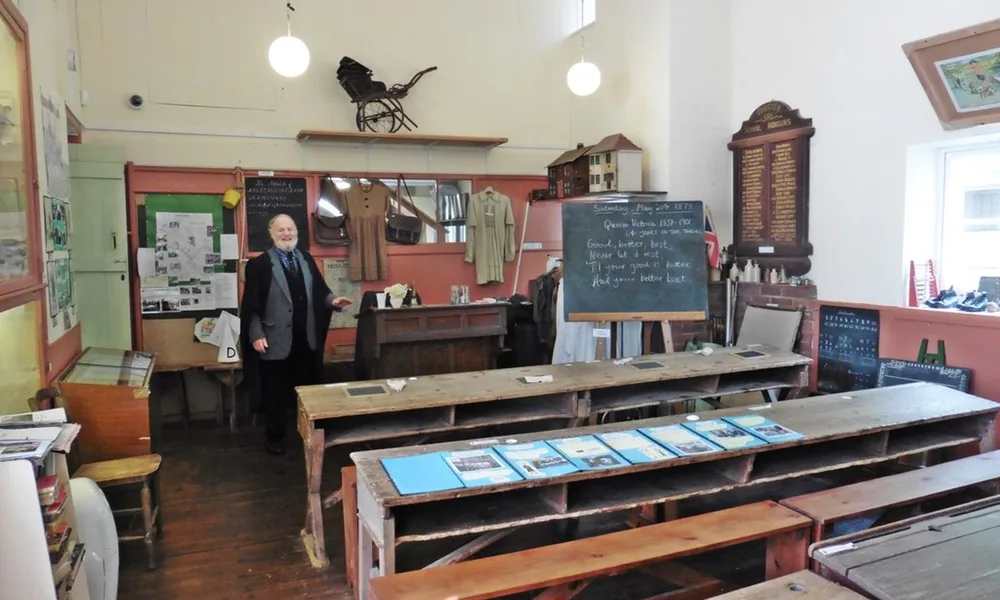
The theme is the old village schoolroom of a hundred years ago: wooden desks with hinged lids, copybooks with ruled margins, inkwells sunk into the desk tops, primers for first readers, and rulers for measuring. Nothing here needs a screen or a battery. The supplies are simple, the rules are short, and the races reward care and attention more than haste. If you have run a big day before, you will recognise the shape of it: teams move from post to post, a host calls the time, and a score record travels with each team. The old-globe workshop day in our puzzle games for 551 players uses the same shape, and it works just as well in a schoolroom as it did among the globes.
This plan takes you through the whole day: how the 51 teams are formed, what happens at each of the nine posts, how the scores are added up, and what to have ready before the first team arrives. Follow it in order and the day runs itself. The nine races are Copybook Margin Match Race, Inkwell Dip Count Race, Attendance Roll Order Race, Desk Lid Check Race, Primer Lesson Sort Race, Ruler Span Measure Race, Arithmetic Sum Count Race, Pen Holder Fit Race, and Penmanship Copy Match Race. Each one is explained in full below, with the supplies, the running order, and the scoring.
Key takeaways
- 561 players form 51 teams of eleven, divided into three flights of seventeen teams.
- Nine races run in order, one post at a time, with every team trying every race.
- All nine races use ordinary schoolroom supplies: copybooks, inkwells, rulers, primers, and pen holders.
- Scores travel with each team on a score record, and the top team is the one with the highest total.
- The whole day takes about six hours, including two pauses for food and fresh air.

How 561 Players Fit Into One Day
Fifty-one teams of eleven is the shape of the day. Each team has a named captain, and the teams are divided into three flights of seventeen. A flight is a group of teams that starts at the same post, so the hall never holds more than seventeen teams at once at any one post.
Each race takes twenty-five minutes, with five minutes to move to the next post. Nine races come to four and a half hours, and two pauses for food and fresh air, plus time for the final scores, bring the total to about six hours. The bookshop day in our puzzle games for 515 players runs on the same rotation, and its timetable is a good model for yours.
A host calls the time at each post, and a score record travels with each team. The host at each post checks the answers, writes the points on the score record, and sends the team on to the next post. At the end of the day, the score records are added up, and the team with the highest total is named the top team of the day.
The Nine Races
Each race below gives you the supplies, the running order, and the scoring. Read each one through before the day, and have the supplies ready for all nine posts the evening before.
1. Copybook Margin Match Race
A copybook is a small exercise book with ruled pages, and the margin is the empty strip down the side of each page where the writer leaves space. In this race, each team receives a bundle of copybooks opened at pages where the margins have been drawn in different ways. Some margins are straight and even, some wander, and some end halfway down the page. The team must match each copybook to the margin sample that belongs with it.
The host hands out the bundle and calls the start. Teams work at their own desks, turning pages and comparing margins, and they write down their matches on their score record. When the time is up, the host reads out the correct matches. A team earns two points for each correct match and one point for each match that is close but not exact. The team with the most points at the end of the race takes the top score for this post.
2. Inkwell Dip Count Race
An inkwell is a small pot of ink sunk into the desk top, and a dip pen is a pen with a metal nib that must be dipped into the ink before it can write. In this race, each team receives several inkwells and dip pens, and a page of simple letter shapes to copy. The team dips, writes, dips again, and counts every dip. The team that finishes the page with the fewest dips takes the top score, which means the nib must carry enough ink for several letters at a time.
One teammate keeps count of the dips and calls out the number as the writing goes on. Each dip is tallied on the score record, and a dip that leaves ink outside the well costs the team one point. When every team has finished its page, the host compares the counts. The team with the fewest dips takes the top score, and the next teams follow in order.
3. Attendance Roll Order Race
Every schoolroom day begins with the roll, when the teacher calls out each name in turn and the pupils answer. In this race, each team receives a roll of names in a mixed order and a list of the order in which the names were called. The team must put the names back into the order they were called, from first to last, and write them down on the score record.
The roll is read aloud once, at a steady pace, and then the teams work in silence. A team earns two points for each name in the correct position and one point for each name that is one position out. The team with the most points takes the top score for this post.
4. Desk Lid Check Race
Each old desk has a hinged lid that lifts to show a small space inside, where the pupil kept a copybook, a pencil, and a ruler. In this race, the host opens some desk lids and hides a small object inside each one. The team lifts each lid in turn, looks at what is inside, closes the lid, and then writes down what it found at each desk. The team must recall what was inside each desk without opening the lid a second time.
A team earns two points for each object named correctly. Opening a lid a second time costs the team two points, so the first look must be a careful one. The team with the most points takes the top score for this post.
5. Primer Lesson Sort Race
A primer is a first reading book, and its lessons follow one another from the simplest sounds to whole sentences. In this race, each team receives a bundle of loose primer pages, all mixed up, and must sort them back into the order of the lessons. The pages carry no numbers, so the team must judge the order by the reading itself: short sounds first, then words, then sentences.
A team earns two points for each page in the correct position and one point for each page that is one position out. The team with the most points takes the top score for this post. A team that sorts the whole primer without a mistake earns five extra points, which is the largest bonus of the day.
6. Ruler Span Measure Race
A ruler is the schoolroom tool for measuring, and a span is the distance from one end of a thing to the other. In this race, each team receives a ruler and some objects from the schoolroom: a copybook, a desk top, a primer, and a pen holder. The team measures the span of each object and writes the numbers down on the score record. The nearest measure takes the points for that object.
Each object is measured once, and the team must agree on the number before it is written down. Measurements are given in centimetres, and a measure within one centimetre of the true number earns two points; a measure within two centimetres earns one point. The team with the most points takes the top score for this post.
7. Arithmetic Sum Count Race
Arithmetic is the schoolroom name for working with numbers, and a sum is a small adding task. In this race, each team receives a page of sums, all with small numbers, and must work through them as fast as they can. The sums use only adding and subtracting, and every answer is a whole number.
A team earns one point for each correct answer. The team with the most points takes the top score for this post. A team that finishes all its sums with no mistakes earns five extra points. The sums are the same for every team, so the race is the same for all.
8. Pen Holder Fit Race
A pen holder is a small stand on the desk top that keeps pens upright and within reach. In this race, each team receives a pen holder and some pens, some long and some short, some thick and some thin. The team must fit as many pens as possible into the holder without any pen falling out, and the pens must stand upright.
Each pen that stands upright at the end of the race earns one point. A pen that falls out earns nothing, and a pen that leans against another pen earns nothing either. The team with the most points takes the top score for this post. If two teams tie, the team whose pens were fitted first takes the top score.
9. Penmanship Copy Match Race
Penmanship is the schoolroom art of writing well, with even letters and a steady rhythm. In this race, each team receives a page of fine penmanship and must copy it as closely as they can. The copy is judged on the shape of the letters, the spacing between words, and the straightness of the writing across the page.
Each team member copies one part of the page, so the whole team must write in the same style. The host and two helpers judge the copies and give each team a score from one to ten. The team with the highest score takes the top score for this post.
The nine races in one table
| Race | Supplies | Score |
|---|---|---|
| Copybook Margin Match Race | Copybooks, margin samples | 2 points per correct match |
| Inkwell Dip Count Race | Inkwells, dip pens | Fewest dips takes the top score |
| Attendance Roll Order Race | Roll of names | 2 points per name in the correct position |
| Desk Lid Check Race | Desks with lids, small objects | 2 points per object named correctly |
| Primer Lesson Sort Race | Loose primer pages | 2 points per page in the correct position |
| Ruler Span Measure Race | Rulers, schoolroom objects | 2 points per measure within one centimetre |
| Arithmetic Sum Count Race | Page of sums | 1 point per correct answer |
| Pen Holder Fit Race | Pen holders, pens | 1 point per pen standing upright |
| Penmanship Copy Match Race | Penmanship page, pens | Score from one to ten |
Your schoolroom checklist
Have these six things ready before the first team arrives, and the day will run smoothly. The bookbinder’s workshop day in our puzzle games for 543 players runs on the same checklist shape, and its supply list is a good model for yours.
- Fifty-one team lists of eleven, each with a named captain, printed and fixed to the schoolroom wall.
- Nine posts, each with its own supplies ready the evening before, and a score record for every team at every post.
- Extra copybooks, rulers, and pen holders, in case anything is damaged or lost.
- A timetable with the rotation times, the two pauses, and the time of the final scores.
- A quiet corner where teams can wait between races, with water and seats.
- A small prize for the top team, and a thank-you for every team that took part.
Frequently asked questions
Can 561 players really share one schoolroom?
Not in one room. The schoolroom is the theme, and the day runs in a large hall, with the nine posts spread across the hall and the grounds outside. The desks are the model for the posts: each post is a desk, and the teams move between them.
What if we have fewer than 561 players?
Form teams of eleven as far as you can, and let the last team be smaller. The races work with any number of teams, and the scoring stays the same. A day with twenty teams runs in the same way as a day with fifty-one.
Do players need to know arithmetic or penmanship before the day?
No. Every race is explained at its post, and the skills are the simple ones of the schoolroom: counting, matching, sorting, and measuring. A team that works together will do well even if no member has tried a race like it before.
What supplies do we need?
Copybooks, inkwells and dip pens, a roll of names, desks with lids, loose primer pages, rulers, pen holders, and pens. Most schoolrooms already have these things, and what is missing can be borrowed from a village hall or a local school.
How long does the whole day take?
About six hours. Each race takes twenty-five minutes, with five minutes to move to the next post, which comes to four and a half hours for the nine races. Two pauses for food and fresh air, and time for the final scores, bring the total to about six hours.
Can children join in?
Yes. The races suit all ages, and a team that mixes ages often does best, because the younger members are fast with numbers and the older members are steady with the writing.
The Bottom Line
An old village schoolroom gives 561 players a day that is simple to run and full of moments worth recalling. Nine races, fifty-one teams, and one clear plan are all you need. Have the supplies ready the evening before, call the roll on time, and let the schoolroom do the work.