The best party games for 560 players need a setting that can take 560 people at the same time, and a village flower show in the marquee gives you exactly that. Long tables run the length of the marquee, the blooms sit where every visitor can see them, and 9 contests use the dahlias, sweet peas, marigolds, pansies, fuchsias, geraniums, chrysanthemums, asters and zinnias that exhibitors have already brought along. Nobody waits, because every contest runs at the same time across the whole marquee.
The plan is to split the 560 players into 14 teams of 40 and let every team take part in all 9 contests. Each contest takes about 15 minutes, so a team can work through the full event in about 2 hours and 15 minutes, with a 15-minute interval in the middle. The assessor at each table keeps the points, so the organiser never has to calculate 560 separate results.
This article gives you the 9 contests in full, with the equipment for each one, a table that lets you compare them in 5 minutes, a checklist of 6 things to arrange before the show, and answers to 6 questions that organisers ask most often. Every contest uses blooms that are already in the marquee, so you do not need to buy equipment that serves 1 event and then sits unused.
Key takeaways
- Split 560 players into 14 teams of 40 so every person has a part in every contest.
- Run all 9 contests at the same time across the marquee, with 15 minutes at each one.
- Use the blooms exhibitors already brought: dahlias, sweet peas, marigolds, pansies, fuchsias, geraniums, chrysanthemums, asters and zinnias.
- Make the points simple: 10 points for the top team in a contest, and 1 point fewer for each team below it.
- End with the awards in the marquee while every team is still together.

Why 560 Players Changes the Show
Most party games are made for 8 to 12 people. Multiply that by 50 and 3 difficulties appear. The waiting grows: at 30 seconds a person, 560 people in a single queue means hours between one person’s part and the following one. Half the marquee cannot hear the rules or see the blooms. And the points become a burden, because 1 assessor cannot look after 560 people at the same time.
The answer is to change the shape of the event, not the games. Almost every good party game can be played in teams, at several tables at the same time, or with everyone playing together. The game barely changes, but the arrangement does, and the arrangement is what makes the event work.
There is also a social reason to get the format right. At 560 players, your group probably includes people who have not met before: a village show, a large family get-together, or a reunion. The right party game gives people who have not met something to do together within seconds. A flower show is a kind leveller: luck and a keen eye matter more than skill, and a newcomer can beat a veteran on any contest.
The orchard-themed games in our party games for 558 players works the same way, with a fruit theme that lets a large group play at the same time.
How to Arrange the Marquee for 560 Players
Put 1 table in the marquee for each contest, so the marquee takes 9 tables. Each table needs a paper, a pen, and the blooms for its contest. The assessor at each table explains the contest in under 2 minutes, records the points, and announces the top team at the end of each 15-minute part.
Give every team a number from 1 to 14 and a captain. The captain collects the team’s paper at each table and gives it to the assessor. That keeps 560 people moving in an orderly way, because every team knows where to be and when to be there.
Allow 15 minutes for each contest, 15 minutes for the interval, and 15 minutes for the awards. That is 165 minutes in all, or about 2 hours and 45 minutes from the opening contest to the awards. Put the interval in the middle, so teams can have a breather and look at the blooms they have not played with yet.
The 9 Games
Each contest below works for 40 people at a time, because the whole team takes part together. The assessor explains the contest, the team plays for 15 minutes, and the points belong to the top team. Read the 9 contests from Game 1 to Game 9, then use the table below them to choose the ones that suit your marquee best.
Game 1: Dahlia Vase Count
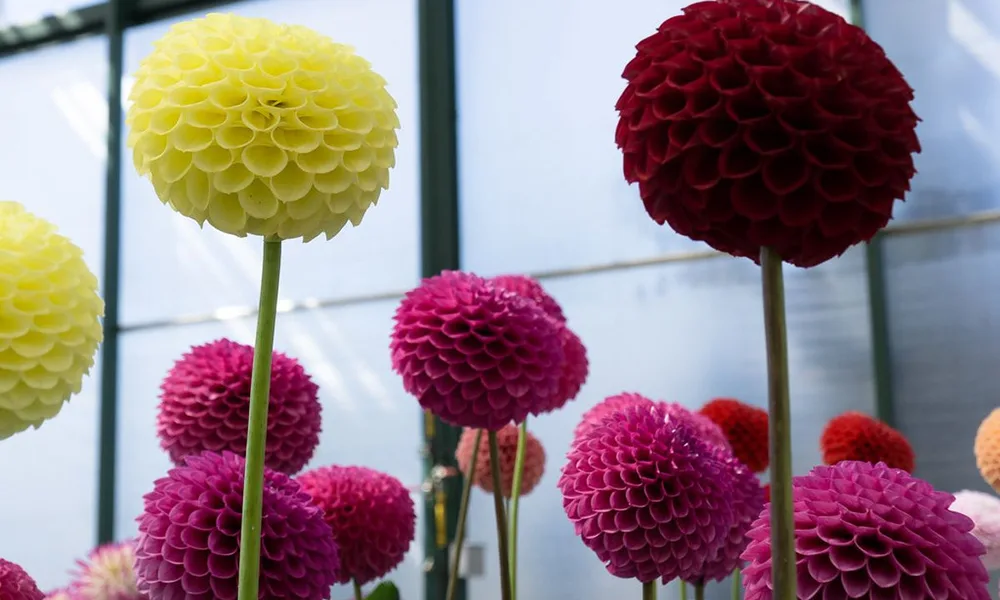
The assessor puts 6 vases on the table, each with dahlias in pink, red, purple or white. The team divides into 4 groups of 10. Each group counts the blooms in the vases on its side of the table and writes the number on its paper. The 4 groups then compare their numbers and agree on 1 number for the team.
The assessor compares the team’s number with the true number. The quickest correct team takes 10 points, the following correct team takes 9 points, and each correct team after that takes 1 point fewer, to a minimum of 1 point. A team with a wrong number takes no points, so careful counting is worth more than hurried counting.
Tip: give each group a different colour to count, so the 4 groups do not count the same blooms twice.
Game 2: Sweet Pea Posy Tie
The assessor puts a tray of sweet pea stems on the table, with soft ties beside them. Each member of the team takes 3 stems and ties them into a posy. The team needs 40 posies in 15 minutes, so every member has a part to play.
The assessor looks at every posy and gives 1 point for each posy that is tied neatly and keeps its shape. The team with the most points takes the top position in this contest. A posy that comes apart earns nothing, so a firm tie matters more than a fast tie.
Tip: let the team see 1 complete posy before the 15 minutes begin, so every member knows what a neat posy looks like.
Game 3: Marigold Pot Sort
The assessor puts 30 pots of marigolds on the table in a jumbled group, with pink, red, purple and white blooms together. The team sorts the pots into 4 colour groups, 1 group for each colour. Every member moves pots to the right group, so the whole team works at the same time.
The assessor looks at the 4 groups and gives 1 point for each pot in the right group. The team with the most points takes the top position. A pot in the wrong group earns nothing, so the team should look at each pot twice before the 15 minutes end.
Tip: put the 4 colour groups at the 4 ends of the table, so members do not confuse the groups as they work.
The tea-garden games in our party games for 556 players also runs 9 contests for a large group, with a different theme and different equipment.
Game 4: Pansy Tray Order
The assessor puts 8 trays of pansies on the table, each tray with a different number of blooms. The team puts the trays in order from the fewest blooms to the most blooms. Every member counts the blooms in 1 tray, then the team agrees on the order together.
The assessor compares the team’s order with the true order. The team takes 10 points for an exact order, and 1 point fewer for each tray that is in the wrong position. A team that puts every tray in the wrong position takes no points, so the team should count every tray with care.
Tip: count the blooms in each tray twice, because 1 miscount can alter the order of several trays.
Game 5: Fuchsia Basket Weigh
The assessor puts 5 baskets of fuchsias on the table. Each basket has a different weight of blooms and soil. The team takes each basket, one after another, feels its weight, and writes its estimate on its paper.
The assessor weighs each basket and compares the true weight with the team’s estimate. The team takes 10 points for the closest estimate, and 1 point fewer for each step away from the true weight. A team that writes no estimate for a basket takes no points for that basket, so every basket needs an estimate.
Tip: let every member feel 1 basket, because 40 different feels give a better estimate than 1 feel alone.
Game 6: Geranium Label Match
The assessor puts 12 geranium plants on the table, each with a paper label beside it that gives the variety. The team reads the labels and matches each label to the plant it belongs to. Every member reads 1 label, then the team agrees on the matches together.
The assessor looks at the matches and gives 1 point for each correct match. The team with the most points takes the top position. A label beside the wrong plant earns nothing, so the team should read every label with care before it decides.
Tip: read the labels aloud in the team, so every member hears the variety names and can help with the matches.
Game 7: Chrysanthemum Stem Measure
The assessor puts a bunch of chrysanthemum stems on the table, with a cloth tape beside them. The team measures each stem with the cloth tape and writes the length on its paper. Every member measures 3 stems, so the team measures the whole bunch in 15 minutes.
The assessor adds the team’s lengths together and compares the combined length with the true combined length. The team takes 10 points for the closest combined length, and 1 point fewer for each step away from the true length. A team that measures a stem twice takes the lower length for that stem, so the team should measure each stem 1 time only.
Tip: measure from the lower end of the stem to the top of the bloom, and use the same method for every stem.
Game 8: Aster Bunch Pick
The assessor puts 10 bunches of asters on the table, each bunch with a different number of blooms. The team looks at the bunches by eye and picks the bunch with the most blooms, without counting. Every member points to the bunch they favour, then the team agrees on 1 bunch together.
The assessor counts the blooms in the team’s bunch and compares the number with the other bunches. The team takes 10 points if it picked the fullest bunch, and 1 point fewer for each bunch that has more blooms than the team’s bunch. A team that picks the bunch with the fewest blooms takes 1 point, so every bunch deserves a close look.
Tip: look at the bunches from the side, because a bunch can look full from above and thin from the side.
Game 9: Zinnia Cutting Dip
The assessor puts a tray of damp soil on the table, with 40 zinnia cuttings beside it. Each member takes 1 cutting and dips it in the damp soil, then puts it in a neat group on the tray.
The assessor looks at the tray and gives 1 point for each cutting that sits upright in the soil and has its leaves above the soil. The team with the most points takes the top position. A cutting that falls over earns nothing, so the team should put each cutting with care.
Tip: make a hole in the soil with a pen before you dip the cutting, so the stem keeps its shape.
The 9 Games at a Glance
Use this table to compare the 9 contests in 5 minutes. Every contest takes 15 minutes and uses the whole team of 40.
| Game | Equipment | People | Minutes |
|---|---|---|---|
| Dahlia Vase Count | 6 vases of dahlias | 40 | 15 |
| Sweet Pea Posy Tie | 1 tray of sweet pea stems, soft ties | 40 | 15 |
| Marigold Pot Sort | 30 pots of marigolds | 40 | 15 |
| Pansy Tray Order | 8 trays of pansies | 40 | 15 |
| Fuchsia Basket Weigh | 5 baskets of fuchsias | 40 | 15 |
| Geranium Label Match | 12 geranium plants, 12 paper labels | 40 | 15 |
| Chrysanthemum Stem Measure | 1 bunch of chrysanthemum stems, 1 cloth tape | 40 | 15 |
| Aster Bunch Pick | 10 bunches of asters | 40 | 15 |
| Zinnia Cutting Dip | 1 tray of damp soil, 40 zinnia cuttings | 40 | 15 |
The bonfire-night games in our party games for 554 players uses the same rotation, with 9 contests that run at the same time.
Your Flower-Show Checklist
Arrange these 6 things before the show, and the event runs as planned.
- 14 team papers, 1 per team, with the 9 contests listed on each paper.
- Pens for every table, plus extra pens for the assessors.
- Vases, pots, trays and baskets for the 9 contests, with damp cloths for the cuttings.
- A cloth tape for the chrysanthemum stems, and points sheets for every assessor.
- Awards for the top 3 teams, with 1 award for each team.
- A written plan for the interval, with cold drinks for every team.
Frequently Asked Questions
These are the 6 questions that organisers ask most often about a flower-show party for 560 players.
Can 560 people play at the same time?
Yes. The 560 players make 14 teams of 40, and all 9 contests run at the same time, so every person has a part to play from the opening contest to the awards. Nobody waits, because the whole team takes part together in every contest.
How many helpers do we need for 560 players?
You need 9 assessors, 1 for each table, plus 1 organiser and 6 helpers for the equipment. That is 16 helpers in all. The 14 team captains are players, not helpers, so they do not add to the number.
What if the marquee gets wet?
The contests still work, because the blooms, papers and pens remain under the marquee. A wet showground does not end the contests, as every contest uses a table inside the marquee. Put the points sheets on the tables, away from the marquee sides, so they remain dry.
Do we need extra equipment for every game?
No. The blooms come from the exhibitors, and the vases, pots, trays and baskets are the same ones the show already uses. You only need papers, pens, a cloth tape and the awards. Borrow the vases, pots, trays and baskets from the show, and leave them with the show organiser at the end.
How long does the full event take?
The 9 contests take 135 minutes, the interval takes 15 minutes, and the awards take 15 minutes. That is 165 minutes in all, or about 2 hours and 45 minutes from the opening contest to the awards.
Can younger visitors join in?
Yes. Every contest gives younger visitors a part to play, and the parts are simple enough for everyone.
The Bottom Line
A village flower show in the marquee can take 560 players without a fuss, because the blooms are already there, the tables are already there, and the 9 contests use them all. Make 14 teams of 40, run the 9 contests at the same time, make the points simple, and end with the awards while every team is still together.
The dahlias, sweet peas, marigolds, pansies, fuchsias, geraniums, chrysanthemums, asters and zinnias do the work for you: they give every contest its equipment, its colour and its feel. Choose the 9 contests above, arrange the marquee, and let 560 players enjoy a flower show that belongs to them all.