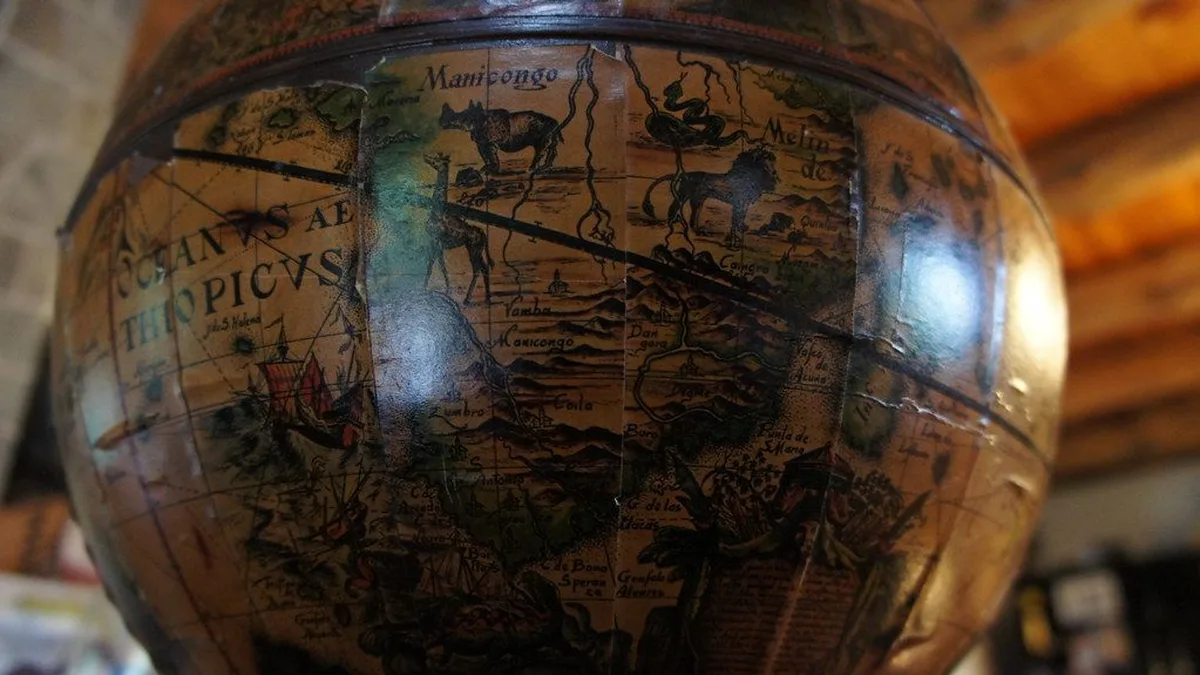
Running puzzle games for 551 players sounds impossible until the day is built around nine short races and one steady rotation. This plan turns a crowded hall into an old globe workshop, where every crew works with paper gores, brass rings, and printed panels instead of standing around waiting for a turn. The theme is simple to stage, the kit is cheap, and the nine races below give all 551 players something real to do from the opening call to the closing tally.
Five hundred and fifty-one players arrive as fifty crews. Forty-nine crews hold eleven players and one crew holds twelve, so nobody is left without a crew and nobody has to sit out a race. The crews move in five waves of ten crews, and each wave runs the same nine races in turn. While one wave is at the benches, the next wave is watching, resting, and studying the printed panels, so the hall never feels jammed and every crew gets a clear bench for every race.
The globe workshop suits a crowd this size because the work is quiet, hands-on, and easy to judge at a glance. A trimmed paper gore either lies flat on the sphere or it does not, and a brass ring either sits level or it wobbles. If you want a second large-group day with the same steady rotation, the sail-loft day in our puzzle games for 550 players runs on the same wave system with canvas work at the benches.
Key takeaways
- Nine short races carry the whole day, and every race uses the same plain kit of paper and brass.
- Fifty crews of eleven or twelve players move in five waves of ten crews, so each bench stays clear.
- Each race lasts fifteen minutes, with five minutes to move on, and the full day runs about four hours with breaks.
- Points are kept on one tally sheet per crew, and two officials check every tally before the closing call.
- No crew needs any skill with globes before the day, and every race is explained at the bench in under a minute.
How 551 Players Fit Into One Day
The hall holds nine benches, one for each race, and each bench holds the kit for ten crews at a time. A wave of ten crews starts together, and each crew spends fifteen minutes at a bench before the host calls every crew one bench along. Five minutes of moving time sits between races, which is enough for a slow walk, a drink of water, and a look at the next bench. After nine races the wave has spent three hours at the benches, and the next wave takes over.
Two officials run each bench, one to explain the race and one to keep the tally. The explaining official reads the same short brief at the start of every race, so no crew gets a longer explanation than any other crew. The tally official writes points on the crew tally sheet in full view of the crew, and the crew leader signs the sheet before moving on. If a crew disagrees with a call, the bench official notes the doubt on the sheet and the head official settles it at the lunch break, not in the middle of a race.
Kit stays light on purpose. Each bench needs printed paper gores, a plain practice sphere, brass rings, paper strips, pencils, and a tally sheet. Nothing is fragile enough to break under normal use, and nothing needs power. The harbour day in our puzzle games for 500 players uses the same light-kit idea, with harbour work at the benches instead of globe work.
| Race | What crews do | Minutes | Points |
|---|---|---|---|
| 1. Globe Gore Cut Race | Trim paper gores to lie flat on a sphere | 15 | Up to 20 |
| 2. Meridian Ring Fit Race | Fit a brass ring level around a sphere | 15 | Up to 20 |
| 3. Latitude Line Count Race | Count and place latitude lines in order | 15 | Up to 20 |
| 4. Longitude Arc Measure Race | Measure arcs between longitude lines | 15 | Up to 20 |
| 5. Equator Band Match Race | Match band pieces to the equator line | 15 | Up to 20 |
| 6. Ocean Current Sort Race | Sort current pieces into warm and cold piles | 15 | Up to 20 |
| 7. Tropic Circle Order Race | Order tropic circles by distance from the equator | 15 | Up to 20 |
| 8. Cartouche Label Check Race | Check labels on a globe cartouche for errors | 15 | Up to 20 |
| 9. Hemisphere Flip Race | Flip a sphere and name the hemisphere on top | 15 | Up to 20 |
The Nine Races
Each race below takes fifteen minutes, and each one is judged on what the crew produces at the bench, not on how fast they shout. Crews may talk as much as they like, and the quietest crew often does the neatest work. Read the nine races in order, because the skills build: cutting comes before fitting, and measuring comes before matching.
1. Globe Gore Cut Race
A globe gore is a long pointed strip of printed paper, and a whole globe is covered by pasting a ring of gores around a sphere. In this race each crew gets printed gores, scissors, and a plain practice sphere. The crew cuts along the printed edge of each gore, taking care to leave no white rim and no torn point. A clean cut matters more than a quick cut, because a ragged edge will lift off the sphere later in the day.
When the cutting is done, the crew lays the gores flat on the bench in order from the opening gore to the closing gore, with the printed side up. The bench official checks three things: every edge is smooth, every point is whole, and the gores sit in the right order. Two points are given for each gore that meets all three checks, up to twenty points for ten gores.
2. Meridian Ring Fit Race
A meridian ring is the brass circle that holds a globe upright and lets it turn on its axis. In this race each crew gets a practice sphere, a brass ring, and a small wooden base. The crew slides the ring over the sphere, seats it in the base, and turns the sphere until the printed pole points sit at the top and bottom of the ring. The ring must sit level, with the same gap all the way around, and the sphere must turn without catching on the brass.
The bench official checks the fit with a finger width of space at four points around the ring, and then gives the sphere a slow turn. If the sphere turns freely and the poles stay in line, the crew earns full points. If the ring tilts or the sphere sticks, the crew may adjust it once and try again for fewer points. Two points are given for a level ring, and two points for a free turn, repeated across five fittings for up to twenty points.
3. Latitude Line Count Race
Latitude lines run around a globe in rings, and they sit at fixed gaps from the equator to each pole. In this race each crew gets a globe with the latitude lines wiped blank and a bundle of numbered line pieces. The crew counts the gaps, works out which line belongs where, and places the pieces in order from the equator to the north pole and then from the equator to the south pole. The pieces must sit in a straight row, with no piece out of place.
The bench official checks the order by reading the numbers aloud from the equator outward in both directions. A crew earns two points for each direction that is fully correct, and the race is repeated five times with the pieces shuffled between rounds. Ten correct directions earn twenty points.
4. Longitude Arc Measure Race
Longitude lines run from pole to pole, and the gap between two of them is an arc that can be measured with a strip of paper. In this race each crew gets a globe, a handful of paper strips, and a pencil. The crew measures five arcs between marked longitude lines, writes each measurement on a paper strip, and places the strips in order from the widest arc to the narrowest arc. The strips must be measured flat against the sphere, not held above the sphere.
The bench official remeasures each arc with a fresh strip and compares the numbers. Two points are given for each arc that matches within a finger width, up to ten points, and two points are given for each arc that sits in the right place in the order, up to ten more points. Crews that measure with care do well here, and crews that rush will find their strips in the wrong order at the end of the race.
5. Equator Band Match Race
The equator is the widest ring on a globe, and a band of printed paper can be wrapped around it to show the line. In this race each crew gets a box of band pieces, some of which belong at the equator and some of which belong elsewhere on the globe. The crew sorts the pieces, picks the ones that fit the equator, and wraps them around the practice sphere in the right order. The band must meet neatly at the join, with no overlap and no gap.

The bench official checks the join, then reads the printed words on the band to confirm that every piece belongs at the equator. Two points are given for a neat join, and two points for each of four band pieces that is correctly placed, up to twenty points across five rounds. The observatory day in our running puzzle games for 511 players uses the same matching idea, with star work at the benches instead of globe work.
6. Ocean Current Sort Race
Ocean currents carry warm water away from the equator and cold water back toward it, and a globe shows them as arrows on the printed surface. In this race each crew gets a bundle of current pieces, each piece naming one current and showing one arrow. The crew sorts the pieces into a warm pile and a cold pile, then places each pile in order from the strongest current to the weakest current. The arrows must all point the right way for the pile they sit in.
The bench official checks the two piles by reading the pieces aloud, the warm pile and then the cold pile. Two points are given for each pile that holds only currents of the right kind, and two points for each pile that sits in the right order, up to twenty points across five rounds. Crews that read every piece before sorting do far better than crews that sort by the colour of the arrow alone, because the warm and cold arrows share the same printed colours.
7. Tropic Circle Order Race
The tropic circles sit north and south of the equator, and their distance from the equator decides their order on the globe. In this race each crew gets a handful of circle pieces, each piece naming one tropic circle and giving its distance from the equator in degrees. The crew reads the distances, orders the pieces from nearest the equator to farthest from it, and places them in a row on the bench. The row must run in one direction only, with no piece turned back.
The bench official checks the row by reading the distances aloud from the opening piece to the closing piece. Two points are given for each round in which the row is fully correct, and the race is repeated five times with the pieces shuffled between rounds. Ten points come from the northern circles and ten from the southern circles.
8. Cartouche Label Check Race
A cartouche is the decorated panel on an old globe that holds the title and the names of the makers. In this race each crew gets a printed cartouche with ten labels, and four of the labels hold small errors in spelling or numbers. The crew reads every label with care, circles the four errors with a pencil, and writes the correct spelling or number beside each one. No label may be left unread, and no circle may be drawn on a label that is already correct.
The bench official checks the circled labels one by one against the answer sheet. Two points are given for each error that is found and fixed correctly, up to sixteen points, and two points are given for each correct label that is left untouched, up to four points. A crew that circles five labels instead of four loses points for the extra circle, so steady reading beats fast guessing. This race rewards the crew that reads slowly and checks twice.
9. Hemisphere Flip Race
A globe has two hemispheres, north and south, and flipping the sphere swaps which one sits on top. In this race each crew gets a practice sphere on a brass ring and a handful of hemisphere pieces. The official calls a hemisphere, the crew flips the sphere to bring that hemisphere to the top, and then the crew holds up the piece that names the hemisphere now on top. The flip must be done with both hands, and the sphere must rest level before the piece is shown.
The bench official watches the flip and checks the piece against the sphere. Two points are given for each correct flip and piece, up to twenty points across ten calls. The calls come quickly, so crews must listen for the word north or south and not flip on a guess. A crew that flips before the call earns no points for that call, and the official moves on to the next call without waiting.
Checklist: Ready Before the Doors Open
Run through this checklist the evening before the day, and again one hour before the opening call. Tick each item only when it is truly done, not when it is nearly done.
- Print fifty crew tally sheets, nine bench briefs, and one answer sheet for each bench official.
- Cut and count the paper gores, band pieces, and current pieces, and put each race kit in its own labelled box.
- Check every practice sphere for cracks, every brass ring for bends, and every pencil for a sharp point.
- Number the nine benches in order, hang a numbered label above each bench, and lay out the wave boards.
- Brief the eighteen bench officials together, so every bench explains its race in the same words.
- Put water, cups, and a rest area at the far end of the hall, away from the benches and the kit.
Frequently Asked Questions
How long does the full day take?
Each wave spends three hours at the benches, with nine races of fifteen minutes and five minutes of moving time between races. Five waves run back to back with a short break between waves, so the full day runs about four hours from the opening call to the closing tally.
What if a crew has fewer than eleven players?
Crews of nine or ten players can still run every race, because no race needs more than ten hands at the bench at once. The crew leader simply covers two jobs in the races that ask for two players working together, and the bench official counts the crew as full. A crew of fewer than nine players should join with another short crew before the day starts.
Do crews need any experience with globes?
No experience is needed. Every race is explained at the bench in under a minute, and the kit is plain paper and brass. The races test care and attention, not knowledge of geography, and a crew that has never held a globe can still earn full points by following the brief.
Can the nine races run indoors?
Yes, the whole day is built for a hall. The benches need flat tables and good light, and the moving lanes need to stay clear of kit boxes. A hall with nine tables and room for fifty crews to walk between them is enough, and no race needs outdoor space or power.
How are the tallies kept fair?
Each crew carries one tally sheet, and the bench official writes the points on it in full view of the crew. The crew leader signs the sheet before moving on, and two officials check every sheet at the lunch break. If a sheet and a bench record disagree, the head official asks the bench official and then the crew leader.
What happens when two crews finish level?
Two crews that finish level share the place, and both crews are named at the closing call. No extra race is run to split a tie, because a tie after nine races is a fair result. The closing call names every crew in order, from the highest tally to the lowest, so every crew hears its place.
The Bottom Line
Nine short races, fifty crews, and one steady rotation are enough to carry 551 players through a full day in an old globe workshop. The kit is cheap, the judging is plain to see, and every crew leaves with a tally sheet that shows exactly what it did. Keep the benches clear, keep the briefs short, and let the globes do the talking.