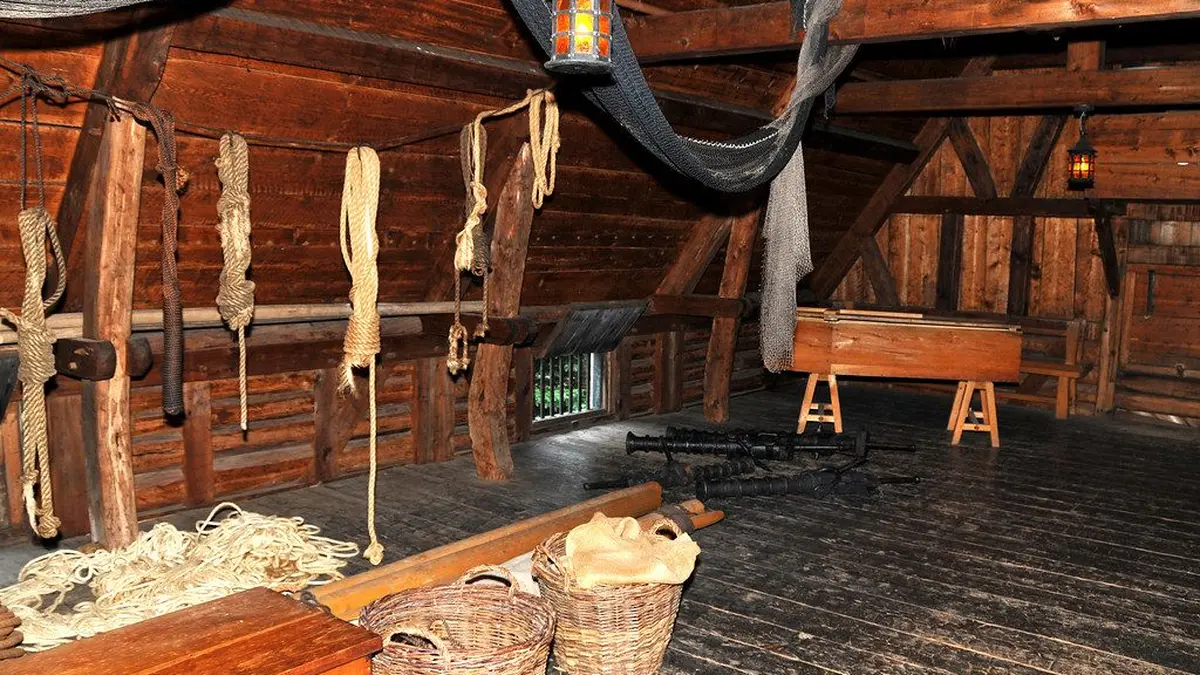
Puzzle games for 550 players work best when the venue itself does half the organising, and an old village sailmaker’s loft does exactly that. The long wooden floor gives fifty crews room to spread out, the high beams carry the sound of the host without any raised voices, and every round uses something the loft already holds: panels of canvas, lengths of cordage, and the honest fittings of a working loft. Nobody needs prior knowledge of canvas work, and nobody is left watching from the side.
The day runs on a simple rotation. Fifty crews of eleven move through nine rounds, with a host at the front keeping time and a tally keeper at each round recording results. Each round lasts about twenty minutes, crews change places on a whistle, and the whole day fits into a single afternoon with a pause in the middle for food and fresh air.
What makes the loft special is the material. Canvas is forgiving to handle, plain to see from a distance, and honest about mistakes: a miscounted panel shows at once. The nine rounds below use that honesty. They ask crews to count, measure, match, sort, weigh and check real pieces of canvas work, and they reward care more than speed.
Key takeaways
- Fifty crews of eleven players each take part, so all 550 players are busy in every round.
- Nine rounds run in rotation around the loft floor, each lasting about twenty minutes.
- Every round uses canvas, cordage and loft equipment already on site, with nothing exotic to buy.
- Tally keepers at each round record the results, and the tallies are read aloud at the end of the day.
- The games welcome complete beginners, and the material shows mistakes plainly, so disputes stay rare.
How 550 Players Fit Into One Day
Fifty crews of eleven is the shape of the day. Eleven is large enough for a crew to divide into smaller working groups inside a round and small enough that every member works with the material. Each crew picks a name from the loft and wears a coloured armband so tally keepers can tell them apart across the floor. The host opens the day with a short look around the loft, pointing out the nine round positions and the pause area, and then the whistle starts the first round.
Rotation keeps the day moving. Crews move one position forward after each round, so no crew waits long at a busy round and no round sits empty. Tally keepers stay where they are and record each crew as it arrives, which means the tallies travel with the rounds rather than with the crews. At the end of the ninth round, the host gathers everyone in the middle of the floor, reads the tallies aloud, and gives out a small wooden token to each member of the leading crew. Our puzzle games for 549 players followed the same workshop pattern in a violin-maker’s workshop, with nine rounds built around the maker’s own work, and the same rotation keeps a crowd of 550 moving without fuss.
After the fifth round, crews take forty minutes for food, water and fresh air, and the tally keepers use that time to check their figures. A crew that is behind at the pause often comes back sharper, because the early rounds teach the skills the later rounds need. Nobody is eliminated at any point, so the final rounds still have all fifty crews in play.
The 9 Loft Puzzle Games
Each round below gives the crew a real bit of loft work to puzzle over. The host explains the round in under a minute, the crew works together for about twenty minutes, and the tally keeper records the result before the whistle moves everyone along. Read the nine in order and the skills build: counting first, then measuring, then ordering, matching, fitting, sorting, weighing and checking.
1. Mainsail Panel Count Race
The mainsail is the largest canvas in the loft, and it is made of panels fastened edge to edge. For this round, the tally keeper lays out a finished mainsail flat on the floor and covers part of it with plain canvas, so only a portion of the panels can be seen. The crew must work out how many panels the whole mainsail holds, using the visible panel edges and the regular width of each panel to reason about the hidden part. A crew that counts the visible panels and multiplies carefully will beat a crew that blurts a number at once.
The round rewards patience. Crews that divide the visible area between two counters and compare figures usually land on the right sum, while crews that let one loud voice decide often miss by a panel or two. The host gives a small hint after ten minutes: the number of panels in one full row. The tally keeper records the crew’s final figure, and the crew closest to the true total takes the round.
2. Topsail Width Measure Race
A topsail is a smaller canvas that flies above the mainsail, and its panels are narrower, which makes measuring them a finer job. In this round, each crew receives a topsail and a plain wooden measuring strip with no numbers on it, only a single marked length. The crew must work out the width of one panel by comparing it with the marked length, doubling the canvas over until the comparison is exact. No other measuring tool is allowed.
The trick is to halve carefully. A crew that halves the panel, then halves it again, can compare eighths against the marked length and build up the width bit by bit. A crew that rushes will double unevenly and end up a finger width out. The tally keeper checks the crew’s answer against the true width, with the nearest crew in front.
3. Staysail Tack Check Race
The staysail is the canvas that runs along the front of a vessel, and its lower forward end — the tack — takes the hardest pull of all. For this round, the tally keeper shows the crew three staysails, each with its tack end reinforced in a slightly different way. One of the three has a flaw: a reinforcement that is one layer short, or a fastening that sits a finger width out of place. The crew must find the flawed end by looking closely and feeling the layers, without unpicking anything.
This round is quiet work. Crews that spread the three canvases side by side and compare them end by end usually find the flaw. The host allows each crew one question, answered plainly by the tally keeper. The crew that names the flawed staysail and explains the flaw takes the round.
4. Jib Clew Order Race
The jib is the small forward canvas of a vessel, and its lower back end — the clew — carries several small rimmed openings where cordage is attached. In this round, the tally keeper lays out nine loose openings of different measures and asks the crew to arrange them in order from smallest to largest. The catch is that the openings look alike at a glance, and the crew may only measure each one against the others, never against a measure. The pewterer’s workshop day in our puzzle games for 548 players used the same crew rotation, with nine rounds built around the maker’s own materials, and the ordering skill it taught carries straight into this round.
Ordering by comparison takes longer than ordering by measuring, and that is the point. A crew that lines the openings up and moves them until the row runs small to large will finish with a clean order. The tally keeper checks the final row against the true order and records how many openings sit in their correct place. The crew with the most correct places takes the round.
5. Mainsail Leech Match Race
The leech is the trailing edge of a mainsail, and it carries a row of small canvas tabs that mark where the canvas is gathered. For this round, the tally keeper cuts the tabs from a worn mainsail and mingles them with tabs from two other mainsails, so the crew faces a pile of similar-looking tabs. The crew must match each tab to its own mainsail by comparing the canvas, the colour, and the wear at the edges. Tabs from the same mainsail share the same canvas and the same wear.
Matching is a group job. One member sorts by colour, another by weight, and a third checks the wear, and the three sorts have to agree before a tab is taken. Crews that take tabs too early end up with mixed families and lose time unpicking their work. The tally keeper counts the correctly matched tabs at the end of the round, and the crew with the most correct matches takes the round.

6. Topsail Cringle Fit Race
A cringle is a reinforced opening where two edges of a canvas meet, made to take cordage without tearing. In this round, each crew receives a topsail end with three cringles and a box of small wooden toggles in different measures. The crew must find which toggle fits each cringle snugly — not loose, not forced — by trying them one at a time. The box holds more toggles than the crew needs, so a careful record of tried toggles wins the round.
The best crews keep a simple record: one member tries, one member records, and one member holds the end steady. A toggle that fits loosely is not a fit, and one that needs force is not a fit either, so the crew must agree on what snug means before they start. The tally keeper checks the three chosen toggles. The crew with all three correct in the shortest time takes the round.
7. Staysail Grommet Sort Race
A grommet is a rimmed opening fitted into canvas so cordage can run through without fraying the canvas. For this round, the tally keeper tips a mixed box of grommets onto a canvas — some brass, some plain iron, some large, some small — and asks the crew to sort them into groups by material first and then by measure within each material. Brass feels warmer than iron under the fingers, and crews sort by feel as much as by sight.
Sorting by two qualities at once is the puzzle here. A crew that sorts by material first and then measures each material group will finish with neat groups. The tally keeper counts the grommets in their correct groups and records the total. The crew with the most correctly sorted grommets takes the round.
8. Jib Luff Weigh Race
The luff is the leading edge of a jib, and it carries a strip of heavier canvas that takes the strain when the wind fills the canvas. In this round, each crew receives three strips of canvas cut for a jib luff, all the same length but different weights, and a simple balance of beam and baskets. The crew must work out which strip is heaviest, which is lightest, and which sits in the middle, using only the balance.
Weighing by balance is a thoughtful job. A crew that compares two strips, then compares the heavier one with the third, will reach a plain order in two weighings. A crew that guesses from how the strips feel will often swap the middle and the lightest. The tally keeper checks the crew’s order against the true order and records whether it is correct. A correct order takes the round, and crews that finish early may check their work once more.
9. Spinnaker Foot Measure Race
The spinnaker is the large, light canvas that flies ahead of a vessel in a following wind, and its bottom edge — the foot — is the longest single measure in the loft. For the final round, each crew receives a spinnaker and must work out the length of its foot without opening the whole canvas. The crew may open one layer at a time and measure the exposed part against a marked length of cordage, adding the parts together as they go. The canvas is light, so two members must hold it steady while a third measures.
This round brings the whole day together: counting layers, measuring parts, and adding carefully. Crews that keep a running sum as they measure each layer will finish with a figure they trust. The tally keeper checks the crew’s final figure against the true foot length and records how close they came. The crew closest to the true length takes the final round, and the host reads the day’s tallies aloud straight after.
At a Glance
The summary below gives each round in one line. Times are for one crew at one round, and the pause after the fifth round is not counted in the round times.
| Round | Game | What crews do | Crew members | Minutes |
|---|---|---|---|---|
| 1 | Mainsail Panel Count Race | Count the panels of a partly covered mainsail | 11 | 20 |
| 2 | Topsail Width Measure Race | Work out one panel width with a marked strip | 11 | 20 |
| 3 | Staysail Tack Check Race | Find the flawed end among three staysails | 11 | 20 |
| 4 | Jib Clew Order Race | Arrange nine openings from smallest to largest | 11 | 20 |
| 5 | Mainsail Leech Match Race | Match loose tabs to their own mainsail | 11 | 20 |
| 6 | Topsail Cringle Fit Race | Find the snug toggle for each of three openings | 11 | 20 |
| 7 | Staysail Grommet Sort Race | Sort grommets by material and then by measure | 11 | 20 |
| 8 | Jib Luff Weigh Race | Order three canvas strips by weight on a balance | 11 | 20 |
| 9 | Spinnaker Foot Measure Race | Work out the foot length layer by layer | 11 | 20 |
550 Player Checklist
Use this list in the week before the day, and again on the morning itself. The broom-maker’s workshop in our puzzle games for 546 players ran nine rounds the same way, and the same six checks kept its day running smoothly. Work through them in order and nothing important will be missed.
- Count the crews. Confirm fifty crews of eleven, with names and coloured armbands ready, before anyone arrives at the loft.
- Mark the nine positions. Place the round positions around the loft floor with wide gaps between them, and place the pause area where crews can sit.
- Prepare the canvas pieces. Place the mainsails, topsails, staysails, jibs and spinnaker the night before, with each round’s materials kept apart.
- Brief the tally keepers. Give each tally keeper a plain tally and a pen, and show them what counts as correct in their round.
- Plan the pause. Arrange food, water and fresh air for forty minutes after the fifth round, and give tally keepers time to check figures.
- Keep the closing simple. Bring all fifty crews into the middle of the floor, read the tallies aloud, and give the leading crew its wooden tokens.
Frequently Asked Questions
How long does the full day take?
Nine rounds at twenty minutes each come to three hours of play, plus forty minutes for the pause and about half an hour for the opening look around and the closing tally reading. Plan for four hours and a half from the first whistle to the last token.
What if a crew has fewer than eleven players?
A crew of nine or ten can still play every round, because the rounds ask for careful work rather than many people. Give a short crew the same materials and the same time, and let the tally keeper note the crew’s number so the closing tally stays fair. Crews of fewer than eight should borrow a player from a nearby crew for the day.
Do crews need any experience with canvas work?
No experience is needed. Every round is explained in under a minute, the material shows mistakes plainly, and the first two rounds teach the counting and measuring skills the later rounds build on. A crew new to canvas will be working confidently by the third round.
Can the nine rounds run indoors?
Yes, and the loft is the right place for them. All nine rounds were designed for the loft floor, with no round needing a long outdoor run. If the day turns wet, the whole programme stays inside without any alteration to the rounds or the rotation.
How are the tallies kept fair?
Each round has its own tally keeper, who remains at that round while crews rotate past. The keeper records each crew’s result before the whistle moves the crews along, and the keepers check their figures together during the pause. Reading the tallies aloud lets every crew hear its own result.
What happens when two crews finish level?
When two crews end the day level on tallies, the host asks both crews one final question about the loft’s canvas — the number of panels in the mainsail from the first round. The crew that answers closest takes the leading place, and both crews keep their wooden tokens from the rounds they won.
The Bottom Line
A sailmaker’s loft brings a crowd of 550 players together as fifty working crews, and nine honest rounds fill a full afternoon with canvas, cordage and careful counting. The material does the teaching, the rotation does the organising, and the tallies do the talking at the end. Bring fifty crews of eleven, prepare the canvas the night before, and let the loft do its work.