Running board games for 550 players sounds impossible until you quit picturing a lone table and start picturing a festival. Nobody expects 550 people to crowd around the same board. The trick is to run many tables at once, keep every table on the same timetable, and give the whole crowd a shared scoreboard so the evening feels like a shared event rather than dozens of separate ones. When the format is right, a crowd this large can feel calm, sociable, and genuinely competitive.
This guide gives you 9 board games that work well with a crowd this large, a simple timetable for the day, a checklist for the equipment you will need, and answers to the questions organisers ask most often. Every game below teaches quickly, plays in under 2 hours, and works when several copies run side by side.
The plan suits a community hall, a school hall, a workplace social, or a large reunion. You will need volunteers, a clear timetable, and plenty of copies of each game.
Key takeaways
- Split 550 players into tables of 5, with every table playing the same game at the same hour.
- Pick games that teach in 10 minutes and finish in under 2 hours, so no table falls far behind the rest.
- Run 3 sessions across the day, with a shared scoreboard updated between sessions.
- Give each table a volunteer host who knows the rules and keeps the pace steady.
- Keep spare copies, spare pieces, and printed rule summaries on every table.
The Nine Games at a Glance
Use this table to plan your timetable: shorter games suit the opening session, while longer games suit the middle session, when everyone is settled. Player counts are for 1 copy of each game, so multiply copies to suit your crowd.
| Game | Players per copy | Playing time | Best for |
|---|---|---|---|
| Arcs | 2 to 4 | 60 to 120 minutes | Keen rivals |
| Doggerland | 1 to 4 | 30 to 120 minutes | Patient planners |
| Heredity | 1 to 4 | 60 to 120 minutes | Campaign tables |
| Tiletum | 1 to 4 | 60 to 120 minutes | Travelling traders |
| Civolution | 1 to 4 | 90 to 180 minutes | Heavy thinkers |
| Knarr | 2 to 4 | 30 minutes | Brisk openers |
| Men-Nefer | 1 to 4 | 60 to 120 minutes | City raisers |
| Sankoré: The Pride of Mansa Musa | 1 to 4 | 60 to 120 minutes | Quiet planners |
| Distilled | 1 to 5 | 30 to 150 minutes | Relaxed closers |
The Games
Each game below includes a short description, the reason it works for a crowd of 550, and a practical tip for running it on many tables at once. Pick 3 games for your 3 sessions: a gentle opener, a longer middle game, and a brisk closer. The full list gives you spares, so a table that dislikes a game can change to another without breaking the timetable.
1. Arcs
Arcs is a far-future game of rival factions in a crumbling Reach, where players pursue ambitions across a short campaign. Each sitting asks the group to declare a goal, then play a trick-taking system in which the lead suit shapes what everyone else may do. Ships and agents move across a compact board, and the faction that reaches its points target takes the honours.
For a crowd of 550, Arcs works because every sitting stays tight to the late moves. Tables stay quiet and focused, which helps when a hall holds 110 tables at once. With 2 to 4 players per copy, you need about 138 copies to seat everyone at the same hour, or fewer if groups rotate across sessions.
The game can run long with cautious players, so agree a firm finish: when the bell sounds, each table completes its current run of moves and then counts its ending total.
2. Doggerland
Doggerland takes players back to a harsh time around 15,000 BCE, when modest groups moved with the seasons across a drowned plain. Each clan forages, shapes tools, and raises standing posts, while the seasons turn from mild to bitter without warning.
For 550 players, Doggerland earns its place as a patient game for tables that like to plan. The seasons give every sitting a clear rhythm, and the clan boards keep each table busy without much host help.
Teach it in stages: explain the seasonal actions to start with, then the crafting, then the scoring. Give each host a spare copy of the reference sheet, and warn tables that supplies thin out quickly once the harsh months arrive.
3. Heredity
Heredity is a campaign game that opens after a vast collapse, where modest groups of survivors cross a broken landscape in search of a safe place to live. Each sitting follows an episode of a longer saga, with choices that carry over from one sitting to the next.
With 550 players, Heredity earns its place as a reliable opener for tables that enjoy a strong narrative. It teaches in about 10 minutes, plays in about an hour, and leaves every table with a clear result to write on the scoreboard.
Ask hosts to watch for a common mistake: groups often move ahead without agreeing on a plan, and the campaign punishes haste.
4. Tiletum
Tiletum sends players travelling from city to city as merchants in the 1400s, moving wares from city to city and earning favours from the people they meet. Dice decide which actions are open each sitting, so every table faces a fresh problem.
For a large crowd, Tiletum offers a calm middle game. Tables that want a slower pace can settle here, and the dice keep every sitting different without any direct conflict among players.
Print a short guide to the dice actions, because that is where newcomers pause most. Hosts should be ready for questions about the merchant rules: those rules are the part newcomers find fiddliest, and a quick worked example at the start saves 20 minutes of confusion later.
5. Civolution
Civolution is the heaviest game in this list, a deep game of development in which each clan discovers resources, learns fresh abilities, and adapts to a changing board. A handful of dice drives the action: players spend dice to trigger any of many possible moves, and the board changes as each clan grows.
With 550 players, Civolution suits the middle session, when players have warmed up and want something meatier. It rewards patience and careful planning, and the many actions mean no 2 tables play it the same way.
Place Civolution tables near each other so hosts can help across tables, and keep a shared reserve of spare pieces nearby. A plain rule helps: a stray piece is replaced from the reserve without argument.
6. Knarr
Knarr is a brisk seafaring game from Pandasaurus, where players assemble a company, travel to distant ports, and bring home wares that earn points. The rules take up a few pages, the sittings are short, and the game rewards bold sailing over cautious delay.
With 550 players, Knarr is your best opener. After everyone arrives and tables are still finding their rhythm, a 30-minute game is exactly what the opening hour needs. The short length also gives you slack: if an earlier session overruns, Knarr still works, and if the day runs well, tables can play it twice and count their better total.
Teach Knarr by playing the opening 2 moves openly, with the host narrating each choice. Remind tables that a full company earns more than a thin company. The scoring at the end is quick, which helps when you need results from 110 tables at once.
7. Men-Nefer
Men-Nefer is a game of founding a large Nile city, where players place tiles, manage supplies, and shape a city beside the Nile. The board grows as districts grow, and each fresh tile changes what the tiles beside it can do, so every move matters.
For 550 players, Men-Nefer is a strong choice for tables that like a steady, thoughtful game. It plays in about 2 hours, seats up to 4 per copy, and its theme stands out from the rest of this list. That variety matters in a large event: players who sat at a seafaring game often light up when the theme turns to a Nile city.
Teach Men-Nefer by starting with the tile action, then the supply action, then the scoring action. Players who understand those 3 moves can play the rest of the game.
8. Sankoré: The Pride of Mansa Musa
Sankoré takes players to a centre of learning, where keen minds copy prized manuscripts and fund more halls of learning. The setting is a 14th-century city of scholars, but the play is grounded: attract students, manage supplies, and spend your gains wisely.
For 550 players, Sankoré is a strong choice for the thoughtful tables in your crowd. It plays in about 2 hours, seats up to 4 per copy, and its theme stands out from the rest of this list. That variety matters in a large event: players who sat at a seafaring game often light up when the theme turns to scholars and manuscripts.
Teach Sankoré by starting with the student action, then the manuscript action, then the funding action. Players who understand those 3 moves can play the rest of the game.
9. Distilled
Distilled is a game of running a modest drinks workshop, where players buy ingredients, mature their drink in wooden containers, and present the results to discerning customers. Combine the right ingredients with the right method at the right moment, and your earnings grow. The game is peaceful and thoughtful, and surprisingly tight in its late stages, when every result matters.
For a large crowd, Distilled offers a relaxed nook in a loud day. Tables that want a slower pace can settle here, and the lack of direct conflict means newcomers never feel crowded out by stronger players. The game also has a solo mode, which is handy if a table ends up short of players.
Print a short guide to the ingredient choices, because that is where newcomers pause most.
How 550 Players Fit Into a Single Day
The simplest timetable uses 3 sessions with a break after each. Session 1 runs from late morning to lunch, Session 2 runs across the afternoon, and Session 3 runs into the early evening. Each session uses a different game, so every player tries 3 games across the day, and the shared scoreboard gives the whole crowd a reason to care about each result.
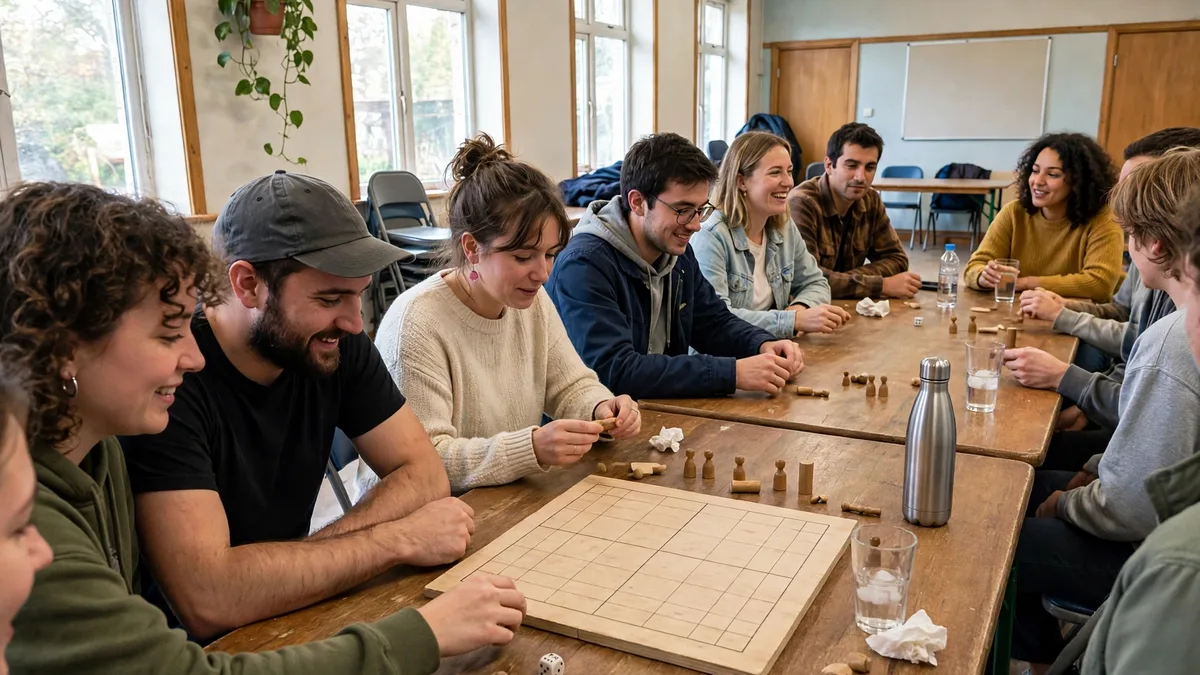
Seat players in groups of 5 at numbered tables, and give each group a colour or a letter so hosts can find them quickly. With 550 players, you need 110 tables of 5. Prepare a printed seating list, post it where everyone arrives, and put 2 volunteers at the door to direct newcomers toward their table.
After each session, collect results on a simple form: table number, game, and each player’s ending total. 2 volunteers with a laptop can enter 110 results in about 20 minutes. Announce the top tables after each session, but keep the tone light.
The Board 548 collection shows how a slightly larger crowd was organised around Evacuation, Kutná Hora, Tindaya, Ancient Knowledge, At the Gates of Loyang, Rebirth, Frostpunk, Daitoshi, and Ceres, and its 3-session structure adapts neatly to 550 players: read the Board 548 collection for a fuller worked example of the same format.
If your hall is smaller than the crowd, run the same timetable across 2 halls, or split the crowd into 2 groups that share the tables at different hours.
What You Need
Equipment matters more than decoration. You need enough copies of each game, tables and chairs, a public address system or a loud bell, printed rule summaries, result forms, pens, and a scoreboard that everyone can see. Count copies carefully: for a game played by everyone at once, you need 1 copy per table, which means about 110 copies for 550 players in groups of 5. Borrow from clubs and regular players well in advance, and label every copy with its owner’s name.
Volunteers are the other essential: aim for 1 host per 8 tables, plus 2 people at the door, 2 on the scoreboard, and 1 person in charge of the timetable. Hosts need to know the rules of the game their tables are playing, so run a short training evening a week before the event, with each host playing the game they will oversee.
A hall of 550 players gets warm and thirsty, so arrange water on every table, a lunch break nearby, and a quiet area where players can rest across sessions.
The Board 546 collection used a similar volunteer plan for its heavier games, led by Black Forest, CloudAge, Kokopelli, Forum Trajanum, Carnegie, SETI: Search for Extraterrestrial Intelligence, Shackleton Base, Zoo Vadis, and Galileo Galilei, and the same host-to-table ratio works here: read the Board 546 collection for a fuller worked example of the same format.
Checklist
- Book a hall with seating for 550 players and space for 110 tables.
- Borrow or buy enough copies of each chosen game, labelled with owners’ names.
- Recruit 1 host per 8 tables and train them on their assigned game.
- Print seating lists, rule summaries, result forms, and a large timetable board.
- Arrange water on every table, lunch nearby, and a quiet rest area.
- Prepare a projected scoreboard and try it before the opening session begins.
Frequently Asked Questions
How many copies of each game do I need?
You need 1 copy per table: with 550 players in groups of 5, that means 110 copies of whichever game everyone plays at the same hour. If that number sounds daunting, rotate instead: split the crowd into groups, give each group a different game, and change games across sessions. Rotation cuts the copies needed for any game to roughly a third.
What if some players have never played a board game before?
Start them on Knarr or Heredity, the 2 gentlest games in this list. Both teach in about 10 minutes and forgive early mistakes. Seat each newcomer beside an experienced player, and ask the host to play the opening few moves openly.
Can children join an event with 550 players?
Yes, if the games suit their years and the timetable suits their energy. Knarr and Heredity work well for older children, while Civolution and Arcs suit adults and older teenagers because of their length and heft. Seat children with relatives rather than with people they have just met, keep their sessions short, and give them a clear finish time.
How do I keep 110 tables on the same schedule?
Use a loud bell or a public address announcement at the start, mid-session, and the finish of each session. Hosts should watch their own tables, but the bell is the shared cue everyone obeys. When the finish bell sounds, tables complete their current run of moves, count their ending totals, and submit their result forms.
What happens if a table finishes early?
Let them play a short filler from your spare list, or begin another sitting of the same game and count the better total. Early finishers are a sign of a well-taught game, not a problem. The Board 544 collection used the same approach, with its Marrakesh, Carpe Diem, Broom Service, Blue Moon City, Golem, A Study in Emerald, Rats of Wistar, Tawantinsuyu: The Inca Empire, and Anunnaki: Dawn of the Gods games filling spare slots between longer sessions: read the Board 544 collection for a fuller worked example of the same format.
Do I need prizes?
Prizes help, but they do not need to be expensive. A modest trophy for the top table, a certificate for the best newcomer, and a playful award for the most sporting table are enough. Announce the awards at the end and thank the volunteers by name. Most players remember the day and the games far longer than they remember the prizes.
The Bottom Line
Running board games for 550 players is a logistics task with a joyful core: many tables, a shared timetable, and a scoreboard for the whole crowd. Pick 3 games from the 9 above, recruit enough hosts, print your seating lists and result forms, and keep the finish bell firm. Do that, and a crowd that looks unmanageable becomes a hall full of people enjoying good games together. Start with Knarr, move on to Men-Nefer or Sankoré, and end with Distilled, and your 550 players will leave already asking about the next event.