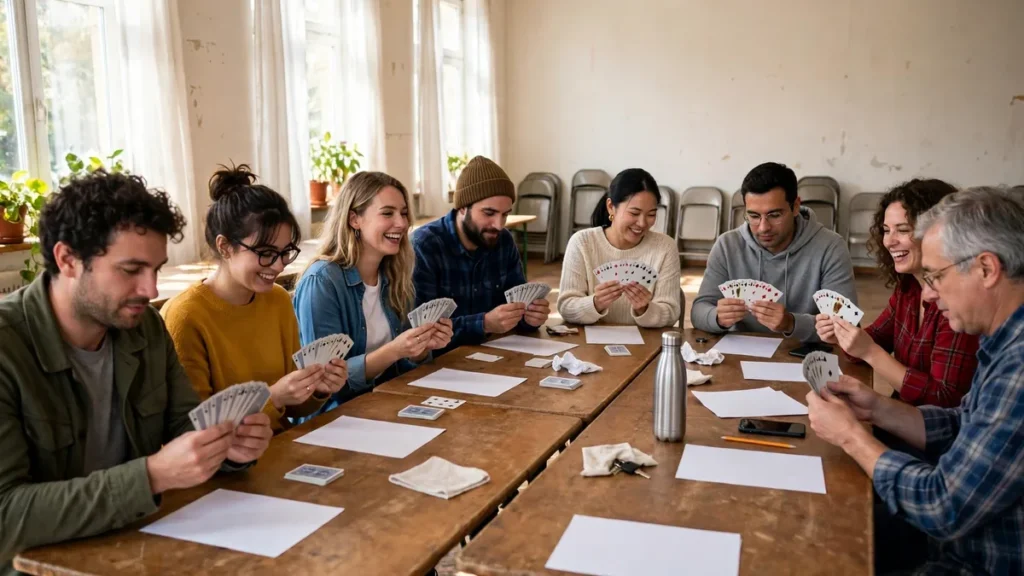
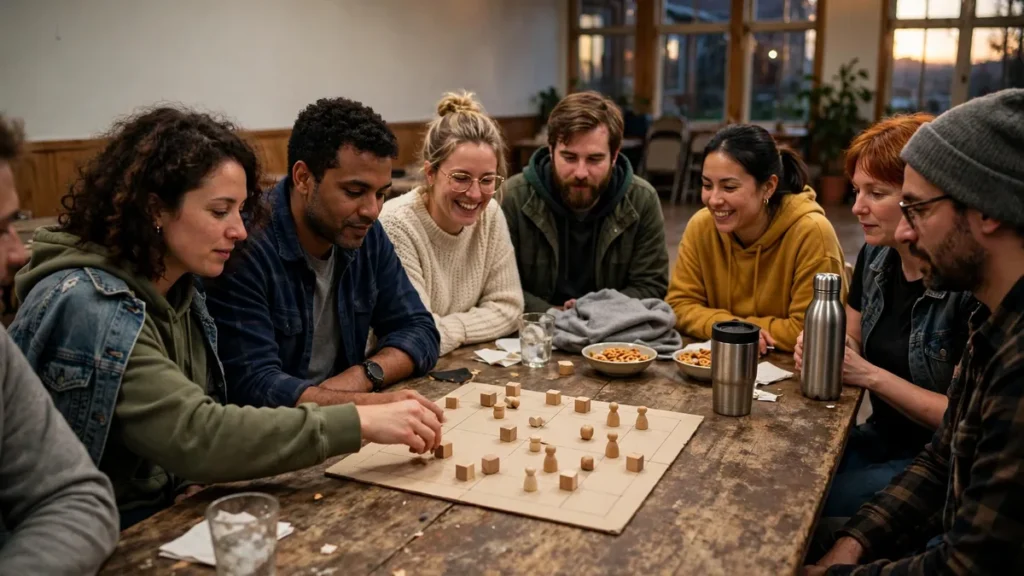
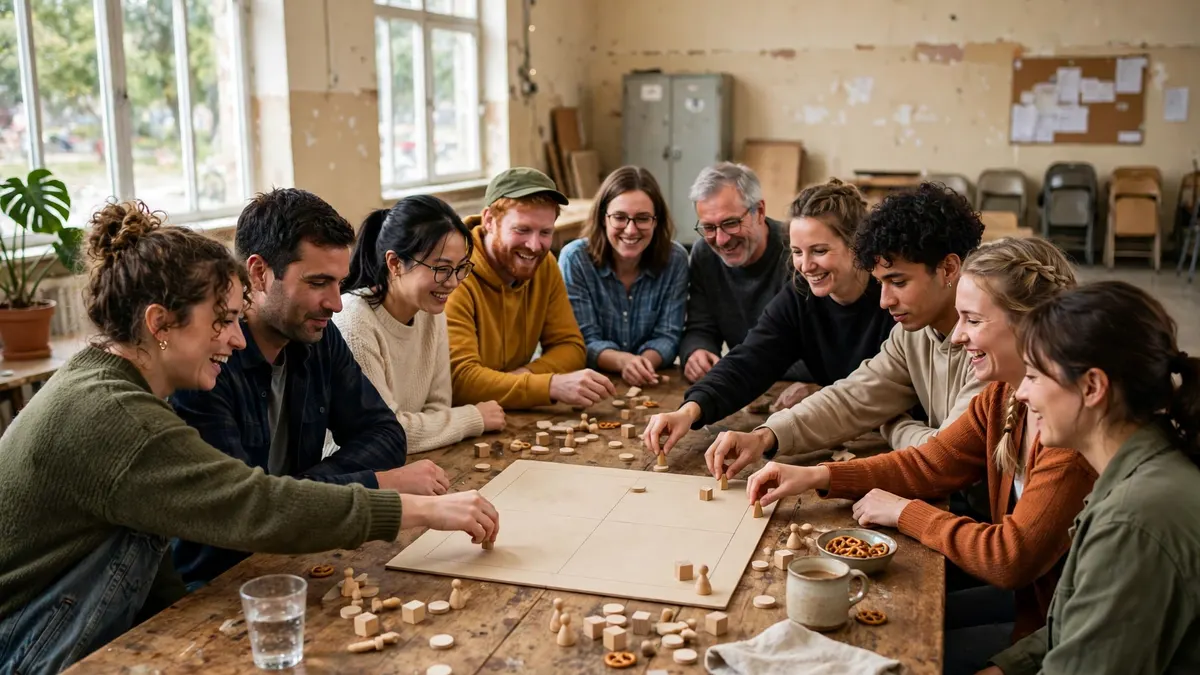
Running board games for 546 players sounds impossible until the format changes. Nobody expects 546 people to sit around a single board. The trick is to run 91 groups of 6 at once, all playing the same 9 titles on a shared clock, with every group finishing a title at the same moment and rotating to the next title. The hall hums, the groups stay compact, and every person plays every title by the end of the day.
The 9 titles below were chosen because they teach in minutes, play in under 90 minutes, and keep a group of 6 busy without a single person waiting extended periods for a turn. Each title rewards planning over luck, so a thoughtful newcomer can hold their own against a seasoned player. If the heavier Euro collection in our board games for 544 players appeals to your crowd, this list continues in the same spirit, with fresh titles that reward careful planning and patient resource management.
Plan for 6 hours of play, 9 rounds of 40 minutes, and a 10 minute break between rounds. A chief organizer calls the start and the end of each round from a microphone at the front of the hall, while 9 station leads each look after 10 groups playing the same title. That structure is what turns a crowd of 546 into 91 lively tables instead of an unmanageable mass.
Key takeaways
- 546 players split into 91 groups of 6, with 9 titles rotating on a shared 40 minute clock.
- Every title below teaches in minutes and finishes inside 90 minutes, so no group waits extended periods.
- Each group needs a copy of the title, a timer, and a points sheet; nothing else is essential.
- Station leads, not a single host, keep 10 groups each on schedule and answer rules questions.
- Points are tallied per group and per title, then combined for an overall champion at the close.
| Title | What a group does | Minutes per table | Players per group |
|---|---|---|---|
| Black Forest | Run workshops and shape delicate vessels | 60 to 90 | 1 to 4 |
| CloudAge | Travel between settlements in a hazy terrain | 60 to 90 | 1 to 4 |
| Kokopelli | Draft pieces and complete rites | 45 to 60 | 2 to 4 |
| Forum Trajanum | Lay out pieces for a classical plaza | 60 to 90 | 2 to 4 |
| Carnegie | Found departments and fund public works | 90 to 120 | 1 to 4 |
| SETI: Search for Extraterrestrial Intelligence | Send probes and probe distant sectors | 60 to 120 | 1 to 4 |
| Shackleton Base | Develop an outpost on a pale orb | 60 to 120 | 1 to 4 |
| Zoo Vadis | Offer pieces to move figures along a shared path | 30 to 45 | 3 to 5 |
| Galileo Galilei | Improve instruments and record observations | 60 to 90 | 1 to 4 |
The 9 Titles for 546 Players
1. Black Forest
Black Forest puts each player in charge of workshops in a German region known for glassworks, where resources are gathered, vessels are shaped, and orders are filled for points. A rotating action selector decides which actions are available on a given turn, so a group must adapt its plans constantly instead of repeating the same opening every time. The pieces are plain wood and the board is uncluttered, which helps newcomers follow the action.
At a table of 6, split the group into 2 subgroups of 3 and run 2 copies side by side, then compare points at the end of the round. The teach takes about 8 minutes if the station lead demonstrates 2 turns before letting the groups begin. Keep the points sheet visible, and remind the groups that the rotating selector decides which actions pay off.
2. CloudAge
CloudAge sends players travelling between settlements across a hazy terrain, collecting resources and improving their crews of travellers as they travel. Each player builds a compact supply of action pieces and uses it to move, gather, and bargain, so every turn offers a genuine decision about where to invest effort. The theme is gentle and the rules are forgiving, which suits a mixed crowd.
The teach takes about 10 minutes, and the station lead should walk the groups through an entire round of movement before the clock starts. At a table of 6, play 2 copies with 3 players each, since the title shines brightest with fewer players per copy. Points come from delivered goods, improved travellers, and completed objectives, so there are several paths to a respectable tally. Tell the groups to keep their decks tidy and their resources in neat piles,
3. Kokopelli
Kokopelli is a drafting title in which players collect pieces of 4 kinds and complete rites to earn points, with the value of each rite rising as more players commit to it. The tension is delicious: join a popular rite early for a safe return, or back a lonely rite and hope the rest of the table follows. Rounds are short, the rules fit in a short paragraph, and a group of 4 can finish in under an hour, which makes it the quickest title on this list.
Teach it in 5 minutes by dealing a sample group of pieces and playing 2 rites in front of the group. At a table of 6, run 2 copies with 3 players each and compare tallies when the round ends. The station lead should watch for the usual mistake, which is drafting a piece without checking which rites it supports. A single reminder at the start of the round prevents most errors. Groups often ask to play it twice, and the schedule allows another sitting inside the same 40 minute slot.
4. Forum Trajanum
Forum Trajanum asks players to lay out pieces and create a classical plaza in the Roman era, placing workers, raising columns, and arranging the plaza so that neighbouring pieces support each other. The board is a grid, the pieces are chunky and pleasant to handle, and the scoring rewards careful placement over several turns rather than a single clever move. It suits players who enjoy building something visible on the table.
The teach takes about 10 minutes, and the station lead should demonstrate a completed plaza before the groups begin, so everyone understands what a finished layout looks like. At a table of 6, play 2 copies with 3 players each. Points come from columns raised, areas completed, and the arrangement of the plaza, so groups should be encouraged to plan 2 turns ahead. Keep spare pieces in a shallow tray, and ask the groups to return every piece to its tray when the round ends.
5. Carnegie
Carnegie is the heaviest title on this list, and it earns its place because it gives ambitious players a deep, satisfying puzzle. Each player builds a network of departments across the United States, hires staff, and funds public works, with every decision feeding into the next. The rules take longer to teach than any other title here, around 15 minutes, so the station lead should arrive early and rehearse the teach before the doors admit the crowd.
At a table of 6, play 2 copies with 3 players each, and warn the groups that the opening 20 minutes feel unhurried before the engine starts paying off. Points come from the network, the staff, and the funded works, so there is no single route to the top of the tally. Give each group a reference sheet listing the department actions, and ask the station lead to visit each copy twice during the round to answer questions. Patient groups that plan ahead usually finish with the highest tallies of the day.
6. SETI: Search for Extraterrestrial Intelligence
SETI: Search for Extraterrestrial Intelligence sends players probing distant sectors, sending probes outward and listening for faint traces of far-off civilisations. Each player manages a compact agency with its own instruments and budget, choosing where to probe and when to invest in better equipment. The mix of exploration and careful resource management keeps newcomers and veterans engaged for the entire round.
The teach takes about 12 minutes, so the station lead should use the sample turn printed in the rulebook to demonstrate how a probe moves and how a trace is recorded. At a table of 6, play 2 copies with 3 players each. Points come from probes sent, sectors explored, and traces found, so groups should balance bold probing with steady investment. Remind the groups that the probe pieces are delicate, so a steady table and a steady pace help everyone.
7. Shackleton Base
Shackleton Base asks players to develop an outpost on a pale orb above us, constructing habitats, generating power, and sending expeditions outward from a central hub. Each player runs a corporation with its own strengths, and the shared outpost grows visibly on the board as the round progresses. The combination of building, planning, and a striking theme makes it a favourite with players who enjoy watching a shared project take shape.
The teach takes about 12 minutes, and the station lead should point out the 3 kinds of construction before the groups begin, so nobody wastes early turns on the wrong kind. At a table of 6, play 2 copies with 3 players each. Points come from habitats built, power generated, and expeditions completed, so a balanced approach usually beats a narrow approach. Keep the corporation sheets face up so the groups can see each other’s strengths.
8. Zoo Vadis
Zoo Vadis is the liveliest title on this list, a bidding title in which players offer pieces to move their figures along a shared path toward the front. Every move is a negotiation, every offer is public, and the table erupts whenever a bold offer succeeds or a careful offer is outbid. The rules take 5 minutes to teach, the rounds are short, and the title works beautifully with 5 players per copy.
At a table of 6, play a copy with 5 players and rotate the sixth person in as the tally keeper, swapping roles halfway through the round so everyone plays. The station lead should demonstrate a bidding round before the clock starts, because the offer mechanic is unfamiliar to most newcomers. Points come from positions reached along the path, so aggressive offers pay off when they succeed and cost dearly when they fail.
9. Galileo Galilei
Galileo Galilei puts players in charge of improving their instruments and recording observations of distant objects in the night heavens. Each player chooses which objects to observe, which instruments to improve, and when to publish findings for points. The decisions are meaningful, and the board fills with observation markers as the round progresses.
The teach takes about 10 minutes, and the station lead should demonstrate how an observation is recorded before the groups begin. At a table of 6, play 2 copies with 3 players each. Points come from observations recorded, instruments improved, and findings published, so groups should avoid spending the whole round on a single object. Ask the groups to count their points together at the end of the round, which catches arithmetic slips before the tallies are handed in.
How 546 Players Fit Into One Day
The day runs on 9 rounds of 40 minutes, with a 10 minute break between rounds for rotation and refreshments. Each group visits all 9 stations, so every player tries every title. The Khora-led collection in our board games for 542 players runs on a similar rotation, and the same arithmetic applies here: 91 groups, 9 stations, and a shared clock that keeps everyone moving together.
Seat the groups in advance and print a rotation sheet for each table, listing the station order and the start time of each round. The chief organizer announces each rotation over the microphone, and the station leads check the groups in as they arrive. A group that finishes early uses the spare minutes to tidy its table and review its points sheet. Nobody is rushed off a table mid-turn, but the clock is firm, and the groups learn the rhythm within the opening 2 rounds.
Reserve the opening 30 minutes of the day for arrival, seating, and a welcome from the chief organizer, and the final 30 minutes for the overall tally and the champion’s announcement. A midday break sits in the middle of the day, after round 5, and lasts 45 minutes. That gives the day a natural midpoint, a chance to rest, and a moment for the station leads to compare notes on any rules questions that came up in the morning rounds.
What You Need
Each station needs 10 copies of its title, 10 timers, 10 points sheets, and a printed rules summary. Across 9 stations that means 90 copies in total, plus 9 spare copies held at the welcome desk for replacements. Borrow copies from local clubs where possible, and label every copy with its station number. For a lighter afternoon, the gentler list in our board games for 540 players, led by Dorfromantik, Copenhagen, and Targi, shows how a gentler list can still fill a hall.
The hall itself needs 91 tables, 546 chairs, and enough floor area for the station leads to move between tables without squeezing past seated players. Allow at least 2 metres of aisle between rows of tables, and place the welcome desk near the entrance so late arrivals can be seated without crossing the whole hall. A microphone and 2 speakers carry the chief organizer’s announcements, and a large visible clock at the front of the hall keeps every group honest about the time.
Print 91 rotation sheets, 546 name badges, and 91 points sheets, plus 20 spare points sheets for errors. Provide a writing implement for every table, and ask each group to appoint a tally keeper at the start of every round. Water stations at the back of the hall and a refreshments table near the entrance keep the day comfortable without pulling players far from their tables.
Checklist
- Confirm the hall booking, the 91 tables, and the 546 chairs a week before the day.
- Collect 90 copies of the 9 titles, label each copy with its station number, and hold 9 spares at the welcome desk.
- Print 91 rotation sheets, 546 name badges, and 111 points sheets, and pack pencils for every table.
- Brief the 9 station leads on their title, the teach, and the 2 minute warning before each round ends.
- Test the microphone, the speakers, and the large visible clock at the front of the hall.
- Prepare the overall tally sheet and the champion’s announcement for the final 30 minutes.
Frequently Asked Questions
Can a complete newcomer enjoy these 9 titles?
Yes. Every title on this list teaches in 15 minutes or less, and the station leads demonstrate a sample turn before each round begins. Newcomers should start at the Kokopelli or Zoo Vadis stations, where the rules are shortest and the table talk is liveliest, and save Carnegie for a later round.
What happens if a group has only 5 players?
A group of 5 plays normally at most stations, using a copy with 5 players where the title supports it. At stations where a title plays best with 4 or fewer, the group splits into a subgroup of 3 and a subgroup of 2, each with its own copy, and the points are combined. The rotation sheet notes which stations need a split.
How are points tallied across 91 groups?
Each group records its points on its points sheet at the end of every round, and the station lead signs the sheet before the group rotates. At the close of the day, the chief organizer adds the 9 round tallies for each player and announces the overall champion, plus the highest tally at each station. A tie is broken by the highest single-round tally.
Do we need 90 copies, or can groups share?
Sharing across stations does not work on a shared clock, because every station plays at the same time. Each station needs its own 10 copies, a copy per group, plus a spare. Borrow from local clubs, ask regular attendees to lend copies, and label everything. A missing copy at a station delays 10 groups, so the spares at the welcome desk matter.
What if a title proves too heavy for a group?
The station lead can simplify a heavy title by removing an advanced element for that group, such as an optional module, and noting the change on the points sheet. The group still earns points and still rotates on schedule. Carnegie is the title most likely to need this treatment, so its station lead should be the most experienced of the 9.
How noisy does the hall get?
Very noisy during Zoo Vadis and lively during Kokopelli, and far more hushed during Carnegie and Forum Trajanum. Place the lively stations near the edges of the hall and the still ones near the centre, so the buzz does not drown out the thinking tables. The chief organizer uses the microphone only for round starts, round ends, and the final announcement.
The Bottom Line
Board games for 546 players work when 91 compact groups play 9 well-chosen titles on a shared clock, with station leads keeping the rhythm and a plain points system crowning a champion at the close. Choose titles that teach quickly, play inside 90 minutes, and reward planning, and the crowd takes care of the rest.