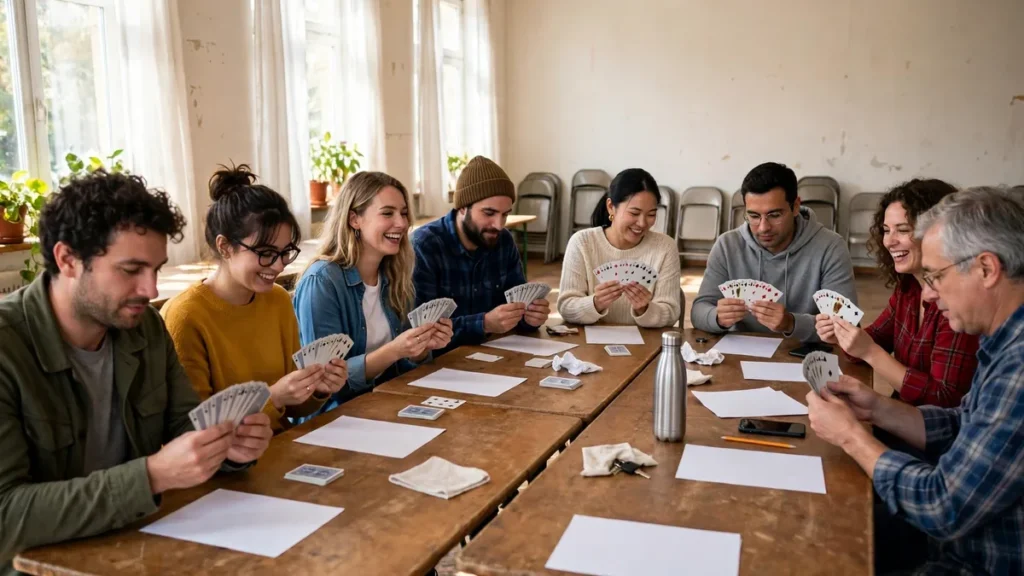
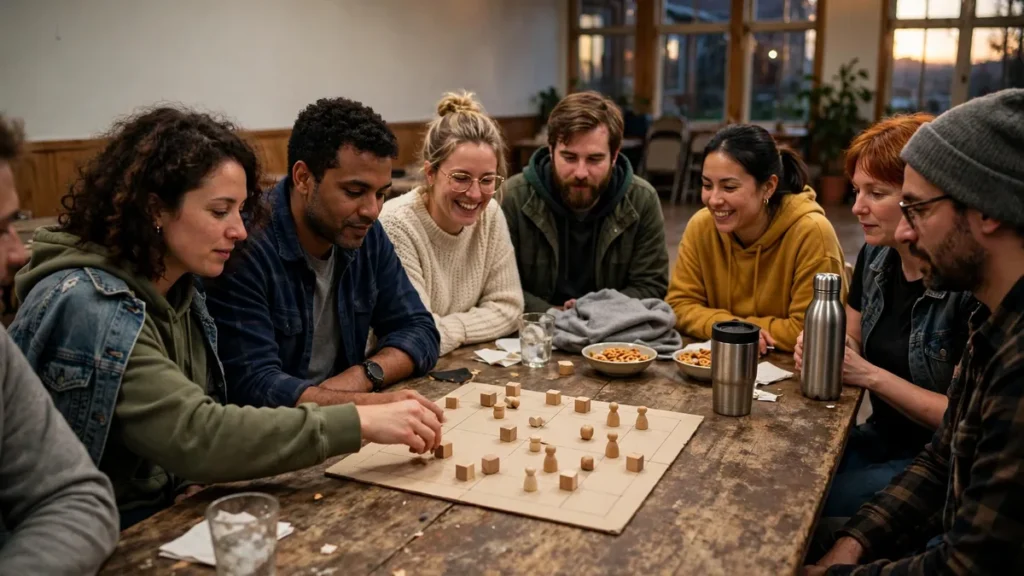
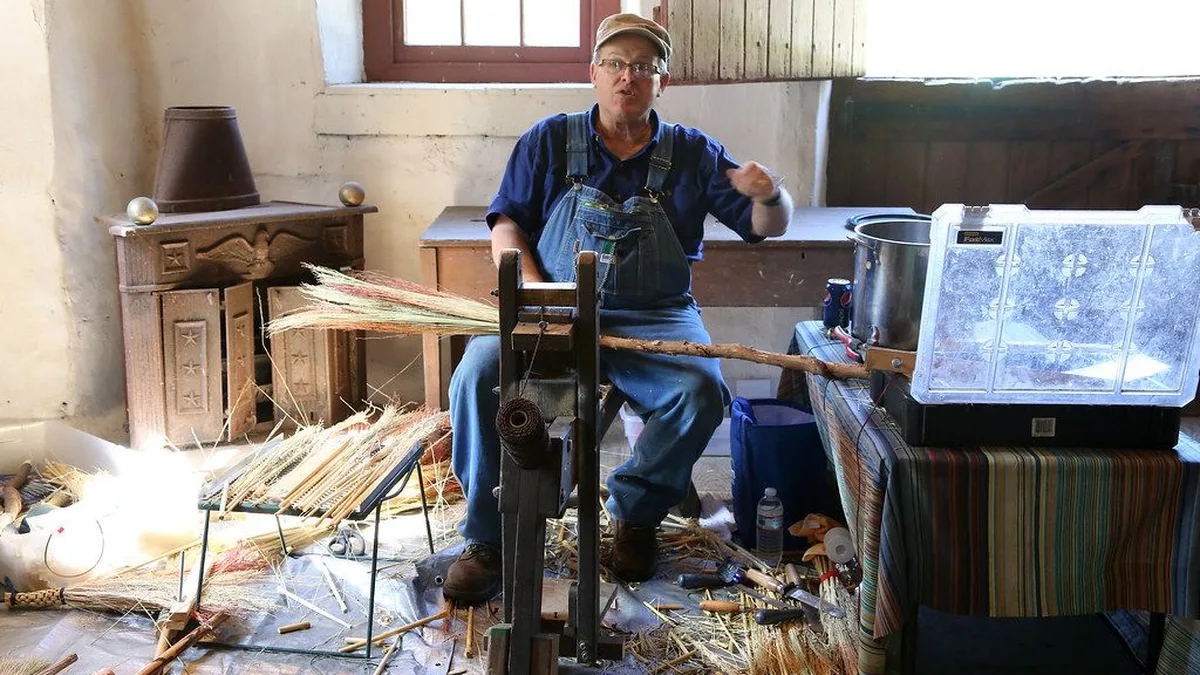
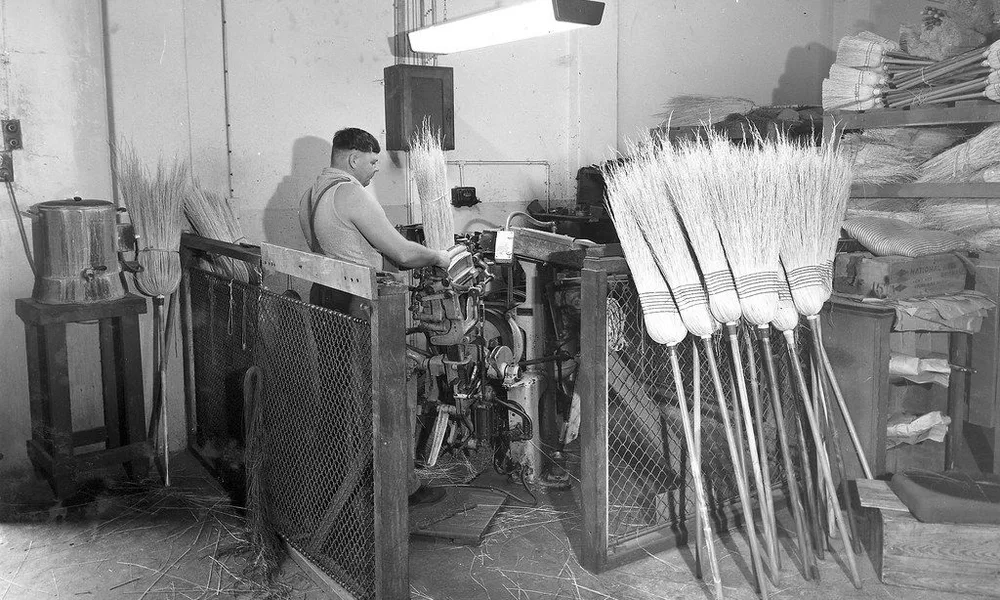
A broom-maker’s workshop is a small place with a long bench, a pile of birch twigs, bundles of straw, and a wooden vice that holds a half-made head steady. It is the kind of place where every job can be seen, counted, and checked in a minute, and that is exactly what a day for 546 players needs. Nobody has to learn a new craft from scratch. Every race below takes one ordinary bench job, turns it into a timed contest, and hands every team the same kit, so the day runs on fairness rather than luck.
The nine races all carry the “Race” suffix, and every one comes from the bench itself: counting twigs, binding a head, measuring a handle, sorting bristles, wrapping a neck, ordering bundles, packing straw, notching a handle, and weighing a finished head. Teams of thirteen move from bench to bench in turn, and the host calls out the tally after each round, so every team knows where it stands before the next race begins.
The chair-maker’s workshop article in our puzzle games for 545 players runs on the same idea, with nine bench races of its own, and this broom-maker day follows that pattern closely. What follows is the full plan: the nine races at a glance, each race in detail, how 546 players move through one day, how the points stay fair, a short checklist, and answers to the questions hosts ask most often.
Key takeaways
- Nine races, each with the “Race” suffix, all taken from real bench jobs in a broom-maker’s workshop.
- Forty-two teams of thirteen players rotate through nine benches, so nobody queues for long.
- Every team uses the same kit, and the host calls out the tally after each round.
- Points come from accuracy first and pace after that, so careful teams stay in the running.
- The whole day fits into two halves with a meal break in the middle.
The 9 Races at a Glance
The table below gives the whole day in one view. Each race names its bench job and the one thing the host looks at when the round ends.
| Race | Bench job | What the host checks |
|---|---|---|
| Birch Twig Count Race | Counting birch twigs into bundles of ten | Bundles hold ten twigs each, no more, no fewer |
| Besom Head Bind Race | Binding straw around a short handle | The binding stays firm when the head is lifted and turned |
| Handle Length Measure Race | Measuring handles against a marked rod | Handles stand in order from longest to shortest |
| Bristle Tip Sort Race | Sorting bristle tips by length | Three groups hold short, middle, and long tips only |
| Broom Neck Wrap Race | Wrapping twine around a broom neck | Wraps sit evenly spaced with no gaps showing |
| Twig Bundle Order Race | Ordering twig bundles thinnest to thickest | The row runs thinnest to thickest with none out of place |
| Straw Head Pack Race | Packing straw into a head frame | The head feels firm when the host presses it |
| Broom Handle Notch Race | Notching handles at measured points | Notches sit at the marked points, level and true |
| Broom Head Weigh Race | Weighing finished broom heads | Heads come nearest to the target weight the host names |
The 9 Broom-Maker Races
Each race below runs the same way: the host shows the job once, the teams work in turn, and the tally is called out before the next race begins. Kit is identical at every bench, so a team that loses knows it lost on the work, not on the tools.
1. Birch Twig Count Race
Each team gets a tray of loose birch twigs and an empty row of ten binding bands. The job is simple to explain and hard to rush: count the twigs into bundles of ten, and bind each bundle with one band. A bundle with nine twigs or eleven twigs earns nothing, however fast it was made, so quick teams learn to count aloud in twos, with one player double-checking each bundle.
The host walks the row when the whistle sounds and opens three bundles at random. If all three hold ten twigs, the team earns full points for the race. If one bundle is wrong, the team loses a third of its points for that race, and if two are wrong, it loses two thirds.
2. Besom Head Bind Race
A besom is the old name for a broom made from twigs and straw, and this race asks each team to make one. The team gets a short handle, a hank of straw, and a length of twine. One player holds the handle upright while another lays the straw around its lower end, and a third binds the straw tight with the twine in firm turns.
When the whistle sounds, the host lifts each head by its handle and turns it slowly. A good binding stays firm, with no straw slipping loose and no twine riding up over the straw. A loose binding drops straw on the floor and costs the team points.
3. Handle Length Measure Race
Twelve handles of different lengths lie in a jumble on the bench, and the team must lay them out in order from longest to shortest. A marked rod stands at the end of the bench, but it may be used only three times, so teams must size up most lengths by eye.
The host measures the finished row with the rod after the whistle. Each handle in its true place earns points, and a row with only one handle out of place still earns most of its points, so teams are wise to spend their three measures on the middle of the row, where two handles of near-equal length cause the most difficulty.
4. Bristle Tip Sort Race
A tray of loose bristle tips waits at this bench, mixed together in one heap. The team must sort them into three groups: short, middle, and long. A marked gauge board shows the three lengths, with a short tip, a middle tip, and a long tip glued to the board for comparison.
The host checks the three groups when the whistle sounds and counts how many tips sit in the wrong group. Every tip in its true group earns points, so a team that sorts slowly and checks each tip against the board will beat a team that sorts fast and guesses.
5. Broom Neck Wrap Race
The neck of a broom is the narrow part just above the head, where the straw meets the handle, and a neat wrap of twine there keeps the whole broom together. Each team gets a half-made broom with a bare neck and a length of twine. The job is to wrap the twine around the neck in even turns, close together, with no gaps showing and no turns crossing over each other.
The host looks at each neck in turn after the whistle and counts the gaps. A neck with no gaps earns full points, and each gap costs a point, so patience pays. The best teams wrap slowly, with one player turning the broom a little at a time while another feeds the twine.
6. Twig Bundle Order Race
Six twig bundles of different thickness wait on this bench, and the team must lay them in a row from thinnest to thickest. The bundles look alike at a glance, and the difference between two neighbours in the row can be as small as a finger width, so teams must handle each bundle and compare it with the ones beside it before they settle the order.
The host checks the row with a marked wooden rod after the whistle. Each bundle in its true place earns points, and the host calls out the result so the team can see where it went wrong.
7. Straw Head Pack Race
Each team gets a head frame, a tray of loose straw, and a flat wooden press. The job is to pack the straw into the frame until the head feels firm all the way through, with no soft hollow in the middle and no straw poking out at odd angles. One player feeds the straw in small handfuls while another presses it down.
When the whistle sounds, the host presses each head with a thumb in three places. A head that feels firm in all three places earns full points, and a head with a soft hollow loses points for each soft place.
8. Broom Handle Notch Race
A broom handle needs notches at measured points, where the binding will sit and the head will grip. Each team gets three plain handles and a marked rod. The job is to notch each handle at the points the rod shows, using a small hand tool, each notch level and true.
The host holds the rod against each handle after the whistle and checks every notch. A notch at the true point earns points, and a notch that wanders off the true point earns nothing, so teams that measure twice and notch once do best.
9. Broom Head Weigh Race
The closing race is the simplest to explain and the hardest to tell by feel. The host names a target weight, and each team must make up a broom head that comes as near to that weight as it can, adding or taking away straw until the head feels right. No weighing device is allowed during the race, so teams must tell by lifting the head and comparing it with a sample head the host holds up.
When the whistle sounds, the host weighs each head and calls out the number. The head nearest the target earns the most points, and the heads after it earn fewer points in order, so every team stays in the running until the final call.
How 546 Players Fit Into One Day
Five hundred and forty-six players sounds like a crowd too large for one workshop, but the number divides neatly: forty-two teams of thirteen players. Thirteen is a good size for a bench, because it lets three players work while the rest watch, advise, and rest. The host keeps a master tally on a large board where every team can see it, updated after each round.
The day runs in two halves with a meal break in the middle. Each half holds four or five races, and each race takes about twelve minutes of work plus three minutes to move, tidy the bench, and hear the tally called out. The morning half closes with the wrap race, which needs the most patience, and the afternoon half closes with the weigh race, so the day ends on a single dramatic call rather than a scramble.
Teams that finish a race early wait at their bench and tidy their kit rather than wandering off, because the next race starts on the whistle for everyone at once. The bookbinder’s workshop article in our puzzle games for 543 players runs on the same two-half plan, and it works because the meal break gives the host time to check the tally, restock the benches, and deal with any dispute while the players are away from the benches. A dispute settled over lunch never spoils an afternoon.
Stations That Keep 546 Players Moving
Nine benches stand in a wide loop, with a clear path around the outside and a rest area in the middle. Each team starts at a different bench and moves one place along the loop after each race, so every team visits every bench once and no bench ever holds two teams at the same time.
Each bench holds the kit for its race and nothing else. A helper stands at each bench with extra kit, so a snapped band or a dropped handle costs seconds rather than minutes.
The rest area in the middle holds water, seating, and the master tally board. Teams that finish early sit there, and teams with a player who needs a break can swap in a rested player at any time, because the races are written so that any thirteen players can do the work. The joiner’s workshop article in our puzzle games for 535 players uses the same loop of benches and the same middle rest area, and the pattern holds up well at this size because the movement is always in one direction and nobody has to ask where to head next.
Keeping the Points Fair
Points come from accuracy first and pace after that. A team that finishes a race early earns a small bonus, but the bonus is never worth more than a single careful check, so rushing never beats working well. The host calls out the tally after each race, and any team may ask the host to look again at its work before the next race begins.
Ties are settled by a dead heat rule: if two teams hold the same points at the end of the day, the team that earned more points in the weigh race takes the higher place, because the weigh race asks for judgement rather than luck. Nobody leaves the day feeling that a single doubtful call decided everything.
The host keeps a written tally as well as the board, with each race recorded in its own column, so any question can be answered from the paper. Teams are asked to name one player each as their tally-watcher, and that player may stand beside the host while the tally is called out.
Checklist: Your Broom-Maker Day in Order
Work through this list the day before, and the day itself will run on rails. Each item is a job for one named person, not a hope for the morning.
- Count the kit: forty-two trays of birch twigs, forty-two handles, straw for nine benches, twine, bands, rods, gauge boards, presses, and hand tools.
- Number the benches: nine benches in a loop, numbered in order, with the rest area and the master tally board in the middle.
- Brief the helpers: one helper per bench, each knowing the race at that bench and the whistle that ends the round.
- Prepare the tally: a large board with forty-two rows, a written tally in matching columns, and one named tally-watcher from each team.
- Plan the meal break: food and water for 546 players, seating in the rest area, and time for the host to check the tally.
- Rehearse the opening huddle: the nine races in order, the dead heat rule, and the promise that the tally is called out after every race.
Frequently Asked Questions
How long does the whole day take?
Plan for about six hours from the opening huddle to the final call, including a meal break of forty-five minutes in the middle. Each race takes about twelve minutes of work plus three minutes to move and tidy, and nine races at that pace fill two halves of a little over two hours each.
What ages can take part?
The races work for players from about ten years old upward, because every job uses ordinary bench tools and no race needs strength. Younger players do well in the counting and sorting races, where care matters more than force. Mixed-age teams work best, because the jobs reward different strengths.
Do teams need broom-making experience?
No experience is needed at all. The host shows each job once before the race begins, and the jobs themselves are simple: count, bind, measure, sort, wrap, order, pack, notch, and weigh. A team that has never seen a broom-maker’s bench can still earn full points in the counting race within minutes.
What happens if it rains?
The benches stand beneath a canopy, and the loop of benches is laid out so that the path between benches stays dry. If the rain turns heavy, the host lengthens the meal break and runs the races in the same order, because the order matters more than the hour. No race is ever cancelled for rain alone.
How are the points counted?
Each race is worth the same number of points, and the host awards them for accuracy first: bundles that hold ten twigs, bindings that stay firm, rows in true order, and heads nearest the target weight. A small bonus is given to teams that finish early, but it never outweighs a careful check.
Can we run the day with fewer players?
Yes. The plan scales down cleanly: keep nine benches and shrink the teams to eight or nine players each, which works for a group of about seventy to eighty players. The races stay the same, the movement stays one place along the loop, and the meal break stays in the middle. With fewer teams, each race can run a little longer.
The Bottom Line
A broom-maker’s workshop gives 546 players nine honest jobs, nine fair races, and one day that runs on care rather than noise. Count the twigs, bind the heads, measure the handles, sort the bristles, wrap the necks, order the bundles, pack the straw, notch the handles, and weigh the finished heads, and the tally will look after itself. Bring the kit, number the loop, brief the helpers, and let the benches do the talking.