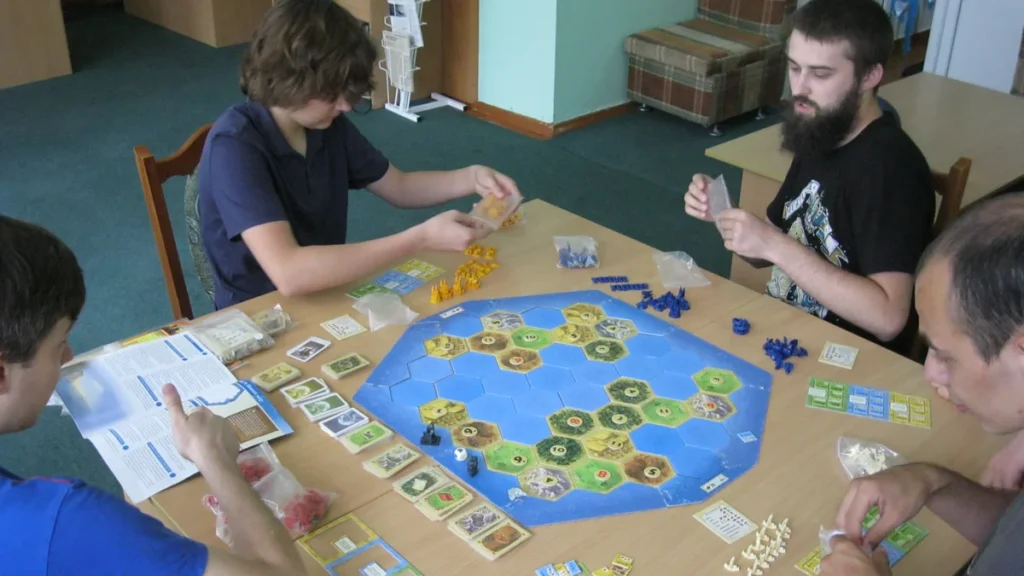
Four hundred and seventy-one players sounds like far too many people for one dice night, until you stop picturing a single table and start picturing a hall full of small tables. With six or seven players at each table, 471 people fill about seventy tables, and every table can roll the same game at the same time. The dice do the work, the scorecards keep everyone honest, and a single caller at the front keeps the whole room moving together.
Winter gives this format a natural theme. Snow, sleds, skating, cocoa and long dark evenings all suit a big indoor gathering, and the games below use that theme without needing snow outside or any special equipment beyond dice, pencils and printed scorecards. Each game takes only a few minutes per round, so a hall can play several games in one evening and still finish on time.
The nine games in this guide were designed for exactly this scale. They work for mixed ages, they need no prior knowledge of winter sports, and they keep every player rolling rather than watching. Set up the tables, hand out the kits, call the rounds from the front, and 471 players will feel like one big game instead of seventy separate ones.
Key takeaways
- Split 471 players into tables of six or seven, with about seventy tables in the hall.
- Give every table the same kit: two dice, pencils, scorecards and a printed rules sheet.
- Run every table on the same clock, with one caller announcing each round from the front.
- Keep each game short, with rounds of five to ten minutes and a clear winner per table.
- End the night with table winners only, so nobody waits for a hall-wide final.

The Nine Winter Dice Games at a Glance
Use this table to plan the evening. Every game below uses ordinary six-sided dice, and every table plays the same game at the same time, so the caller only ever explains one set of rules per round.
| Game | Players per table | Dice per table | Best for |
|---|---|---|---|
| Dice Snowball Fight | 6 to 7 | 2 | Fast opening rounds |
| Dice Sled Hill | 6 to 7 | 2 | Exciting races |
| Dice Ice Skating | 6 to 7 | 2 | Graceful scoring |
| Dice Snowman Build | 6 to 7 | 3 | Creative building |
| Dice Hot Cocoa | 6 to 7 | 2 | A calm middle round |
| Dice Penguin Waddle | 6 to 7 | 2 | Laughs and movement |
| Dice Northern Lights | 6 to 7 | 2 | Colourful scoring |
| Dice Snowflake Hunt | 6 to 7 | 3 | Careful searching |
| Dice Winter Cabin | 6 to 7 | 2 | A cosy final round |
How to Set Up Dice Night for 471 Players
Start by counting tables, not players. With 471 players and six or seven at each table, you need between 68 and 79 tables. Seventy tables of six or seven works neatly: sixty-nine tables of seven hold 483 places, so a few tables simply seat six. Nobody needs to know which tables are short, and nobody feels singled out, because every table plays the same way.
Give every table an identical kit before anyone sits down. Two or three dice, a stack of scorecards, pencils, and a one-page rules sheet for the game in play are enough. When the kits match, no table can claim an advantage, and helpers can restock any table from a single spare box. Keep a few extra dice at the front desk, because dice roll off tables and under chairs in every large hall.
Appoint one caller and two or three floor captains. The caller stands where everyone can hear, explains each game once, starts the round, and calls time. The floor captains walk the room, answer questions quietly, and settle any dispute about a score before it grows. This small team replaces seventy separate hosts, and it keeps the night moving at one steady pace.
Plan the evening in blocks of about twenty minutes. Ten minutes of play, five minutes to total scores and hand out the next rules sheet, and five minutes of breathing room is a comfortable rhythm for a hall this size. Nine games at that pace would take three hours, so most organisers pick five or six games for one night and save the rest for the next gathering. The space-themed dice games for 469 players show how the same table layout works with a completely different theme, which is useful if your group meets again soon.
The Nine Games
1. Dice Snowball Fight
Dice Snowball Fight is the best opener, because it is fast, loud in a friendly way, and impossible to get wrong. Each player rolls two dice on their turn and adds the total to their snowball score. A roll of seven or more adds a snowball to the pile, and a roll of two or three means the snowball melts and the player scores nothing that turn. The first player to reach twenty snowballs wins the table, and most tables finish in under ten minutes.
The fun comes from the shared pile. Every table keeps one running total in the middle of the table, written large enough for everyone to see, and each player adds their own roll to it in turn. When the pile passes twenty, the player who pushed it over the line takes the win, and the rest of the table cheers the finish rather than counting down in silence. It is a simple race, and it warms the room up nicely.
2. Dice Sled Hill
Dice Sled Hill turns two dice into a downhill race. Each player has a sled drawn as a track of twenty spaces on their scorecard, and each roll moves the sled forward by the total shown. Rolling a double gives the sled a push of two extra spaces, while rolling a two sends the sled into a snowdrift and costs the player their next turn. The first sled to reach space twenty wins the table.
The race works because everyone can see the track. Players mark their position with a pencil cross, so the whole table can watch the sleds climb, stall and surge without any extra pieces. A player who falls behind can still catch up with a run of doubles, which keeps the last places interested right to the end of the race.
3. Dice Ice Skating
Dice Ice Skating rewards smooth, steady rolling rather than big numbers. Each player rolls two dice and scores the difference between them, so a roll of six and five scores one, while a roll of six and one scores five. A low difference means a graceful skate, and a high difference means a wobble. The lowest total after five rounds wins the table, which surprises players who expect the highest roller to win.
The scoring twist makes this game a good second or third round, once players have settled in. Everyone understands the idea within one practice roll, and the table soon fills with groans and laughter as a promising roll turns into a wobble. It also gives quieter players a real chance, because careful, steady play beats lucky high rolls over five rounds.
4. Dice Snowman Build
Dice Snowman Build is the creative game of the night. Each player needs three dice, and each roll builds one part of a snowman: a one or two builds the base, a three or four builds the middle, and a five or six builds the head. A player must build the base before the middle and the middle before the head, so the dice decide the order and every snowman grows differently. The first player to complete all three parts wins the table.
The building order creates natural drama. A player who rolls head numbers early must wait, while a player who rolls base numbers first races ahead, and the table can see every snowman taking shape on the scorecards. Players draw a small snowman as they build, adding a circle for each part, which gives the table something cheerful to look at between rolls.
This game suits the middle of the evening, when the room needs a change of pace. It is slower than the racing games, it invites conversation, and it works well for players of all ages, because the rules fit in two short sentences. If a table finishes early, players can decorate their snowman drawings while the caller prepares the next round, and nobody is left sitting idle.
5. Dice Hot Cocoa
Dice Hot Cocoa is the calmest game in the set, and it works best just after a break. Each player rolls two dice and adds the total to their cocoa cup, aiming for exactly twenty-one. A player who passes twenty-one spills the cocoa and must start again from zero, so the game rewards players who know when to stop rolling and bank their score. The first player to land exactly on twenty-one wins the table.
The stop-or-roll choice is what makes the game interesting. A player sitting on eighteen must decide whether to risk a roll that could spill everything, and the table watches the decision with real suspense. Some players stop early and wait, hoping others will spill, while others keep rolling and trust their luck. Both approaches win often enough to keep the game honest.
6. Dice Penguin Waddle
Dice Penguin Waddle is the silliest game of the night, and it is the one players remember afterwards. Each player rolls two dice and waddles forward that many steps on a track of twenty-four spaces, but a roll of doubles means the penguin slips and slides back three spaces. The first penguin to reach the end wins the table, and the slips keep the race close until the final rolls.
The waddle itself is optional but encouraged. Players can rock gently from side to side as they move their pencil along the track, and tables that join in tend to laugh more and play faster. The game needs no acting skill and no standing up, so everyone can take part from their seat, including players who prefer to stay quiet.
7. Dice Northern Lights
Dice Northern Lights is the most colourful game in the guide. Each number on the dice stands for a colour in the sky: one and two are green, three and four are purple, and five and six are pink. Each player rolls two dice and colours in one band of their lights for every colour rolled, aiming to complete a full set of three colours. The first player to complete all three bands wins the table.
The colour sets give every roll a purpose, even a low one. A player who needs only pink will cheer a five or six and groan at a one, while the player next to them wants exactly the opposite, so the same roll means different things around the table. Players shade their bands with pencils as they go, and the scorecards end up looking like small winter skies.

8. Dice Snowflake Hunt
Dice Snowflake Hunt is a searching game that rewards patience. Each player uses three dice, and each roll is read as a three-digit snowflake number, from 111 to 666. Before the game starts, each table agrees on six target numbers, written on the rules sheet, and the first player to roll any three of the six targets wins the table. The targets are the same at every table, so the caller can announce a win as soon as any table finds its third snowflake.
The hunt feels different from the racing games, because progress is invisible until it happens. A player can roll for several turns with nothing to show, then find two targets in a row and suddenly lead the table. That slow build suits the later part of the evening, when players are comfortable with the format and happy to concentrate on a quieter challenge.
9. Dice Winter Cabin
Dice Winter Cabin is the cosy final game, and it is designed to end the night gently. Each player rolls two dice and adds the total to their cabin score, aiming to reach exactly fifty. A player who overshoots must subtract the extra from their total, so the finish is slow and careful rather than a sudden sprint. The first player to land exactly on fifty wins the table, and the last game of the night ends with a quiet cheer instead of a rush.
The exact-finish rule is what makes the cabin game special. Players in the forties must roll small numbers to land cleanly, and a big roll can push them backwards, so the lead changes hands several times near the end. It is a fair finish for a long night, because it rewards patience over luck, and every player at the table stays in the game until the final roll. The ocean-themed games in the dice games for 468 players use a similar exact-finish idea, and they are a good next theme if the group wants another night.
Running the Whole Evening Smoothly
The difference between a good night and a chaotic one is rarely the games themselves. It is the timing, the kits and the calling. Prepare the kits the day before, print the rules sheets in one batch, and lay the tables out with space for helpers to walk between them. A hall with seventy tables needs wide aisles, clear signs for the entrance and the winners board, and a front table where spare dice and pencils are kept within easy reach.
Watch the clock, not the tables. If a game runs long, call time and let the leading player at each table take the win, rather than waiting for every table to finish. Players accept a called finish far more easily than a long wait, and the evening keeps its shape. A night that ends on time is a night players will want to repeat, and the garden-themed dice games for 465 players offer a fresh set of games for the next gathering.
Checklist for the Night
- Count the tables first, then seat six or seven players at each one.
- Pack identical kits for every table, with dice, pencils, scorecards and rules sheets.
- Choose one caller and two or three floor captains before the players arrive.
- Print a winners board and place it where every table can see it.
- Keep spare dice, pencils and scorecards at a front table for quick restocking.
- Call time on any game that runs long, and let the leading player take the table win.
Frequently Asked Questions
Can 471 players really play dice games at the same time?
Yes, once the players are split into tables of six or seven. About seventy tables play the same game on the same clock, with one caller announcing each round, so the hall plays as one group rather than seventy separate games.
How many dice do we need for 471 players?
Plan for about two dice per table, plus a small box of spares at the front. Seventy tables need roughly 140 dice in play, and another 30 spares cover dice that roll away or go missing during the night.
What if a table has only three or four players?
Play exactly the same way. The games in this guide work with three players or more, and a smaller table simply finishes a little faster, which gives those players time to tidy their scorecards before the next round.
How long does the whole night take?
Five or six games take about two hours, including breaks and scoring. Nine games would take closer to three hours, so most organisers save three or four games for a second night.
Do players need to know about winter sports already?
No. Every game uses ordinary dice and a short rules sheet, and none of them needs any knowledge of skating, sledding or snow. The winter theme is decoration, and the dice do all the work.
Are the winter dice games played for money?
No. These games are played for fun, for table wins, and for names on the winners board. Keep the stakes friendly, and the night stays relaxed for every player in the hall.
The Bottom Line
Four hundred and seventy-one players need tables, kits, a caller and a clock, not a miracle. Split the hall into small tables, give every table the same dice and scorecards, and let the nine winter games carry the evening one round at a time. Start with a snowball fight, end with a winter cabin, and the hall will feel like one big game night from the first roll to the last.