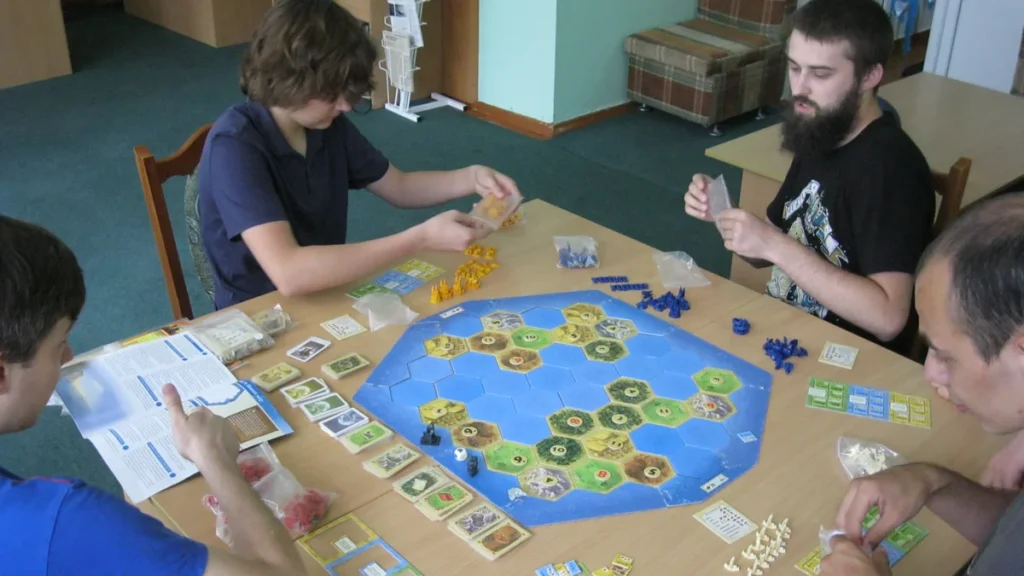
Four hundred and sixty-eight players, one hall, and a sea full of dice. That is the scale of this guide, and it works because dice games get better as the crowd grows. Nobody waits for a turn that never comes, and every roll gives the whole room something to cheer about.
The theme tonight is the ocean. Each of the nine games below turns a roll of the dice into a small seafaring mission: pirate crews set sail, divers sink to the reef, lighthouse keepers flash signals across the hall, and shark watchers try to spot the fin before the other tables do. The ocean theme is only the dressing. Underneath it, every game is a simple dice mechanic that runs cleanly with six players at a table, and the hall runs cleanly because all seventy-eight tables play the same game at the same time.
You do not need a boat, a big budget, or any experience running large events. You need dice, printed score sheets, a loudspeaker or a whistle, and one person at the front calling the rounds. If your crowd would rather eat than sail, the food-themed dice games for 467 players use the same hall layout with a kitchen theme, but if you want a night that feels like a voyage, read on.
Key takeaways
- Split 468 players into 78 tables of six, and run every table on the same game at the same time.
- Use one caller, one whistle, and a printed countdown so all tables start and stop together.
- Give every table the same kit: six dice, a score sheet, a pencil, and a mission card.
- Play short rounds of ten to fifteen minutes, then rotate the mission while the tables stay put.
- Score tables as crews, not individuals, so a quiet table still feels part of the mission.

How a 468-player dice night actually works
The maths is simple and worth doing before anyone arrives. Four hundred and sixty-eight divides neatly into seventy-eight tables of six, and six is the sweet spot. Six players can all see the dice, all hear each other, and nobody is stuck at the far end of a long table watching the game happen without them. If a few players drop out on the night, a table of five still plays perfectly well.
Every table plays the same game in the same round. The caller explains the mission once, on the microphone, while a helper holds up a big printed example. Then the whistle blows, every table rolls at once, and the hall fills with the sound of dice. Ten or fifteen minutes later the whistle blows again, scores are called in, and the next mission begins. Nobody waits, because every table finishes together.
The kit matters more than the decorations. Each table needs at least six dice, and nine is better, because a dropped die should never stop a game. Print the score sheets in advance, one per player per game, and clip a pencil to each sheet so pencils do not wander. A mission card on each table states the goal in two or three sentences. The same table system powers the 466-player food dice night, and it works just as well with waves as with recipes.
Appoint a floor captain for every six to eight tables. The captain is not a referee. They hand out fresh score sheets, collect finished ones, and tell the caller when their zone is ready. Give captains a coloured badge or a bright lanyard so players can spot them across a crowded hall.
The nine ocean dice games at a glance
All nine games use ordinary six-sided dice, and none needs special equipment beyond the table kit. The table below shows the shape of each mission so you can plan the running order before the night begins.
| Game | Players per table | Dice per table | Round length | Best for |
|---|---|---|---|---|
| Dice Pirate Ship | 6 | 6 | 15 minutes | Opening the night |
| Dice Deep Dive | 6 | 6 | 15 minutes | Careful, quiet play |
| Dice Coral Reef | 6 | 9 | 10 minutes | Fast pattern spotting |
| Dice Treasure Island | 6 | 6 | 15 minutes | Moving around the hall |
| Dice Wave Rider | 6 | 6 | 10 minutes | Quickfire challenges |
| Dice Lighthouse Keeper | 6 | 9 | 15 minutes | High-energy racing |
| Dice Shark Watch | 6 | 6 | 15 minutes | Bluffing and guessing |
| Dice Sailor’s Knot | 6 | 9 | 15 minutes | Team building |
| Dice Ocean Race | 6 | 6 | 10 minutes | A big noisy finale |
The nine games
Play them in order for a night that starts loud, settles into clever play, and ends with the whole hall shouting.
1. Dice Pirate Ship
Every table is a pirate crew, and every player holds one job on the ship. On each turn a player rolls one die: a one or a two signs on the captain, a three or a four signs on the navigator, a five signs on the cook, and a six raises the flag. The crew must fill all four jobs in any order, and the first table to shout that their ship is crewed wins the round. Roll a job the crew already has and it goes to the spare-hands pile. Setup is a printed ship diagram with four empty boxes, six dice, and a pencil per player, and the caller counts down from ten to set sail.
It scales because the game is a race, not a conversation. Every table plays at its own speed, the rules fit in one sentence, and the whole hall understands the winner instantly when a flag goes up. Seventy-eight tables can finish inside fifteen minutes without a single dispute.
2. Dice Deep Dive
This is the quiet game, and it works best straight after the noise of the pirate ship. Each table is a dive crew sinking toward the reef. Players take turns rolling two dice and adding the total to their depth chart. The crew must reach exactly one hundred metres, no more and no less. Dive past one hundred and the crew floats back up, so they subtract ten and keep going. The first table to reach exactly one hundred wins. Setup is a depth chart numbered zero to one hundred in steps of ten, printed on the score sheet, plus six dice and a pencil.
It scales because the target is exact, so tables finish at different moments and the hall gets a steady stream of small celebrations instead of one big rush. The maths is simple addition, and a table that falls behind can still win with two lucky rolls near the end.
3. Dice Coral Reef
Each table has a printed reef map, a grid of thirty-six squares, and the players are charting coral. A player rolls two dice, and the total tells the crew which square to mark: a two marks the top left, a twelve marks the bottom right, and everything else falls in between. Mark a square block of four, two by two, and the table has charted a coral bed. The first table to chart two coral beds wins the round. Setup is a reef grid on every score sheet, nine dice per table so two players can roll at once, and a pencil for marking squares with a cross.
It scales because the map is the same on every table, so the caller can follow along on a big screen or a wall chart while the hall plays. Nine dice per table keeps the game moving fast, and the short ten-minute round means a table that loses quickly gets a fresh start instead of sitting out.
4. Dice Treasure Island
This is the game that gets people out of their seats. Each table is an island, and the islands are arranged around the hall in a ring, with names like Skull Rock, Palm Bay, and Turtle Cove. A player rolls one die and hops that many islands along the route, following the arrows on the floor. At each island they roll again and collect a map piece if the number matches the island’s secret number, written on the table card. The first player to collect five map pieces wins. Setup needs floor arrows marking the route, a stamp or sticker at each table, and a small card per player to record pieces.
It scales because the hall itself becomes the board, so four hundred and sixty-eight players are spread out instead of crowded together. The movement breaks up an evening of sitting down, and the game still works if a few tables are missing players, because travellers simply pass an empty island by.
5. Dice Wave Rider
Riding the waves is a set of five quick drills, and every drill is decided by a single roll. Drill one is the balance test: roll an even number or the rider wobbles. Drill two is the board check: roll a four or higher to wax the board. Drill three is the signal test: roll the exact number the caller shouts out. Drill four is the swell check: roll two dice and beat a total of seven. Drill five is the big wave: roll a six to ride it in. Each player runs all five drills, and the table with the most passes wins.
It scales because the caller controls the pace, so all seventy-eight tables move through the five drills together in ten minutes. Nobody waits for a slow table, nobody finishes early and gets bored, and a brand-new player can join in halfway through without a catch-up explanation. Setup is a drill card listing the five tests, six dice per table, and a pencil for ticking passes.
6. Dice Lighthouse Keeper
A storm is rolling in, and every table is a lighthouse trying to guide the ships home. The caller flashes a large die at the front, and the number it shows is the signal. Each table then rolls its own dice, and any table that matches the signal exactly lights one lamp. A table needs five lit lamps to guide its ship safely in, and the first table to light all five wins. Every three minutes the caller flashes again and the signal changes. Setup is nine dice per table, a score sheet with five empty lamp boxes, and a large die for the caller that the whole hall can see.
It scales because the caller drives the whole game, so seventy-eight tables stay in step without needing to talk to each other. The signal format creates a shared moment every time the big die lands, and a table with no lamps lit yet can still win the next signal outright.
7. Dice Shark Watch
Each table has spotted a shark, and the shark only answers questions in numbers. One player is the shark and secretly writes down a number between two and twelve. The other five players take turns rolling two dice and guessing whether the shark’s number is higher or lower than their total. The shark answers with a nod or a shake, nothing more. The first player to name the exact number wins the round and becomes the next shark. Setup is a small slip of paper and a pencil for the shark, six dice per table, and a low-voices rule so the shark’s nods can be seen, not heard.
It scales because the game needs no equipment beyond dice and paper, and it works just as well with a shy group as with a loud one. The guessing game gives every player a turn in the spotlight, the shark role rotates so nobody is stuck watching, and the whole table stays involved because every guess narrows the number down for the next player.
8. Dice Sailor’s Knot
The crew must tie six knots before the ship can leave harbour, and each knot needs a sailor who can roll its number. The bowline needs a one, the reef knot a two, the clove hitch a three, the sheet bend a four, the figure eight a five, and the anchor bend a six. Players roll one die at a time, and when a player rolls a number that is still free, they tie that knot and write their name on it. A table that ties all six knots can set sail, and the first table to tie them wins. Setup is a knot diagram with six labelled boxes, nine dice per table, and a pencil per player.
It scales because the knots are a team puzzle, not a solo race, so tables talk to each other and plan who rolls next. Nine dice keep the tying fast, and the shared goal gives quieter players a real job to do inside the game. A table may swap one tied knot per round, so one unlucky roll never ruins a table’s night.
9. Dice Ocean Race
The finale is pure noise, and it is the simplest game of the night. Every player has one die, and on the caller’s whistle the whole hall rolls at once. Any player who rolls a six has been swept overboard and sits out, cheering, while the rest roll again. The last player still rolling at each table is the table champion, and the seventy-eight champions come to the front for one final roll-off under the lights. The last player standing in the roll-off is the ocean champion of the night. Setup is six dice per table, a whistle for the caller, and a clear space at the front of the hall for the champions.
It scales because the elimination format handles any number of players without changing the rules, and the champion roll-off gives the night a proper ending. Four hundred and sixty-eight players become seventy-eight champions, then one, in about ten minutes, while every knocked-out player shouts for their table’s champion.
Your 468-player checklist
Run through this list the day before the night, and again an hour before the doors open. Everything on it is cheap, and each item has ruined a large game night when forgotten.
- Count the dice twice: at least six per table, nine for the fast games, plus a spare box at the front.
- Print score sheets for all nine games, one per player per game, and clip a pencil to each sheet.
- Test the microphone and the whistle from the back of the hall, not just from the front.
- Brief the floor captains together, give them coloured badges, and hand each one a printed running order.
- Mark the Treasure Island route on the floor before the first player arrives, and keep the walkways clear.
- Leave fifteen minutes at the end for the champion roll-off, the photos, and the thank-yous.
Frequently asked questions
Can 468 players really play dice games at the same time?
Yes, and the trick is that they do not play one game of 468. They play seventy-eight games of six, all on the same mission, all starting and stopping on the same whistle. The caller runs the hall, the floor captains run their zones, and each table runs itself. If the ocean is not your crowd’s thing, the music dice games for 462 players use the same hall layout with songs instead of waves.
How many dice do we need for 468 players?
Plan for about five hundred dice. Six per table covers seventy-eight tables, and the fast games need nine per table, so buy a bulk box of six hundred and keep the spares at the front desk. Dice get dropped under tables, so spares matter.
What if a table has only three or four players?
Every game in this guide works with three or four players, because each game is built around individual rolls rather than a fixed number of seats. A table of four simply finishes its rounds a little faster.
How long does the whole night take?
About two and a half hours, including the welcome, the nine games, and the finale. The games themselves take around two hours: six games at fifteen minutes and three at ten, plus a few minutes between rounds for score sheets. Add thirty minutes at the start for seating and the welcome, and fifteen minutes at the end for the champion roll-off.
Do players need to know about the ocean already?
No, and that is the point of the theme. The ocean words are decoration on top of ordinary dice mechanics: matching numbers, adding totals, and collecting sets. A player who has never sailed a boat will still understand that a six raises the flag.
Are the ocean dice games played for money?
No. These are party games, and the prizes should be small and silly: a paper sailor badge, a foil starfish, or the honour of being named ocean champion for the night. Keep the stakes friendly and the scoring about tables, not individuals, so the night stays a party rather than a competition.
The bottom line
A 468-player dice night works when the hall plays as one crew and the tables play as small teams. Pick the ocean theme, print the sheets, count the dice twice, and let the whistle do the organising. The pirate ship will sail, the lighthouse will flash, and the ocean champion will have a story for weeks. Set the tables, hand out the dice, and start the countdown.