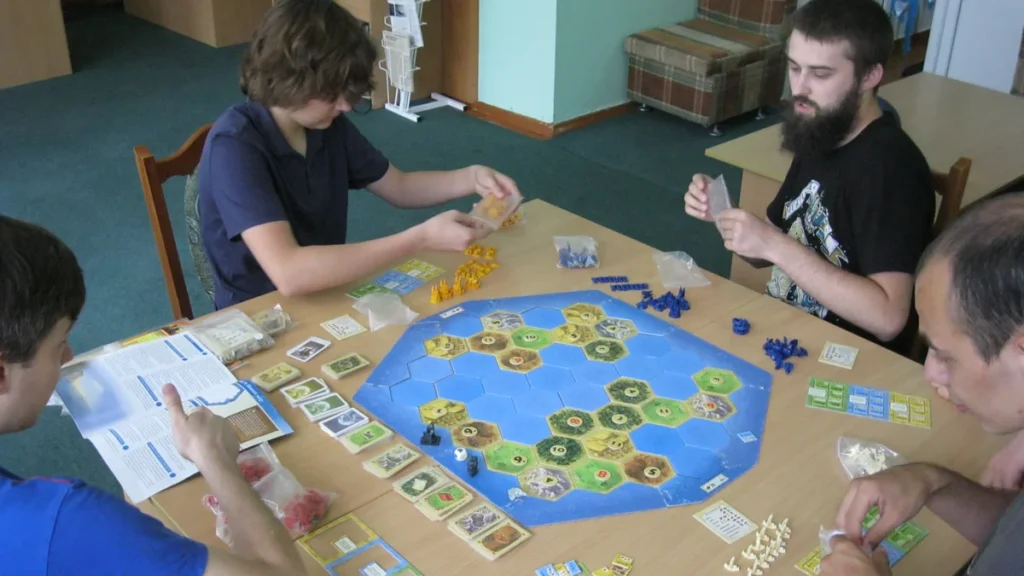
Four hundred and seventy players in one room sounds like a concert crowd, not a game night, yet dice make it work. A single roll can be seen, heard, and copied by every table at once, so nobody waits for a turn that never comes. When the whole hall rolls together, the room fills with the same small sound at the same moment, and that shared beat is what turns a very large gathering into one game.
This guide is built around music. Every game below uses a roll to choose a sound, a rhythm, or a move, so players do not need to read music or play an instrument to join in. A table of six friends can drum on a tabletop, hum a tune, or clap a pattern, and the table next to them can do the same thing with a different roll. The result is loud, friendly, and easy to follow from any seat in the hall.
You do not need a stage, a band, or expensive equipment to run the night. You need enough dice for every table, a clear voice at the front, and a simple plan for keeping the rounds short. The nine games in this guide were designed for a crowd of exactly 470 players, with tables of five or six, short rounds, and scoring that a floor captain can add up without a spreadsheet.
Key takeaways
- One roll per table keeps 470 players moving together, with no waiting for individual turns.
- Music gives every game a sound, so the whole hall can hear when a round starts and ends.
- Tables of five or six players work best, with one dice set and one score sheet per table.
- Short rounds of five to eight minutes keep energy high and stop the night from dragging.
- Simple scoring, with one point per completed pattern, is easy to count and hard to argue about.

The 9 Music Dice Games at a Glance
The table below gives a quick view of all nine games, including the dice each table needs and the length of a round. Every game uses ordinary six-sided dice, and every game works with the same table layout, so you can move from one game to the next without rearranging the room.
| Game | Dice per table | Round length | What players do |
|---|---|---|---|
| Dice Drum Beat | 1 | 6 minutes | Roll a drum pattern and play it together |
| Dice Guitar Jam | 2 | 8 minutes | Roll a chord and strum pattern, then jam along |
| Dice Piano Keys | 1 | 6 minutes | Roll a note group and hum or play it |
| Dice Sing Along | 1 | 8 minutes | Roll a song style and sing the chorus |
| Dice Rhythm Clap | 2 | 5 minutes | Roll a clap pattern and copy it back |
| Dice Trumpet Call | 1 | 6 minutes | Roll a fanfare and sound it with kazoos |
| Dice Violin Bow | 1 | 6 minutes | Roll a bow stroke and tempo, then play air violin |
| Dice Dance Step | 2 | 8 minutes | Roll a dance move and perform it at the table |
| Dice Choir Harmony | 1 | 8 minutes | Roll a harmony part and sing it together |
The 9 Music Dice Games for 470 Players
Each game below is written for tables of five or six players, with one or two dice per table. Read the steps out loud before the first roll, run a short practice round, and then start scoring. If a table is unsure what a roll means, the floor captain can show the pattern once, and the table can copy it.
1. Dice Drum Beat
Dice Drum Beat is the simplest way to start the night, because everyone already knows how to tap a table. Each table rolls one die, and the number on top chooses a drum pattern from the chart at the front of the room. A one means a single slow tap, a two means two quick taps, a three means a tap, a pause, and a tap, and the higher numbers add more taps and a louder finish.
Once the pattern is called, every player at the table plays it together, three times through, while the floor captain counts the beat. The table earns one point for playing the pattern in time and a second point if every player finishes on the same final tap. The pattern changes with each new roll, so a table that struggled with a fast pattern may get a slow one next, and the game stays fair across the room.
2. Dice Guitar Jam
Dice Guitar Jam turns a roll into a short burst of music, even when nobody at the table owns a guitar. Each table rolls two dice. The first die chooses a chord shape, shown on a simple chart with pictures of hand positions, and the second die chooses a strum pattern, such as down, down, up, or a slow single strum. Players can mime the chord on an air guitar, tap the rhythm on the table, or strum a real guitar if the table has one.
The table plays its chord and strum together for four bars, and the floor captain walks the room listening for tables that stay in time. A table scores one point for finishing the four bars together and one more point if the strum pattern matches the chart exactly. The chart stays the same for every table, so a table that plays a gentle pattern and a table that plays a fast pattern are both judged on the same simple rules. The same roll-and-play style works with other themes too, such as the space-themed dice games for 469 players, where the charts use rockets and planets instead of chords.
3. Dice Piano Keys
Dice Piano Keys uses a roll to pick a small group of notes, and the table then hums or plays those notes together. Each table rolls one die. The number chooses a note group on a chart, with one meaning a low group, three meaning a middle group, and six meaning a high group. The chart shows the notes as coloured blocks rather than written music, so nobody needs to read a score to take part.
Players hum their notes in order, slowly at first, and then repeat the group twice at a steady pace. A table earns one point for humming the notes in the right order and a second point for keeping a steady pace from the first note to the last. If a table has a small keyboard, a phone with a piano app, or a toy xylophone, one player can play the notes while the rest of the table hums along.
4. Dice Sing Along
Dice Sing Along is the loudest and happiest game in the set, and it is the one most players remember at the end of the night. Each table rolls one die, and the number chooses a song style from a short list at the front, such as a gentle ballad, a marching song, a fast folk tune, a lullaby, a sea shanty, or a round. The front of the room then names a well-known chorus that fits the style, and every table sings it together.
Tables score one point for singing the whole chorus and a second point if they keep the words and the tune together from start to finish. The words are printed on the table sheets, so nobody has to remember them from memory, and the tune is played once through by the host before the singing starts. A table that sings quietly but in tune scores the same as a table that sings loudly, which keeps the game fair for shy singers.
5. Dice Rhythm Clap
Dice Rhythm Clap is a fast call-and-response game that tests how well a table can listen and copy. Each table rolls two dice. The first die chooses how many claps are in the pattern, and the second die chooses whether the pattern is slow, steady, or quick. The table leader claps the pattern once, and the rest of the table claps it back together, twice through.
A table earns one point for copying the pattern correctly and a second point for clapping it back in time with the leader. If the pattern is wrong, the table can roll again and try a fresh pattern, but the retry costs the second point for that round. This small rule keeps the game moving and stops one tricky pattern from holding up a whole table for too long.
6. Dice Trumpet Call
Dice Trumpet Call gives every table a chance to make a grand entrance with a fanfare. Each table rolls one die, and the number chooses a short fanfare pattern from a chart, with higher numbers meaning longer and louder calls. Players sound the fanfare with kazoos, party horns, or simply by humming a bright note together, and the table tries to start and finish as one group.
Tables score one point for playing the fanfare in the right order and a second point for starting and ending together. The host can call the tables in groups, so that one side of the room sounds its fanfare while the other side listens, and then the sides swap. This keeps the noise under control and lets everyone hear how different the fanfares sound from table to table. A similar group fanfare appears in the ocean-themed dice games for 468 players, where tables sound their calls for ships and waves instead of trumpets.
7. Dice Violin Bow
Dice Violin Bow is a gentle game that asks players to move slowly and carefully, which makes a nice change after the louder rounds. Each table rolls one die. The number chooses a bow stroke from a chart, such as a long smooth stroke, a short bouncy stroke, or a slow stroke with a pause at the end. Players mime the stroke with an air violin, moving their arms together in time.
The table earns one point for matching the stroke on the chart and a second point for keeping the same tempo from the first movement to the last. A floor captain can show each stroke once before the game begins, so every table starts with the same picture in mind. The game is scored on movement and timing, not on musical skill, so everyone can take part on equal terms.
8. Dice Dance Step
Dice Dance Step gets players on their feet, but it keeps the movement small enough for a crowded room. Each table rolls two dice. The first die chooses a dance move, such as a side step, a turn, a dip, a hop, a sway, or a clap and step, and the second die chooses how many times the move is repeated. The table stands together, clears a small space beside the chairs, and performs the move in time with a steady count.
Tables score one point for performing the move in the right order and a second point for finishing together on the final count. The host should keep the music slow and steady, and the floor captains should watch for tables that need a little more room. Nobody is judged on style or grace, only on following the move and finishing together, which keeps the game friendly for every age and ability.
9. Dice Choir Harmony
Dice Choir Harmony is the closing game, and it brings the whole hall together into one sound. Each table rolls one die, and the number assigns the table a harmony part, such as a low part, a middle part, or a high part. The host teaches a simple three-note tune, and each table sings its own part while the other tables sing theirs, so the room fills with a gentle harmony.
Tables score one point for holding their part through the whole tune and a second point for starting and ending together with the rest of the hall. The tune is short and easy, with words printed on the table sheets, and the host sings each part once before the full hall tries it together. A table that sings softly but stays on its part scores just as well as a louder table, which matters when hundreds of voices are singing at once.

Setting Up the Room and the Sound
A hall for 470 players needs clear sight lines and a sound plan before the first roll. Place the host at the front where every table can see the charts, and put a floor captain in each section of the room so questions can be answered without shouting across the hall. Tables of five or six work best, which means about eighty tables, each with its own dice set, score sheet, and printed charts for the nine games.
Sound matters more than decoration. A simple speaker and microphone help the host call the rounds, and a raised hand signal helps when the room is too loud for a voice to carry. Keep the music low enough for tables to hear each other, and turn it down during the quiet games.
Plan for about an hour and a half for the nine games, plus a short break. Start with the loud drumming game, move through the guitar, piano, and singing games, and finish with the dance and choir games, so the energy rises and falls naturally. The food-themed dice games for 466 players follow the same room plan, which shows that the layout works for any theme once the tables and the sound are in place.
Your 470-Player Checklist
Use this short checklist on the day of the event, and tick each item off as it is done. It covers the equipment, the room, and the people you need, so nothing important is left to the last minute.
- Count out one dice set per table, with a spare set for every ten tables in case dice roll away.
- Print the game charts, song words, and score sheets, with one pack per table.
- Place a floor captain in each section of the room and give each captain a whistle or a raised card for signals.
- Test the microphone, the speaker, and the music player before the first players arrive.
- Set the tables in clear rows with space to stand for the dance game and room to move between tables.
- Keep a clock visible at the front and call each round on time so the night finishes as planned.
Frequently Asked Questions
Can 470 players really play dice games at the same time?
Yes, because every table plays its own game at the same time, and the host only calls the rounds. With about eighty tables of five or six players, each table rolls its own dice and scores its own points, so nobody waits for a turn.
How many dice do we need for 470 players?
You need about eighty dice sets, with one set per table, plus spares. Most games use one die per table, and two games use two dice, so two dice per table covers every game in this guide.
What if a table has only three or four players?
A table of three or four players can play every game in this guide without any changes. The patterns, the scoring, and the round lengths stay the same, because each game is scored on the table working together, not on the number of players.
How long does the whole night take?
The nine games take about an hour and a half, with a short break in the middle. Each round runs for five to eight minutes, with a minute between rounds to hand out the next chart and call the next roll.
Do players need to know about music already?
No, and that is the point of the music theme. Every pattern is shown on a chart with pictures and colours, every song has its words printed on the table sheet, and every tune is played once before the tables try it.
Are the music dice games played for money?
No, these games are played for fun and for friendly competition between tables. Points are the only prize, and the final chorus is shared by the whole hall.
The Bottom Line
Nine music dice games, eighty tables, and one shared beat are all it takes to give 470 players a night they will remember. Roll together, listen to each other, and let the room find its own rhythm, one game at a time.