Card games for 560 players sound impossible until the hall is full and the first deal lands on the first table. Five hundred and sixty people need far more than a single deck and a hopeful host. They need a plan that splits a crowd into small tables, keeps every table busy at the same time, and lets a host move the whole evening forward without shouting across a hall.
The answer is not a bigger deck. It is a bigger system. Each table runs one title with four to eight people, each table keeps its own score, and a simple rotation moves people between tables after every stage. Nobody waits long, and the evening feels like one shared event.
This guide gives nine titles that suit that system. Each one uses ordinary decks, explains in minutes, and runs on points only, with no money changing hands. The card games for 558 players on this site lean on Black Hole, Auld Lang Syne and Scotch Patience, three titles that show how a big hall can run several tables at once, and the nine titles below follow the same idea for 560 people.
Key takeaways
- Split 560 people into tables of four to eight, with one title per table and one host per eight tables.
- Use ordinary decks only, and keep every title points only, with no money changing hands.
- Run short stages of about twenty minutes, then rotate people to a fresh table and a fresh title.
- Keep one score sheet per table, and add the scores together at the end of the evening.
- Teach each title in under five minutes, with a short demo hand before the real stages begin.
How 560 Players Fit Into One Day
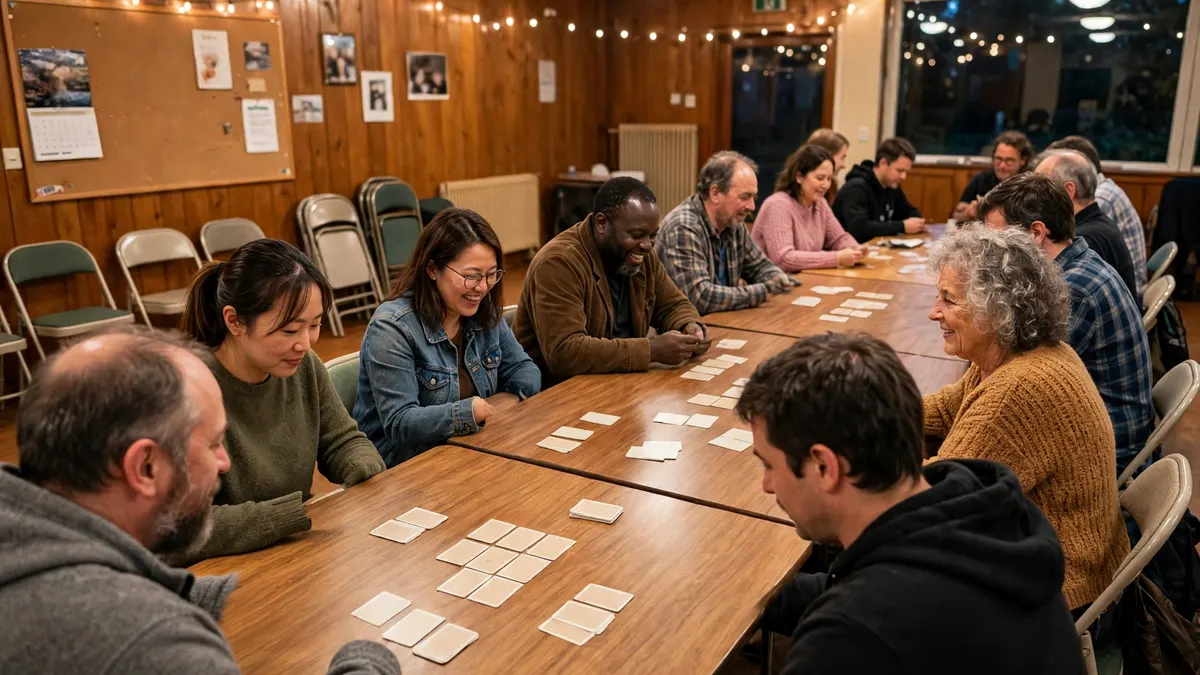
Five hundred and sixty people divide neatly into seventy tables of eight, or eighty tables of seven, or 112 tables of five. A host can choose the table size that suits the room. Eight per table keeps the number of tables low, and five per table gives each person more hands.
Each table needs one deck for most titles, and two decks for the patience layouts later in this guide. A host who packs ninety decks has enough for the whole evening, with spares for decks that wear out. Score sheets, pencils, and a clock that everyone can see matter just as much as the decks.
Rotation is the part that makes a huge crowd feel like one event. After each stage, every person moves one table along, so new faces sit together and no table stays fixed for the whole evening. A host who announces the move with a bell keeps the hall moving.
The Nine Titles at a Glance
| Title | People per table | What it asks for | Stage length |
|---|---|---|---|
| Seep | Four | Careful capture of cards from the centre | Twenty minutes |
| Mendikot | Four | Team capture of the tens | Twenty minutes |
| Dehla Pakad | Four | Team capture of every hand | Twenty minutes |
| Kachuful | Four to six | Bidding and capture in teams | Twenty-five minutes |
| Agnes | One per layout | Patient building of ascending groups | Twenty minutes |
| Easthaven | One per layout | Patient building with fewer choices | Twenty minutes |
| Gargantua | One per layout | Patient building with two decks | Twenty-five minutes |
| Capricieuse | One per layout | Patient building in four piles | Twenty minutes |
| Narcissus | One per layout | Patient building with open rows | Twenty minutes |
The Nine Card Games for 560 Players
1. Seep
Seep is a capture title from South Asia, and it suits a table of four in two teams of two. The dealer gives each person four cards, and four cards lie face up in the centre. On a turn, a person either adds a card to the centre or captures cards from the centre with a card of the same value, or with a card that adds up to the value of cards in the centre. Captured cards sit in a pile beside the team, and the team with the most captured value earns the points for the stage.
Seep works for a huge crowd because the centre stays visible and the choices stay simple. A newcomer can watch one stage and understand the idea: take cards that add up, leave cards that do not, and keep the centre tidy for a teammate. Before the deal, each team can name a target score for the stage, and a team that reaches its target earns a bonus.
For 560 people, Seep needs fourteen tables per hundred people, which is easy to staff. A table host can teach it in four minutes with a demo hand, talking through two captures before the table runs on its own.
2. Mendikot
Mendikot is another team capture title, and it earns its place here because the tens matter so much. Four people sit in two teams of two, partners facing each other, and the dealer gives each person thirteen cards. The aim is to capture the tens, because each ten captured earns points for the team that takes it. All four tens in one hand earn a bonus that can change the score for the whole stage.
The capture rule is simple to teach. A person leads a card, the next people follow with a card of the same suit where they can, and the highest card of the led suit takes the hand. The team that takes the hand keeps the cards in a pile, and the tens in that pile count at the end of the stage.
Mendikot suits a big hall because partners can talk quietly between hands and plan which tens to chase. A table of four finishes a full deal in about fifteen minutes. The card games for 556 players here include Vint, Reversis and Eight Off, and they prove that older patience layouts can hold a crowd, while Mendikot proves the same for team capture titles.
3. Dehla Pakad
Dehla Pakad is a team capture title in which every hand matters, not only the tens. Four people sit in two teams of two, and the dealer gives each person thirteen cards. The team that takes the most hands in a deal earns the points for that deal, and the team that takes all thirteen hands earns a bonus. The name means capture of ten hands, and that target gives every deal a clear aim.
The mechanics are familiar to anyone who has sat at a capture table before. A person leads a card, the others follow suit where they can, and the highest card of the led suit takes the hand. The counting is simple: count the hands each team has taken, compare the totals, and write the result on the score sheet.
Dehla Pakad fits a 560-person evening because a deal ends quickly and the result is easy to record. A table can finish two deals in a twenty-minute stage, and the host can announce the leading teams after each stage without stopping the hall.
4. Kachuful
Kachuful is a bidding and capture title that suits four to six people at a table. The dealer gives each person a hand, and each person bids on how many hands they expect to take. The highest bidder names the trump suit, and then the table runs through the hands one by one. A person who takes at least as many hands as they bid earns points, and a person who falls short earns a penalty on the score sheet.
The bid is the part that makes Kachuful lively. A person with a strong hand can bid high and name a trump suit that suits their cards. A person with a weak hand can bid low and aim to take only a few hands, which is a safer aim and still earns points.
Kachuful works for a huge crowd because the bid gives each person a personal target inside a shared table. A host can run a table of six with the same ease as a table of four, which helps when the hall has uneven numbers.
5. Agnes
Agnes is a one-person patience layout, and it earns its place here because a hall of 560 people needs quiet tables as well as noisy ones. Each person gets a layout of their own, with seven piles in a row and a stock of cards to draw from. The aim is to build ascending groups in the same suit, from the lowest card up to the highest, and to move cards between piles to free the cards underneath.
The layout starts with one card in the first pile, two in the next, and so on up to seven in the final pile, with only the top card of each pile face up. A person can move a face-up card onto a card of the next value in the same suit, and can move a whole ascending group together when the group is in order.
Agnes suits a big event because it needs no partner and no waiting. A person can start at once, work at their own pace, and record a score based on how many cards reached the top piles. A table host can arrange eight layouts on one table, which gives a noisy hall a calm corner.

6. Easthaven
Easthaven is a one-person patience layout with fewer choices than Agnes, and that narrow focus is exactly why it suits a huge crowd. Each person gets a layout with seven piles and a stock to draw from, and the aim is to build ascending groups in the same suit from the lowest card upward. The difference is that a person can only move single cards, not whole groups, so each move needs more thought and the layout changes more slowly.
The slow pace is a strength in a hall of 560 people. A person who has never tried a patience layout before can follow Easthaven without feeling rushed, because the rules leave little room for a wrong move that ruins the whole layout. A person draws from the stock one card at a time, places it where it fits, and moves cards between piles only when the move is clear.
Easthaven also suits a hall because the score is easy to record. At the end of the stage, each person counts the cards that reached the top piles and writes the total on the score sheet.
7. Gargantua
Gargantua is a one-person patience layout that uses two decks, and it suits the people in a huge crowd who want a longer challenge. Each person gets a layout with nine piles and two stocks to draw from, and the aim is to build eight ascending groups, one for each suit in the two decks, from the lowest card up to the highest. The layout is wide, the choices are many, and a single stage can absorb a full twenty-five minutes without feeling long.
The two decks change the feel of the layout. A person can find the card they need more often, because each value appears twice. The cost is space: a Gargantua layout needs a full table to itself, or a wide end of a long table, and a host should plan the room with that in mind.
Gargantua earns its place because it gives experienced people a title that matches their skill. A hall of 560 people holds many people who have tried patience layouts for years, and they deserve a stage that tests them. The card games for 554 players on this site feature GOPS, Trefoil and Sir Tommy, a reminder that short, sharp titles suit a packed evening, and Gargantua is the long, deep title that balances them.
8. Capricieuse
Capricieuse is a one-person patience layout built around four piles, and it suits a huge crowd because the layout is small and the rules are clear. Each person gets four piles in a row, with cards dealt face up, and a stock to draw from. The aim is to build ascending groups in the same suit from the lowest card upward, moving cards between the four piles to free the cards underneath.
The four piles make Capricieuse easy to teach. A host can show the layout on one table, point to each pile, and talk through three moves. After that, each person can run their own layout without help. The small layout also means a host can fit many layouts on one long table, which helps when the hall has more people than tables. Twelve layouts can sit along a single long table with room left over.
Capricieuse also suits a big event because the stage ends cleanly. When the stock runs out, the person counts the cards that reached the top piles and writes the total down. A person who finishes early can start a fresh layout and add the two totals together.
9. Narcissus
Narcissus is a one-person patience layout with open rows, and it closes this guide because it is the most visual of the nine titles. Each person gets rows of face-up cards laid out in the open, with a stock to draw from, and the aim is to build ascending groups in the same suit from the lowest card upward. Every card is visible from the start, so a person can plan several moves ahead instead of guessing what lies underneath.
The open rows change how people talk about the layout. A person can point to a row and show a nearby person the move they plan to make, and a table host can walk along a row of layouts and notice a good move without touching a card.
Narcissus fits a 560-person evening because it needs only one deck per person and a small space per layout. A host can arrange a row of Narcissus layouts along the edge of a hall, and people can drift to them between the louder team tables. The score is the number of cards that reached the top piles, and the top scorers can be announced with the team results at the end of the evening.
How to Run the Evening
Start with a short welcome that explains the rotation, the clock, and the score sheet. Keep the welcome under five minutes, because a crowd of 560 people loses focus quickly. Show one demo hand of Seep on a raised table, so people at the back can see the cards, then send people to their tables and start the clock.
Keep each stage to twenty minutes, with a five-minute move between stages. A host who walks the hall during the move can answer questions and fix seating problems before they grow.
Checklist for the Host
- Count the decks before the doors open, and pack ten spares for every fifty tables.
- Print one score sheet per table per stage, with space for eight names and a total column.
- Place a clock where every table can see it, and announce each stage change with a bell.
- Teach each title with a demo hand, and keep the teaching under five minutes per title.
- Assign one host per eight tables, and give each host a list of the tables they look after.
- Add the scores together at the end of the evening, and announce the top teams and the top patience scorers together.
Frequently Asked Questions
Can 560 people really sit at card tables at the same time?
Yes, when the crowd splits into tables of four to eight. Seventy tables of eight hold 560 people, and each table runs its own title with its own score sheet.
Do we need special decks for these nine titles?
No. Ordinary decks are enough for every title in this guide. The team titles use one deck per table, and the patience layouts use one deck per person, except Gargantua, which uses two decks per person. A host who packs ninety decks has enough for the whole evening.
How long does each stage take?
Most stages take twenty minutes, with five minutes to move between tables. Kachuful and Gargantua take twenty-five minutes, because the bid and the two decks need a little more time.
What happens when a table has uneven numbers?
Kachuful suits four to six people, so it can absorb uneven numbers. The patience layouts suit one person per layout, so they can absorb any number at all. A host can move people from a full team table to a patience table, and the scores still count.
Can newcomers join a table halfway through the evening?
Yes. A newcomer can join at the start of any stage, because each stage starts fresh. The table host can teach the title in under five minutes with a demo hand.
How are the top scorers decided at the end?
Each table adds its scores together at the end of every stage, and the host adds the stage totals together at the end of the evening. The team with the highest total earns the top team honour, and the person with the highest total across the patience layouts earns the top patience honour.
The Bottom Line
Card games for 560 players work when the system is simple, the titles are clear, and the rotation keeps people moving. Nine titles are enough for a full evening: four team capture titles, one bidding title, and four patience layouts that give the hall its quiet corners. Pack the decks, print the score sheets, show the clock, and let the tables do the rest.