Are word games good for couples? In my experience, yes — with a condition that has nothing to do with how many words either of you knows. Word games are good for a couple when both people enjoy the language itself, rather than treating every round as a test of who is cleverer. When that condition holds, a word game does something no other kind of game quite manages: it turns the way two people already talk to each other into the game itself. When the condition fails, the same game turns an ordinary evening into a spelling exam neither of you signed up for, and the board gets put away for months.
What word games ask of a couple
Most games give a couple something to do side by side. A word game gives them something to do inside each other’s heads. When you play a crossword together, one of you reads a clue and the other supplies the missing word, and the answer usually arrives because of something the two of you share: a holiday you took, a film you watched together, a phrase one of you uses all the time. The game keeps reaching into your shared life and pulling out evidence of it. That is a different pleasure from moving a token around a board, and it is the reason couples often describe word games as feeling personal in a way other games do not.
There is a third thing word games ask, and it is the one that decides whether they work for you: they ask both players to be comfortable being wrong in words. A word game is a long series of small public guesses, and half of them will be wrong. A wrong guess in a word game is not a bad move or a lost piece. It is a funny misfire, a word that almost fits, a clue read the wrong way. Couples who enjoy that — who can laugh at a terrible guess instead of wincing at it — tend to love word games. Couples who find wrong answers embarrassing, even slightly, tend to find word games quietly stressful, and that stress rarely announces itself. It just shows up as one person gradually declining to play.
The shared language effect
The strongest reason to play word games as a couple is not mental exercise, though that is a pleasant side effect. It is that word games grow the private language every long relationship builds anyway. Every couple has words and phrases that mean something to nobody else: a mispronounced place name from a holiday, a nickname for a neighbour, a line from a film you quote at each other. A word game gives that private language somewhere to go. A clue game rewards you for knowing how your partner thinks, not for knowing the dictionary. Give the clue “beach” and your partner might reach for “sand” or “towel” or “that terrible hotel”, and whichever one they pick tells you something about the two of you that a quiz question never could.
This is also why word games suit couples better than they suit strangers. Two people who have lived together for years carry a huge stock of shared references, and a good word game spends that stock freely. A categories game with prompts like “dishes we have ruined together” or “towns we still want to see” is not really a vocabulary test at all. It is a conversation with a timer and a score, and the score is the least interesting part. The game becomes an excuse to remember things together, which is a genuinely nice way to spend an evening, and it is hard to reproduce with any other kind of game.
Against each other, or on the same side?
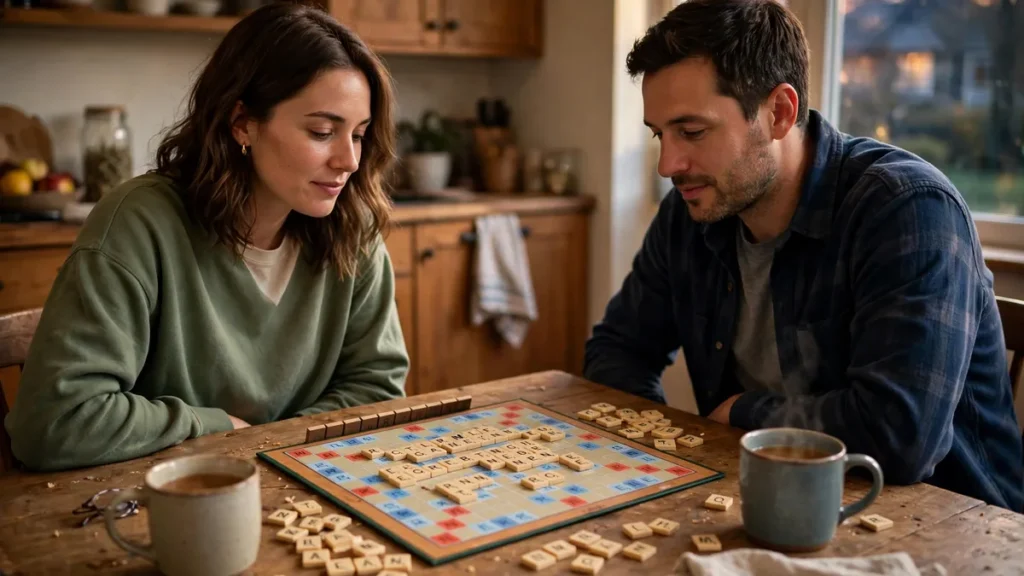
The single biggest choice in a couples word game is whether you play against each other or together, and most couples get this wrong the first time because they buy the most famous game instead of the one that fits their evening. A head-to-head game like Scrabble or Boggle is a proper contest: two players, one winner, and a score that says exactly who played better. That suits a bright evening when both of you have energy to spare and genuinely enjoy a contest. The teasing is part of the affection, a good word earns real admiration, and a narrow loss stings just enough to make the rematch matter.
It suits far less well on a tired weeknight, or in a couple where one partner is much stronger than the other. A word contest with a wide skill gap is not a contest at all. It is a demonstration, repeated weekly, and the weaker player knows it. The stronger player often makes it worse without meaning to, by explaining the clever word they just played, or by suggesting the move the other person should have made. None of that is unkind. It is still unbearable after the third week.
Cooperative word games solve this by removing the scoreboard between you. In a game where the two of you work together against the puzzle — giving each other one-word clues, unravelling a shared mystery, building a word neither of you can see — there is no winner to gloat and no loser to soothe. You share the blame when a clue misfires and you share the delight when a strange guess turns out to be exactly right. For couples who bicker easily, or for evenings when both people arrive at the table already worn out, the team version is usually the wiser pick. Keep one of each kind within reach and let the mood of the evening choose, rather than deciding in advance that your household is a competitive one or a cooperative one. Most couples are both, on different nights.
When word games go wrong for a couple
Word games have their own particular ways of spoiling an evening, and they are worth naming plainly, because they are easy to mistake for a problem with the relationship when they are really a problem with the game. The first is the dictionary argument. Every couple that plays word games seriously has had one: is that a real word, does the dictionary allow it, did you just invent it to win. The argument is never really about the word. It is about fairness, and it flares up because a word game lets one player win with knowledge the other person cannot check in the moment. The fix is dull and it works: settle the dictionary before the first tile is drawn, decide whether proper nouns and abbreviations count, and name one source as the judge. Sort the rules out first and the row never gets going.
The second problem is a skill gap that stays wide. If one of you takes nine games in ten, the next one stops being a contest and starts feeling like a formality for the person who can already see how it ends. The usual advice is to handicap the stronger player, and it does help — a points head start, an extra tile, a mulligan each game. But the better fix is often to change the game rather than the score. Pick a game neither of you has played before, so you are both beginners at once. Choose a fast game where luck and speed matter as much as vocabulary. Or play cooperatively for a while, so the gap stops being something the evening measures. An even match matters more than a beloved old favourite.
The third problem is subtler and more common: the correction habit. When one partner knows a game well and the other is learning, it is easy to fall into fixing every move, pointing out the better word, suggesting the play the other person should have made. It feels helpful. It lands as a lesson, and nobody wants a lesson at nine o’clock on a Tuesday. Let the newer player learn by playing. Keep the tactics chat for the fourth or fifth game, or better still, wait until they ask. A word game is at its best when both people are guessing, not when one person is teaching.
The last problem is the one nobody warns you about: word games can make vocabulary feel like status. In a long relationship, both people know who is “the wordy one”, and a game that keeps score on vocabulary can quietly turn that label into a ranking. If one partner starts dreading the game because it reminds them, week after week, that their vocabulary is smaller, the game has stopped doing its job. The answer is not to stop playing. It is to pick games where vocabulary is not the whole contest — clue games, creative answer games, games where a funny answer beats a clever one — so that both people have a way to shine.
Choosing games that suit both of you
Start small and cheap. A pen-and-paper game costs nothing and tells you more about whether word games suit you as a couple than any boxed game will. Try a word ladder on a scrap of paper, or a categories game with prompts drawn from your own life. If that evening works, you have learned something valuable for free. If it does not, you have learned something equally valuable, and you have spent nothing finding it out. When you do buy a game, buy one for the evening you actually have, not the evening you imagine. One short game, one slow game, and one cooperative game will cover almost any night between you, and our roundup of the best word games for couples groups them by exactly that kind of evening.
It is also worth saying that word games are not the only kind of game that suits a pair, and comparing them honestly helps. A board game asks a couple to share a table and a plan, and our take on board games for couples reaches a similar answer by another road: the game matters less than the fit. Word games simply make the fit more personal, because the material is language, and language is the thing couples already share most intimately. If words are not your thing as a pair — if neither of you enjoys language play, or if one of you finds it stressful — a different kind of game may serve you better, and there is no shame in that. The right game is the one both of you reach for, not the one a list told you to buy.
Small rules that keep word night happy
Second, settle on a stopping time before you begin. Word games have a way of stretching: one more round, one more puzzle, one more rematch. An open-ended evening invites tiredness, and tired players take losses badly and remember the night as a slog. An hour and a half is plenty for a first night, and stopping while you are both still enjoying it is the single best way to make sure there is a second night. For the practical side of the evening itself, our game-night planning guide for couples covers timing, snacks, and winding down.
The honest limits
Fairness demands a word about what word games cannot do. They cannot patch up a relationship that is struggling, and they cannot stand in for a hard talk that keeps being put off. A game can give a good relationship a better evening. It cannot give a troubled one a shortcut around the talk it needs. If there is something the two of you need to discuss properly, a game will not settle it, and it may push the talk back by handing you both something easier to do.
My verdict
So, are word games good for couples? My answer is yes — provided the game suits the pair, both people enjoy language play rather than enduring it, and the evening itself matters more than the final score. Given that, a word game pulls off something few pastimes can: it takes the words two people already share, the jokes, the references, the private vocabulary of a life lived together, and turns them into an evening’s entertainment. It costs almost nothing, it needs no booking or babysitter, and it leaves you both with a small store of moments that belong only to the two of you.
Finding out takes a single evening. Choose a short word game neither of you feels strongly about, sit down together, and give it a proper go. If the time flies and a hopeless guess has you both laughing, that tells you everything. If it drags and you both feel quietly glad when it ends, that tells you everything too, and the lesson cost you nothing. Whichever way it goes, you will have spent the evening talking properly with the person opposite you, using words only the two of you would choose — and after years together, that is seldom an hour wasted.