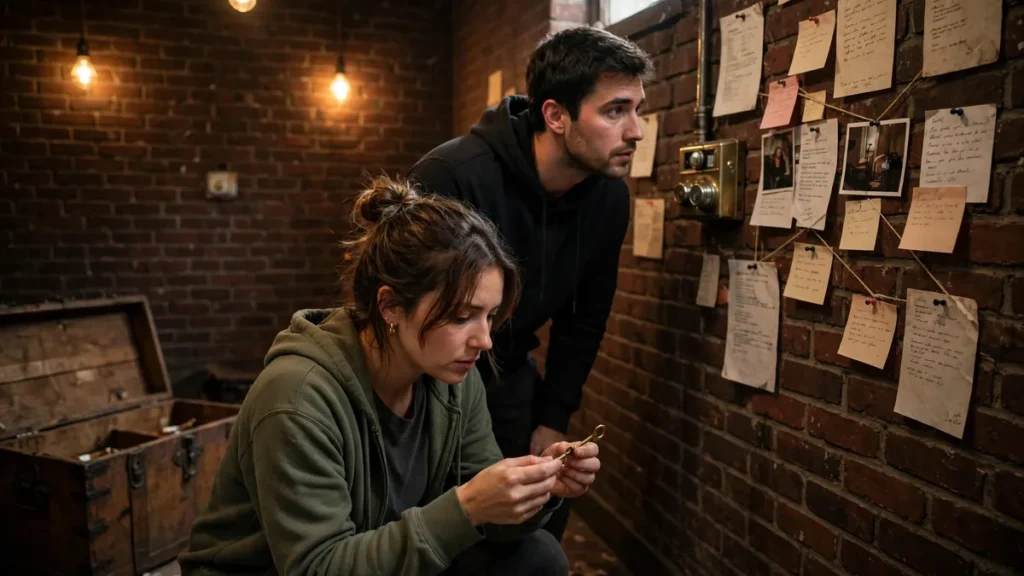
Lock two people who love each other in a room with a ticking clock and a chain of puzzles, and you find out something about them faster than a year of dinners will. That is the promise of the escape room as a date, and also the risk. My answer is yes, escape rooms suit couples, but only in a specific shape: a room booked for just the two of you, at a gentle difficulty, for a pair who already like solving things together and can laugh when a plan collapses. Arrange it that way and the hour hands you something most dates never manage, a problem you genuinely cracked side by side. Arrange it badly and you pay good money to discover, in a cramped room with no polite escape, that one of you did all the thinking while the other one watched.
Two players, no cover
A room designed for five forgives a great deal. Somebody misses a clue and somebody else spots it. Somebody goes quiet and the other four carry the hour. A pair has no such safety net. Every clue runs through one of two minds, every silence is noticeable, and every disagreement happens face to face with nobody else around to break the tension. That exposure is what makes the format interesting for a couple, and what makes it unforgiving.
Then there is the plain arithmetic. Most commercial rooms assume four to six pairs of hands: drawers to open in three corners at once, a code that wants one person reading numbers from a wall while another turns a dial. Two people cannot sweep a whole room in the opening minutes the way a group can, so the first stretch feels slow and the countdown feels short. Good venues will tell you straight which of their rooms work for a pair and which ones leave two people permanently a step behind. Ask before you book, and trust the answer, even when it points you at a different room from the one with the poster you liked.
What the hour gives a pair
Start with the most obvious gain, because it is the one couples mention first when you ask them afterwards. An escape room hands two people sixty minutes of undivided attention to the same thing. No phones, no television murmuring in the background, no half-listening while one of you scrolls. For an hour you are looking at the same wall, the same lock, the same riddle, talking about nothing else. Plenty of couples spend whole evenings in one room while paying attention to entirely different things. A locked door simply removes the alternative, and for a pair whose evenings have drifted into parallel scrolling, that enforced shared focus can feel like a small holiday.
The second gain is the story you leave with. Dinner gives you a meal you forget by Thursday. A film gives you somebody else’s plot. An escape room gives you your own: the drawer that finally opened, the code you worked out from a painting you had passed three times, the last lock clicking with seconds left. Couples retell those moments for weeks, and the retelling counts for more than the hour itself, because each retelling reminds you that the two of you achieved something together that neither of you could have managed alone. A small claim, but a truthful one. A room will not deepen a relationship by itself. It hands a good one something fresh to talk about.
The one-person show
Now the flaw that spoils more couples escapes than any other, and the one booking pages never mention. In most pairs, one person is faster at this kind of puzzle: quicker at patterns, quicker at codes, quicker at seeing the link between a clue and a lock. Left alone, that gap turns the hour into a performance. The quicker partner races from clue to clue while the other trails behind, holding the torch, opening the drawers they are pointed at, and slowly realising they have become scenery in somebody else’s game.
Nobody plans this. The faster partner is usually trying to help, and beating the room feels like a gift to the pair. But being carried through an hour is not the same as playing it, and the partner who spent sixty minutes watching will remember the watching, not the win. I have heard the same account from enough couples to treat it as the central risk of the format. The sidelined person does not want to return, and no explanation about difficult puzzles changes that feeling, because the feeling was never about the puzzles.
The remedy has to be settled before the door closes, and it takes about a minute. Divide the room in half at the start, one side each, so both of you are hunting rather than one hunting and one waiting. Agree that every discovery gets spoken aloud the moment it happens, so nothing is solved silently inside one person’s head. Agree that whoever cracks a puzzle sits out the next one and lets the other person lead it. And agree that hints are a joint call, not a rescue one person summons while the other is still thinking. None of these rules is complicated. All of them feel a touch awkward to say aloud to someone you live with. Say them anyway, in the car on the way there, framed as a plan rather than a warning. A couple who can agree on rules for a game can usually play it well.
The countdown
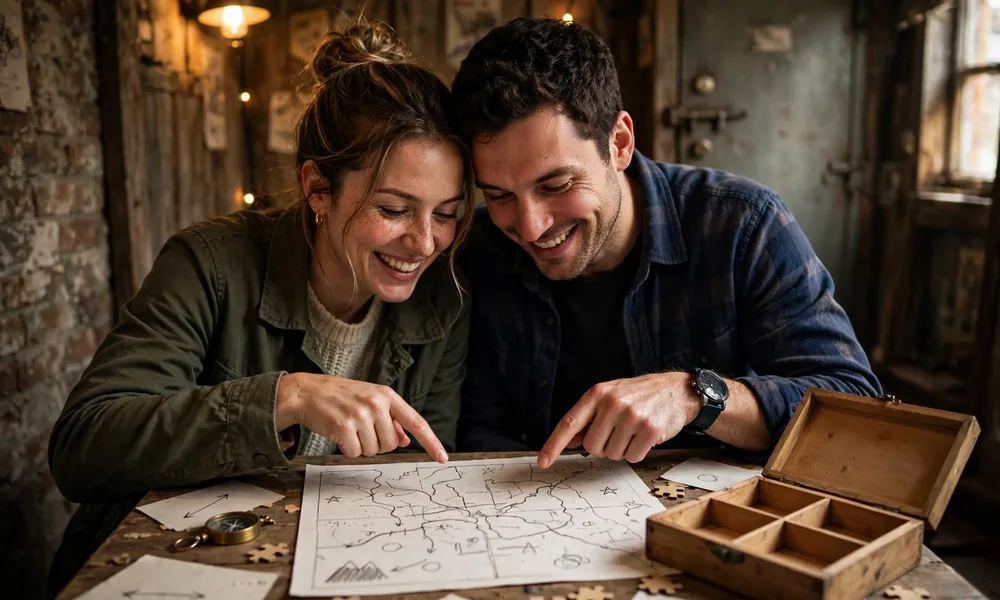
Sixty minutes reads as generous on a booking page and very short inside a room with a timer on the wall. For some couples the countdown is the fun: choices sharpen, talk speeds up, and the final stretch carries a charge that makes a close escape feel earned. For other pairs the timer itself is the trouble. If one of you likes to mull things over, hates an audience while thinking, or goes flustered as minutes drain away, the countdown turns every puzzle up a notch.
First date or later date?
An escape room is a poor first date. On a first outing you have no idea yet if the other person likes puzzles, hates tight spaces, or freezes when a timer runs, and a sealed room with a countdown is a loud way to learn that. A first date should leave both people a simple way to leave, change the subject, or end the evening early. A timed room offers none of those. Hold the idea until the third or fourth time you go out, when you know each other well enough to predict how the hour will land.
For an established couple, the maths flips. You already know whether your partner likes this kind of challenge, whether tight spaces bother them, and whether the two of you argue well or badly when pressed. If those answers are good, the room is a strong date-night choice, better than another dinner at the same restaurant, because it gives you something to do together rather than something to sit through. If the answers are uncertain, try a cheaper version first: a boxed escape game at home, played on the sofa with a cup of tea, tells you most of what you need to know about whether the real thing is worth the ticket price. Our pick of the escape boxes made for the living room covers the ones worth trying between visits.
Booking a room built for two
Choosing well is quick if you ask the right things before handing over money, and a venue that welcomes couples will answer them all gladly. Start with the private booking: never share a couples escape with strangers. A room that adds two people you have never met changes the whole evening, because you spend the hour negotiating with people you do not know instead of playing with the person you came with. Private booking costs more, and it is worth every penny of the difference.
Then ask about size and difficulty together, because for a pair the two are linked. Ask which rooms the venue suggests for two players specifically, not merely which rooms allow two players, and ask how often pairs get out on the easiest setting. A venue that tracks that figure and shares it takes two-player groups seriously. Pick a mystery, detective, or heist story for a first visit: the aim is easy to grasp, the trail of clues is simple to follow, and nobody has to pretend to enjoy being frightened. Horror can wait until you have played one room together and both want something scarier.
Ask about the door itself, plainly and without embarrassment. Is it really locked, or only closed? Can either of you step out and return? How large is the room, and how bright? Rooms differ enormously: some feel like a spacious living room, while others are small, dim, and deliberately cramped, and the booking page seldom says which you are getting. If either of you has even a mild dislike of enclosed spaces, that question outweighs theme, difficulty, and price. An outing one person spends dreading is not a date.
The bill for two
Escape rooms are dear, and a fair verdict has to admit it. Two tickets generally cost about the same as a cinema trip plus a meal, and with travel and a drink afterwards the evening adds up to a proper night out rather than a casual one. That price is fair for an occasion, a birthday or an anniversary or a rare free Saturday, and poor value as a regular habit. A couple who goes monthly will exhaust the good rooms in their city within a year, and their budget long before that, because a room can only be played once. You cannot replay a puzzle you have already solved.
The workable middle path is to treat a real room as an occasional treat, three or four times a year, and fill the gaps with tabletop versions that cost a fraction. Boxed escape games bring the same puzzle-solving loop to the kitchen table for a fraction of the cost, and a pair who have played a few boxes at home will get more from a real room when the occasion arrives. If you want a wider shelf of two-player games for the evenings in between, our guide to the cooperative board games built for two covers twelve titles made for exactly two players, several of which scratch the same teamwork itch without a booking fee.
| Check | What good looks like for a pair | Warning sign |
|---|---|---|
| Booking | Private room, just the two of you | Strangers added to fill the room |
| Difficulty | Gentlest setting, matched to the less practised partner | Hardest room on the menu for a first visit |
| Theme | Mystery or detective story you both chose | Horror theme one of you never asked for |
| Roles | Room split in half, finds spoken aloud, turns leading | One partner solving while the other watches |
| Hints | Asked for together, early, without embarrassment | Ten minutes lost to a puzzle you misread |
| Afterwards | Time booked for a drink and a debrief | Straight home with the evening unexamined |
When to skip it
Some pairs should sit this one out, and honesty demands saying so. If one of you fears small or dark spaces, a locked room will not cure that fear, and an hour inside one is a poor place to test its strength. If one of you feels watched and judged when pressed, the camera, the clock, and an audience of one will make every puzzle harder. If one of you simply dislikes puzzles in every form, then the format is not for your pair, and there is no shame in that. Pressing the point will only sour the idea for both of you. There are plenty of other ways to spend an evening together, and the point was never the room. The point was time together. Our broader take on whether escape rooms suit grown-ups in general covers the group angle, and its warnings about pressure and pacing apply to pairs too.
Our verdict
So, are escape rooms good for couples? Our answer is yes, with conditions that are easy to meet and costly to skip. Book privately, at the gentlest difficulty, in a mystery or detective theme you both chose, for a third or fourth outing rather than a first. Keep an hour free afterwards to talk it over. Meet those conditions and the room earns its place as one of the best occasional dates a couple can book: an hour of genuine teamwork, a story you will retell for weeks, and a small, honest picture of how the two of you handle a problem together. Miss them, and the same hour becomes an expensive lesson in how it feels to be an audience of one. In the end the lock is the least interesting thing in the room. What matters is who is turning the key beside you.