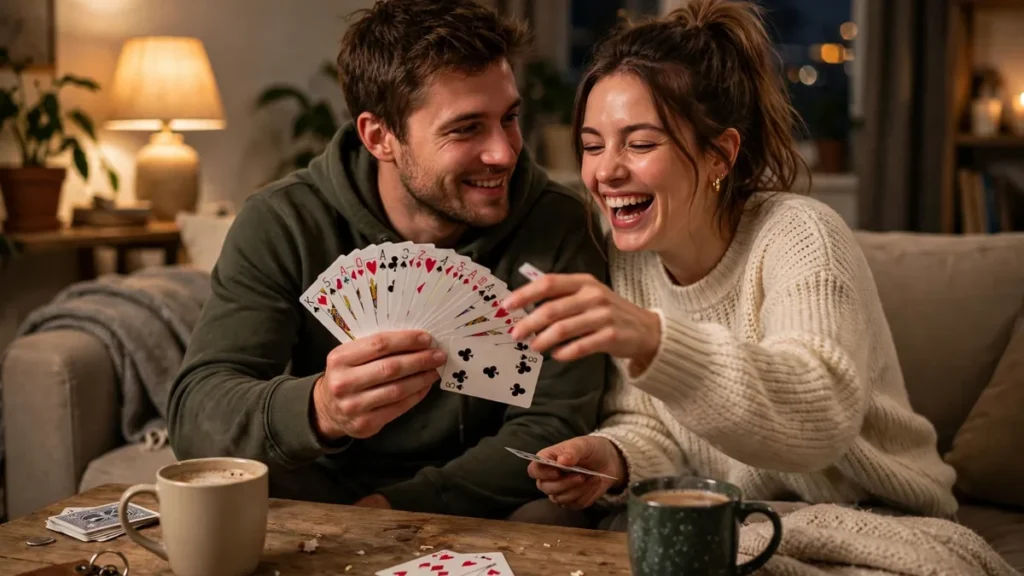
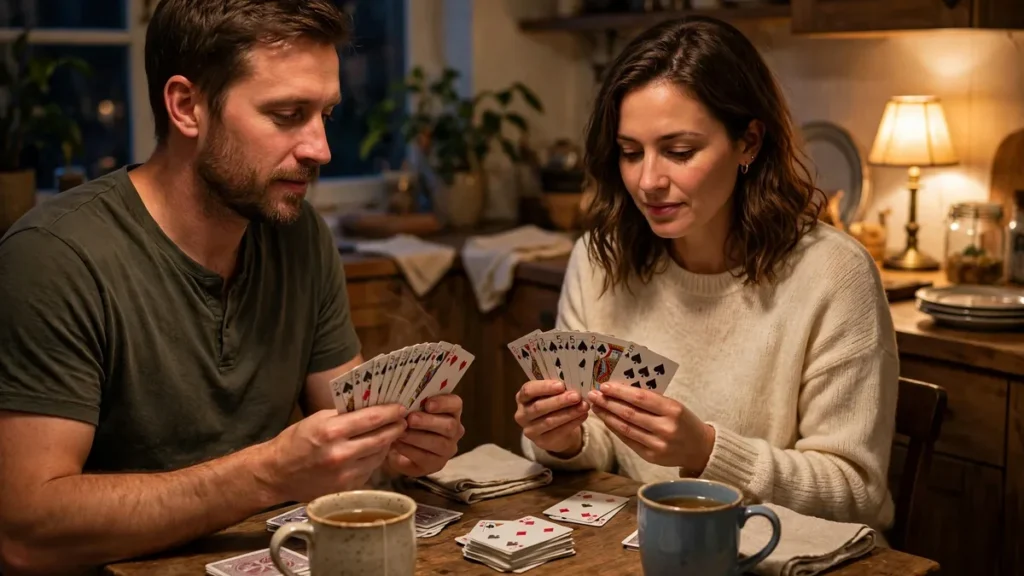
Ask a couple who puzzle together and you will usually get a warm answer. Ask a couple who tried it once and gave up and you will get a shrug, or a story about a thousand-piece sky that sat half-finished on the dining table for a month. Both answers are honest. Puzzles are good for couples, in our view, but the word puzzles covers so many different things that a flat yes or no misses the point. A jigsaw and a crossword are not the same evening. A logic grid and a riddle book are not the same kind of togetherness. The puzzle you pick, and the way the two of you approach it, decide whether it becomes a habit you both look forward to or another good idea that quietly dies on the table.
So here is our verdict first, and the reasoning after it. Yes, puzzles are good for most couples, provided both people genuinely enjoy at least one kind of puzzle and you choose the kind that fits the pair rather than the kind one of you happens to love. The benefit is not about keeping your brain sharp, whatever the boxes claim. It is simpler than that. Puzzles give two people a calm, screen-free way to spend time in the same room, doing something that asks for attention without demanding performance, and they give you small finished things to point at together. That is a modest claim, and it is the honest one. Puzzles will not repair a relationship, they will not replace a real conversation, and they will not suit a partner who finds them dull. But as a regular shared pastime for a willing pair, they are one of the easiest wins available: cheap, quiet, flexible, and hard to get badly wrong once you know which kind suits you both.
The short answer, type by type
Not every puzzle earns the same verdict. Some are built for two people. Some are built for one person and merely tolerate a second. The table below is our honest scorecard, based on how each kind actually plays out for a pair at home rather than how it looks on the box.
| Puzzle type | Best shared as | Talk level | Friction risk | Suits couples who |
|---|---|---|---|---|
| Jigsaw | One puzzle, one table, over several evenings | Easy, drifting chat | Medium, if your methods clash | Like slow evenings and visible progress |
| Crossword | One grid, solved aloud together | High, constant back and forth | Medium, if one of you knows far more answers | Enjoy wordplay and thinking aloud |
| Logic grids and sudoku | Two copies, side by side, compared after | Low while solving, lively after | Low, since each has their own copy | Like quiet focus with a debrief |
| Riddles and word puzzles | Read aloud, taking turns to guess | High, playful and quick | Low, unless someone hates guessing wrong | Want short bursts, not long sessions |
| Puzzle hunts and escape-style boxes | One challenge, tackled as a team | High, but intense and focused | Higher, under time pressure | Want an event, not a nightly habit |
What puzzles actually give a couple
Start with the plainest benefit, because it is also the one couples mention most often when you ask them. An evening with a puzzle is an evening where you are together without a screen running the evening for you. That sounds small until you compare it with the usual alternative: dinner, then two people on the same sofa looking at two different feeds, in the same room and in two different worlds. A puzzle does not banish phones by itself, of course, and it would be naive to pretend it does. What it does is give your hands and your attention somewhere better to go, which makes putting the phone down feel like a choice rather than a rule. If you are weighing puzzles against other quiet pastimes, our verdict on whether puzzles are good for adults covers the solo side of the same question, and much of it carries over here.
Another benefit is the small finished thing. Most of what a couple does in a week leaves no trace. You cook, you eat, you tidy, you sleep, and the week resets. A puzzle leaves something behind: a finished grid, a completed picture, a riddle you finally cracked after three days of coming back to it. These are tiny achievements, and it is tempting to dismiss them as trivial. But couples run on small shared wins more than they run on grand gestures. Finishing something together, even something made of cardboard, is a reminder that the two of you can still make progress on the same thing at the same time. That reminder is easy to undervalue precisely because it feels so ordinary.
Two ways to puzzle together: one puzzle, or two
The first way is the shared puzzle: one jigsaw on the table, one crossword between you, one riddle read aloud. This is teamwork, and it is the version everyone pictures. It works best when your skill levels are close, your patience levels are close, and you both enjoy talking through a problem as you go. It gives you the most togetherness per hour, and it is also where friction lives, because every difference in method is visible in real time. If one of you is faster, the other can end up feeling like an assistant rather than a partner. That feeling is the single most common reason a shared puzzle goes sour, and it is worth watching for early.
The second way is parallel puzzling: two puzzles, one sofa. Each of you has your own crossword book, your own sudoku, your own logic puzzle, and you sit close enough to show each other a good clue or complain about a stuck grid. This sounds like doing puzzles near each other rather than with each other, and in a sense it is. But couples who puzzle this way often love it just as much, sometimes more. There is no waiting, no watching, no one doing all the work. Each of you moves at your own speed, and the togetherness comes from the shared room, the shared quiet, and the small exchanges in between. It is the puzzle equivalent of reading in the same room, and reading in the same room has kept plenty of couples happy for decades.

Where it starts to grate
The pace gap comes first. In almost every pair, one person solves faster than the other. With a crossword, that means one person supplies most of the answers while the other supplies the pencil. With a jigsaw, it means one person places pieces while the other sorts. Neither role is lesser, but it can feel that way, especially if the faster partner does not notice. The fix is not to slow the fast partner down artificially. It is to pick formats where pace matters less, like parallel books, or to split the work so each person owns a part of the puzzle and the progress is visibly shared.
The other frustration is the unfinished puzzle. A jigsaw that stalls becomes furniture, and then it becomes a reproach. Every meal eaten around it is a small reminder of a project you have both quietly abandoned. Crosswords and riddle books do not have this problem, because they end quickly or wait patiently on a shelf. If your home has one table and no spare surface, that is a real argument for shorter puzzles, or for a puzzle board you can slide away, rather than a thousand-piece project that takes over the room. Choose the puzzle that fits the home you have, not the home in the photograph on the box.
Choosing puzzles that suit both of you
Give each person a veto. If one of you genuinely dislikes a kind of puzzle, that kind is off the table, however highly rated it is. A veto is not a failure of open-mindedness. It is the price of an evening both people enjoy, and it is cheaper than three evenings of quiet resentment. One partner may loathe jigsaws yet enjoy crosswords, while the other may dislike wordplay yet love a logic grid, so ruling one kind out usually points you towards the kind that fits, rather than ending the search.
Match the difficulty to the less experienced partner, at least at first. It is tempting to buy the puzzle that challenges the stronger solver, but an evening where one person is stretched and the other is lost is an evening that will not be repeated. Start easier than you think you need to. A puzzle you finish together in good spirits beats a puzzle that beats you both, every time, and you can always step up a level once the habit is established.
Keep the first attempts short. A single crossword, a 300-piece jigsaw, a page of riddles, a short puzzle hunt: these are the right size for finding out whether a format suits you. Long projects can come later, once you know what you both enjoy. If you want a ready-made evening built around a single shared puzzle, we have a separate step-by-step plan for a puzzle night for two that covers choosing the evening and laying out the table.
When puzzles are the wrong answer
If one of you actively dislikes puzzles, in all their forms, then puzzles are not your couple’s activity, and that is fine. Forcing the issue will only attach irritation to the idea itself, and the reluctant partner will be right to resent it. There are many other quiet pastimes, and the point was never the puzzle. The point was time together, and that can be found elsewhere.
If your evenings together are already tense, a puzzle will not fix the tension. It may even make it worse, because a shared task gives tension somewhere to land: a misplaced piece, a wrong guess, a sigh at the wrong moment. A puzzle is a pleasant way to spend a good evening. It is a poor way to spend a bad one, and on a bad evening you are both better off doing something else entirely, or talking about what is actually wrong.
A four-week trial that tells you the truth
In the first week, try a shared jigsaw, around 500 pieces, with a picture you both like. Notice whether you naturally split the work or get in each other’s way. In the second week, try a crossword together, solved aloud, with a pencil each so nobody is only watching. In the third week, try parallel puzzling: two different puzzle books on the same sofa, with a rule that either of you can show the other a good clue. In the fourth week, try riddles or a short puzzle hunt, something with a clear ending inside one evening. Before you start, our jigsaw picks chosen with two solvers in mind will give you a shortlist to choose from.
At the end of the month, ask each other two questions and answer them honestly. Which week did you look forward to most, and which week felt like a chore? The answers will tell you more than any article can, including this one. They will tell you which kind of puzzle suits your pair, whether you prefer one shared puzzle or two side by side, and whether puzzling is something you want to keep. If the same week tops both of your lists, you have found your format. If your lists disagree, you have found something just as useful: the knowledge that parallel puzzling, where each of you gets the kind you like, may suit you better than any single shared puzzle ever could.
Our verdict
So, are puzzles good for couples? Our answer is yes, as long as a few simple conditions hold, and none of them is onerous. Both of you need to enjoy at least one kind of puzzle. The kind you choose needs to give you both something to do. The difficulty needs to fit the pair, not just the stronger solver. And the puzzle needs to stay what it is: a pleasant, low-stakes way to spend an evening together, not a test of the relationship and not a substitute for talking.
Meet those conditions and puzzles earn their place as one of the best quiet habits a couple can build. They are cheap, they are flexible, they fit a weeknight as easily as a weekend, and they give you shared time that feels like rest rather than effort. Try the four-week trial, keep the format that both of you look forward to, and let the rest go. The right puzzle for your couple is the one you both reach for without being asked, and once you have found it, the evenings largely take care of themselves.