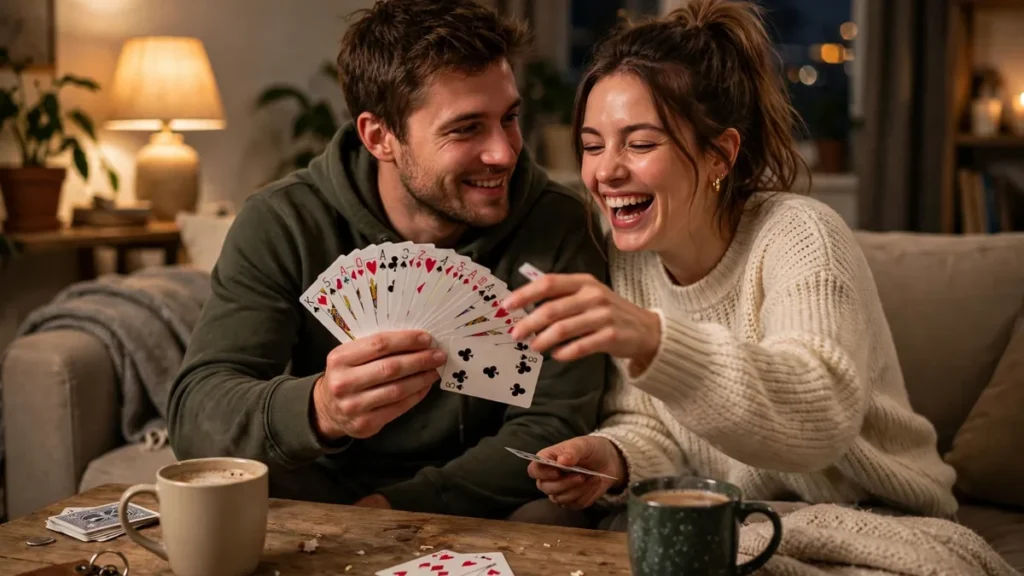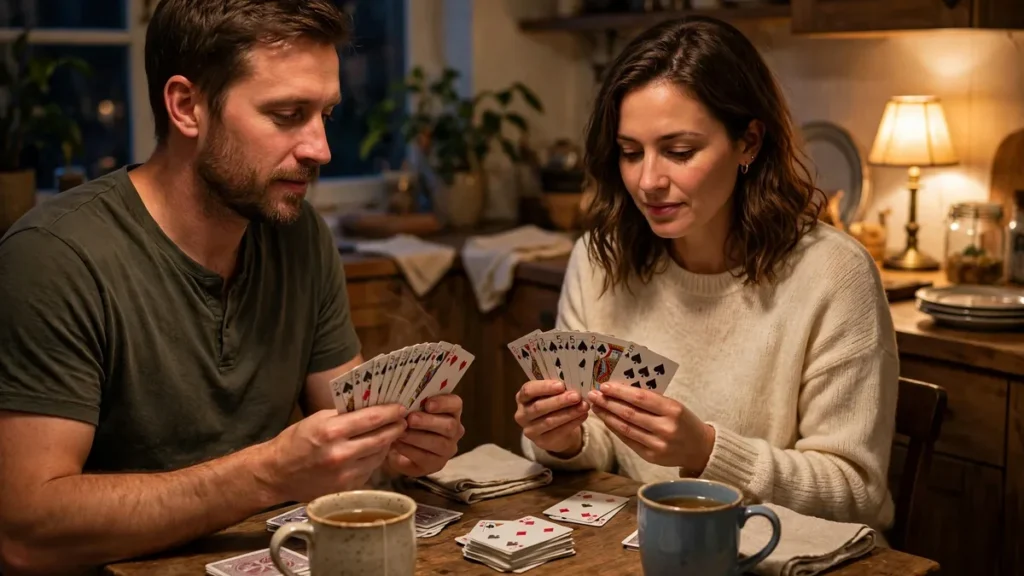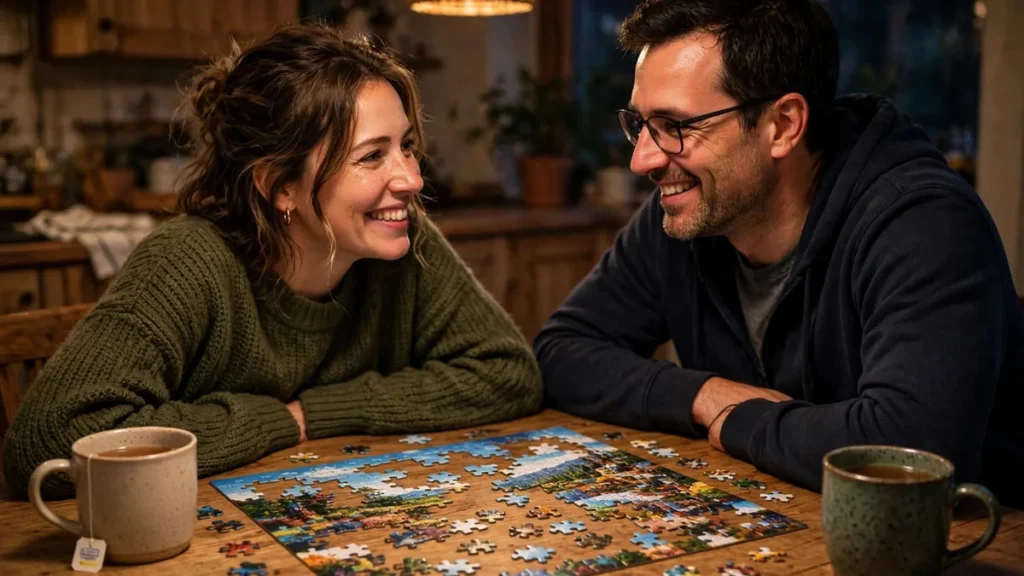
Some date nights need a booking, a babysitter, and a budget. A puzzle night for two needs a table and a box. That is the whole point. You and your partner sit down with one shared problem, work on it side by side, and let the conversation wander wherever it wants while your hands stay busy. It costs almost nothing, it takes no travel, and it gives you two unhurried hours of each other’s company without a screen between you.
Planning it well is what turns a pleasant idea into an evening you actually repeat. With only two people at the table, the details carry more weight than they do at a group night: the puzzle has to fit two solvers, the evening has to fit around real life, and the table has to work for a pair rather than a crowd.
Put the Evening in the Calendar First
Begin with the diary, not the puzzle shelf. A couples puzzle night that lives as a vague intention for “sometime this week” will keep sliding, because the week always offers something louder. Choose one evening, write it down, and guard it the way you would guard a dinner reservation. Fridays suit a lot of couples: the working week is done and nobody needs to be sharp the next morning. A midweek evening can work just as well if you start earlier and keep the night shorter.
Settle the length in advance. Two hours is a comfortable shape for a first attempt, long enough to sink into a proper puzzle and talk properly, short enough that tiredness does not sour the last stretch. Ninety minutes is enough on a weeknight. Under an hour feels rushed, because the opening quarter of an hour always goes to sorting edges and settling in. Note the finish time alongside the start, so neither of you spends the evening quietly wondering when it ends.
Have dinner before you begin, so the food on the puzzle table can stay small and tidy. Put the phones in another room, or face down on a sideboard where reaching for them takes effort. A phone buzzing beside the board is not a puzzle night at all.
Picking Puzzles Made for Two
The best puzzles for a couple are the ones both people can work on at once without getting in each other’s way, and where progress is visible enough to keep you both going. Think in kinds rather than titles, and keep one of each kind on the shelf.
Jigsaws are the natural centrepiece. They are cooperative by default, the two of you can work on different corners of the same picture, and the finished result is something you built together. Crosswords and word puzzles suit couples who like solving aloud, one clue at a time, where one of you spots the answer the other missed. Logic puzzles and riddle collections reward talking a problem through out loud. Escape-room-in-a-box games are designed for exactly two players and give the evening a story and a finish line.
Leave the crowd games for crowd nights: a trivia set built for four teams or a party game that needs shouting will feel wrong with two people at a kitchen table. A couples shelf is a separate shelf. For games designed around exactly two players, our roundup of the best board games for two players is a useful starting point.
Judging Difficulty for a Pair
Difficulty is where most couples puzzle nights go wrong, and the mistake is almost always choosing a puzzle for one person instead of two. A puzzle one of you could finish alone in an evening will feel thin once both of you are working on it. A puzzle that would challenge six people will grind a pair down.
For jigsaws, piece count is the simplest guide. Two casual solvers will enjoy a 500-piece puzzle across a two-hour evening, finishing it or coming close. A 1,000-piece puzzle suits a couple who puzzle often, or a night you plan to stretch over two sessions. Below 300 pieces, keep a second puzzle ready, because the first will be done before the tea is. The picture matters as much as the count: a landscape with wide stretches of sky and water is far harder than a busy street scene full of distinct colours and shapes, even at the same piece count. Choose an image with plenty of different zones, so each of you can own a corner of it.
For word and logic puzzles, think in time rather than size. A crossword that takes one person forty minutes will take a pair about twenty-five, because two minds catch different clues. It also helps to know that jigsaw puzzles are good for your brain in ways that go beyond a pleasant evening.
A Sample Evening, Hour by Hour
A loose plan keeps the evening from dissolving into twenty minutes of sorting followed by an early finish. Here is a two-hour shape you can copy.
First quarter of an hour: set up and warm up. Clear the table, tip out the puzzle, and sort the edge pieces together while you talk about the day. Open a short puzzle from a book, or three quick riddles, so you both land something easy before the real work begins.
Next fifty minutes: the main puzzle. This is the long, quiet middle where the picture grows and the talk wanders. Work on separate areas so you are not both reaching for the same piece, and trade areas now and then so neither of you is stuck on the same patch of sky all night.
Next twenty minutes: a change of pace. Set the main puzzle aside for a short round of something different, a crossword, a logic puzzle, or a few riddles. This stretch rescues the evening when the main puzzle turns stubborn.
Final quarter of an hour: finish or pause cleanly. If the puzzle is nearly done, push on and finish it together. If it is not, agree where it will live until next time: on a puzzle board, on a tray, or covered with a cloth on the table. Never sweep an unfinished puzzle back into its box in loose pieces; that is how puzzles end up forgotten. Settle the next date before you stand up.
Arranging the Table for Two
Two people need less space than a group, but they need it arranged with more care. A kitchen table is ideal: large enough for a puzzle and two drinks, small enough that you can both reach the middle. A low coffee table works if you are happy on the floor, and it suits a relaxed evening, but check that you can both see the puzzle without leaning across each other. Sit opposite one another rather than side by side, so each of you has an edge of the puzzle and a clear view of the picture.

Light does more work than decoration. A harsh overhead bulb makes the evening feel like an office, while one dim lamp makes small pieces hard to read. Angle a lamp over the table and leave the rest of the room soft, so the puzzle is lit and the room still feels like an evening.
Clear everything the night does not need: the puzzle, two drinks, one small bowl of snacks, and a notepad if you are keeping notes. A puzzle board or a large tray is worth owning if you plan to puzzle often, since it lets you slide an unfinished puzzle under a sofa or onto a shelf without scattering the pieces.
Food and Drink That Spare the Pieces
Food belongs in the evening, but the wrong food will cut it short. Greasy, sticky, or powdery snacks are trouble around a puzzle: crisps mark the pieces, chocolate softens onto cardboard, and one knocked glass can undo an hour of work. Keep the puzzle table to snacks that leave nothing on your fingers.
Popcorn is a safe bet: it is light, it passes easily between two people, and it leaves no grease on the cardboard. A small bowl of grapes, a handful of nuts, some cheese cubes, or a few squares of chocolate eaten away from the board all work just as well.
Drinks need the same thought. Tea, coffee, wine, or a cold drink poured into two glasses all suit the table. Set them at the far corners, well away from the puzzle, where an elbow cannot reach them. Wide, stable mugs beat tall glasses that tip at a touch. If you like a proper pause, build a ten-minute snack break into the middle of the evening and eat away from the table, then return with clean hands.
Two Speeds, One Puzzle
Most couples solve at different speeds, and it is only a problem if you let it become one. The quicker solver finishes a corner first and starts reaching into their partner’s area. The slower solver feels watched, rushed, or quietly judged.
Split the puzzle instead of racing through it. One of you takes the top half, the other the bottom, or one takes the border while the other takes the middle. Trade zones after twenty minutes so nobody is stuck with the hardest patch all evening. For word puzzles, take turns reading clues aloud and let the reader have the first guess; the other person offers a hint only when asked for one.
Settle a hint rule before you begin: either of you can ask for a nudge at any time, and the other gives one small clue, not the answer. It keeps the quicker solver helpful without turning them into a teacher, and it keeps the slower solver in the game. If the gap between you is wide, favour puzzles you solve together over ones you play against each other. A jigsaw, a shared crossword, or an escape-room box has no loser.
Making It a Habit You Keep
One puzzle night is a pleasant evening. Do it most weeks and it becomes something steadier: a standing date the two of you keep for yourselves. The habit matters more than any single puzzle. It is one evening a week set aside for the two of you, with no screens and nothing else asking for your attention. If you want to understand why those evenings stay with you long after the picture is packed away, our piece on why we love puzzle nights puts it better than any planning guide can.
Choose a rhythm you can genuinely keep. Weekly is ideal, fortnightly is fine if life is busy. Keeping a fixed night helps, because it ends the weekly debate about when to do it. Take turns picking the puzzle: one week you choose, the next week your partner does. Taking turns keeps the choice balanced, and you will both end up trying puzzles you would never have picked alone.
When the Evening Goes Flat
Some nights simply do not click: the puzzle turns out dull, or one of you is too tired to focus. A backup plan is what keeps couples puzzling after a flat night.
Keep a spare puzzle at hand: a short, familiar one you both like, ready to come out in two minutes when the main puzzle is failing. Give a new puzzle a quarter of an hour before you judge it, since some start slowly and improve as the pieces fall into place. If that time passes and neither of you is enjoying it, put it away without guilt. The evening is the point, not the puzzle.
If the puzzle is too hard, make it easier rather than abandoning it. Study the picture on the box lid together, sort the pieces by colour and then by shape, and work on one small area until it gives you a foothold. If it still beats you after half an hour, set it aside and switch to the change-of-pace round.
Questions Couples Ask
How long does a good puzzle night run? Two hours suits most couples: a quarter of an hour to settle in, fifty minutes on the main puzzle, twenty minutes on something different, and a quarter of an hour to finish or pause cleanly. Ninety minutes works on a weeknight.
What size jigsaw is right for two people? A 500-piece puzzle fits two casual solvers across a two-hour evening. Regular puzzlers will enjoy 1,000 pieces, possibly over two sessions. Below 300 pieces, keep a second puzzle ready, because the first will be finished early.
The Bottom Line
A couples puzzle night is its own kind of evening: two people, one table, and a problem neither of them can finish alone. Choose the night before you choose the puzzle, pick puzzles made for two, set the difficulty a half-step above comfortable, keep the food tidy and the drinks at the corners, and fix the next date before you stand up. Do that most weeks, and what you will remember is the unhurried time you spent together, working on the same small thing, piece by piece.