
The light goes first. Not all at once, but in the slow way evening light goes, thinning at the edges of the windows until the room has to decide what it is going to be for the next few hours. The day has used up its noise. The washing machine has finished. The front door has been locked for the last time. Somebody puts the lamp on, and the pool of warm light it throws across the table is the first real decision of the night: we are staying in, and we are staying here, together, with something small and absorbing to do with our hands.
That is when the puzzle comes out. Not with a flourish, and not because anyone has announced a plan. It comes out the way the good evenings always start, with somebody reaching for it while somebody else is still clearing the plates, as if the night had already been agreed upon hours ago and everyone had simply been waiting for the light to catch up. There is no starting gun. There is a table, a lamp, a thousand small cardboard pieces, and the unspoken understanding that for the next little while, nothing else is required of any of us.
Dusk Is the Invitation
There is a particular hour that belongs to puzzle nights, and it arrives earlier than you would think. It is not midnight. It is that blue hour after supper when the sky outside has gone the colour of slate and the windows turn into dark mirrors, and the house suddenly feels smaller and warmer and more entirely ours. The world beyond the glass is still out there, of course, doing whatever the world does at night, but the windows have stopped showing it to us. They show us ourselves instead, gathered around the lit table, and the sight is quietly reassuring.
I love that the night does not need to be planned in the way other evenings need to be planned. Nobody has to book anything, or dress for anything, or drive anywhere, or remember a reservation. The invitation is the dark itself, arriving on schedule every single day, and the answer is already in the house. A puzzle night asks so little of the people in it that even a tired household can say yes to it. The day may have been long. The week may have been longer. The night does not care. It only asks that we sit down.
Clearing the Table
Every puzzle night begins with the same small act of devotion, and it has nothing to do with puzzles at all. Somebody clears the table. The plates are carried away. The crumbs are brushed into a palm. The salt and pepper are moved to the sideboard, the post is stacked into a neat pile, and the table is wiped until the wood shows through again, bare and ready. It is a humble job, and I love it more than I can explain, because it is the moment the table stops being a place where the day happened and becomes a place where the night will happen.
Then the lamp is angled, just so, so that its light falls across the middle of the table and leaves the corners in a softer dark. The mugs are set down where they will not be knocked. A small cloth is laid out for the pieces that are waiting to be placed. These are tiny decisions, made without discussion, and they are the reason the night feels cared for. Nobody has made a speech about togetherness. Nobody needed to. The table has been cleared, the lamp has been angled, and the evening has already begun.
The Pile
Then comes the sound I love most in the whole evening: the soft, dry rush of a thousand pieces pouring out of the box and spreading across the table. It is a small avalanche, a clatter of cardboard and colour, and for a second the table looks impossible, a bright mess with no order in it at all. That mess is the gift. For a little while, the night holds a problem with no stakes attached to it, a beautiful tangle that asks only to be looked at, slowly, by people who are in no hurry.
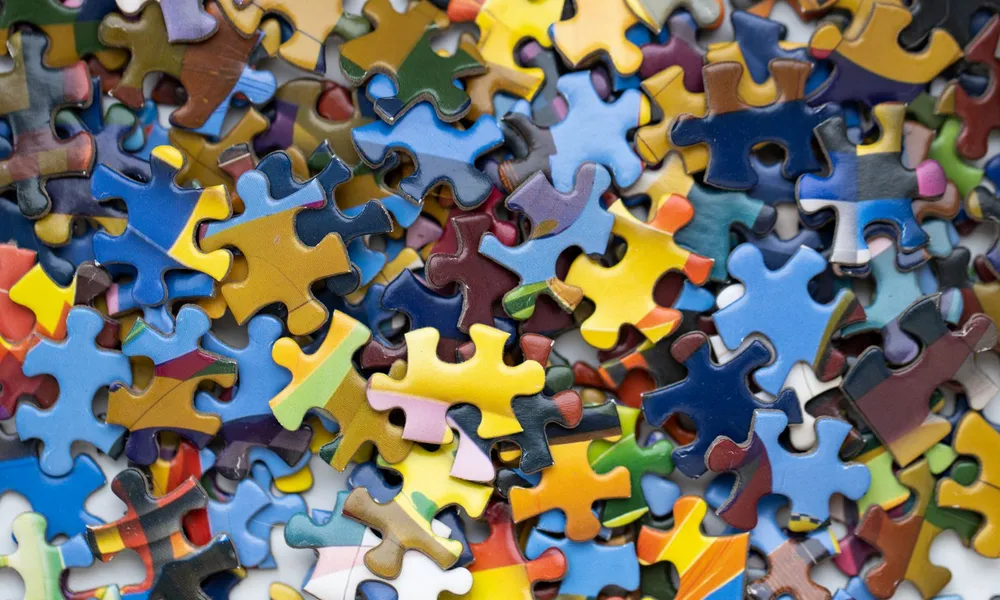
Somebody always starts with the edges. It is the oldest habit at the table, and nobody taught it to anyone. Straight sides, flat backs, the four corners first, like laying the foundations of a small house. The border goes down piece by piece, and the picture acquires a frame before it acquires a subject, which feels right. A night needs its edges too. The lamp on one side, the window on the other, the people ranged around the table, and the world held outside the frame, at least until morning.
Then the sorting begins, and this is where the night finds its rhythm. One person gathers the blues. Another takes the greens. Somebody else, without being asked, starts a little pile of the pieces with writing on them, or the pieces with faces, or the pieces that are almost certainly sky. The piles grow on the cloth like small coloured islands, and the table slowly turns from chaos into a map of intentions. It is satisfying in a way that has nothing to do with winning, because there is nothing here to win. There is only the slow, visible change from scattered to sorted, and the pleasure of watching it happen under your own hands.
Talk That Wanders
Here is the thing nobody tells you about puzzle nights until you have sat through a few of them: the talk is the best talk. Not because anyone has planned a conversation, but because nobody has. The puzzle gives the room something to look at besides each other, and that small mercy changes everything. Eyes down, hands busy, the words come out easier. People say the things they would not say across a table with nothing on it, because the table is full, and the looking is shared, and nobody has to hold anyone else’s gaze while they say something true.
The talk wanders the way talk should wander when nobody is steering it. It starts with the puzzle, a comment about a piece that will not fit, a groan about the sky, and then it drifts, the way a river drifts, into the day that has just passed, and then into a memory from years ago, and then into a plan for the weekend, and then back to the puzzle again, as if the conversation were itself a border being built, piece by piece, around the evening. Nobody keeps track of where it has been. Nobody needs to. The wandering is the point.
There is also the companionable quiet, which deserves its own mention, because it is the part of the night people forget to praise. Long stretches pass with nothing but the clicking of pieces and the occasional murmur, and the quiet is not awkward. It is the comfortable silence of people who do not need to fill every second, who are content to sit near each other and look at the same small problem. In a life full of noise, a quiet that feels like company is a rare and precious thing, and the puzzle table is where I have found it most often.
The Mug Goes Cold
Every puzzle night has a mug in it somewhere, and I have come to think the mug is as much a part of the evening as the pieces. It arrives hot, set down at the edge of the table where it can be reached without disturbing the border, and then it is promptly forgotten, because the picture has started to pull at everyone, and the steam rises and thins while a corner of sky takes shape. By the time anyone remembers it, the drink has gone lukewarm, and nobody minds. The cold mug is proof of a good night. It means the puzzle was more interesting than the drink, and the evening was more interesting than both.
The senses of a puzzle night are small and particular, and I love them for being so. The smell of cardboard and tea. The warmth of the lamp on the back of the hand. The faint roughness of a piece that has been handled a hundred times. The way the colours look richer under lamplight than they did in daylight, the blues deeper, the greens warmer, as if the night itself were finishing the picture along with us. These are not grand sensations. They are the textures of home, and they are the reason the night stays in the memory long after the picture has been taken apart and put back in its box.
Winter Keeps Them
Puzzle nights belong to the dark months, and I think that is no accident. When the evenings draw in and the rain is against the windows and the garden has gone quiet, the house needs something to do with its long hours, and the puzzle answers. Summer has its own pleasures, out of doors and under a wide sky. Winter turns us inward, toward lamplight and tables and each other, and the puzzle is the indoor answer to a season that asks us to stay close.
I love the sound of rain on the window while the pieces click on the table. It makes the room feel like a small lit boat, adrift in the dark, with everyone aboard and accounted for. The weather outside can do what it likes. Inside, the picture grows. There is a particular contentment in being warm and dry and occupied while the night does its work outside, and I have never found a better way to enjoy a winter evening than to spend it with a puzzle, a lamp, and the people I like best in the world.
Choosing the Picture
There is a small, delicious decision at the start of every puzzle night, and it is the only decision the night requires: which picture shall we spend the evening inside? The lid of the box is turned toward the lamp, and the room looks at it together, the way people look at a map before a journey. A mountain lake, blue and still. A crowded market street, full of faces and awnings. A painting, all swirling sky and bright stars. A coastline with a lighthouse at the edge. Each one is a world, and choosing it is choosing where the evening will go.
The wider family of these games is bigger than any one cupboard, and if you want a tour of it, our piece on what counts as a puzzle game lays out the whole family, jigsaws and puzzle boxes included. The affection behind all of it runs deeper than one evening, too, and our piece on why puzzle games hold us the way they do says that part better than I can. But the picture on the lid is where the night itself begins, and I have never known a household to choose badly. Every picture, given a lamp and an evening and a table full of patient hands, becomes the right one.
The Last Piece of the Evening
The night does not end with a flourish. It ends the way a good evening should end, quietly, with the lamp still warm and the picture half emerged, like a story interrupted in the middle of a good chapter. Somebody stretches. Somebody else yawns, and the yawn goes around the table the way yawns do, and the pieces are gathered into their piles, and the lid goes back on the box, and the table is left tidy for the morning. The picture is not finished. Nobody expected it to be. A puzzle night was never about finishing.
So this is my love letter to puzzle nights, written in praise of a small and ordinary pleasure. Not a grand occasion. Not a triumph. Just a table, a lamp, a thousand pieces, and the people I love most, sitting close in the warm light while the night goes on outside. Give me that, on a cold evening, with rain on the window and a picture slowly growing under my hands, and I will not ask the night for anything more. If you have never had one, or if it has been a while, consider this a nudge: clear the table, angle the lamp, tip out the pieces, and see how the evening goes. There is a whole quiet joy waiting there, and it has been waiting for you all along. For anyone ready to begin, our guide to how to host a puzzle night of your own will help you set the table.


