The short answer
Yes, puzzles are good for adults — in the modest, practical sense that matters most. A regular puzzle habit gives your attention a proper job to do, keeps your memory reaching for things instead of letting them fade, and hands you a calm half-hour that does not involve a screen shouting at you. That is a real return on a very small investment of time and money. It is also a far humbler claim than the one printed on the puzzle box. No puzzle will turn you into a genius, none will shield your memory from ageing on its own, and an evening spent furious at a crossword that refuses to yield is not doing you any favours at all.
So here is my verdict, before the detail: puzzles are one of the best low-effort habits an adult can pick up, provided you choose the right kind, keep the difficulty honest, and treat them as one part of a varied life rather than a cure for everything. The rest of this piece is the reasoning behind that sentence — the case for, the limits, who benefits most, and how to start without giving up by Friday.
Key takeaways
- Puzzles train specific skills — attention, recall, pattern-spotting, spatial thinking — rather than raising general intelligence.
- The strongest benefits are practical: steadier focus, a calmer mood, and memory that gets regular exercise.
- No single format does everything; jigsaws, crosswords, word games, and logic puzzles each work different mental muscles.
- Fifteen to twenty minutes a day, at a level that challenges you without beating you, beats heroic weekend marathons.
- The habit works best alongside reading, conversation, movement, and sleep — not instead of them.
What “good for you” actually means
Before praising puzzles, it helps to be clear about what praise is being offered. When people ask whether puzzles are good for adults, they usually mean one of three different things, and the honest answer is different for each. First, do puzzles exercise your mind? Yes, clearly. Second, do they make you smarter in general? No, not in any way that shows up beyond the puzzle itself. Third, do they make your life better? Mostly yes — and this third question is the one that matters most, because it is the one you actually live with.
There is another confusion worth clearing up early. A puzzle is not one activity. A jigsaw asks you to hold shapes in your head and rotate them; a crossword asks you to pull words out of memory; a logic puzzle asks you to hold several facts at once and test them against each other; a word game with friends asks you to think fast while other people watch. These are different workouts. That is why the general verdict — puzzles are good for adults — is more useful than any verdict about one format alone. The variety itself is part of the value.
The case for puzzles
The strongest case for puzzles starts with attention. Most adult days are built from short bursts: messages, meetings, errands, feeds. Very little asks you to stay with one thing for twenty unbroken minutes. A puzzle does. It rewards staying put. You look, compare, decide, and try again, and the only way forward is to keep going. Over weeks, that practice shows up elsewhere — in reading a long article to the end, in listening properly during a conversation, in finishing a job without checking your phone halfway through. It is not magic. It is rehearsal.
Then there is memory. A crossword clue hands you nothing and asks you to produce an answer from storage. A trivia question does the same. That act of pulling something out, rather than recognising it on a list, strengthens the path back to it. You will notice it in small ways: names come back faster, a word you wanted arrives instead of hovering out of reach, a fact from last month is still there when you need it. Again, the gain is specific. Getting good at crosswords mostly makes you good at crosswords and at remembering words. But remembering words is a genuinely useful everyday skill, and one that quietly fades if nothing exercises it.
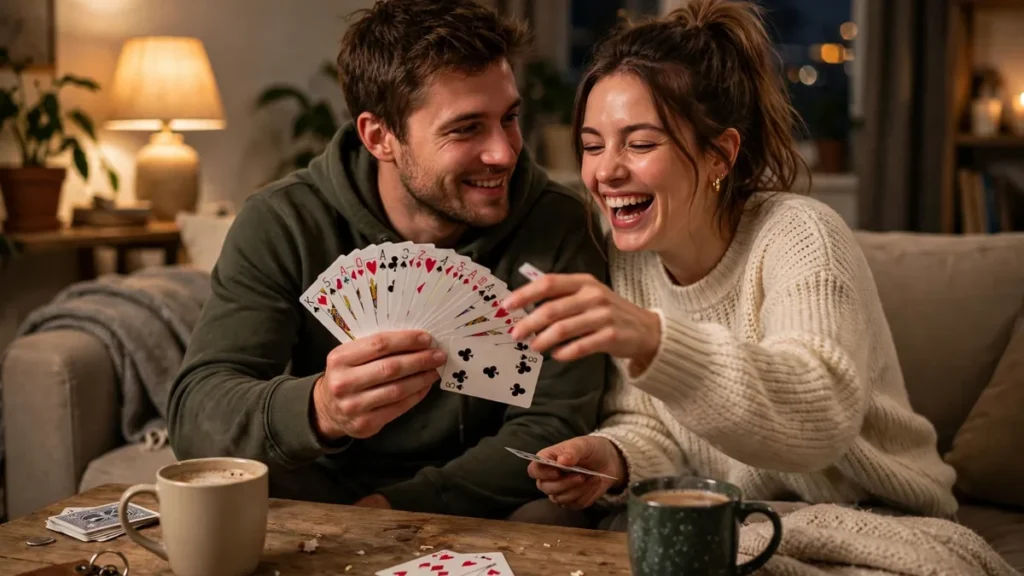
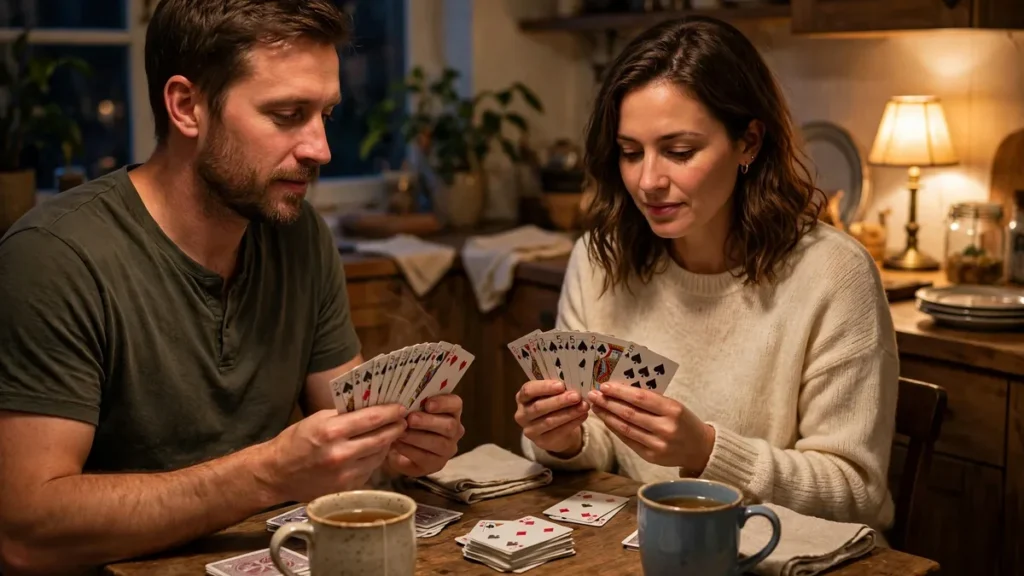
Do not overlook the social side either. Puzzles are one of the few adult pastimes that work just as well alone as with other people, and the shared version adds something the solo version cannot. A puzzle night gives a group a task to gather around that is not drinking, not watching something, and not talking about work. People who would never sit down for a deep conversation will happily argue about a clue for twenty minutes, and that arguing is conversation in disguise. Families, couples, and friends all find the same thing: a puzzle on the table lowers the pressure to perform and raises the chance of actually enjoying each other’s company.

The limits, honestly
An honest verdict needs the other side, so here it is. First, the transfer problem. Getting better at a puzzle mostly makes you better at that puzzle. A Sudoku expert is not automatically better at remembering appointments, and a crossword champion is not automatically better at solving problems at work. The skills overlap, but they do not generalise the way the marketing suggests. If you want a better memory for daily life, you still need the boring foundations: sleep, movement, and paying attention in the first place.
Second, puzzles are not medicine. No honest reading of the research says that doing puzzles prevents dementia or holds ageing at bay on its own. People who do puzzles regularly do tend to stay sharper, but the arrow may point the other way: people whose minds are already sharp are often the ones drawn to puzzles in the first place. A puzzle habit is a good companion to a healthy life, not a substitute for one, and anyone who tells you otherwise is asking you to buy something.
Third, puzzles can backfire. A puzzle pitched far above your level does not train your brain; it trains your frustration. Staring at a cryptic crossword that might as well be written in code teaches you nothing except that you hate cryptic crosswords. The same goes for a thousand-piece jigsaw of a cloudless sky, attempted by someone who has never finished a puzzle before. Difficulty is only useful when it stretches you slightly. When it defeats you repeatedly, the sensible move is to step down, not to push harder out of pride.
Fourth, there is the time question. Twenty minutes with a puzzle is a gift. Two hours every night, while the washing piles up and the people you live with wonder where you went, is a different story. Puzzles are absorbing by design, and absorption can tip into avoidance. The test is simple: does the habit leave you calmer and more present afterwards, or does it leave you tired, irritable, and behind on everything else? If it is the second, the puzzle is not the problem, but the dose is.
Who benefits most
Not everyone gets the same return from puzzles, and saying so is part of the honest verdict. The people who gain the most are usually the ones whose days give their minds the least variety. If your work is repetitive, or your evenings have drifted into the same screen and the same sofa, a puzzle adds a kind of thinking your day otherwise skips. It is a small change of diet for a mind that has been eating the same thing for months.
Stressed adults are high on the list too, for the reason given above: a puzzle is absorbing without being demanding, which is exactly what a wound-up mind needs at the end of the day. It is not a cure for stress, and it should never replace dealing with whatever is causing it, but as a way to come down in the evening it beats scrolling through bad news until midnight. The difference between the two is visible the next morning.
Who benefits least? People who already spend all day doing intense mental work and come home craving rest, not more thinking. If your job is solving hard problems for eight hours, an evening puzzle may feel like overtime. For you, the honest answer might be a walk, a bath, or an early night — and a puzzle on the weekend, when thinking feels like play again instead of work.
How to start without quitting by Friday
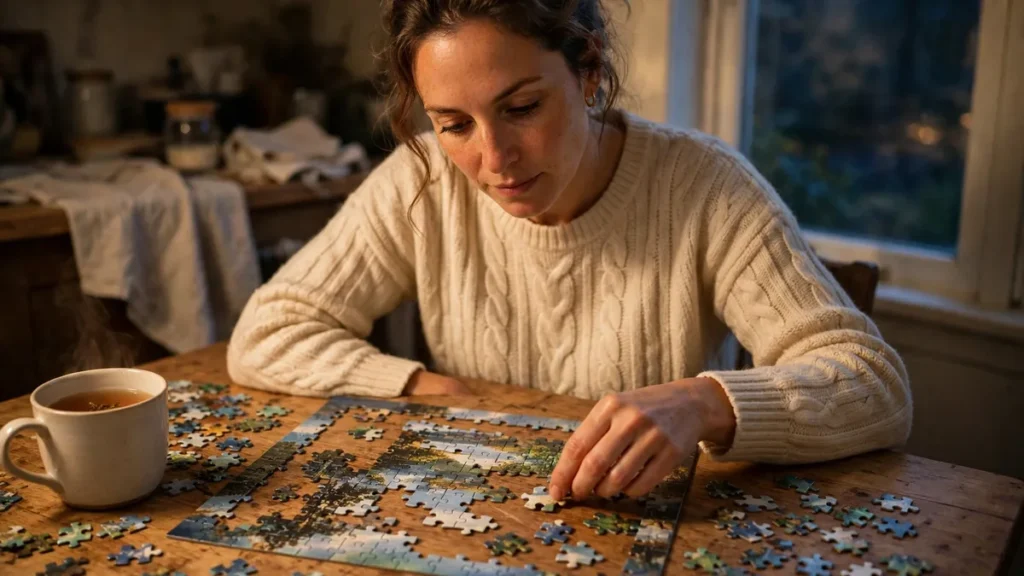
Most puzzle habits fail for the same two reasons: the wrong format, or the wrong difficulty. Both are easy to fix if you choose deliberately. Start by matching the format to your temperament rather than to whatever is fashionable. If you like quiet and pictures, start with a jigsaw. If you love words and trivia, start with a crossword or a word game. If you like rules and clean logic, start with Sudoku or a logic puzzle. If you get bored easily, start with something social, like a puzzle night with friends. The best puzzle is the one you will actually do tomorrow.
Then set the difficulty honestly. A good first puzzle should feel testing for about a third of the time and comfortable for the rest. If you finish in five minutes feeling nothing, it was too easy. If you are stuck on the first clue for twenty minutes, it was too hard. Aim for the middle, and let the difficulty rise slowly as you improve. Puzzle books are useful here because they are usually graded, so you can climb a level when the current one starts feeling routine. If you want a map of the options, our guide to puzzle games for adults lays out the main formats and who each one suits.
Keep the session short on purpose. Fifteen to twenty minutes a day is enough to build the habit, and it is short enough that you will actually do it. Put it in a fixed slot — morning coffee, lunch break, the half-hour before bed — and protect it the way you would protect any other appointment. A puzzle habit that depends on finding spare time will lose to everything else in your diary. A puzzle habit with a slot will survive a busy week.
Mix formats once the habit sticks. A week of only crosswords trains recall; a week that also includes a jigsaw and a logic puzzle trains recall, spatial thinking, and deduction together. You do not need a complicated rotation. Try a simple one: crosswords on weekdays, a jigsaw on the weekend, and a logic puzzle or word game when friends come round. The variety keeps the habit fresh, and it stops any single format from going stale. If you prefer paper, a shelf of puzzle books for adults makes the rotation easy, since one book can carry you through a month of mixed evenings.
My verdict
So, are puzzles good for adults? Yes — with the honesty this question deserves. They are good for your attention, good for your recall, good for your mood, and good for your relationships, in the specific, everyday ways that actually matter. They are not a shortcut to intelligence, not a shield against ageing, and not a replacement for sleep, movement, or a real conversation. They are a small, cheap, reliable habit that makes an ordinary day slightly better, and slightly better, repeated daily, adds up to a lot.
The strongest argument for puzzles is not a study or a statistic. It is the feeling at the end of a session: calmer than when you started, a little prouder of a small finished thing, and ready for whatever comes next. That feeling is available to almost anyone, it costs almost nothing, and it asks for only twenty minutes. Adults spend far more than that on far worse things.
One practical note before you start: if you do use puzzle apps, turn off the notifications and the streak reminders first, and compare a week of app puzzles with a week of paper ones. Our comparison of puzzles against video games reaches a similar conclusion from a different direction: the quieter, slower option usually leaves you in a better state than the faster, louder one. Paper is the slower option here, and slowness is the point.
Frequently asked questions
How much time should an adult spend on puzzles each day?
Fifteen to twenty minutes a day is enough to build the habit and get the real benefits. Longer sessions are fine on a quiet weekend, but daily consistency matters more than occasional marathons.
Which puzzle is best for adults starting out?
The one that matches your temperament. Word lovers should start with crosswords, visual thinkers with jigsaws, and rule lovers with Sudoku or logic puzzles. The best first puzzle is the one you finish and want to repeat.
Do puzzles really improve memory?
They exercise recall, which keeps memory active, but the gains are specific to the skills each puzzle uses. A puzzle habit supports a good memory; it does not replace sleep, exercise, and attention in daily life.