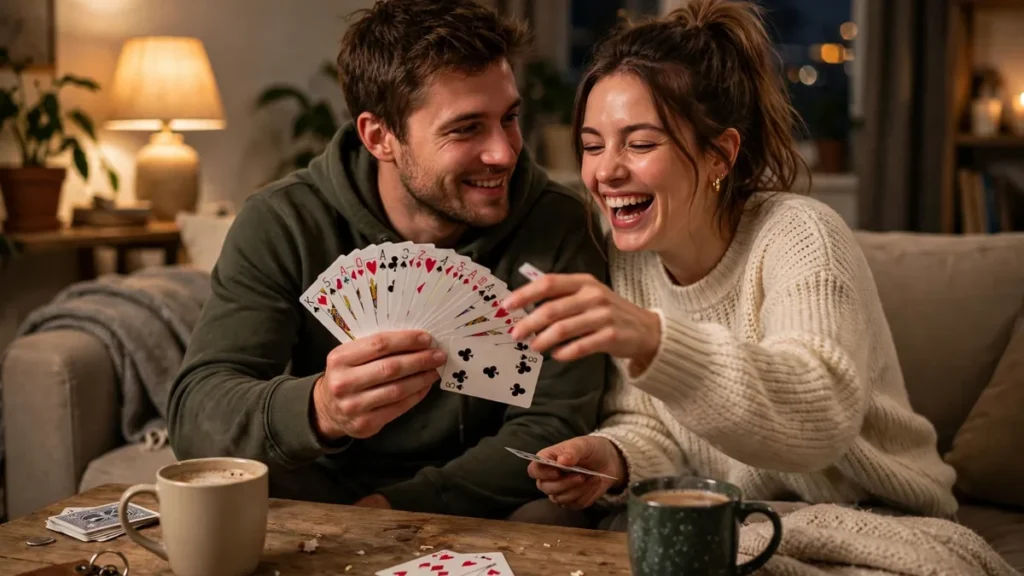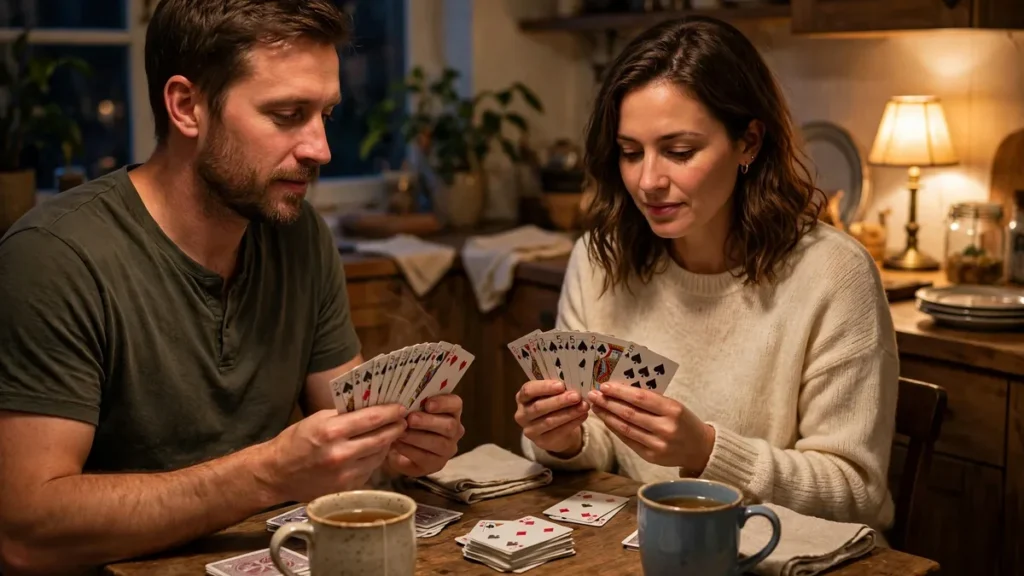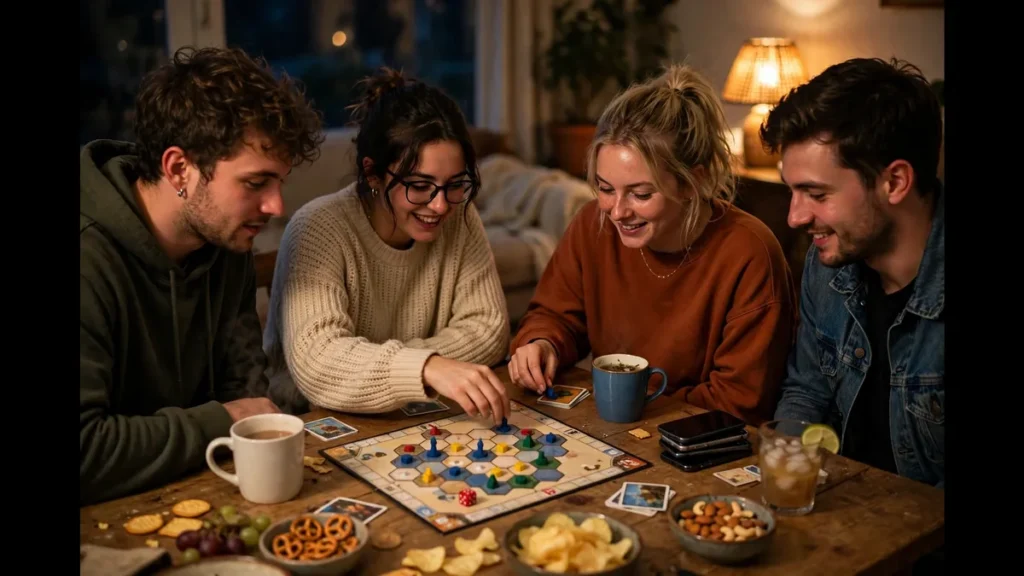
I can tell you the exact minute our game night starts, and it is not when anyone rolls a die or draws a card. It starts earlier, in the small pause after the front door closes, when somebody puts the kettle on without being asked and somebody else clears the last of the dinner plates away. The room changes its mind about what it is for. A table that spent the day holding laptops and schoolbooks and unopened post becomes a meeting place again. I love that change. I love it more than I love any single game we have ever played, because the games come and go, the boxes wear out, the rules get argued over and half forgotten, and still that pause keeps arriving, week after week, asking the same quiet question: are we going to sit down together tonight?
The Phones Go Down First
There is a small stack of phones at the corner of our table now, and I cannot remember who started it. Nobody made a rule. Nobody gave a speech about screen time or attention or being present, because speeches like that would have ruined the mood in about four seconds. One night somebody simply put theirs down, face down, a little apart from the cards, and the rest of us followed without thinking about it. The next week it happened again. By the third week, the stack was just there, waiting for us, like a coat hook by the door.
I love that stack more than I can explain. It is not a ban. It is a choice we keep making, and the choice is the point. Out in the world, our phones are always half in our hands, even when we are talking to someone we love. A message lights up, a headline pulls at us, a video starts playing before we have decided to watch it. At the table, none of that reaches us in the same way. The world can wait for two hours. It turns out it always could. Nobody misses anything that matters. The urgent things find another way to us, and the non-urgent things turn out, on closer inspection, to have been non-urgent all along.
The Ritual Before Anyone Plays
Every good night has a beginning that has nothing to do with winning. Ours starts with the clearing of the table, which sounds dull until you have done it a hundred times with the same people. Somebody moves the salt and pepper. Somebody else folds the newspaper that nobody has read. The board comes out of its box, or the cards come out of their tin, and there is a brief, happy clatter as pieces find their places. Somebody always counts the pieces, even though we have counted them a hundred times before. Somebody always asks whether we are playing the usual way, even though we always play the usual way. These little repetitions are not wasted time. They are the night warming up.
I love the settling-in more than the starting gun. There is a moment, maybe five minutes in, when everybody has a drink, everybody has found a comfortable seat, and the conversation loosens. Someone tells a story from their day that they would not have told if we had stayed in separate rooms. Someone else asks a question that has been waiting since last week. The game has not properly begun, and already the night has done its work. If the game were cancelled at that point, if the box turned out to be missing a vital piece, we would probably just sit there talking anyway, and it would still have been a good evening. That tells me something important about what we are actually doing here.
Losing Gracefully and Winning Kindly
I am not a graceful loser by nature. I wish I were, but I am not. My first instinct, when a plan falls apart in front of everyone, is to blame the dice, the cards, the seating, the lighting, and, on one memorable occasion, a draught from the window. My friends know this about me. They let me have my thirty seconds of grumbling, and then somebody, usually the kindest person at the table, says something that makes the whole thing funny again, and the grumble turns into a laugh, and the laugh turns into the story we tell about that night for months afterwards.
That is the part I love most about losing at this table: it is safe to be bad at something here. There is no audience beyond the people who already like me. There is no score that follows me home. There is no record kept, except the one we keep in our heads, which is mostly made of jokes. Losing here has taught me something that winning never could, which is how to be disappointed in public without making it everybody else’s problem. I take the loss, I make a joke out of it if I can, and I move on to the next round. It is a small skill, but I use it everywhere now: in work, in queues, in plans that fall through. The table was my practice ground, and I did not even know I was practising.
Winning, I have learned, is a skill too, and a harder one. Winning kindly means not rubbing it in, not explaining at length how clever your move was, not turning somebody else’s bad luck into your punchline. The best winners at our table are the ones who win quietly, who laugh with the losers rather than at them, who offer a rematch before anyone has to ask for one. I have watched a friend win three rounds in a row and still manage to make the evening feel fair, simply by being generous about it, by noticing the good move somebody else made, by sharing the joke instead of hoarding the glory. That is a kind of character, and I admire it more than I admire the win itself.
Jokes That Only Make Sense at This Table
Every table develops its own language, and ours is mostly nonsense. There is a phrase one of us said, years ago, in the middle of a game, that made no sense at the time and makes even less sense now, and yet it still makes us laugh every time somebody says it. There is a nickname for a particular kind of bad move, named after the person who made it first, who now wears the nickname like a badge. There is a running argument about a rule that nobody can quite remember, which we have agreed to keep arguing about forever, because settling it would take away one of our favourite jokes.
These jokes would die instantly outside this room. I have tried, once or twice, to repeat one of them to somebody who was not there, and watched their face go politely blank while I tried to explain the context, the timing, the look on somebody’s face, the three earlier jokes it was built on. It cannot be explained. It can only be lived in, like a house you have to visit to understand. That is exactly why I love it. The jokes are proof that we have a shared history, a private store of moments that belong to us and nobody else. They are the small, silly evidence that we have spent real time together, paying attention, remembering, building something that only exists between us. It is the same pleasure I get from a good riddle shared at the right moment: a small puzzle that only works because the people in the room are in on it together.
The Game Is Only the Excuse
If I am honest, the games themselves are almost beside the point. I like them, of course. I like the feel of cards in my hands, the small thrill of a good roll, the quiet satisfaction of a plan coming together. But if somebody replaced every game we own with a different set tomorrow, I would still turn up, and so would everyone else. We would learn the new games, we would argue about the new rules, and within a month we would have new jokes about them. The games are the excuse, not the reason. The reason is the gathering.
That is a useful thing to know, because it takes the pressure off the evening. We do not need the perfect game, or the newest game, or the game everybody is talking about. We need a reason to sit down together, and almost anything will do. A pack of cards would do. A pencil and a piece of paper would do. Even trivia nights with friends work the same way, the questions giving everyone a shared thing to chew over while the real evening happens around them. On one memorable night, when the power went out and the lights went with it, we played by candlelight with a game we half invented on the spot, and it was one of the best nights we have ever had, because the darkness made us listen to each other more carefully, and the silliness of inventing rules as we went along made us laugh harder than any proper game ever had.

When Life Gets Busy, the Night Holds
Life has tried, more than once, to take this night away from us. There have been seasons when work ran late, when children were small and exhausting, when somebody moved house, when somebody else was travelling, when the calendar looked so full that adding one more evening felt impossible. In those seasons, the temptation was always to cancel just this once, and then just once more, until the habit quietly disappeared. We have come close to that, more than once. What saved us, every time, was that somebody refused to let it go.
Usually it was not a grand refusal. It was a short message, sent on a busy afternoon: still on for tonight? Or a gentle insistence: come for an hour, even if you cannot stay for the whole evening. Or a practical offer: I will bring food, you just turn up. Small kindnesses, offered at the right moment, kept the thread from snapping. I am grateful for those messages in a way that is hard to put into words, because they were really saying something bigger. They were saying: this matters to me, and you matter to me, and I am not willing to let a busy season take this away from us without a fight.
Busy seasons pass, too. The work eases, the children grow, the house move settles, the travel slows down. And when it does, the night is still there, waiting, because we kept it alive through the hard weeks. That is what a ritual does that a one-off plan cannot do. It is also why family game night matters beyond the evening itself: the habit keeps the connection alive through the weeks when everything else is pulling people apart. It survives the seasons that would kill a single evening, because it is not a single evening. It is a promise we keep making, and a promise that keeps making us, week after week, into the kind of people who show up for each other.
What I Would Miss If It Stopped
There is a particular kind of love that does not announce itself. It does not arrive with flowers or grand gestures. It arrives, week after week, in a cleared table, a filled glass, a saved seat, a joke remembered from last time. It is the love of people who keep turning up, and who keep making room for each other, long after the novelty has worn off. Game night is where I see that love most clearly, because there is nothing else there to distract from it. No occasion, no performance, no reason except each other. Just us, and a table, and a few hours that belong to nobody but us.
I think about that stack of phones sometimes, after everyone has gone home and the house is quiet again. They sit there for a moment, face down, forgotten, while we say goodnight at the door and promise to do it all again next week. Then, one by one, we pick them up, and the world comes back, and the messages and the headlines return, and life resumes its usual noise. But something has changed, even if only a little. We have spent an evening looking at each other instead of at our screens, and we carry that with us into the days that follow. It is not much, and it is everything. It is the reason the ritual matters, and the reason I will keep coming back to the table for as long as it will have me.