Every long journey has a stretch in it that nobody enjoys. The train is late leaving the station, or the plane is still sitting on the tarmac with the seatbelt sign on, or the car is crawling through roadworks with an hour still to go. The phone is in your hand, and it is no help at all: the signal has gone, the battery is at nineteen percent, and the feed you were scrolling has started to feel like chewing the same mouthful over and over again. This is the moment the puzzle book earns its keep. It does not need a signal. It does not need a charge. It opens flat on your lap, and it waits, patient as a cat, for you to come back to it.
I have carried one on almost every trip I have taken for years, and I have come to think of it as the most honest travel companion there is. It never complains about the seat, it never asks for the window, and it never runs out of things to say. A puzzle book does not try to entertain you the way a screen does. It gives you something small and stubborn to work on, and it lets the miles pass in a way that feels like they belonged to you, rather than to a queue of videos you will not remember by dinner. This is not a shopping list, and it is not a guide to which volume to buy. It is a defence of an old habit that refuses to die, and a claim that the puzzle book was made for travelling long before anyone thought to call it a travel accessory.
Key takeaways
- A puzzle book asks for no charge, no connection and no updates, which makes it the one form of entertainment that works on every leg of a journey.
- It fits the shape of travel: it pauses cleanly, restarts instantly, and survives being shut mid-puzzle when the announcement comes.
- Solving together turns dead time into shared time, and a half-finished page becomes a small ritual between travelling companions.
- The best travel puzzle book is light, varied and forgiving, with short puzzles for short waits and longer ones for the long haul.
- It has limits, and they are worth admitting: bad light, rough roads and queasy stomachs all beat it, and that is fine.
The dead hours are the point
People talk about travel as if it were all arrivals: the city, the beach, the view from the top of the hill. The truth is that most of a journey is waiting. Waiting at the gate, waiting for the connection, waiting for the traffic to move, waiting for the person in front of you to finally put their bag in the overhead locker and sit down. The waiting is not a flaw in the trip. It is most of the trip, and how you spend it decides a surprising amount about how the trip feels afterwards.
No battery, no signal, no problem
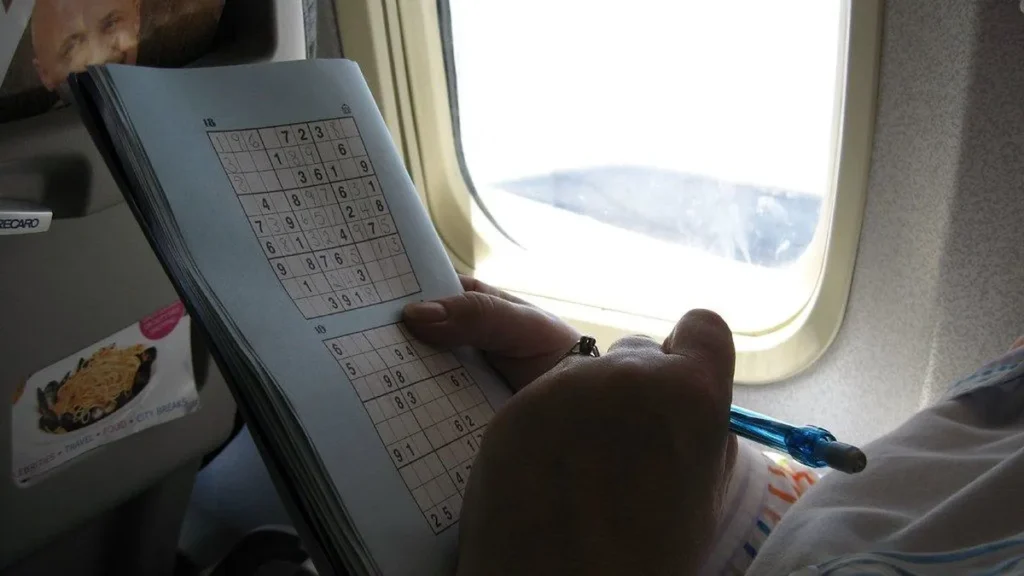
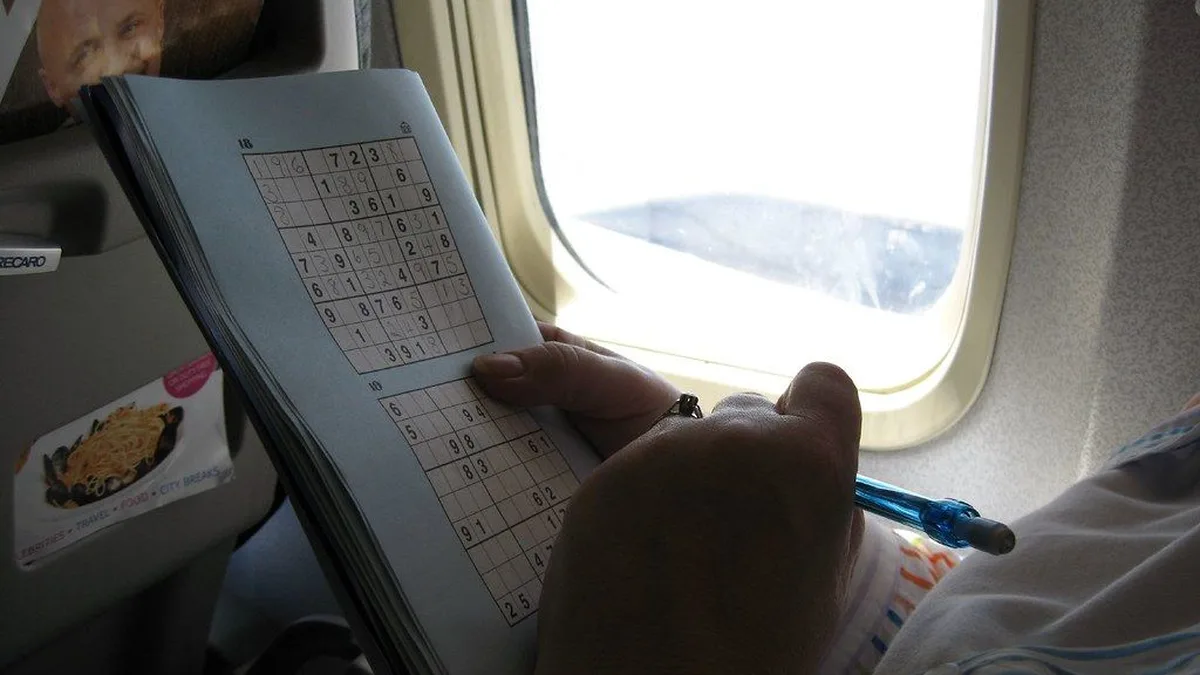
The strongest argument for the puzzle book is also the simplest one, and it is the one that sounds boring until it saves your afternoon. It has no battery to die, no signal to lose, and no software to update at the worst possible moment. The plane is in the air and the Wi-Fi costs more than lunch, the train is cutting through a valley where the bars on your phone have given up entirely, the coach is somewhere between towns and the charger is at the bottom of your bag under a sandwich. The book does not care. It works in a tunnel. It works at thirty thousand feet. It works on a ferry in the rain, where your phone screen is too wet to read.
It fits the shape of a journey
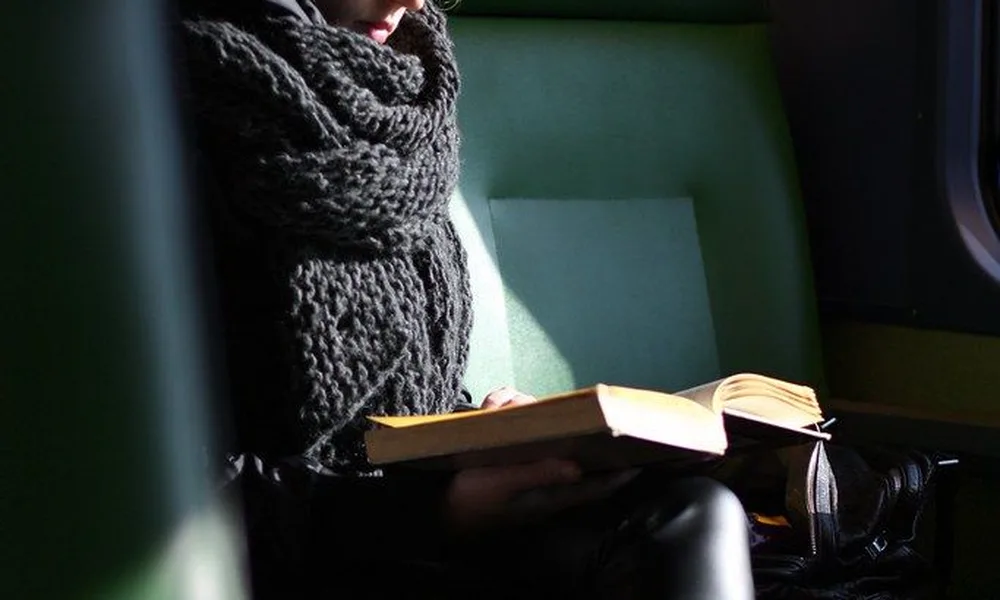
A good travel companion has to fit the places a journey actually puts you in, and this is where the puzzle book quietly beats nearly everything else. It fits on a tray table with room to spare for a cup of tea. It fits on your lap in a car without sliding off at the first bend. It fits in the seat pocket in front of you, in the side pocket of a rucksack, and in the top of a suitcase where you can reach it without unpacking your whole life. It weighs less than a paperback and takes up less room than a scarf, and it never needs a table at all if you are happy to balance it on your knees.
More importantly, it fits the interruptions. Travel is a series of small stops and starts: tickets, announcements, passport checks, a trolley coming down the aisle, a child asking where you are going for the fifth time. Anything that demands an hour of unbroken attention is the wrong tool for this job. A puzzle book is built from pieces that take a few minutes each. You can finish one, put the pencil down, deal with whatever the journey has just thrown at you, and pick the book up again without losing your place. The page remembers where you stopped. It does not time out, it does not log you out, and it does not make you sit through an advertisement before it lets you continue.
Two heads, one page
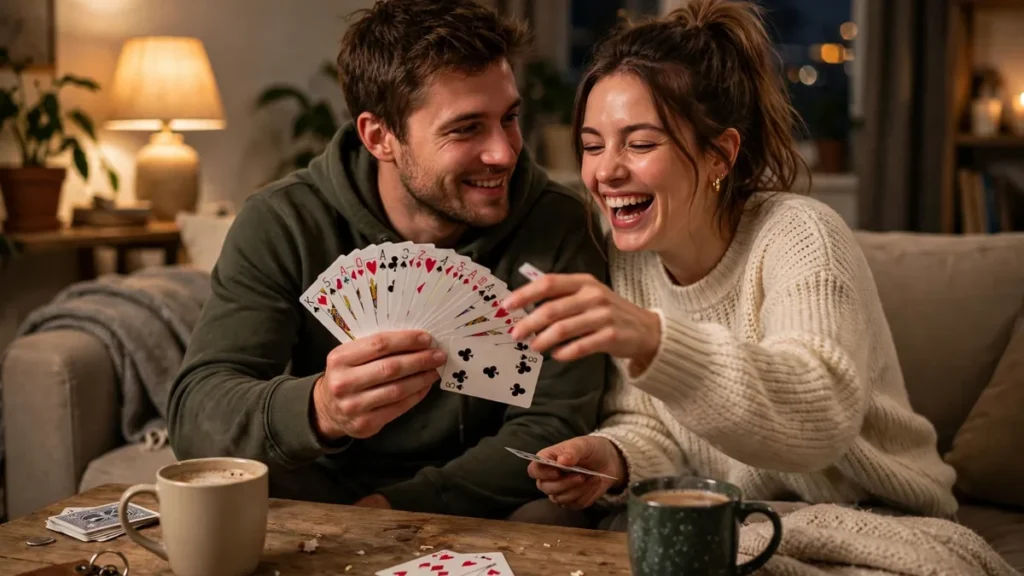
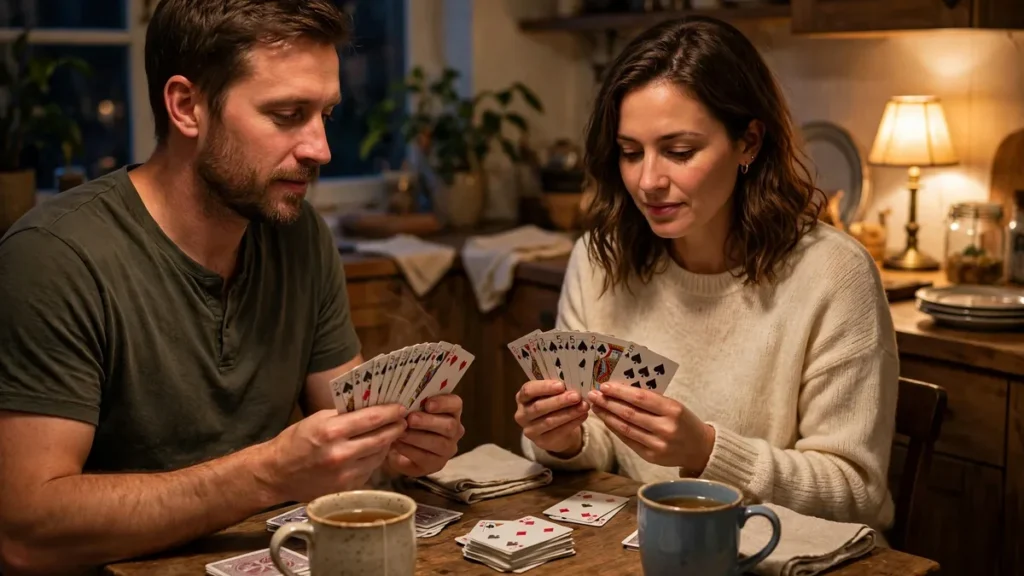
Solo solving is only half the story. The puzzle book comes into its own when there are two of you, and the journey gives you something that home rarely does: hours side by side with nothing else that needs doing. One person reads the clue aloud, the other stares out of the window thinking, and then the answer arrives from nowhere and both of you say it at the same time. It is a small moment, but it is the kind of moment a journey is made of, and it is the kind of moment a pair of headphones can never provide.
The ritual of packing it
Part of the pleasure starts before you leave. Choosing the book is a small ritual of its own, and it tells you something about the trip you are about to take. A short hop calls for something light, with quick puzzles you can finish between stations. A long haul calls for a thicker book, with a mix of easy pages for the tired hours and harder ones for the stretch in the middle when you are properly awake. Families pack one for the children and one for the adults, and the children always want the adults’ book, because the adults’ book looks like the one with the real puzzles in it.
Slow thinking in a fast world
There is a louder point underneath all of this, and it is the reason I think the puzzle book matters more now than it did twenty years ago. Travel used to have natural pauses built into it. You waited, you looked out of the window, you thought about nothing very much, and then you arrived. Now the pauses have been filled in. Every gap in the day is an opportunity to check something, and the checking never ends. The journey becomes a corridor between two lots of noise, and you arrive feeling as if you never actually left.
What makes a good one for the road
Not every puzzle book travels well, and the differences are worth knowing before you pack. The first thing is weight. A heavy hardback is a lovely object at home and a punishment in a bag. A slim paperback that bends without breaking is worth far more on a journey, and a book that opens flat without you having to hold it down with your elbow is worth its weight in gold, particularly on a tray table that is already too small.
The second thing is variety. A book of one puzzle type, repeated for two hundred pages, is fine for an enthusiast and a trial for everyone else. The books that survive a long journey are the mixed ones: a word grid here, a number grid there, a logic puzzle when you feel sharp, a word hunt when you feel tired. Different puzzles suit different hours of the day, and a journey has all of them: the bright morning hour, the sleepy middle, the stubborn evening when you refuse to admit you are tired. Variety is not a luxury here. It is how the book lasts the whole trip.
The third thing is forgiveness. Print that is too small will ruin a puzzle book faster than any hard clue, especially in the dim light of a coach or a night train. Answers at the back are not cheating; they are the safety net that lets you move on when a puzzle has beaten you fairly. And a book that lets you skip ahead without guilt is a better travelling companion than one that insists on being solved in order. You are on holiday, not at school. The book should know that.
The honest limits
A fair defence has to admit where the case runs out, and the puzzle book has real limits on the road. Motion sickness is the first of them. If reading in a moving car makes you feel ill, no puzzle in the world is worth the next three hours. Put the book away, look at the horizon, and try again on the train, where the ride is smoother. Dark cabins are the second. A night flight with the lights dimmed is no place for small print, and a pencil in the dark is an exercise in optimism. The third is the simplest: sometimes you are too tired to think, and the only honest entertainment is closing your eyes.
It has always been this way
None of this is new, and that is part of the charm. Long before phones, long before seatback screens, travellers filled the dead hours with whatever they could carry in a pocket: a folded newspaper, a small book of word grids, a pencil stub kept behind the ear. The crossword in the morning paper was, for generations, a travelling ritual as much as a breakfast one. People solved on commuter trains, on long-distance coaches, on ferries, in waiting rooms, in the back seats of cars, in every place where a person had to sit still and wait for the world to move them somewhere else.
The bottom line
So pack the book. Put it in the top of the bag, not the bottom, where you will have to dig for it. Bring a pencil, and a spare, because the spare is the one that will save the journey when the first one rolls away. Choose a mixed book with print you can actually read, and do not worry about finishing it. The point was never to finish it. The point was to have something worth doing while the world carried you somewhere new.
If you solve alone, the miles will feel like yours. If you solve together, the miles will feel like something you shared, and the half-finished page on the last morning will be a better souvenir than anything you could buy at the station. The puzzle book has been the perfect travel companion for as long as people have travelled with time on their hands and a pencil in their pocket. It was perfect then, it is perfect now, and it will still be perfect on the next journey, long after the battery has died and the signal has gone. If you want a broader picture of how puzzle books work as objects in their own right, our guide to what a riddle book is is a good place to start, and if you are travelling with children, the ideas in the best travel board games for kids pair well with a book in the bag. For the love of the daily grid itself, there is no better company than why we love crossword puzzles.