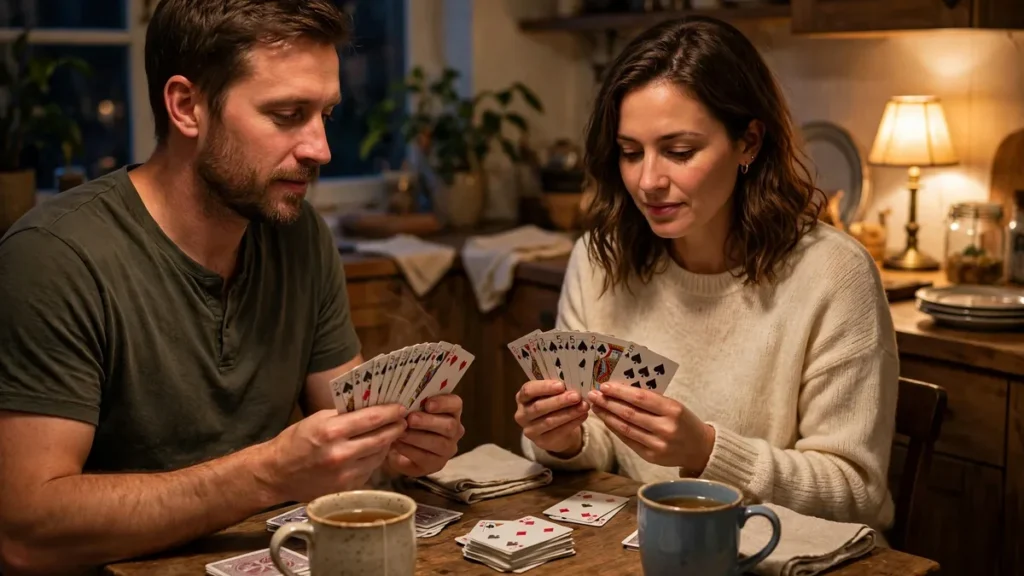
Pick up a riddle book, open it at random, and you will probably read the page twice. The first time, the answer seems nowhere in sight. The second time, after you have guessed and failed and guessed again, the answer suddenly feels obvious. That small moment of confusion followed by a click is why a simple paperback full of questions can keep a family busy for weeks.
A riddle book is a book filled with riddles, usually organised so you can dip in for one puzzle or work through the whole thing page by page. Some are thin collections you finish in an afternoon. Others are thick volumes with hundreds of puzzles and answers tucked away at the back. Instead of telling you a story, the book asks you questions, and the fun is in working out the answers for yourself.
Key takeaways
- A riddle book is a printed collection of riddles, usually grouped by theme or difficulty, with the answers kept separate so you cannot spoil them by accident.
- The main types are general collections, themed books, age-specific books, activity books, and puzzle-hunt books.
- Pick by age and difficulty first, then check the variety of riddles and how the answers are laid out.
- A good riddle book works at home, in a classroom, and at a party, because one riddle at a time is enough to start a conversation.

What Is a Riddle Book?
A riddle book is a book whose main content is riddles: short questions or descriptions that hide an answer you have to work out. Each riddle is usually printed on its own, with a number or a heading, and the answer is printed somewhere else, often upside down at the bottom of the page or in a separate section at the back. That separation is what turns a list of questions into a game. You can read a riddle, think about it, argue about it with the person next to you, and only look at the answer when you are ready. If you want a fuller explanation of the puzzles themselves, our guide to what a riddle is covers the definition, the history, and what makes a riddle work.
The format has been around for a long time, and it has survived because the idea is so simple. A book needs no battery, no signal, and no screen. The difference between a good riddle book and a poor one is editing: a good editor leaves out the unfair riddles, the ones with no real answer, and the ones that are just jokes wearing a question mark.
What Is Inside a Riddle Book?
Open most riddle books and you will find the same basic parts, arranged in slightly different ways. The riddles themselves come first. In a typical book they are numbered, sometimes a hundred of them, sometimes a thousand, and each one is short, usually one to four lines. Some books print one riddle per page with plenty of white space; others fit several on a page. What matters is whether the riddles are readable and the page feels inviting rather than cramped.
Then there are the answers. In the best books, the answers are easy to find but hard to see by accident. Common layouts include answers printed upside down at the foot of the page, answers collected at the end of each chapter, and answers gathered in a single section at the back. The back-of-the-book layout is the safest, because it removes all temptation to peek. A book that prints the answer directly under the riddle is a poor design, because it spoils the puzzle before you have had a chance to think.
The Main Types of Riddle Books
Not all riddle books are the same, and the type matters more than the cover. General collections are the most common. They contain a wide mix of riddles with no single theme: animals, objects, food, nature, wordplay, and logic. A general collection is the best first riddle book to buy.
Themed riddle books focus on one subject, such as animals, the sea, space, food, or spooky riddles for Halloween. A themed book is a good choice when you know the reader’s interests, or when you need riddles for a particular occasion.
Age-specific books are written for a particular age group, and the age on the cover is worth trusting. Books for younger children use simple words, short riddles, and friendly illustrations, and the answers are usually things a child already knows, like a banana, a mirror, or a cat. Books for older children add wordplay and logic, while books for adults use harder vocabulary and trickier misdirection. If you are shopping for a child, our round-up of the top riddle books for kids is a useful place to start.
Activity and puzzle books mix riddles with other puzzles, such as crosswords, word searches, mazes, and brain teasers. They suit readers who like variety and make a good travel companion. The trade-off is depth: a book that tries to do everything rarely has the best riddles.
Puzzle-hunt and treasure-hunt books are the most unusual type. Instead of a list of separate riddles, the book tells a story or sets a quest, and each riddle is a clue that leads to the next one. Some are solved at home, one page at a time. Others send players around a house, a garden, or a neighbourhood. They are wonderful for parties, but usually a one-time experience.

How to Pick the Right Riddle Book
Choosing a riddle book is easier than it looks, as long as you check a few things before you buy. Start with the reader, not the cover. Match the age and reading level. A riddle that uses words the reader does not know is a wall, not a challenge. Flip to the middle of the book and read five riddles. If the reader understands the words but still has to think about the answer, the level is right.
Check the difficulty range. A good riddle book has a spread of difficulties: easy riddles build confidence, medium riddles do most of the work, and hard riddles give the book a longer life. A book where every riddle is the same difficulty gets boring fast, in either direction.
Look for variety. Read ten riddles in a row. If they all use the same trick, the book will feel repetitive after twenty pages. A good book mixes “what am I?” riddles, wordplay, logic puzzles, trick questions, and rhyming riddles, so different people in a family will each find something they enjoy.
Check the answer layout and the format. Make sure the answers are separated from the riddles and easy to find when you want them. Answers at the back of the book are the safest. A small paperback fits in a bag and survives being carried around, which matters for a book used on trips. Finally, read a few pages before you buy. The cover tells you nothing about the quality of the riddles. The first ten riddles tell you almost everything.
How to Use a Riddle Book at Home, in Class, and at Parties
At home, the best approach is one riddle at a time. Read a riddle aloud at breakfast, or in the car, or while dinner is cooking, and let everyone have a guess. Do not rush to the answer. The thinking is the fun, and a riddle that is solved in ten seconds is worth less than a riddle that is argued about for ten minutes. If nobody gets it, give a small hint rather than the answer. A hint keeps the game alive. An answer ends it. Many families read one riddle a night before bed, which turns the book into a shared routine and makes it last for months. Let children take turns being the riddle reader, too. The child gets to be in charge while the adults guess, which builds reading confidence.
In a classroom, a riddle is a lesson disguised as a game. A riddle about an animal can introduce a science topic. A riddle about a word can introduce a spelling rule. The simplest use is a warm-up: write one riddle on the board at the start of the lesson and let the class work on it while they settle in. Riddle books also work well for group work. Split the class into small teams, give each team a page of riddles, and let them race to solve the most in ten minutes. For older students, a riddle book can be a writing prompt. After solving a few riddles, ask students to write one of their own. To write a riddle, a student has to choose an answer, list what is true about it, and describe it in a misleading way. If you want a structured method for that, our guide on how to write a riddle walks through the steps one by one.
At a party, a riddle book is one of the cheapest games you can own, and one of the most reliable. It needs no setup, no pieces to lose, and no rules to explain. The simplest game is a straight quiz: the host reads a riddle, the first person to answer correctly scores a point, and the person with the most points wins. Keep the rounds short, about ten riddles each, and mix easy and hard ones so everyone gets a turn at winning. For a children’s party, use the book as a treasure hunt. Write the answers to a chain of riddles on small cards, hide the cards around the house or garden, and let each riddle lead to the next hiding place. One warning: choose your riddles in advance. Read through the book the night before, mark ten or fifteen that you know work, and ignore the rest. A short list of strong riddles beats a long list of average ones every time.
What Makes a Good Riddle Book?
After looking at enough riddle books, a pattern emerges. A good riddle book has fair riddles. Every clue is true, and when the answer is revealed, every clue fits. If a riddle can be solved only by guessing something the reader could not possibly know, it is not a riddle, it is a trick, and it will annoy the reader. A good riddle book also has one clear answer per riddle. If three different answers all seem to work, the riddle is unfinished.
A good riddle book is well organised and built to last. The riddles are grouped, the answers are easy to find, and the difficulty rises gently as the book goes on. There are enough hard ones to come back to, enough favourites to re-read, and enough variety to suit different moods. Watch out for the warning signs: a book full of riddles you have seen a hundred times before, answers printed next to the questions, or a book that is mostly jokes with a few riddles mixed in.
Frequently Asked Questions
What age is a riddle book suitable for? There is a riddle book for almost every age. Books for young children use simple words and familiar answers. Books for older children add wordplay and logic. Books for teenagers and adults use harder vocabulary and trickier misdirection. Check the age range on the cover, then read five riddles in the middle of the book.
Are riddle books good for children? Yes. Riddles build vocabulary, because they describe familiar things in unfamiliar words. They build thinking skills, because the solver has to look at a problem from a different angle. They build reading confidence, because the riddles are short and the reward is immediate. They also build social skills, because riddles are meant to be shared.
How many riddles does a riddle book usually have? A small gift book might have fifty riddles. A standard paperback usually has between one hundred and three hundred. A large collection can have five hundred or more. The number matters less than the quality. A book with one hundred good riddles beats a book with five hundred forgettable ones.
The Bottom Line
A riddle book is a simple thing: a collection of questions that hide their answers, printed in a form you can carry anywhere and share with anyone. It needs no screen, no battery, and no instructions, and it works for a child learning to read, a teacher warming up a class, or a room full of adults at a party. The best ones are fair, varied, well organised, and built to last, and the best way to find one is to read a few pages before you buy. Pick a book that matches the reader, start with one riddle at a time, and let the guessing do the rest.