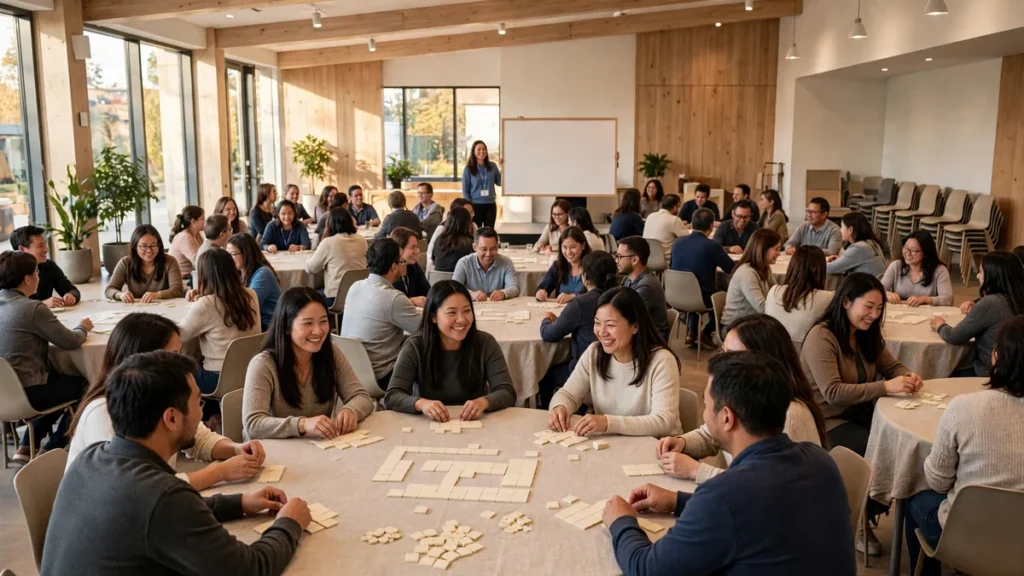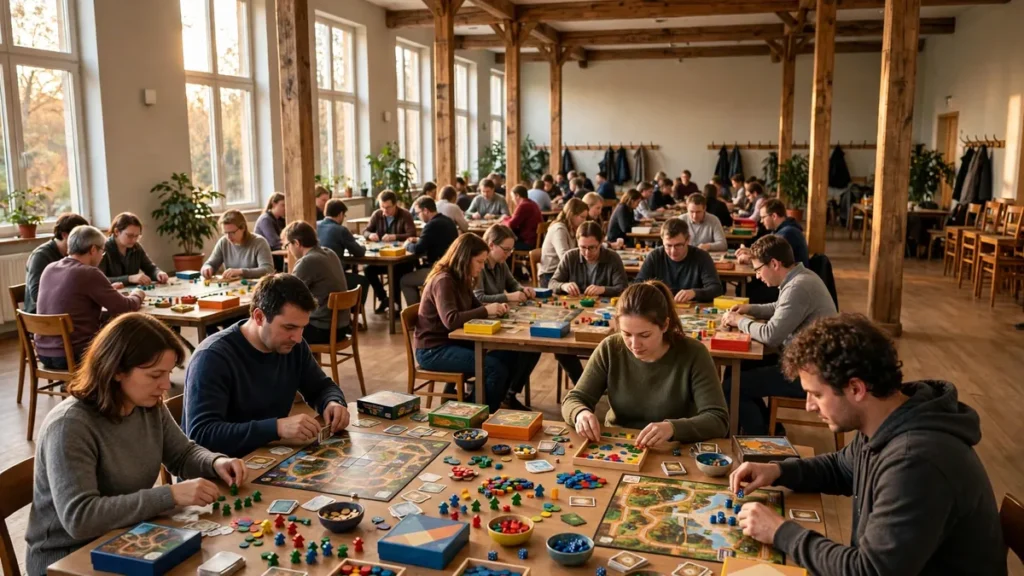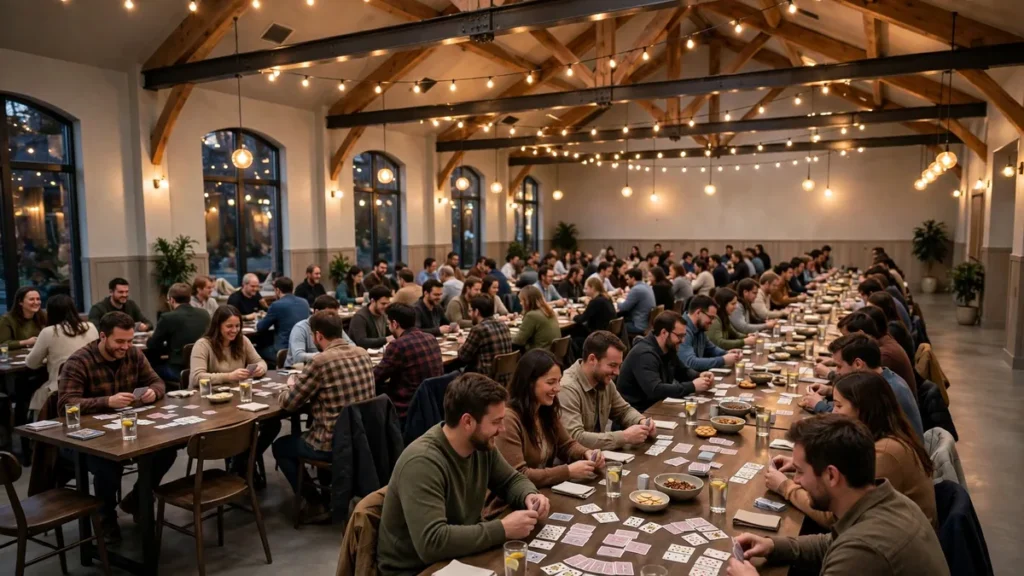
Planning the best party games for 166 players is a different kind of challenge from planning games for a dozen friends around a table. With 166 people in the room, no single board game, card game, or party game will seat everyone at once, and pretending otherwise is the fastest way to leave most of your guests standing around with nothing to do. The good news is that a group of 166 is not too big to play together. It is simply big enough that the games have to be organised in a different way, with teams, tables, rounds, and a few whole-room games that bring everyone back together.
The secret to the best party games for 166 players is structure. Instead of looking for one game that fits 166 people, the best hosts build a mix: a whole-room opener that gets all 166 laughing at the same time, several table games running in parallel so that every guest is playing at once, and a tournament or relay format that lets teams compete, rotate, and meet new people. When the structure is right, a crowd of 166 feels energetic rather than chaotic, and nobody spends the evening waiting for a turn that never comes.
This guide covers the games that genuinely work for 166 players, the team sizes and table counts that make them run smoothly, a sample schedule you can copy, and the mistakes that turn a big party into a long queue. Whether you are planning a company celebration, a school reunion, a wedding reception, or a community gathering, these are the party games that keep 166 players involved from the first minute to the last.
Key takeaways
- No single game seats 166 players, so plan team play, multiple tables, tournaments, relays, and whole-room games instead.
- Split 166 guests into teams of 6 to 10 players for the best balance of energy, fairness, and easy rotation between games.
- Start and finish with a whole-room game so all 166 players share at least two moments together.
- Run at least 12 to 16 table games in parallel so every guest is playing at the same time, not waiting for a turn.
- Keep rounds short, score simply, and announce results often, because a big crowd loses focus faster than a small group.
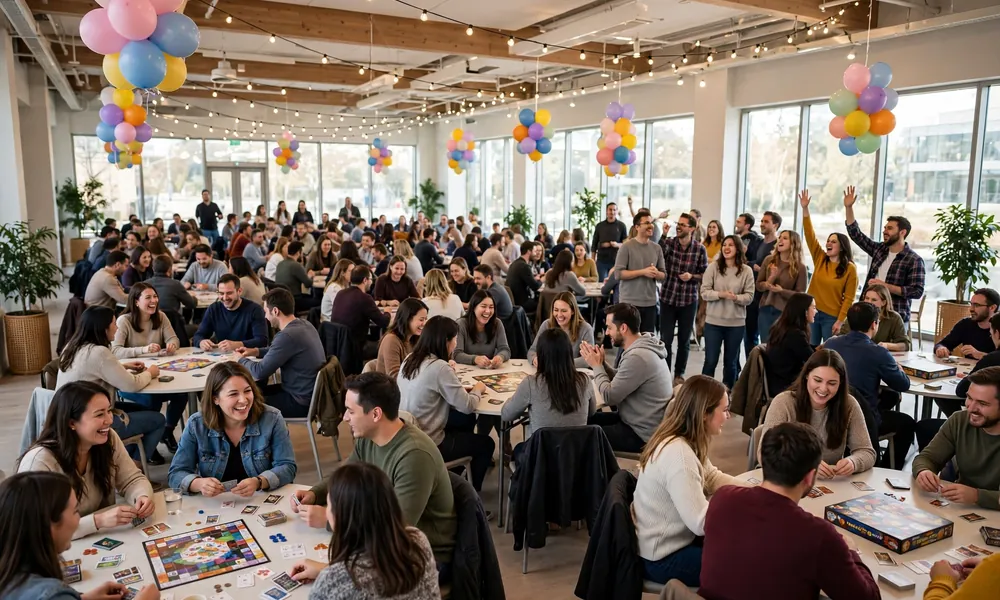
Best Party Games for 166 Players at a Glance
Use this table to compare the strongest options for a group of 166. Every game below works in a team, table, or whole-room format, and every one can be run in parallel so that no guest is left waiting.
| Game | Format | Players per round | Best for |
|---|---|---|---|
| Whole-room trivia quiz | Whole room | All 166 | Opening and finale |
| Bingo | Whole room | All 166 | All ages, low pressure |
| Human bingo | Whole room | All 166 | Icebreaker, meeting people |
| Team relay race | Tournament | 16 to 20 teams | Energy and excitement |
| Card games at tables | Parallel tables | 6 to 10 per table | Fast, familiar play |
| Party board games | Parallel tables | 6 to 10 per table | Drawing and guessing fun |
Why 166 Players Changes Everything
Most party games are designed for 4 to 12 players. A game that is brilliant for eight people can become unplayable for 166, not because the game is bad, but because the waiting time grows with every extra player. If each player takes just 30 seconds per turn, a single round for 166 players would take more than 80 minutes, and most guests would have stopped paying attention long before their turn arrived. That is why the best party games for 166 players are chosen for how they scale, not just for how fun they are in a small group.
Scale changes three things at once: turn length, noise, and fairness. Turn length matters because attention fades while people wait. Noise matters because 166 people talking at once can drown out instructions, so games need clear signals, visible scoreboards, and a host who can be heard. Fairness matters because guests notice quickly when one team gets an easier draw or a longer turn, and a big group has many more people ready to point that out. The games in this guide handle all three by keeping turns short, keeping instructions visible, and keeping every team on the same clock.
Experience from slightly smaller crowds is useful here. The ideas behind the best party games for 164 players translate almost directly to 166, because the two group sizes need the same team structure, the same number of tables, and the same mix of whole-room and parallel games. Two extra players change nothing about the format, which is a useful reminder that the plan matters far more than the exact headcount.
The Simple Math: Teams, Tables, and Rounds
Before choosing any games, do the simple maths that decides whether your party works. Divide 166 players into teams, divide the teams across tables, and divide the evening into rounds. If the numbers work on paper, they will work in the room. If they do not, no amount of enthusiasm will fix them on the night.
Teams of 6 to 10 players are the sweet spot for 166 guests. Teams of 8 give you 20 teams with 6 players left over, which you can handle by making two teams of 9 or by adding two floating players who join the quiz rounds. Teams of 10 give you 16 teams with 6 left over, which works well if you want fewer, larger teams for whole-room games. Teams smaller than 6 create too many teams to manage, and teams larger than 10 leave quieter players with no real role. Pick one team size, stick to it for the whole evening, and give every team a name, a colour, and a captain.
Table games need roughly one table for every 8 to 10 players, so plan for 17 to 21 tables if every guest plays a table game at the same time. That sounds like a lot, and it is, but most venues that hold 166 people already have that many tables, and you can use the same tables for dinner, for table games, and for the final scores. If you have fewer tables, run the table games in two waves instead: half the guests play while the other half play a whole-room game, then swap. The key rule is that nobody should be without a game for more than ten minutes.
Rounds should last 15 to 20 minutes each. Three rounds of table games, plus a whole-room opener and a whole-room finale, fill a 90-minute party programme neatly. Short rounds keep energy high, let teams rotate to a new game, and give the host a natural moment to update the scoreboard. Long rounds do the opposite: the fastest teams finish early and get bored, while the slowest teams feel rushed when the host calls time.
How Many Hosts and Helpers Do You Need?
A party of 166 needs more than one host. Plan for one main host who runs the whole-room games and keeps the schedule, plus one helper for every 4 to 5 tables. That means 4 to 5 helpers for a full parallel session. Helpers explain rules at their tables, keep scores, settle friendly disputes, and signal the main host when a table is ready to rotate. Without helpers, the main host spends the whole evening running between tables instead of hosting.
Whole-Room Games That Seat All 166 at Once
Whole-room games are the backbone of any party for 166 players, because they are the only games in which every guest plays at the same time. They work best at the start, when you need to turn 166 separate arrivals into one crowd, and at the end, when you want a shared finish. Keep them simple, visible, and loud enough to be fun from the back of the room.
A whole-room trivia quiz is the most reliable opener for 166 players. Teams answer the same questions at the same time, write answers on a card or a phone, and hand them in for scoring. Ten questions per round is enough, and you can run three rounds in 30 minutes. Mix the questions across music, food, films, sport, and general knowledge so that every team has a round where it shines. Trivia works because nobody waits for a turn, every team is always involved, and the scoreboard gives the whole room something to follow. The format is close to the trivia games for 164 players that work so well for very large groups, and the same question sets, answer cards, and scoring sheets work for 166 with no changes at all.
Bingo is the second great whole-room game for 166 players, and it deserves more credit than it usually gets. Every guest gets a card, the host calls the numbers, and the whole room plays at once. Bingo needs almost no explanation, it works for every age, and it creates genuine excitement when several teams are one number away from a win. Use printed cards rather than phones if you can, because paper cards keep everyone looking at the same game instead of at their screens, and they double as a keepsake.
Human bingo is the icebreaker version, and it works brilliantly as the first game of the evening. Each guest gets a grid of prompts such as find someone who has visited three countries, find someone who can juggle, or find someone who shares your birthday month. Guests move around the room, introduce themselves, and collect signatures. Give it 15 minutes and a small prize for the first completed grid, and by the end of it, 166 strangers will have spoken to at least a dozen new people.
Table Games That Work in Parallel
Table games are where the real playing happens at a party for 166 players. While the whole-room games bring everyone together, the table games give every guest something to do with their hands, their team, and their wits. The trick is to choose games that are quick to learn, quick to finish, and fun to watch as well as to play.
Card games are the easiest table games to run in parallel, because a deck of cards is cheap, portable, and familiar to almost everyone. Set up several tables with different card games so that teams can choose what suits them, and rotate after 15 minutes so that every team tries at least three games. The card games for large groups that work best at this scale are the ones with simple rules, short rounds, and room for 6 to 10 players at a table, because those are the games a helper can explain in under a minute and a team can finish before the rotation bell.
Board games work well too, provided you choose the right ones. Pick games with short turns, simultaneous play, or team play, and avoid games where one player takes a long turn while everyone else watches. Party board games with drawing, guessing, or word clues are ideal, because the whole table is involved even when it is not their turn. Put one board game on every second table and a card game on the others, so that teams get a mix as they rotate.
Tournaments and Relays for 166 Players
Tournaments turn a party for 166 players from a set of separate games into a single story. Teams collect points across the evening, the scoreboard moves after every round, and the finale feels like a final rather than just another game. You do not need a complicated system. Simple points work best: 10 points for first place in a round, 7 for second, 5 for third, and 3 for everyone who finishes. Add the points up, announce the top five teams after each round, and save the full ranking for the finale.
Relay races are the most energetic tournament format for 166 players, and they work indoors or outdoors. Divide each team into smaller groups and set up a course with simple tasks: a beanbag toss, a balloon pop, a puzzle piece, and a sprint back to the team. Each player completes one task, tags the next player, and the team that finishes first wins the round. Relays are fair, because every team runs the same course, and they are exciting to watch, because the lead changes hands several times in a single race.
Keeping Score Fairly With 166 Players
A Sample 90-Minute Schedule for 166 Players
A schedule is what turns a list of games into a party. Without one, the evening drifts, the best games run out of time, and the finale feels rushed. With one, the host always knows what happens next, the helpers always know where to be, and the guests always know what to expect. This 90-minute schedule is a proven shape for 166 players, and you can stretch it to two hours by adding a second round of table games.
Party Games for 166 Players Checklist
Use this checklist in the week before the party, and tick each item off as you complete it. A party for 166 players has too many moving parts to plan from memory.
- Confirm the venue holds 166 guests with space for 17 to 21 tables and a clear area for whole-room games and relays.
- Split the guest list into teams of 6 to 10 players, assign team names and colours, and print a team list for the door.
- Choose one whole-room opener, at least three table games, and one whole-room finale, and test each game with one table.
- Book a microphone, a speaker, a projector or large screen, and a visible scoreboard, and test the sound before guests arrive.
- Recruit one main host and 4 to 5 helpers, give each helper a one-page rules sheet, and walk them through the rotation plan.
- Prepare answer cards, score sheets, pens, dice, card decks, prizes, and a camera, and pack spares of everything small enough to lose.
Frequently Asked Questions
Can one game really seat 166 players?
No single board game or card game seats 166 players at once, and any plan that promises otherwise should be treated with suspicion. What works for 166 players is a mix of whole-room games, where everyone plays at the same time, and parallel table games, where every guest plays at their own table. Together, those formats give all 166 players a game at every moment of the evening.
How many teams should 166 players form?
Teams of 8 are the easiest starting point, giving you 20 teams with a few players to distribute, while teams of 10 give you 16 teams with the same small remainder. Either size works well. The important thing is to keep every team roughly the same size, because a team of 12 playing against a team of 6 is not a fair contest, and the smaller team will notice.
How long should a party for 166 players last?
Ninety minutes of organised games is the right length for most parties, with arrival time and a meal or drinks either side. Shorter than an hour feels rushed, because teams barely settle before the finale, and longer than two hours of continuous games leaves guests tired. If your event runs longer, add a break for food and conversation in the middle rather than adding more games.
What if the venue only has 10 tables?
Run the table games in two waves. Half the teams play table games while the other half play a whole-room game, then swap after 15 minutes. Nobody waits for more than a few minutes, every guest plays the same games, and the whole-room game keeps the waiting half entertained. You will need a second host or helper to run the whole-room game while the main host manages the tables.
What games work best for mixed ages?
Whole-room quizzes, bingo, human bingo, team relays, and simple card games work for the widest age range, because they need no special knowledge and no physical skill beyond moving around the room. Avoid games that rely on recent films, current slang, or fast reactions, because those favour one age group over another. Mix the quiz questions across decades so that every generation has a round it can win.
How do you keep 166 players from getting bored?
Keep rounds short, rotate games often, update the scoreboard after every round, and never leave a team without a game for more than ten minutes. Boredom at a large party almost always comes from waiting, not from the games themselves, so the schedule matters more than any single game. If a game is dragging, cut it short and move on while the energy is still high.
The Bottom Line
The best party games for 166 players are not the biggest games or the loudest games. They are the games that give all 166 guests something to do at the same time, whether that is answering a quiz question with their team, playing cards at a table of eight, or racing a relay in front of a cheering room. Build the evening around teams of 6 to 10, whole-room games at the start and the end, parallel table games in the middle, and a simple scoreboard that everyone can follow. Do that, and 166 players will feel like one party, not a crowd waiting for a turn.