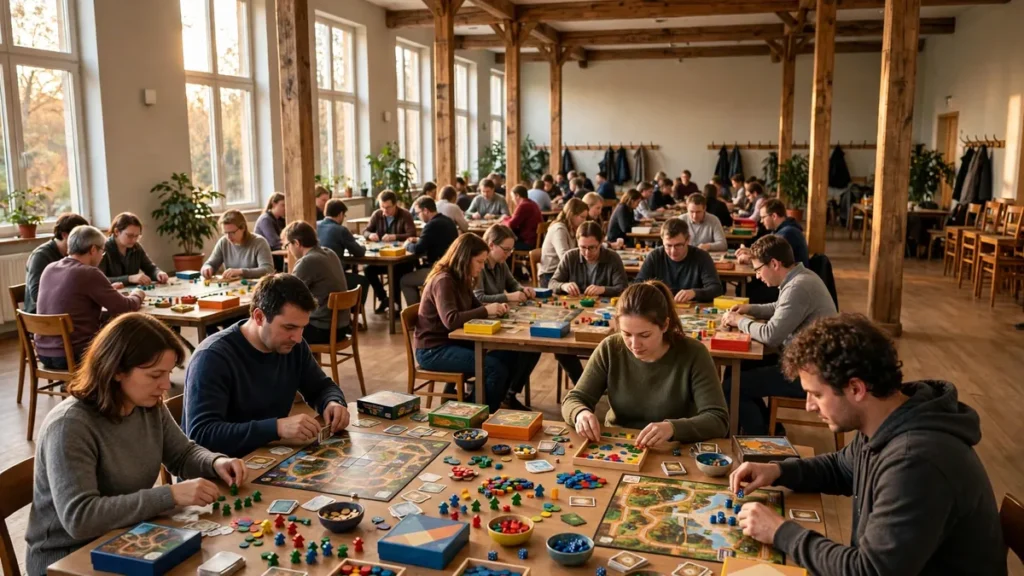
Finding the best board games for 173 players is a very different challenge from choosing a game for a family night. No single board game on the shelf seats 173 people around one table, and any list that pretends otherwise is not being honest with you. The good news is that 173 players can still enjoy a brilliant board game night together, as long as you plan it the right way, with the right games, the right format, and enough tables, teams, and hosts to keep everyone playing at the same time.
A group of 173 players is really a small festival, a school hall full of guests, a company away day, or a community event that happens to love board games. The secret is not to hunt for one magical box that holds everyone. It is to choose games that split neatly into teams, run well across many tables at once, or turn the whole room into a single game. When you do that, 173 players stops feeling impossible and starts feeling like the best game night you have ever organised.
This guide explains exactly how to do it. You will find the honest truth about player counts, the formats that actually work for 173 people, the best board games for each format, a comparison table to help you choose, a planning checklist, and answers to the questions every large-group organiser asks. Everything here is practical, tested in spirit by the way large game nights really run, and designed so that nobody spends the evening watching from the sidelines.
Key takeaways
- No single board game seats 173 players, so plan for teams, multiple tables, tournaments, or whole-room play instead of one giant table.
- Team games such as Codenames and Wavelength scale best, because one copy can involve dozens of players at once.
- Tournament formats let strategy games such as Ticket to Ride, Catan, and Azul work for 173 players across many simultaneous tables.
- Budget for at least 25 to 30 tables, one host or scorekeeper per table, and several copies of each game you choose.
- Keep rounds short, score simply, and rotate players between games so everyone meets new people and tries something different.

Why 173 Players Changes Everything
Most board games are designed for two to six players, and even the biggest party games usually stop at eight, ten, or twelve. That is not a flaw in the games. It is simply how board games work. A game needs turns, decisions, and a shared board or set of cards, and all of those become slow and confusing when too many people try to share them. With 173 players, the challenge is not finding a bigger box. It is designing an event where 173 people all feel like players, not spectators.
The first decision you need to make is what kind of evening you want. A relaxed social night suits team games and whole-room games, where the atmosphere matters more than the final score. A competitive night suits a tournament, where tables play the same game and winners advance to a final. A mixed event, which works well for 173 players, combines both: team games in the first half, a tournament in the second, and a whole-room finale that brings everyone back together.
Space matters just as much as the games. A group of 173 needs a hall, a large function room, or several connected rooms, with enough tables for everyone to sit comfortably. Plan for roughly one table per four to six players, which means about 30 to 40 tables, plus space for a welcome area, a scoreboard, and a place to store spare games. If the room feels crowded, people will drift away, so leave generous walkways between tables and keep the noise level in mind.
The Honest Truth About Games That Seat 173
Let us be completely clear: no board game seats 173 players at one table. Some games claim very high player counts, but they usually mean that many people can shout answers, vote, or join a team, not that 173 people can each take a turn around a single board. That distinction matters, because an organiser who buys one copy of a game expecting it to serve 173 people will be disappointed on the night.
What does work is scale by design. A game such as Codenames works for a huge group because players join two teams and the whole team discusses each clue together. A game such as Wavelength works because everyone in the room can debate where a target falls on a scale. A game such as Dixit works in a tournament because many tables can play it at once and compare scores. The game itself does not need to hold 173 people. The event format does.
Team Play
In team play, a large group splits into two or more teams, and each team plays as a single unit. One person gives a clue, moves a piece, or makes a decision on behalf of the team, while everyone else discusses, debates, and suggests ideas. This format is ideal for 173 players because it turns a game designed for six people into a game for sixty or more, without changing the rules very much at all.
Team play also solves the social problem of a very large group. People who arrive alone or who do not know many others can join a team and immediately have a role. Shy players can contribute quietly, confident players can lead discussion, and nobody is put on the spot alone. If you want your 173 players to talk to each other, team play is the fastest way to make it happen.
Multiple Tables
Multiple tables is the simplest format of all. You set up many tables, put a copy of a game on each one, and let groups of four to six players enjoy a normal game. With 173 players, you might run 30 tables at once, with five or six different games in rotation. Players stay at a table for one round, then move to a new table and a new game, meeting new people each time.
This format works best when you have enough copies of each game, enough hosts to explain the rules, and a clear rotation plan. It is also the most flexible format, because a table that finishes early can start a short filler game while it waits. For a mixed group with different tastes, multiple tables are hard to beat, because every player can find a game they enjoy.
Tournaments
A tournament takes the multiple-table format and adds competition. Every table plays the same game, scores are recorded, and the best players or teams advance to the next round. With 173 players, you might start with 30 tables, then narrow to eight tables, then to a final table of four to six players, with the rest of the room watching and cheering.
Tournaments need careful planning. You need a simple scoring system, a visible leaderboard, and a host who can keep rounds moving on time. You also need games that are fair, quick to learn, and short enough to play several times in an evening. When it works, though, a tournament gives 173 players a shared story: everyone remembers who won, who made the surprise comeback, and which table produced the closest finish.
Whole-Room Games
Whole-room games involve everyone at once, usually with a single host, a screen or a large board, and simple actions such as voting, guessing, or shouting answers. These games are perfect as an opening activity, a break between rounds, or a finale, because they bring 173 players together after they have spent time in smaller groups. They are also the easiest format to run, since you only need one host and one set of materials.
The best whole-room games for 173 players are simple, visual, and fast. Think of guessing games, word games, and drawing games where the whole room can take part. Keep each round to a few minutes, keep the rules to one sentence, and keep the energy high. A good whole-room game should make the room laugh within the first minute, and it should end before anyone gets bored.
The Best Board Games for 173 Players
Now that you understand the formats, here are the best board games for 173 players, grouped by how they work at this scale. Each game below has been chosen because it is easy to learn, fun for mixed groups, and genuinely workable for a very large number of players when you use the right format. You do not need to buy all of them. Pick three or four that suit your group, buy enough copies, and build your evening around them.
Best Team Board Games
Codenames is the standout team game for a group of 173. Two teams compete to find their secret words on a grid, with one spymaster giving one-word clues. The whole team discusses each clue, so a single copy can involve dozens of players. For 173 players, split the room into several Codenames arenas, each with two teams, and run short rounds of 15 minutes. It is easy to learn, endlessly replayable, and it creates the kind of lively debate that makes a game night memorable.
Best Tournament Board Games
Ticket to Ride is a perfect tournament game for 173 players. It is easy to learn, quick to play, and it works the same way at every table, so scores are easy to compare. Buy several copies, run them at many tables at once, and record each table winner. The game is about collecting train cards and claiming routes across a map, and it strikes a lovely balance between luck and planning. If you are looking for a reliable tournament centrepiece, start here.
Best Whole-Room Board Games
How to Organise 173 Players on the Night
Good organisation is what turns a good game list into a great evening. Start by sending clear information before the event: the venue, the start time, the format, and a simple message that no experience is needed. Ask players to arrive on time, because a late start with 173 people can cost you half an hour before the first game even begins. A friendly welcome, a visible schedule, and a clear explanation of the first activity will settle everyone quickly.
Assign a host or a table leader to every table. The host explains the rules, keeps the game moving, records the score, and answers questions. You do not need 30 expert hosts. You need 30 friendly people who have played the game once before and are happy to help. Brief them before the event, give each one a short rules sheet, and make sure they know who to ask if a dispute arises. If you are comparing formats, the team approach used in board games for 172 players is a useful starting point, because it shows how a similarly huge group can be split into playable teams.
Comparison Table: Best Board Games for 173 Players
Use this table to compare the leading choices at a glance. The format column shows how each game scales to 173 players, the copies column is a rough guide for a full evening, and the round time is the length of a typical game at one table. Mix a team game, a tournament game, and a whole-room game for the most balanced evening.
| Game | Best format for 173 players | Players per table | Round time | Copies needed | Best for |
|---|---|---|---|---|---|
| Codenames | Team play | 8 to 20 per arena | 15 minutes | 6 to 8 | Word lovers and lively debate |
| Wavelength | Whole room or teams | Whole room | 20 minutes | 2 to 3 | Discussion and laughter |
| Ticket to Ride | Tournament | 4 to 5 | 45 minutes | 8 to 10 | Relaxed strategy |
| Catan | Tournament | 4 | 60 minutes | 8 to 10 | Trading and negotiation |
Equipment, Space, and Budget for 173 Players
Budget carefully, because 173 players need more equipment than a normal game night. The biggest cost is usually the games themselves. Buying eight to ten copies of a popular game is a real expense, so consider borrowing from a local game shop, a board game cafe, or a community group. Many shops are happy to lend games for a large event, especially if you mention the event in advance and take good care of the boxes.
Tables and chairs are the next consideration. If your venue does not provide enough, hire them in advance and check the layout the day before. Leave space for a welcome desk, a scoreboard, and a refreshments table, because 173 players will need drinks and snacks. Keep food away from the game tables if you can, or provide separate snack tables, so that cards and boards stay clean and dry.
Do not forget the small things: score sheets, pens, timers, a microphone, a bell for round changes, and spare dice and tokens. A simple printed score sheet, with space for the table number, the game, and each player’s score, will save your hosts a lot of confusion. Print more copies than you think you need, because sheets get lost, and a spare is always useful. For a different kind of large-group fun, the ideas behind party games for 171 players can inspire your whole-room rounds and your breaks between board games.
Planning Checklist for 173 Players
Use this checklist in the weeks before your event, and tick each item off as you complete it. It covers the essentials, from venue to prizes, and it will help you spot gaps while there is still time to fix them.
- Book a venue with space for 30 to 40 tables, walkways, a welcome area, and a scoreboard, and confirm the layout in advance.
- Choose three or four games that fit team play, tournaments, or whole-room formats, and secure enough copies for every table.
- Recruit and brief one host per table, with a short rules sheet for each game they will run.
- Prepare colour-coded teams, score sheets, pens, timers, a microphone, and a bell or signal for round changes.
- Plan a schedule of short rounds, with a whole-room opener, a tournament middle, and a lively finale, plus breaks for refreshments.
- Arrange prizes, a short prize ceremony, and a thank-you for hosts and helpers, and share photos and results with players after the event.
Frequently Asked Questions
Can one board game really seat 173 players?
No, no single board game seats 173 players around one table in the normal sense. Games that claim very high player counts usually mean that many people can join a team, vote, or shout answers. For 173 players, the honest approach is to use team play, multiple tables, tournaments, or whole-room games, so that everyone is genuinely playing at the same time.
How many tables do I need for 173 players?
Plan for about 30 to 40 tables, with four to six players at each one. The exact number depends on the games you choose and the size of your venue. Allow extra space for walkways, a welcome desk, and a refreshments area, and check the layout in advance so that nobody is squeezed into a corner.
What is the best game for a group of 173?
Codenames is often the best single choice, because it scales so well in teams and creates lively discussion. For a full evening, though, the best approach is a mix: Codenames or Wavelength for team play, Ticket to Ride or Azul for a tournament, and Monikers or Telestrations for a whole-room finale. That combination gives every kind of player something to enjoy.
How long should a board game night for 173 players last?
Three to four hours works well for most groups. That allows time for a welcome, two or three rounds of games, a break, and a finale with prizes. Shorter events can feel rushed, while longer events can tire players out, especially if the room is warm or noisy. Keep rounds short, keep breaks on time, and finish while the energy is still high.
Do I need experienced players to run an event for 173 people?
No, you do not need 173 experienced players. You need a small team of hosts who have played each game once before and can explain the rules simply. Most of your players can be complete beginners, as long as the games are easy to learn and the hosts are friendly and patient. Choose simple games, and your beginners will have a wonderful time.
How much will it cost to run board games for 173 players?
The cost depends on the venue, the games, and the refreshments, but the games are often the biggest variable cost. Borrowing games from a shop, a cafe, or a community group can keep costs low, while buying eight to ten copies of several games can be expensive. Start with the games you already own, borrow what you can, and buy only the copies you truly need. Word-based team games are also worth exploring, and the format used for word games for 171 players shows how a simple guessing game can involve a very large room at once.
The Bottom Line
The best board games for 173 players are not the ones with the biggest box or the highest player count on the cover. They are the games that work in teams, across many tables, in tournaments, and in front of a whole room, with simple rules, short rounds, and plenty of laughter. Choose three or four of them, plan your format carefully, recruit friendly hosts, and keep the schedule moving. Do that, and 173 players will not feel like a problem to solve. It will feel like the best board game night you have ever hosted.


