Finding the best puzzle games for 156 players starts with an honest truth: no single puzzle game seats 156 people around one table. A jigsaw puzzle built for a family of four does not magically stretch to a crowd the size of a wedding reception, and a crossword designed for one solver cannot hold the attention of a whole hall. That does not mean a 156-player puzzle night is impossible. It means the format has to change, and once it does, puzzle games become one of the best large-group activities you can run.
The secret is structure. Instead of one game for 156 people, you run many copies of the same puzzle at once, split the crowd into teams, and let the competition between tables do the work. A room of 156 players becomes 26 teams of six, or 13 teams of twelve, or a relay of squads racing through the same set of challenges. Every player stays busy, every team has a real chance to win, and the puzzles themselves stay exactly as satisfying as they are at home.
This guide covers the formats that actually work at this scale, the puzzle games that scale best, and a complete plan for running the night without chaos. Whether you are organising a school event, a company social, a church gathering, a camp reunion or a community fundraiser, these are the best puzzle games for 156 players, chosen because they survive contact with a very large crowd.
Key takeaways
- No single puzzle game seats 156 players, so the winning approach is team play, multiple tables, tournaments and relays rather than one giant game.
- Split 156 players into teams of six to twelve for the best balance of participation, pace and manageable scoring.
- Buy or print multiple identical copies of each puzzle so every team faces exactly the same challenge at the same time.
- Jigsaws, crosswords, Sudoku, escape-room style challenges, scavenger hunts and logic puzzles scale best to very large groups.
- Keep rounds short, score simply and visibly, and always run a practice round so every team understands the rules before the real competition starts.

Why 156 Players Changes Everything About Puzzle Games
Puzzle games are usually intimate. A jigsaw puzzle is a quiet evening activity. A crossword is a solo challenge. A Sudoku grid fits on a single page. The pleasure comes from focus, and focus is hard to protect when 156 people share one room. The noise alone changes the game, and so does the simple geometry of bodies around tables. If you try to run a puzzle night for 156 players the way you would run one for six, the result is a handful of confident players doing everything while everyone else watches.
The fix is to design for the crowd instead of fighting it. Teams turn a passive audience into active players, because every person has a role and every role matters. Parallel play keeps the pace up, because no team waits for another team to finish a turn. And visible scoring keeps the energy high, because a leaderboard on a wall gives 156 people a shared story to follow. When the format fits the crowd, puzzle games stop being a quiet hobby and become a proper event.
How to Run Puzzle Games for 156 Players
Every successful large-group puzzle event uses one of four formats, and most use a mix of two or three across the evening. Pick the format first, then choose the puzzles that fit it. The format decides how many copies you need, how many helpers you need, and how long each round takes.
Team Tables
Team tables are the simplest and most reliable format for 156 players. Divide the room into tables of six to twelve players, give every table the same puzzle, and start the clock. The first team to finish wins the round, or the team with the most progress when time runs out takes the points. With 156 players you will have somewhere between 13 and 26 tables, so buy or print that many identical copies of each puzzle. Identical copies matter, because the competition is only fair when every team faces exactly the same challenge.
Relay Races
A relay turns a puzzle into a race. Each team lines up and sends one player at a time to the puzzle station, where that player places a set number of pieces, solves one clue, or fills in one row before running back and tagging the next teammate. Relays are loud, physical and very funny, which makes them perfect for the middle of the evening when attention starts to dip. They also solve the crowding problem, because only a few players are at the puzzle at any one time while the rest of the team cheers.
Tournament Brackets
A tournament bracket gives a long evening a proper shape. Teams play head-to-head puzzle rounds, winners advance, and the field narrows until two teams meet in the final. With 156 players you can start with 26 teams of six and run five rounds to reach a champion, which fits comfortably into an evening if each round lasts 15 minutes. Brackets create natural drama, because every round eliminates teams and the stakes rise as the night goes on.
Whole-Room Games
Whole-room games involve all 156 players at once, with no tables and no teams, or with the whole room split into just two or three giant sides. A giant crossword projected on a screen, a riddle read aloud with hands raised to answer, or a scavenger hunt that sends everyone searching the venue all count as whole-room games. These work best as openers and closers, because they gather the crowd’s attention at the start and bring everyone back together at the end.
The Best Puzzle Games for 156 Players
The games below are ranked by how well they scale, how easy they are to run for a huge group, and how much fun they create at this size. Every one of them has been chosen because it works with team tables, relays, tournaments or whole-room play, and because it keeps all 156 players involved rather than leaving most of them watching. If your group is one player smaller, the best puzzle games for 155 players use the same formats and scale just as well.
1. Team Jigsaw Races
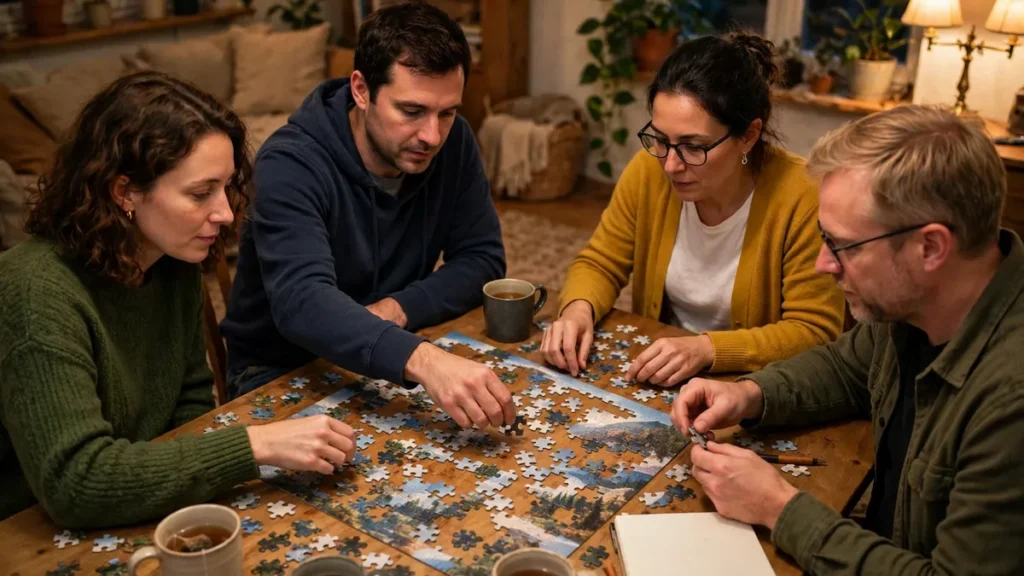
Jigsaw races are the classic large-group puzzle game for a reason. Give every team the same 500-piece puzzle, start the timer, and watch the room come alive. Jigsaws are wonderfully democratic, because anyone can find an edge piece or match a colour, and a team of mixed ages and abilities can all contribute. For 156 players, use 500-piece puzzles for a 20-minute round or 1,000-piece puzzles for a longer 45-minute challenge. Buy identical copies so the race is fair, and choose pictures with clear colour regions, because a puzzle that is all sky or all sea will frustrate even good teams.
2. Giant Crossword Tournaments
Crosswords scale brilliantly to large groups because they need almost no equipment. Print the same crossword for every team, hand out pencils, and start the clock. A good tournament crossword has a mix of easy and hard clues so that every team can make progress, and a theme that fits the occasion, such as the school, the company or the holiday being celebrated. Teams that finish first win, or the team with the most correct answers when time runs out takes the round.
3. Sudoku Showdowns
Sudoku is a perfect tournament puzzle because it is silent, fair and easy to score. Give every team the same Sudoku grid, set a time limit, and award points for the most correctly filled cells. Sudoku rewards careful logic rather than speed alone, which means thoughtful teams can beat fast ones, and that makes the competition feel fair to everyone. For 156 players, print the same puzzle for every table and use a medium difficulty, because a puzzle that is too hard will leave half the room stuck, while one that is too easy ends in a tie. The same team-table approach works for other game types too, and the best board games for 156 players show how a whole hall can play together at once.
4. Escape-Room Style Challenges
Escape-room style challenges bring adventure to a puzzle night. Instead of one room, you create a series of puzzle stations around the venue, and teams move from station to station solving codes, finding keys and unlocking the next clue. Each station takes five to ten minutes, so a team can complete the full circuit in about an hour. This format is ideal for 156 players because the crowd spreads out naturally, and no single station ever gets overwhelmed.
5. Scavenger Hunt Puzzles
A scavenger hunt turns the whole venue into a puzzle. Hide clues around the space, and give each team a first clue that leads to the next, and so on until the final location. Clues can be riddles, word puzzles, picture puzzles or codes, and each one should take a minute or two to solve. With 156 players, run the hunt in waves so teams do not bunch up at the same clue, or create several different routes that all lead to the same finish.
6. Logic Grid Tournaments
Logic grid puzzles, the kind where you work out who owns which pet or lives in which house, are made for team play. One player reads the clues aloud, another tracks the grid, and the rest of the team argues about the deductions. This division of labour makes logic puzzles ideal for teams of six to twelve, because everyone has a job and the solving is genuinely shared. Print the same puzzle for every table, and score on correct answers when time runs out.
7. Picture Puzzle Rounds
Picture puzzles include spot-the-difference, hidden-object images, tangram challenges and visual riddles. They are fast, visual and easy to project on a screen, which makes them perfect for whole-room rounds. Show the image on a large screen, give teams a minute to study it, and then ask a question, such as how many objects are hidden or what is different between the two pictures. Teams write their answers on cards, and the host reveals the correct answer to cheers or groans.
8. Riddle Relay Races
A riddle relay combines the best of word puzzles and physical races. Each team sends runners to a central table, where the runner reads a riddle, solves it, and runs back to tag the next teammate. The riddles should be short and solvable in under a minute, with a mix of easy and tricky ones so that every team can score. Riddle relays are noisy, fast and very funny, and they work well as the closing game of the evening because they leave the room buzzing.
Comparison Table: Best Puzzle Games for 156 Players
| Game | Best Format | Round Length | Equipment Needed | Best For |
|---|---|---|---|---|
| Team Jigsaw Races | Team tables | 20 to 45 minutes | Identical puzzles, mats | All ages, mixed ability |
| Giant Crossword Tournaments | Team tables or whole room | 15 to 20 minutes | Printed grids, pencils | Word lovers, low budget |
| Sudoku Showdowns | Team tables or relay | 15 minutes | Printed grids, whiteboard | Logic fans, fair scoring |
| Escape-Room Challenges | Stations circuit | 60 minutes total | Locks, clues, scorecards | Adventure, memorable nights |
| Scavenger Hunt Puzzles | Whole venue | 30 to 45 minutes | Hidden clues, maps | Active players, big venues |
| Logic Grid Tournaments | Team tables | 15 to 20 minutes | Printed grids, pens | Careful thinkers, semi-finals |
| Picture Puzzle Rounds | Whole room | 1 to 5 minutes | Projector or prints | Visual thinkers, tiebreakers |
| Riddle Relay Races | Relay | 15 to 20 minutes | Riddle cards, judge | Warm-ups, closing games |
Setting Up Your 156-Player Puzzle Event
A great puzzle night is mostly good planning. The puzzles matter, but the room, the materials, the scoring and the schedule matter just as much. Get these right and the evening runs itself. Get them wrong and even the best puzzles cannot save the night.
Space and Seating
You need a room that holds 156 people at tables with space to move between them. Plan for 13 to 26 tables depending on your team size, and leave wide aisles so helpers and runners can move freely. A school hall, a community centre or a large function room works well, and a venue with a stage or a raised area is ideal because the host can be seen and heard by everyone. Test the sound system in advance, because a host without a microphone cannot run a room of 156 players. Arrange the tables before anyone arrives, put a team number on each table, and have a clear entrance so players can find their team quickly.
Materials and Copies
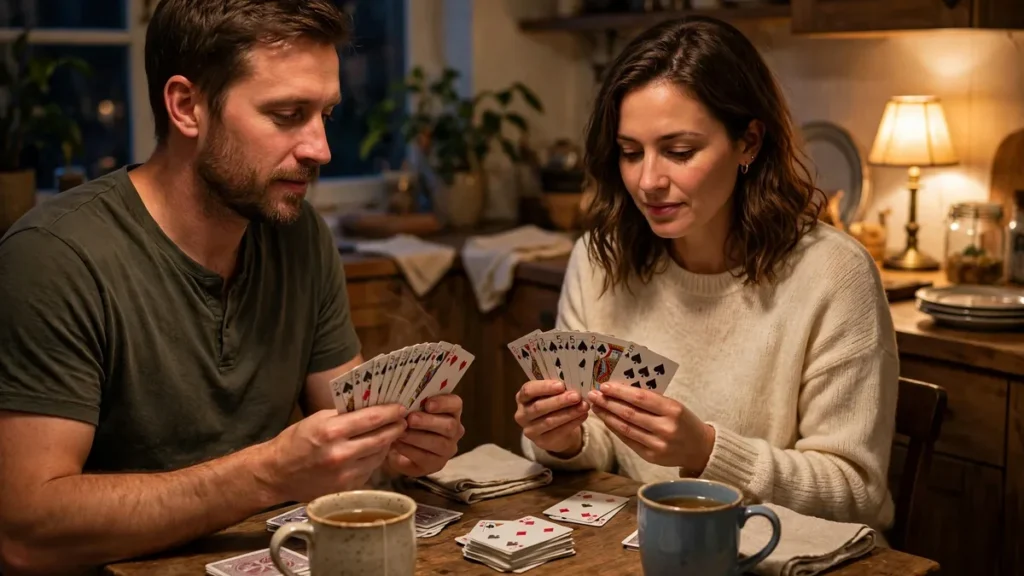
Count everything twice. You need one copy of each puzzle per team, plus spares for damaged copies and for the practice round. For 26 teams that means at least 28 copies of each puzzle, and the same number of pencils, scorecards and answer sheets. Print answer sheets in advance so scoring is fast, and prepare a master answer key for the judges. If you are buying jigsaws, order early, because finding 26 identical copies of one puzzle can take time. Card games can fill a gap in the programme too, and the best card games for 156 players show how a simple deck scales to a huge crowd when every table plays the same game at once.
Checklist: Your 156-Player Puzzle Night
- Divide 156 players into teams of six to twelve and assign each team a number and a table before the event starts.
- Buy or print identical copies of every puzzle, one per team plus spares, and test each puzzle yourself before the night.
- Book a venue with enough tables, wide aisles, a microphone and a screen or whiteboard for whole-room rounds.
- Recruit at least one helper per five tables, plus a judge for scoring and a host to run the evening.
- Prepare a simple points system, a visible leaderboard and prizes for the winning team and the last-placed team.
- Run a short practice round first so every team understands the rules, then follow a written schedule with buffer time between activities.
Frequently Asked Questions
Can one puzzle game really seat 156 players?
No single puzzle game seats 156 players at one table, and any product that claims to is stretching the truth. The honest answer is that 156 players play in teams, with multiple identical copies of the same puzzle running at the same time. That is how every large-group puzzle event works, and it is why the games in this guide are chosen for how well they scale across many tables rather than for a player count printed on the box.
How many teams should 156 players form?
Teams of six work best for most puzzle games, giving you 26 teams, while teams of twelve give you 13 teams and suit games where many hands help, such as jigsaws. Teams smaller than six leave players with too much to do alone, and teams larger than twelve leave some players with nothing to do. Pick your team size based on the game, and keep it the same all evening so scoring stays simple.
What is the best puzzle game for a mixed-age group of 156?
Team jigsaw races are the safest choice for a mixed-age crowd, because anyone can place a piece and every team member can contribute. Picture puzzle rounds are a close second, since visual puzzles do not depend on reading speed or maths ability. Avoid puzzles that rely on one narrow skill, such as advanced crosswords, unless you are confident your whole group shares that skill.
How long should a 156-player puzzle night last?
About two and a half hours works well, including a welcome game, three table rounds, one big activity such as a scavenger hunt or escape-room circuit, a final and a prize ceremony. Shorter evenings feel rushed for a crowd this size, because moving 156 people between activities takes time. Longer evenings risk losing the attention of younger or less patient players.
Do I need a professional host for 156 players?
A confident volunteer with a microphone can host a 156-player puzzle night very well, as long as the schedule is written down and the scoring is simple. What matters most is a clear voice, a visible clock and helpers who can answer questions at the tables. A professional host helps if the event is a fundraiser or a corporate occasion, but it is not required for a great evening.
What should I do if some teams finish much faster than others?
Keep a bonus puzzle ready at every table, such as a small word search or a mini jigsaw, so fast teams stay busy while slower teams catch up. Announce a fixed finish time for each round instead of waiting for every team, and award bonus points for the bonus puzzle so early finishers still have something to play for.
The Bottom Line
The best puzzle games for 156 players are not the ones with the biggest player count on the box. They are the games that survive being split across 26 tables, raced in relays, played in tournament brackets and projected onto a screen for a whole room. Jigsaws, crosswords, Sudoku, escape-room challenges, scavenger hunts, logic grids, picture puzzles and riddle relays all pass that test, because they stay fun when the crowd is huge and the format does the heavy lifting. Pick your format first, buy identical copies, keep the scoring simple, and give the evening a clear schedule. Do that, and 156 players will not feel like a problem to manage. They will feel like the best part of the night.