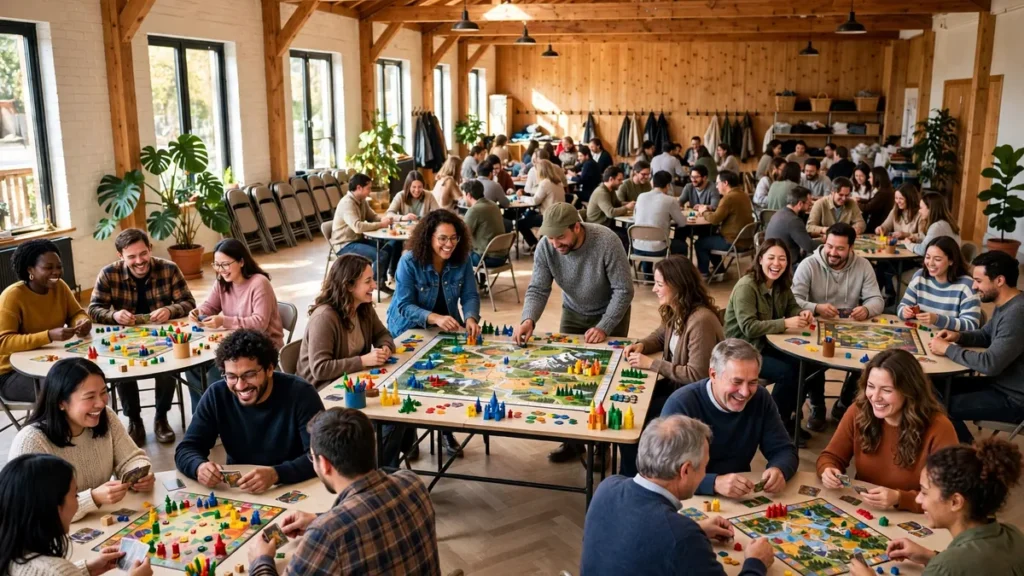
Finding the best puzzle games for 75 players is a different kind of challenge from picking a game for a family of four. Seventy-five people is a hall full of players, not a table full, and the games that work at that scale are the ones that split a crowd into teams, run in parallel across several tables, or turn the whole room into one shared puzzle. The best choices keep everyone busy at the same time, give every team a fair shot at winning, and finish with a clear result that the whole room can celebrate together.
The best puzzle games for 75 players are not single-box board games with seventy-five seats, because no such game exists. Instead, the strongest options are formats that scale: giant jigsaw relays, team escape-room races, puzzle hunts, crossword and Sudoku tournaments, and riddle chains that pass from team to team. Each rebuilds a small-group puzzle so that fifteen teams of five can all play at once.
This guide explains exactly how to set up puzzle games for a group of seventy-five, compares the twelve strongest options side by side, and gives you a ready-to-use checklist for the day itself. The formats below are affordable, easy to explain, and proven to keep a very large group engaged from the first clue to the final answer.
Key takeaways
- No single puzzle game seats 75 players, so every workable option uses teams, multiple tables, or a whole-room format.
- Teams of three to five players work best, giving you fifteen to twenty-five teams that can all play at the same time.
- Giant jigsaw relays, team escape-room races, and puzzle hunts are the most reliable choices for a crowd of seventy-five.
- Run several puzzle stations at once and rotate teams through them, so nobody waits more than a few minutes between turns.
- Keep the rules short, the scoring visible, and the final round a shared whole-room puzzle that everyone can follow.

The Honest Truth About Puzzle Games for 75 Players
Before choosing a game, it helps to be honest about the numbers. A standard jigsaw suits one to six people, and even a large party game rarely handles more than twenty. Seventy-five players is roughly fifteen times a normal game night, so the answer is never to buy one bigger box. The answer is to change the structure of play.
There are four structures that genuinely work for seventy-five players. The first is team play, where the crowd is split into teams of three to five and each team plays the same puzzle at the same time. The second is multiple tables, where the same game is set up on ten or fifteen tables and every table runs its own match. The third is a tournament, where teams play short rounds, winners advance, and the event builds toward a final. The fourth is a whole-room game, where one puzzle is projected or read aloud and every team answers at once. Most of the best events combine two of these structures, for example a team tournament ending with a whole-room final.
Team size matters more than most organisers expect. Teams of three to five players are the sweet spot for puzzle games. With three players, everyone has a job. With five, there is enough brainpower for hard clues, but the team is still small enough that everyone can hear each other. Teams of eight or more split into a few active solvers and several spectators. Aim for fifteen teams of five and keep them fixed, so rivalries and team spirit can build.
Space matters too. Seventy-five players need roughly one table for every team, plus room for a host station, a scoreboard, and a final-round stage area. A community hall, school gym, or large function room works well. Walk the room before the event, count the tables, and check that every team can see the host and the scoreboard.
How to Run Puzzle Games for 75 Players
Running puzzle games for seventy-five people is mostly a logistics job, and the logistics are simple once you decide on a format. Start by splitting the players into teams before the event begins, if you can. Pre-assigned teams save twenty minutes of chaos, and you can mix ages and abilities so no team is stacked with the strongest solvers. Give each team a name, a colour, and a table, and print a simple score sheet for every team captain.
Next, choose a rotation. The simplest rotation is to run one game at a time for all teams at once, which works well for puzzle hunts, quizzes, and whole-room games. The more exciting option is a station rotation, where teams move between four or five puzzle stations every fifteen minutes. The format used by puzzle games for 73 players works on the same principle, with teams rotating through short puzzle rounds rather than sitting through one long game.
Scoring should be simple and visible. Award points for each solved puzzle, add bonus points for speed, and update a big scoreboard after every round. When teams can see the scores, they stay engaged even when they are behind, because a single strong round can change the standings. Avoid scoring systems that need a calculator. If the host cannot explain the scoring in thirty seconds, it is too complicated.
Finally, plan the timing. A good large-group puzzle event lasts ninety minutes to two hours: a ten-minute welcome, four or five fifteen-minute rounds, and a ten-minute final. Shorter rounds are better than longer ones, so give a two-minute warning and then move on.
The 12 Best Puzzle Games for 75 Players
The twelve games below are ranked by how well they scale to seventy-five players, how easy they are to set up, and how much fun they create for a mixed crowd. Every one works with teams of three to five, using ordinary supplies that cost very little.
1. Giant Jigsaw Relay
A giant jigsaw relay is the simplest large-group puzzle game, and it is often the most popular. Buy three identical large jigsaw puzzles of one thousand pieces each, and set up one puzzle per five teams. Each team works on its own puzzle, and the first team to finish wins the round. In the relay version, only one member works at a time and players swap every two minutes. Jigsaw relays work because they are visual, quiet enough for conversation, and easy for players of all ages to join. Choose puzzles with bright, distinct sections so teams can divide the work by colour.
2. Team Escape-Room Race
A team escape-room race recreates the excitement of a commercial escape room without the cost or the capacity limit. Set up five identical puzzle stations, each with a locked box, clues, and a combination lock. Every team starts at a different station and must solve the clues to open the box and collect a token. Teams rotate when they finish, and the first to collect all the tokens wins. You can build the puzzles yourself with padlocks, envelopes, and printed riddles for far less than a real escape room. Keep each station solvable in about ten minutes so that no team gets stuck for too long.
3. Puzzle Hunt
A puzzle hunt sends teams around a venue following a trail of clues, and it is one of the best whole-room games for a very large group. Hide fifteen clue cards around the hall, each containing a small puzzle such as a word ladder, a number code, or a picture riddle. Teams must solve each clue to find the location of the next one, and the first team to complete the trail wins. Hunts work well because teams spread out, so the room never feels crowded. Place a volunteer at the trickiest locations to help teams that get stuck.
4. Crossword Relay
A crossword relay turns a quiet solo puzzle into a fast team race. Print a large crossword and give each team a copy. Teams race to complete the grid, with bonus points for finishing each section first. The relay version works even better: each team member may only fill in one answer before passing the sheet to the next player, which forces the whole team to stay involved. Crosswords are cheap, easy to theme, and fair for mixed-age groups. A themed crossword about your event adds a personal touch.
5. Sudoku Tournament
A Sudoku tournament is ideal when you want a calm, fair, and genuinely competitive puzzle event. Print the same Sudoku grid for every team, and give teams fifteen minutes to solve it together. Award points for a correct solution, with bonus points for the fastest finish. Run three rounds with increasing difficulty, from easy to hard, and keep a running score. Sudoku needs only printed sheets and pens, every team faces the same challenge, and results are objective. A two-minute demonstration before the first round is enough for beginners.
6. Rubik’s Cube Team Relay
A Rubik’s cube team relay is fast, visual, and surprisingly dramatic for a crowd. Each team gets one cube, and team members take turns making moves, with each player allowed a fixed number of turns before passing the cube on. The team that solves the cube first wins, or the team that gets closest in five minutes takes the points. A simpler version has teams race to complete a single face of the cube. Cubes are cheap and durable, and the relay format lets beginners contribute too. This game works best as one station in a rotation, rather than as the only game of the night.
7. Logic Puzzle League
A logic puzzle league is a series of short brain teasers played over several rounds, and it is one of the most flexible formats for a large group. Prepare twenty short logic puzzles, such as grid puzzles, nonograms, and deduction problems, and hand one to each team per round. Teams have five minutes per puzzle, and the scores accumulate across the league. Logic puzzles reward careful thinking over speed, which keeps the league fair. They are easy to print and mark, because every puzzle has one correct answer. Vary the puzzle types from round to round so that no single skill dominates the event.
8. Picture Puzzle Relay
A picture puzzle relay combines drawing, guessing, and puzzle solving into one lively game. One player from each team draws a picture based on a secret word or phrase, while the rest of the team guesses what it shows. When the team guesses correctly, the next player takes over as the artist. Teams earn points for each correct guess, and the team with the most points after ten minutes wins the round. This game is loud and funny, a good change of pace after quieter puzzles. It needs only paper, pens, and a list of words.
9. Word Ladder Tournament
A word ladder tournament is a word puzzle race in which teams change one letter at a time to turn one word into another, for example turning COLD into WARM in four steps. Give every team the same ladder, set a time limit, and award points for each completed ladder, with bonus points for the fastest team. Word ladders need no equipment and reward vocabulary and lateral thinking. Run several ladders in a row with increasing difficulty.
10. Riddle Chain Relay
A riddle chain relay is a race in which each answer unlocks the next question. Prepare a chain of twenty riddles, print them on separate cards, and give each team the first card. When a team solves a riddle, it brings the answer to the host, who hands over the next card. The first team to complete the chain wins. Riddle chains are cheap, easy to theme, and naturally dramatic. Keep the riddles short and fair. The structure is similar to the format used in puzzle games for 70 players, where short rounds and visible progress keep a large crowd engaged.
11. Tangram Team Challenge
A tangram team challenge is a hands-on geometry puzzle in which teams use seven flat shapes to build pictures such as animals, houses, and boats. Give each team a tangram set and a series of silhouette cards, and award points for each picture completed correctly. Tangrams are inexpensive, reusable, and completely silent, which makes them a good choice for a mixed programme that includes louder games. They suit visual thinkers, and work well for children and adults together. Print the silhouette cards in large format.
12. Whole-Room Mystery Puzzle
A whole-room mystery puzzle is the perfect final round for an event with seventy-five players. The host presents a mystery, and every team works on the same clues at once. Clues are revealed one at a time on a screen. The first team to solve the mystery wins the final, and the whole room shares the excitement of the reveal. Whole-room finals bring all teams together, need no extra equipment, and end the event with a moment everyone remembers. Keep the mystery simple enough to solve in fifteen minutes.
Comparison Table: Puzzle Games for 75 Players
The table below compares all twelve games on players, round length, equipment, and cost for seventy-five people.
| Game | Players | Round length | Equipment needed | Cost |
|---|---|---|---|---|
| Giant jigsaw relay | 75 | 20 minutes | Jigsaw puzzles, tables | Medium |
| Team escape-room race | 75 | 30 minutes | Padlocks, clue cards, boxes | Medium |
| Puzzle hunt | 75 | 30 minutes | Printed clues, hiding spots | Low |
| Crossword relay | 75 | 15 minutes | Printed crosswords, pens | Low |
| Sudoku tournament | 75 | 15 minutes | Printed grids, pens | Low |
| Rubik’s cube relay | 75 | 10 minutes | Rubik’s cubes | Low |
| Logic puzzle league | 75 | 20 minutes | Printed puzzles, pens | Low |
| Picture puzzle relay | 75 | 10 minutes | Paper, pens, word lists | Low |
| Word ladder tournament | 75 | 10 minutes | Printed ladders, pens | Low |
| Riddle chain relay | 75 | 20 minutes | Printed riddle cards | Low |
| Tangram team challenge | 75 | 15 minutes | Tangram sets, silhouette cards | Low |
| Whole-room mystery | 75 | 15 minutes | Screen, printed clues | Low |
As the table shows, most of these games cost very little to run. Nine of the twelve need nothing more than printed sheets and pens. The jigsaw relay and the escape-room race cost a little more, but they also create the most memorable moments. If you are planning a wider programme of large-group games, the ideas in party games for 74 players use the same team structure and pair well with these puzzle formats.
Checklist: Running Puzzle Games for 75 Players
Use this checklist in the week before your event, and again on the day itself.
- Split players into teams of three to five before the event. Pre-assigned teams save time, balance abilities, and let team spirit build from the first round.
- Book a venue with one table per team plus a host station. Walk the room in advance, count the tables, and check that every team can see the host and the scoreboard.
- Prepare all puzzles, answer sheets, and score sheets in advance. Print spares, pack extra pens, and test every lock, code, and clue yourself before the players arrive.
- Brief two or three volunteers to help run stations. Volunteers can hand out puzzles, check answers, update scores, and help teams that get stuck.
- Keep rounds short and the scoreboard visible. Fifteen-minute rounds, a two-minute warning, and a big updated scoreboard keep seventy-five players engaged.
- End with a whole-room final that everyone can follow. A shared mystery or puzzle brings all the teams together and gives the event a clear, memorable finish.
Frequently Asked Questions
Can one puzzle game really seat 75 players?
No single boxed game seats seventy-five players at one table. The games in this guide work because they use teams, multiple tables, tournament rounds, or whole-room formats. Fifteen teams of five can all play the same puzzle at the same time.
What is the best team size for 75 players?
Teams of three to five players work best. Three players keep everyone involved, and five players give a team enough brainpower for hard clues without anyone being left out. Avoid teams of eight or more, because they tend to split into a few active solvers and several spectators.
How long should a puzzle event for 75 players last?
Ninety minutes to two hours is ideal: ten minutes for setup, four or five fifteen-minute rounds, and ten minutes for a final.
How much do puzzle games for 75 players cost?
Most of the games in this guide cost very little. Nine of the twelve need only printed sheets and pens. A jigsaw relay and an escape-room race cost a little more, but both are still far cheaper than booking a commercial venue.
What if some players have never played puzzle games before?
Choose a mix of games, and start with the easiest one. A picture puzzle relay or a tangram challenge needs no experience at all, and a two-minute demonstration before a Sudoku or crossword round is enough for complete beginners. Mixed teams also help, because experienced players can guide newcomers.
Do I need a host for 75 players?
Yes, a host makes a large difference. The host explains the rules, keeps the rounds on time, updates the scoreboard, and runs the whole-room final. A confident volunteer with a microphone and a printed running order is enough.
The Bottom Line
The best puzzle games for 75 players are the ones that turn a very large crowd into a set of small, busy teams. Giant jigsaw relays, team escape-room races, puzzle hunts, and riddle chains all work because they give every player a job, keep every team playing at the same time, and build toward a shared finish that the whole room can enjoy. Keep the teams small, the rounds short, and the final round a whole-room puzzle, and seventy-five players will feel like one great game night.