The best trivia games for 78 players are not the games you would pick for a quiet night with four friends. Seventy-eight people is a hall full of players, a company social, a school fundraiser, or a community night where the room itself becomes part of the game. No single board, buzzer set, or card deck seats 78 people at once, and any guide that pretends otherwise is selling a fantasy. The honest answer is that the best trivia games for 78 players are the formats that scale: team play, multiple tables, relay rounds, and whole-room games where everyone answers at the same time.
That scale is also what makes a 78-player trivia night so much fun when it is planned well. Thirteen teams of six, or six teams of thirteen, create a buzz that a small game never reaches. There is cheering, friendly rivalry between tables, and a leaderboard that changes after every round. The trick is choosing games that keep all 78 people involved at once, rather than leaving most of the room watching a handful of players take turns. The formats below do exactly that, and they work with nothing more than printed answer sheets, a projector, and a confident host.
This guide explains how to organise 78 players, compares the formats that work best at this size, and reviews the strongest trivia games for a crowd of this scale. Every recommendation has been judged on the same tests: can 78 people play at the same time, can the host score it without chaos, and does it stay fair when teams differ in strength?
Key takeaways
- No single trivia game seats 78 players, so the best options use teams, multiple tables, or whole-room play.
- Teams of six give you thirteen even teams, which is the simplest and fairest split for 78 players.
- Answer-sheet and app-based formats scale best, because every team answers every question at the same time.
- Turn-taking games only work for 78 players as a final or a stage show.
- Mix question types across rounds, keep rounds short, and score after every round to hold the room.

Why 78 Players Changes Trivia Completely
A trivia game built for six people assumes everyone can hear each other, see the board, and take a turn within a minute or two. Multiply that group by thirteen and every one of those assumptions breaks. Seventy-eight players cannot gather around one table, cannot all reach a buzzer, and cannot wait patiently while seventy-seven other people answer in turn. The game has to change shape, and the best trivia games for 78 players are the ones designed, or easily adapted, for that change.
The first change is space and sound. You need a hall or a large function room with enough tables for every team, plus a host with a microphone and speakers. If the back tables cannot hear the questions clearly, they stop playing, and no amount of clever question writing will bring them back. A projector or a large screen helps in the same way, because it lets the host show picture rounds, music clues, and the running leaderboard to the whole room at once.
The second change is pace. With 78 players, every minute of dead time is multiplied by 78. The formats that work best therefore keep the rhythm tight: a question, a short thinking window, an answer, and a score, repeated in rounds of ten questions lasting about fifteen minutes each. Short rounds also make scoring manageable, because the host can mark thirteen answer sheets between rounds while a music or picture round keeps the room busy.
The third change is fairness. Teams will not all be the same strength, and that is fine, provided the rules are clear and the same for everyone. Capping teams at six players, banning phones during play, and using a mix of general knowledge, picture, music, and themed rounds all help level the field. Variety is not decoration at this scale; it is how you keep thirteen teams believing they can still win in round five.
How to Organise 78 Players for Trivia
Start with the team split, because everything else follows from it. Seventy-eight divides neatly into thirteen teams of six, which is the split this guide recommends for most events. Six is small enough that everyone at a table can talk, yet large enough that a team usually has someone who knows the answer. If your players arrive as couples, families, or work groups of uneven size, let teams form naturally and then balance them, so no team has more than six and no team has fewer than four. A team of eight against a team of four is not a fair contest, and the smaller team will feel it by round two.
Scoring That Stays Simple at Scale
Keep scoring as simple as the questions are varied. One point per correct answer, with a bonus point for a perfect round, is enough for 78 players. Avoid complicated systems with half points, wagering, and penalty deductions unless you have a dedicated scoring team. A simple system also makes it easy to swap answer sheets between tables for marking, which is faster and fairer than the host marking thirteen sheets alone. After each round, teams pass their sheet to the table on their left, the host reads the answers aloud, and each team marks the sheet it received.
The Host, the Sound, and the Schedule
The host is the single most important part of a 78-player trivia night, more important than the questions themselves. A good host reads clearly, keeps the pace brisk, repeats each question once, and never lets one team argue a ruling for five minutes. Plan for a host plus at least two helpers: one to run the projector and music, and one to collect sheets and update the leaderboard.
A realistic schedule is five or six rounds of ten questions, with a break after round three. Each round takes about fifteen minutes including marking, so the game itself runs for roughly ninety minutes, plus a welcome, a break, and a prize ceremony. If you are running a shorter event, cut a round rather than rushing the questions; a four-round night with a relaxed pace is far better than a six-round night where the host is racing the clock.
Best Trivia Games for 78 Players
The games below are ranked for a crowd of 78, not for a living room. A format earns a high place here when all 78 players can take part at once, when the host can run it without specialist equipment, and when the energy in the room rises rather than falls as the night goes on.
1. Classic Pub Quiz
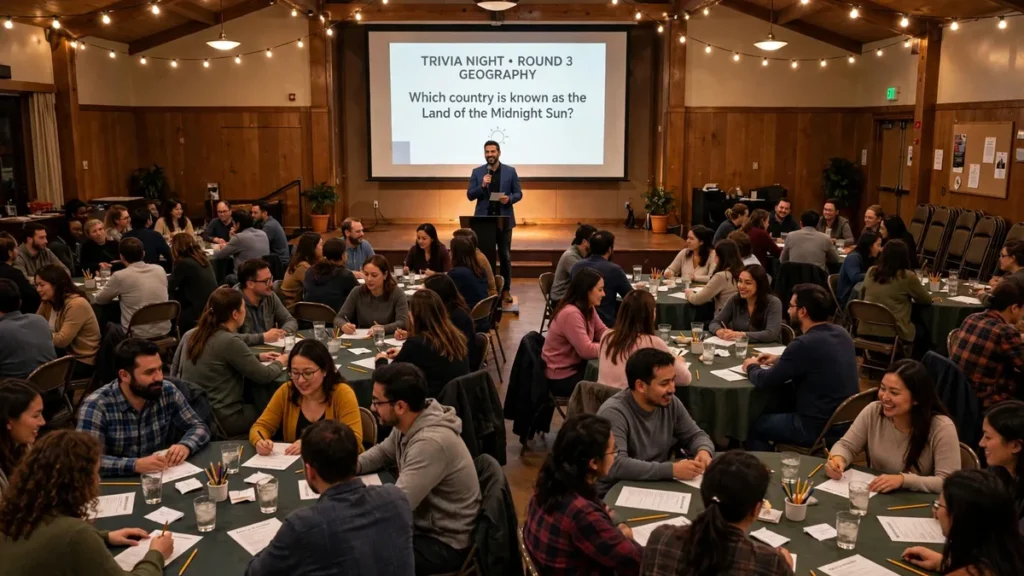
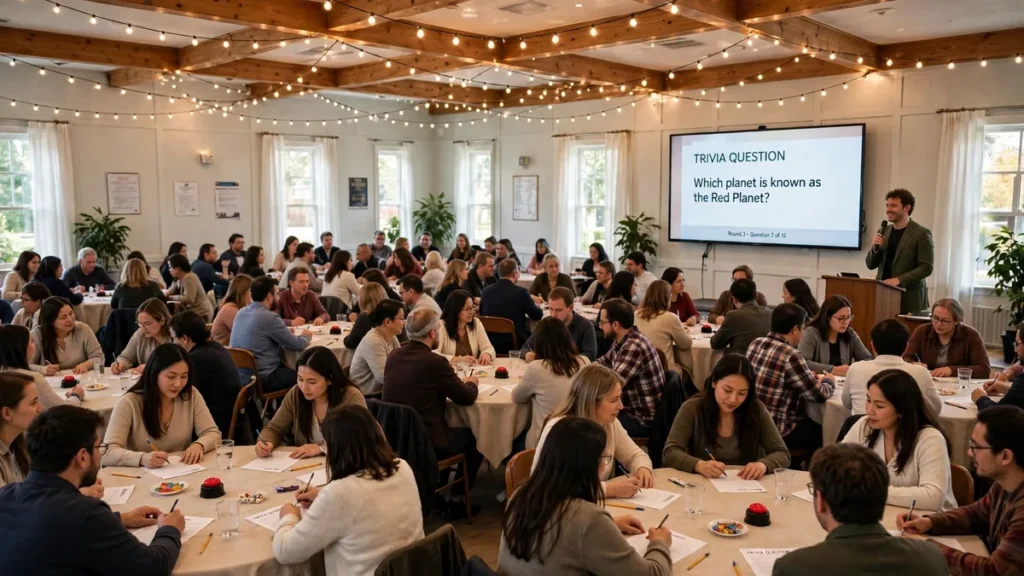
The classic pub quiz is still the best trivia game for 78 players, because it was built for rooms full of teams answering at the same time. The host reads a question, every team writes an answer on its sheet, and the host reads the next question. Nobody waits for a turn, nobody needs a buzzer, and the format works in any hall with a microphone. Thirteen teams of six can play a full pub quiz with nothing more than printed sheets, pencils, and a projector for the leaderboard. Rounds can cover general knowledge, geography, history, sport, food, and current events, while picture and music rounds break up the spoken questions and give different teams a chance to shine.
2. App-Based Live Trivia
App-based live trivia, in the style of Kahoot and similar quiz platforms, is the best option when you want instant scoring and a live leaderboard that the whole room can see. Each team uses one phone or tablet to answer, the questions appear on the big screen, and points are awarded for correct answers. For 78 players, this is the fastest way to score thirteen teams without a single paper sheet, and the sight of the leaderboard shuffling after every question keeps the room engaged. Test the venue Wi-Fi before the night, keep printed answer sheets as a backup, and consider turning off speed bonuses so careful teams are not punished for thinking.
3. Team Trivia Tournament
A team trivia tournament takes the pub quiz and adds a knockout structure, which suits 78 players when you want a clear winner and a dramatic finish. Thirteen teams of six play three qualifying rounds, and the top four teams go through to a semi-final and a final played on stage. The early rounds keep everyone involved, while the later rounds give the room a show to watch, with the audience answering along silently. The format works best at fundraisers and company events where a grand final feels like an occasion, and the final should use a different format, such as head-to-head buzzer questions, so it feels distinct from the earlier rounds.
4. Picture Round Trivia
A picture round is a round rather than a whole game, but for 78 players it deserves a place of its own, because it solves one of the hardest problems of a large quiz: keeping the back tables involved. Projected images are visible to the whole room at once, and a team that struggles with spoken general knowledge may be excellent at identifying films, landmarks, album covers, or famous faces. Plan picture rounds with ten images and a clear theme, such as capital cities or classic films, show each image for about thirty seconds, and reveal the answers with the images still on screen.
5. Music Round Trivia
Music rounds work on the same principle as picture rounds: the clue reaches the whole room at the same instant, and every team answers at the same time. The host plays ten short clips, teams write the song title and artist, and a point is given for each correct half. Music rounds are the loudest, happiest part of most large trivia nights, so choose clips that span decades and genres, keep each clip to about ten seconds, and test the sound system with the actual clips before the event.
6. Jeopardy-Style Team Trivia
A Jeopardy-style game, with categories on a board and questions worth different points, is a strong format for 78 players when it is played in teams rather than by individuals. Each team takes turns choosing a category and a value, the whole room sees the question, and the choosing team answers first, with other teams able to steal if it gets the question wrong. The steal rule is what makes the format work at scale: every team has a reason to listen to every question, even when it is not their turn. Limit each team to one choice per round and rotate the order, so the same teams are not always choosing first.
Comparison Table: Best Trivia Games for 78 Players
Use this table to pick the format that matches your venue, your equipment, and the mood you want. The pub quiz and the app-based game are the safest choices for a first 78-player event, while the tournament adds drama once the basics are in place.
| Game format | Players at once | Equipment needed | Best for | Energy level |
|---|---|---|---|---|
| Classic pub quiz | All 78 | Microphone, printed sheets | Any large trivia night | Steady and social |
| App-based live trivia | All 78 | Screen, Wi-Fi, one device per team | Corporate and modern events | High and competitive |
| Team trivia tournament | All 78, then top four | Microphone, projector, stage | Fundraisers and finals | Rising to a climax |
| Picture round trivia | All 78 | Projector or large screen | Warm-ups and mixed groups | Bright and visual |
| Music round trivia | All 78 | Speakers, playlist, screen | Parties and themed nights | Loud and joyful |
| Jeopardy-style team trivia | All 78, one team choosing | Projected board, microphone | Themed nights and finals | Focused and tense |
Choosing the Right Format for Your Event
The right format depends on who your 78 players are. A company social will enjoy an app-based game with a live leaderboard, because the competition feels friendly and the technology feels modern. A charity fundraiser with a mixed-age crowd will do better with a classic pub quiz, picture rounds, and music rounds, because those formats need no technology and no one is left out by a format they do not understand. A school or community event with families will benefit from a mix of easy and hard questions, so younger players can contribute in the picture and music rounds even when the general knowledge rounds are tough.
Venue matters too. If your hall has a good projector and reliable Wi-Fi, app-based trivia and picture rounds are easy wins. If the venue is a village hall with a single speaker and no screen, the classic pub quiz on printed sheets is the sensible choice. Always check the sound system, the screen, the table layout, and the Wi-Fi before the night. Finally, think about the prize: a trophy, a hamper, or a voucher for the winning table, plus a small prize for the best team name, gives every table something to aim for.
Checklist: Running a Trivia Night for 78 Players
Use this checklist in the week before your event, and again on the night itself. Each step is small, but together they are the difference between a smooth evening and a chaotic one.
- Split 78 players into thirteen teams of six, with a named captain for each team.
- Print thirteen answer sheets per round, plus pencils, a leaderboard, and spare sheets.
- Test the microphone, speakers, projector, and Wi-Fi in the actual venue before the night.
- Prepare five or six rounds of ten questions, mixing general knowledge, picture, and music rounds.
- Brief the host and two helpers on scoring, sheet swapping, and the schedule.
- Display the rules and the leaderboard clearly, announce the prize, and start on time.
Frequently Asked Questions
Can one trivia game really seat 78 players?
No single board or card game seats 78 players at once, and the best trivia games for 78 players are honest about that. They work by splitting the room into teams, usually thirteen teams of six, so every player answers every question as part of a team. Whole-room formats such as pub quizzes, app-based trivia, and picture rounds let all 78 people play at the same time, which is why they rank highest in this guide.
What is the best team size for 78 players?
Six players per team is the best size for 78 players, giving thirteen even teams. A team of six is small enough for everyone to talk and contribute, and large enough to cover a good range of knowledge. Teams smaller than four struggle on broad rounds, and teams larger than eight leave quieter players with little to do, so balance uneven groups before the first round.
How long does a trivia night for 78 players take?
Plan for about two hours in total, with five or six rounds of ten questions taking roughly ninety minutes including marking. Add a welcome, a short break after round three, and a prize ceremony. If your time is shorter, cut a whole round rather than rushing the questions, because a relaxed four-round night is far more enjoyable than a hurried six-round one.
Do I need special equipment for 78 players?
You need a microphone and speakers, a projector or large screen for picture rounds and the leaderboard, and printed answer sheets with pencils. App-based trivia also needs reliable Wi-Fi and one device per team. Beyond that, nothing specialist is required, and a classic pub quiz can run well on paper alone if the sound system is good.
How do I stop teams from using their phones?
State the rule clearly before the first question: phones away, one warning, then a points deduction. The simplest enforcement is a visible rule and a host who applies it once, early in the night. Teams that see the rule enforced fairly will respect it for the rest of the evening.
What makes a good prize for 78 players?
A prize for the winning team, such as a trophy, a hamper, or a voucher shared between six people, works well, and a small prize for the best team name gives every table something to aim for. Keep the prize visible at the start of the night and announce it with the rules, so every team has a reason to keep playing through the final round.
The Bottom Line
The best trivia games for 78 players are the ones that treat 78 as a strength rather than a problem. A classic pub quiz, an app-based live game, or a team tournament, mixed with picture and music rounds, gives every player a part to play and every team a fair chance to win. Split the room into thirteen teams of six, keep the scoring simple, test the sound before the night, and let the host keep the pace brisk. Do that, and a hall full of seventy-eight players will feel less like a crowd to manage and more like the best trivia night you have ever run. For a smaller crowd with a similar feel, the guide to trivia games for 77 players shows how the same formats adapt when one player fewer is in the room, while the party games for 77 players guide offers wider large-group ideas beyond trivia, and the board games for 77 players guide covers table games that scale in a similar team-based way.