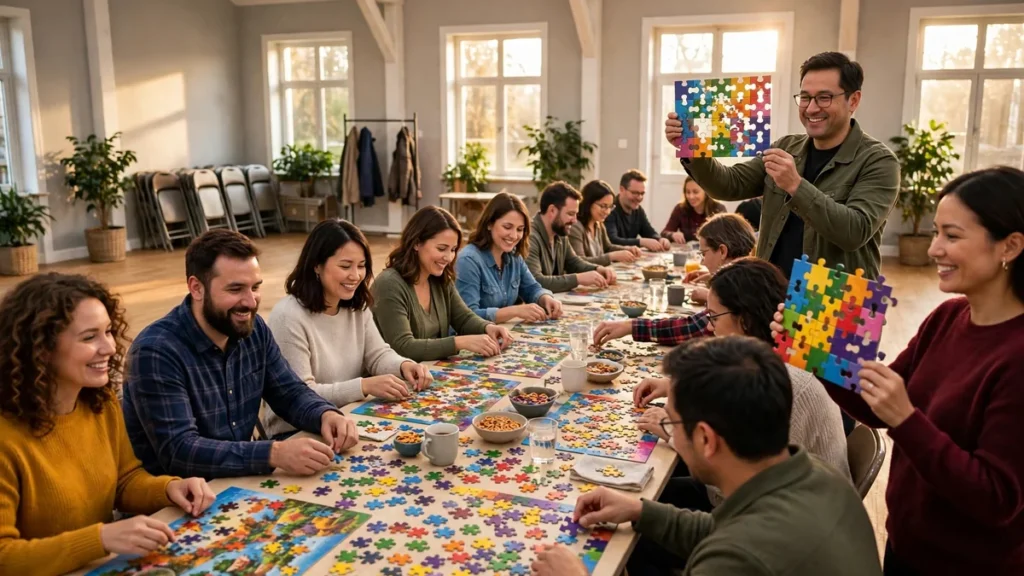
Finding the best puzzle games for 79 players starts with an honest fact: no single puzzle game seats 79 people around one table. A standard jigsaw, board game, or escape room kit is built for a handful of players, not a crowd the size of a small wedding. That does not mean a group of 79 cannot enjoy puzzle games together. It means the format has to change.
The secret is to stop thinking of one game and start thinking of one event. Split 79 players into teams of five to eight, run the same puzzle challenge at several tables at once, and let the teams compete in heats, relays, and tournament rounds. A jigsaw race becomes a relay. An escape room becomes a multi-room tournament. A crossword becomes a whole-room race with a live leaderboard. The puzzles stay the same; the structure scales them up.
This guide covers the ten best puzzle games for 79 players, each chosen because it genuinely works at this size. Every game below includes a clear format for large groups, the team sizes that work best, and the time it takes. You will also find a comparison table, a setup checklist, and answers to the most common questions about running puzzle games for a very large group.
Key takeaways
- No single puzzle game seats 79 players, so every game in this guide uses teams, multiple tables, heats, or relays to include everyone.
- Teams of five to eight players work best, giving 79 players ten to sixteen teams and keeping every person actively involved.
- Timed rounds and a live leaderboard keep a large group engaged, because teams can see exactly where they stand.
- Buy or print identical puzzle sets for each team so the competition is fair and the winner is decided by skill, not by an easier puzzle.
- Plan for ninety minutes to two hours, with a short break in the middle, so the event feels like a proper night out rather than a rushed activity.

How 79 Players Actually Play Puzzle Games Together
Three formats make puzzle games work for 79 players. The first is the parallel format, where every team plays the same puzzle at the same time at separate tables. This is the simplest option and it works beautifully for jigsaws, crosswords, Sudoku, and logic puzzles. Each team gets an identical set, a timer starts, and the first team to finish wins the round.
The second format is the relay, where team members take turns at the puzzle table while the rest of the team watches, advises, and plans. Relays work well when the puzzle itself is small but the group is large, because they turn waiting time into coaching time. The third format is the tournament, where teams rotate through a series of puzzle stations and collect points at each one. Tournaments suit escape-room style games and puzzle hunts, because different stations test different skills. Most successful 79-player events combine two of these formats, for example parallel rounds followed by a relay final.
The 10 Best Puzzle Games for 79 Players
1. Giant Jigsaw Puzzle Relay
A giant jigsaw puzzle relay is the most reliable crowd-pleaser on this list, and it is the easiest to organise. Buy one identical 500-piece puzzle for each team, or one 1,000-piece puzzle per team if your players are experienced. Teams of six to eight work best, because a jigsaw table gets crowded with more than eight pairs of hands. Give every team the same puzzle, start the clock, and award points for the first finished puzzle and the most pieces placed.
The relay twist makes it work for 79 players. Each team sends two builders at a time and swaps them every five minutes, while the waiting players sort edge pieces, study the picture, and plan the next section. A 500-piece puzzle usually takes a team of six about forty-five minutes.
2. Escape Room Tournament
An escape room tournament brings the excitement of a real escape room to a group of 79 without needing a commercial venue. Set up four or five puzzle stations around the room, each with a different challenge: a combination lock, a coded message, a hidden object search, a logic grid, and a pattern puzzle. Teams rotate through the stations in turn, earning points for every puzzle they solve and bonus points for speed.
Each station should take about ten minutes, so a full rotation lasts under an hour. Station hosts keep the game moving by giving hints when a team gets stuck. For more team puzzle formats that suit a crowd of this size, see the best puzzle games for 78 players.
3. Puzzle Hunt Around the Venue
A puzzle hunt turns the whole venue into the game board. Hide clues in different rooms, corridors, and outdoor areas, and give each team a first clue that leads to the next. Every clue is a small puzzle: a riddle, a word search, a cipher, a rebus, or a set of coordinates on a map. Teams race to solve the chain of clues and reach the final location, where the last puzzle reveals the winner.
Puzzle hunts are ideal for 79 players because the teams spread out naturally. Ten to twelve teams of six to eight can move through a large venue without crowding each other. Build in a mix of easy and hard clues so every team solves something early and stays motivated. A hunt with eight to ten clues usually takes sixty to ninety minutes.
4. Giant Crossword Race
A giant crossword race works brilliantly for 79 players because crosswords are naturally team-friendly. Print the same large crossword on big sheets of paper, one per team, and stick each sheet to a wall or lay it on a table. Teams work together to fill in the answers, and the first team to complete the grid wins. Because the grid is large and visible, everyone on the team can see the clues and shout out answers at the same time.
Choose a crossword with a theme your group will enjoy, such as films, food, travel, or sport, so every team has a similar chance of knowing the answers. You can buy large-print crossword books, print a grid from a crossword maker, or write your own clues around the occasion, which works especially well for birthdays and reunions. A crossword race usually takes thirty to forty minutes.
5. Sudoku Relay
Sudoku is one of the few puzzle games that is exactly the same for every team, which makes it a superb competition for 79 players. Print the same Sudoku grid for each team at a large size, and let teams solve it together on a shared board. Teams of five to seven are ideal, because Sudoku rewards careful checking as much as speed.
The relay format adds energy to a quiet game. Each team member takes a turn at the board for two minutes, filling in as many numbers as they can, then hands the pen to the next player. A medium-difficulty Sudoku takes a team of six about twenty to thirty minutes, and you can run two or three grids in a row for a longer session. If your group also enjoys board games at this scale, the best board games for 79 players offers a strong set of options that pair well with a puzzle relay.
6. Logic Puzzle League
A logic puzzle league is a series of short brain teasers played over several rounds, with teams earning points in each round. Each round presents a different type of puzzle: a logic grid, a sequence puzzle, a lateral thinking riddle, a maths teaser, and a visual pattern challenge. Teams have ten minutes per round, then the answers are revealed and the leaderboard is updated before the next round begins.
The league format is perfect for 79 players because it rewards breadth rather than a single skill. A team that struggles with number puzzles might dominate the visual round, and the changing puzzle types keep the energy high. Keep a visible scoreboard on a whiteboard or a projected screen, because a visible leaderboard is what turns a quiet puzzle session into a proper competition.
7. Tangram Team Challenge
Tangram is an ancient Chinese puzzle made of seven flat shapes that fit together to form pictures, and it is surprisingly competitive in a team setting. Give each team a tangram set and a series of silhouette cards showing animals, people, and objects. The team must arrange the seven pieces to match each silhouette, and the first team to complete the series wins the round.
Tangram works for 79 players because the sets are cheap, the rules take thirty seconds to explain, and the puzzles suit all ages and abilities. Teams of five to six are best, with two players handling the pieces and the rest studying the silhouette and suggesting moves. A series of six silhouettes, from easy to hard, takes about thirty minutes. Tangram is also a good quiet round to place between two loud, fast games.
8. Rubik’s Cube Relay
A Rubik’s cube relay is the fastest and loudest game on this list, and it is a guaranteed crowd favourite. Each team gets one cube, and team members take turns making as many moves as they can in sixty seconds before passing the cube on. The team that solves the cube first wins, or, if no team finishes, the team with the most correctly placed squares after a fixed time takes the points.
Most teams will not solve a cube from scratch, so set the challenge at the right level. Beginners can race to complete a single face, intermediate players can aim for two layers, and experienced cubers can go for a full solve. Cubes are inexpensive and every team needs only one, which makes this one of the cheapest games per player on the list. If your group enjoys word-based challenges as well, the best word games for 78 players is a useful companion guide for team word games at almost exactly the same group size.
9. Mystery Puzzle Night
A mystery puzzle night combines a whodunit story with a series of puzzle challenges, and it is the most immersive game on this list. Each team plays the role of a detective squad investigating the same fictional case. Clues arrive in envelopes over the course of the evening: a coded letter, a torn photograph, a set of fingerprints, a train timetable, and a witness statement full of contradictions. Teams must solve each clue to narrow down the suspects.
The mystery format suits 79 players because the story does the heavy lifting. Teams stay engaged even during the slower puzzle sections, because every solved clue feels like progress in the story. Run the night in three acts of about thirty minutes each, with a reveal at the end of each act, and ask each team to name the culprit, the motive, and the method in the final act.
10. Word Ladder Relay
A word ladder is a puzzle where you change one letter at a time to turn one word into another, for example turning COLD into WARM in four steps. In a relay, each team member writes one step of the ladder before passing the paper on, and the team must reach the target word without breaking the chain. It sounds simple, until the clock is running and the third player realises the second player chose a dead end.
Word ladders are ideal for a closing game because they are quick, funny, and easy to score. Prepare ten ladders of increasing difficulty, run them one at a time, and award points for each completed ladder plus bonus points for the fastest team. A full set of ten ladders takes about twenty-five minutes, which makes it a perfect finale after a longer game.
Best Puzzle Games for 79 Players Compared
Use this table to pick the right mix for your event. The best evenings combine one long game, one fast game, and one quiet game, so that every kind of player has a moment to shine.
| Game | Best team size | Time needed | Difficulty | Setup effort |
|---|---|---|---|---|
| Giant Jigsaw Puzzle Relay | 6 to 8 | 45 minutes | Easy to medium | Low |
| Escape Room Tournament | 6 to 8 | 60 minutes | Medium to hard | High |
| Puzzle Hunt Around the Venue | 6 to 8 | 60 to 90 minutes | Medium | High |
| Giant Crossword Race | 5 to 8 | 30 to 40 minutes | Easy to medium | Low |
| Sudoku Relay | 5 to 7 | 20 to 30 minutes | Medium | Low |
| Logic Puzzle League | 5 to 8 | 90 minutes | Medium | Medium |
| Tangram Team Challenge | 5 to 6 | 30 minutes | Easy | Low |
| Rubik’s Cube Relay | 5 to 8 | 20 minutes | Easy to hard | Low |
| Mystery Puzzle Night | 6 to 8 | 120 minutes | Medium to hard | High |
| Word Ladder Relay | 5 to 8 | 25 minutes | Easy | Low |
How to Set Up a 79-Player Puzzle Night
Setting up a puzzle night for 79 players is mostly about logistics, not puzzles. Book a venue with enough table space for ten to fourteen teams, plus room for a scoreboard and a refreshments area. Form the teams before the night begins, aiming for ten to thirteen teams of six to eight players. If the numbers do not divide evenly, make two teams of five rather than one team of ten, because a team of ten leaves too many players waiting for a turn.
Scoring That Keeps Everyone Involved
Score every round, not just the final game, and keep the scoreboard visible at all times. Award points for finishing first, but also for finishing at all, for the best team name, and for the most creative solution. These extra points keep the teams at the bottom of the table motivated. Decide the tie-breaker before the night starts and announce it early.
Checklist for a 79-Player Puzzle Night
- Book a venue with table space for ten to fourteen teams, a scoreboard area, and a refreshments table, and visit it in advance to check the layout.
- Split 79 players into teams of five to eight before the night, and share the team lists early so nobody is left waiting to find their group.
- Buy or print identical puzzle sets for every team, and count the sets twice, so no team starts a round with missing pieces.
- Prepare a visible scoreboard and a timer, and appoint one quizmaster and one scorekeeper to keep the rounds moving on schedule.
- Plan ninety minutes to two hours of games with a short break in the middle, and keep water, snacks, and spare pens within easy reach.
- Bring spare puzzle sets, extra paper, and a backup tie-breaker puzzle, so a damaged set or a tied score never stops the evening.
Frequently Asked Questions
Can 79 people really play puzzle games together?
Yes, as long as you use teams. No single puzzle seats 79 players, but ten to thirteen teams of six to eight can all play the same puzzle at the same time, in heats, or in a relay. The team format is what makes the whole evening possible, and it is also what makes it fun, because players work together rather than sitting alone.
What is the best puzzle game for 79 players?
The giant jigsaw puzzle relay is the safest choice for a mixed group, because everyone understands jigsaws and the relay format keeps all 79 players involved. For a more adventurous evening, the escape room tournament is the most exciting option, while the logic puzzle league is the best choice if your group loves brain teasers.
How long does a 79-player puzzle night take?
Plan for ninety minutes to two hours of games, plus arrival time and a short break. A single game such as the crossword race takes thirty to forty minutes, while a full mystery puzzle night takes about two hours on its own. Two or three shorter games with a break in the middle usually works better than one very long game.
How many teams should 79 players form?
Aim for ten to thirteen teams of six to eight players. Teams of five to eight keep everyone involved, while larger teams leave too many players waiting for a turn. If the numbers do not divide evenly, create two smaller teams of five rather than one oversized team of ten.
Do I need to buy expensive equipment?
No. Most of the games on this list need only printed puzzles, pens, and a timer. Jigsaw puzzles, tangram sets, and Rubik’s cubes are inexpensive, and many puzzles can be printed at home. The escape room tournament and the mystery night need more preparation, but even those can be built from printed clues, household locks, and simple props.
What if some players have never done puzzles before?
Start with an easy game such as the tangram challenge or the word ladder relay, and mix puzzle types so every player finds something they enjoy. Pair beginners with experienced players in each team, and choose puzzles with clear rules that take less than a minute to explain. A good puzzle night welcomes newcomers rather than testing them.
The Bottom Line
The best puzzle games for 79 players are not the games with the biggest boxes or the highest player counts on the packaging. They are the games that split a crowd into teams, give every player something to do, and turn solving into a shared race. Start with a jigsaw relay or a crossword race, add a tournament or a puzzle hunt for the main event, and finish with a quick word ladder relay while the energy is high. Plan the teams, prepare identical sets, keep the scoreboard visible, and your group of 79 will leave asking when the next puzzle night is.


