
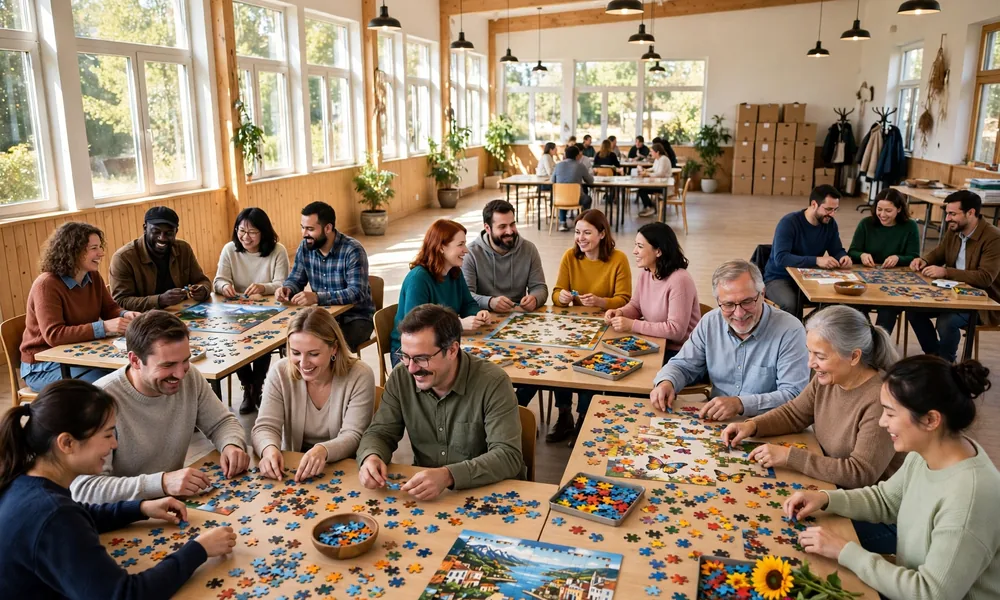
Planning the best puzzle games for 81 players is a very different challenge from choosing a puzzle for a quiet evening at home. No single board game, card game, or jigsaw puzzle seats 81 people at once, and any game that asks players to take turns one at a time would take hours before everyone in the room had a single go. The best puzzle games for 81 players are the ones that split a huge crowd into teams, run several puzzles at the same time, and give every person a clear job from the very first minute.
A group of 81 is large enough to feel like a real event, whether it is a school celebration, a company away day, a wedding reception, or a big family reunion. It is also large enough that poor planning shows up fast: unclear instructions, uneven teams, or a host half the room cannot hear will drain the energy quickly.
The good news is that a group this size also brings a huge advantage: with 81 players, you can run parallel games, create lively team rivalries, and build an atmosphere a small gathering cannot match. This guide covers the puzzle games that actually work at this scale, how to organise 81 players into teams and stations, and what equipment you need.
Key takeaways
- No single puzzle game seats 81 players, so every format below uses teams, multiple tables, or whole-room play.
- Split 81 players into 9 teams of 9 for the simplest maths, or 27 teams of 3 when you want more tables and faster rounds.
- Run several puzzles at the same time so nobody waits more than a few minutes for a turn.
- Whole-room games such as puzzle hunts, escape-room relays, and projected puzzle races work best for the opening and closing rounds.
- Keep the rules short, the scoring visible, and the rounds under 20 minutes each to hold attention across a large room.
Why 81 Players Changes the Game
Most puzzle games are designed for two to six players. A standard jigsaw puzzle has one box, one picture, and one table. When you scale up to 81 players, the game has to change shape: the puzzle becomes a system of several puzzles, several tables, and a schedule that moves people between them.
The first thing to accept is that 81 divides neatly by 3 and by 9, which makes team sizes easy. Nine teams of nine works well for table games, while 27 teams of three suits fast relay formats. What does not work is 81 individuals competing at the same time: long waits, unclear scoring, and a room full of people who feel left out.
The second thing to accept is that sound and sight become part of the game design. In a room of 81 people, a host without a microphone will not reach the back tables, and a puzzle on a single sheet will not be readable from more than a metre away. Plan for a microphone, large-print puzzle sheets, and a screen or whiteboard where scores and clues can be seen by everyone.
The Three Formats That Work
Every successful large-group puzzle event uses one of three formats, and most use a mix of all three. The first is parallel tables, where each team works on its own copy of the same puzzle at its own table. The second is a relay or rotation, where teams move between puzzle stations and each station tests a different skill. The third is whole-room play, where everyone works on the same puzzle at the same time, usually through a projected screen, a puzzle hunt around the venue, or a shared set of clues.
Parallel tables are the easiest to run and the fairest to judge, because every team faces the same puzzle under the same conditions. Relays are the most energetic, because teams move and compete in short bursts. Whole-room games are the best for opening and closing the event, because they unite the room.
How to Organise 81 Players
Organisation matters more than the puzzles themselves. A well-organised event with simple puzzles will always beat a disorganised event with clever ones. Decide your team structure first, because team size shapes how many tables you need, how many puzzle copies to buy or print, and how long each round will take.
Teams of Nine
Nine teams of nine is the simplest structure for 81 players. Each team gets a table, a puzzle set, and a team captain who collects materials, reports scores, and keeps the team on schedule. Nine is a large team, so give each team clear roles: piece sorters, edge builders, section builders, and a coordinator. Without roles, a few people do everything while the rest watch.
Teams of nine suit jigsaw races, team crosswords, and logic puzzles where many hands help, and they suit mixed-age groups, because a team of nine can include strong puzzlers and beginners without anyone feeling exposed. If your group is only slightly smaller, our guide to puzzle games for 79 players shows how a near-identical group size is handled with the same team maths.
Teams of Three
Twenty-seven teams of three is the best structure when you want speed and energy. Small teams move quickly between stations, and every player has a visible job. Three-person teams suit relays, puzzle hunts, and escape-room challenges where each station takes five to ten minutes. The trade-off is logistics: 27 teams need more tables, more station leaders, and a clearer rotation plan.
With 27 teams, use a simple rotation chart on a whiteboard or a printed sheet at each station. Number the teams and the stations, and move each team one station forward after each round. Announce rotations with a whistle or a bell so the whole room moves at once, and keep station instructions on a card at each table.
The Best Puzzle Games for 81 Players
The games below are ranked by how well they scale, how little equipment they need, and how much fun they create in a large room. Each one works with teams of nine, teams of three, or whole-room play.
1. Jigsaw Puzzle Race
The jigsaw race is the simplest large-group puzzle game and still one of the best. Buy nine identical jigsaw puzzles, one per team, with 300 to 500 pieces each. Every team starts at the same time, and the first team to finish wins. A 300-piece puzzle takes a team of nine about 20 to 30 minutes. Use puzzles with clear, colourful pictures and distinct sections so teams can split the work, and keep a spare puzzle in reserve.
2. Escape Room Relay
An escape room relay turns the whole venue into a puzzle. Set up six to nine stations, each with a different puzzle: a combination lock, a coded message, a logic grid, a pattern puzzle, a word ladder, and a hidden-object search. Teams move from station to station, solving each puzzle to earn the next clue. The first team to complete all stations and unlock the final box wins. You do not need a professional escape room kit: a locked box, a few padlocks with codes, printed clue cards, and simple puzzles are enough. Keep each station solvable in five to eight minutes, with a helper at the harder puzzles to give hints.
3. Puzzle Hunt Around the Venue
A puzzle hunt sends teams around the venue looking for clues. Hide puzzle pieces, riddle cards, or coded messages in different rooms, corridors, or garden areas, and give each team a clue sheet that leads them from one hiding place to the next. Each clue solved reveals the location of the next one, and the final clue leads to a prize or a completed puzzle picture. Keep the hunt area safe and clearly marked, and give each team a different starting clue so all 27 teams are not crowding the same spot. A hunt usually takes 30 to 45 minutes.
4. Projected Puzzle Race
A projected puzzle race uses a big screen or a projector so the whole room plays together. Display a crossword, a word search, a Sudoku, a logic puzzle, or a picture puzzle on the screen, and let teams shout out answers or send a runner to the front with their answer. Award points for each correct answer, and keep the score on a visible board. This format is excellent for the opening round because it needs no equipment per team and it gets the whole room talking at once. Use large fonts, high contrast, and simple puzzles solvable in under a minute each.
5. Team Crossword Challenge
A team crossword gives each team the same large-print crossword grid and the same set of clues. Teams work together to fill the grid, and the team with the most correct answers after 20 minutes wins. Crosswords suit mixed-age groups because different players know different answers. Print the grid on A3 paper or larger so the whole team can see it, and choose a theme that fits the occasion, such as travel, movies, food, or general knowledge.
6. Logic Puzzle Tournament
A logic puzzle tournament uses short puzzles that test reasoning rather than knowledge: grid logic puzzles, sequencing puzzles, pattern puzzles, and matchstick puzzles. Each round presents a new puzzle, teams have ten minutes to solve it, and points are awarded for correct answers and for speed. After four or five rounds, the team with the most points wins. Logic puzzles are fair because they do not favour players with more general knowledge, and they are easy to print in bulk.
7. Build-a-Puzzle Relay
A build-a-puzzle relay combines physical movement with puzzle solving. Each team sends one player at a time to a central table, where they collect a puzzle piece and carry it back to their team table. The team assembles the puzzle piece by piece, and the first team to complete the picture wins. Use a puzzle with 100 to 200 large pieces, and mark a clear running lane so players do not collide. This game works best outdoors or in a large hall.
8. Riddle and Word Puzzle Rounds
Riddle rounds are cheap, fast, and easy to run for 81 players. Prepare a set of 30 riddles or word puzzles, read them out one at a time, and let teams write down their answers. Award one point per correct answer, and add a bonus point for the first team to answer. Riddles suit the end of the event, when players are tired and want a game they can play sitting down. Riddle rounds pair well with a party atmosphere, and the ideas in our guide to party games for 80 players show how to blend puzzle rounds into a wider party schedule without losing the energy of the room.
Comparison Table
Use this table to compare the eight games at a glance and pick the right mix for your event. The best events combine one whole-room game, two table games, and one relay or hunt.
| Game | Best format | Time per round | Equipment needed | Energy level |
|---|---|---|---|---|
| Jigsaw puzzle race | Parallel tables | 20 to 30 minutes | Identical puzzles, tables | Medium |
| Escape room relay | Relay stations | 30 to 45 minutes | Locks, clue cards, boxes | High |
| Puzzle hunt | Whole venue | 30 to 45 minutes | Hidden clues, maps | High |
| Projected puzzle race | Whole room | 15 to 20 minutes | Projector, screen | High |
| Team crossword | Parallel tables | 20 minutes | Printed grids, pens | Low |
| Logic puzzle tournament | Parallel tables | 10 minutes per round | Printed puzzles | Medium |
| Build-a-puzzle relay | Relay | 15 to 20 minutes | Large-piece puzzles | High |
| Riddle and word rounds | Whole room | 15 minutes | Printed riddles | Medium |
Equipment and Setup Checklist
Good equipment planning prevents most problems before they happen. Work through this checklist in the week before your event, and pack everything the night before.
- Count the players and confirm the team structure: nine teams of nine or 27 teams of three, with a named captain for each team.
- Buy or print one identical puzzle set per team, plus one spare set in case a box is damaged or pieces go missing.
- Check the venue: enough tables and chairs for every team, a microphone or loudspeaker, a screen or whiteboard for scores, and clear walkways between tables.
- Print all puzzle sheets, clue cards, answer sheets, and rotation charts in large print, and prepare a scoring sheet the host can update in front of the room.
- Prepare prizes for the winning team and small prizes for the best teamwork, the funniest team name, and the most improved team.
- Run a quick test of every puzzle yourself before the event, and time each round so the schedule fits the time you have.
How to Keep 81 Players Engaged
Keeping 81 people engaged is a hosting skill as much as a game-design skill. The host sets the pace, explains the rules, keeps the scores visible, and notices when a team is stuck or bored. A good host talks to the whole room and walks around between rounds to check on teams at the back.
Keep Rounds Short
Short rounds are the single best way to hold attention. A round of 10 to 20 minutes keeps energy high and gives teams a fresh start if they did badly in the last round. A round of 45 minutes will lose the weaker teams halfway through. If a game needs more time, split it into two rounds with a break in between.
Make Scoring Visible
Visible scoring turns a quiet puzzle session into a competition. Write the scores on a whiteboard or a big sheet of paper where everyone can see them, and update them after every round. Teams that can see the leaderboard will try harder in the next round, and teams at the bottom will still enjoy chasing the team just above them. Award points for more than winning: points for finishing, teamwork, and creative answers keep everyone in the game. Whole-room quiz formats help when energy dips, and our guide to trivia games for 80 players covers the same room-management ideas for a group of almost the same size, with scoring and hosting tips that transfer directly to puzzle events.
Give Every Player a Role
Every player needs a job, even in a team of nine. Rotate roles between rounds so the same people are not always sorting pieces or running to the front. Useful roles include captain, piece sorter, edge builder, clue reader, scorekeeper, and runner. When players have a role, they stay involved; when they do not, they drift away.
Plan Breaks and Prizes
Plan a short break every 45 minutes, with drinks and snacks available. Plan prizes that suit the occasion: small trophies, puzzle books, or gift cards. Announce the prizes at the start so teams have something to aim for, and celebrate the winners loudly at the end.
Frequently Asked Questions
Can one puzzle game really work for 81 players?
Yes, but only in a team or whole-room format. No single puzzle seats 81 players at one table, so the game must split the group into teams, run several puzzles at the same time, or project one puzzle for the whole room.
How many teams should 81 players form?
Nine teams of nine is the simplest choice, and it suits table games such as jigsaw races and crosswords. Twenty-seven teams of three suits relay and station formats, where small teams move quickly. Choose teams of nine when you have limited tables and helpers, and teams of three when you have plenty of space and want a fast, energetic event.
How long does a puzzle event for 81 players take?
A good event takes two to three hours, including breaks. Plan an opening whole-room game of 15 minutes, two or three table or relay rounds of 20 to 30 minutes each, a break, and a finale of 15 to 20 minutes. Add 30 minutes at the start for arrival and team formation, and 15 minutes at the end for scoring and prizes.
What equipment do I need for 81 players?
You need one identical puzzle set per team, enough tables and chairs for every team, a microphone or loudspeaker, a screen or whiteboard for scores, and printed puzzle sheets, clue cards, and answer sheets in large print. Keep a spare puzzle set, extra pens, and a first-aid kit on hand. Most of the equipment is cheap, and much of it can be printed at home.
What if some players have never done puzzles before?
Mix puzzle types so every player has a strength: jigsaws suit visual thinkers, crosswords suit word lovers, logic puzzles suit careful reasoners, and hunts suit energetic players. Put at least one confident puzzler on each team and give a practice round before scoring starts.
How do I stop the strongest team from winning everything?
Use varied games so no single skill dominates, award points for teamwork and creativity as well as speed, and add a bonus round that lets lower teams catch up. A final whole-room round where every team starts equal keeps the ending exciting for the whole room.
The Bottom Line
The best puzzle games for 81 players are not the hardest puzzles or the most expensive games. They are the games that split a huge crowd into teams, run several puzzles at the same time, and give every person a clear role and a fair chance to contribute. Start with a whole-room game to unite the room, use parallel tables or relays for the main rounds, and finish with a shared finale that everyone can watch. Keep the rounds short, the scoring visible, and the rules simple, and 81 players will leave feeling like they played together rather than waited together.


