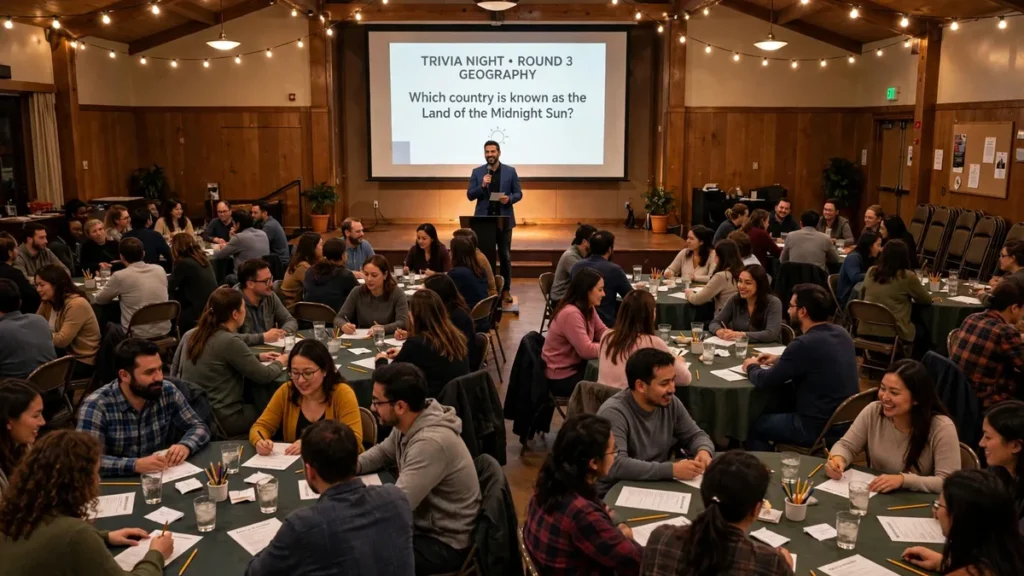
Finding the best trivia games for 80 players starts with an honest fact: no single trivia game is designed to seat 80 people around one table. A crowd that size fills a conference hall or a school gym, and the games that work for it are built around teams, tables, and whole-room formats rather than a single board or buzzer. The good news is that trivia scales beautifully to a huge group, because one question can be answered by 80 people at the same time.
The best trivia games for 80 players share three traits. First, they keep everyone playing at once instead of making most of the room watch a few people compete. Second, they use a scoring system simple enough that a host can run it without a spreadsheet. Third, they build in moments of noise, movement, and laughter, because 80 quiet people answering questions in silence is a lecture, not a party.
This guide covers the ten formats that actually work at this scale, from classic pen-and-paper pub quizzes to live app-based games. You will find a comparison table, a setup plan, a checklist, and answers to the questions every first-time host asks. Every format here handles 80 players honestly, through team play, multiple tables, tournament brackets, relay rounds, or whole-room play.
Key takeaways
- No single trivia game seats 80 players; the best formats split the crowd into teams of four to eight and let every team answer every question.
- Pen-and-paper pub quizzes and live app quizzes are the two most reliable formats for 80 players, because both keep the whole room playing at once.
- Plan on 10 to 16 teams, six rounds of ten questions, and about two hours including breaks, scoring, and a tiebreaker.
- One host, one scorekeeper, and one person on sound or slides is the minimum crew for a smooth 80-player night.
- Mix question styles, pictures, music, and movement rounds so that different kinds of players all get a moment to shine.
Why 80 Players Changes Trivia Completely
A trivia game built for six people breaks in predictable ways when 80 people show up. The first problem is time: if every player answers in turn, a single round takes half an hour. If only a few players answer, the rest of the room checks out and starts side conversations that drown out the host. The second problem is scoring: keeping track of 80 individual scores by hand is slow and error-prone. The third problem is sound: in a room of 80 people, a host without a microphone is inaudible past the third table.
The fix is to stop thinking of 80 players as 80 individuals and start thinking of them as 10 to 16 teams. A team of five to eight people can discuss an answer, write it down, and hand it in, which means the host only ever deals with a dozen answer sheets instead of 80. Discussion is also what makes trivia fun at this scale: the geography expert, the film buff, and the loudest debater all get their moment, and teams turn a quiz into a social event.
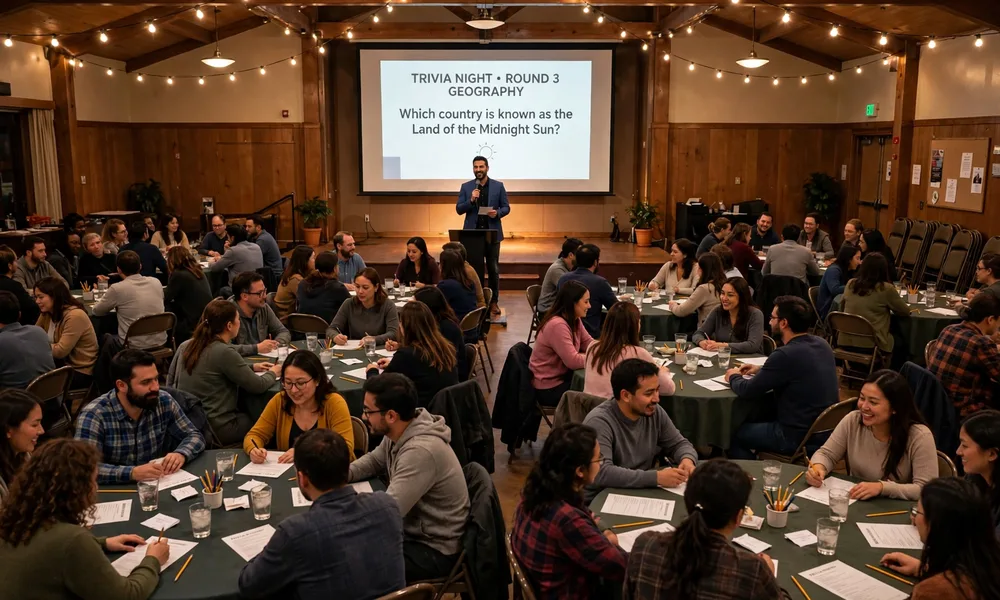
Room layout matters as much as the game itself. Round tables of six to eight work best, because everyone can see each other and hear the discussion. Long banquet rows force people to shout down the table and leave the people at the ends out. Leave a clear aisle down the middle so the host and the score runners can move, and put the screen where every table has a sightline.
How the Best Trivia Games for 80 Players Actually Work
Every format in this guide uses one of three engines to handle a crowd of 80. The first is the team-table engine: the room is divided into teams, every team answers every question on paper or on a phone, and the host scores the sheets between rounds. This is the classic pub quiz, and it is still the most reliable option because it needs almost no technology and survives a dead battery or bad Wi-Fi. The second engine is the tournament engine: teams play head-to-head in brackets or heats, and the winners advance. This works well when the evening is a competition with a clear champion, but it leaves losing teams with nothing to do unless you plan side games. The third engine is the whole-room engine: every player answers at the same time through an app, a buzzer, or a show of hands.
Most great 80-player nights combine two engines: four rounds of team-table trivia, a whole-room music round in the middle, and a tournament-style final where the top four teams face off. If your crowd is slightly smaller, the same format scales down neatly, and the best trivia games for 78 players use an almost identical setup with one or two fewer tables.
Team Tables of Four to Eight
Four to eight players per team is the sweet spot. Fewer than four and a team can be sunk by one weak round; more than eight and half the table stops contributing. With 80 players, aim for ten teams of eight, thirteen teams of six, or sixteen teams of five. Let people form their own teams where possible, but keep one or two open tables for solo arrivals and merge them into full teams at the door.
Tournament Brackets and Relay Rounds
Brackets work when you want a winner and a spectacle. Split 80 players into 16 teams of five, run four heats of four teams each, and bring the four heat winners to a final. The risk is downtime for eliminated teams, so schedule the bracket as the second half of the night, after everyone has enjoyed the team rounds. Relay rounds solve the downtime problem differently: each team sends one player at a time to answer a question at the front, then tags the next player in. Relays are noisy and funny, and they work brilliantly as a finale.
Whole-Room Games With One Host
Whole-room games put the host and the screen at the centre and let all 80 players answer together. Live quiz apps are the modern version: players join with a code, answer on their phones, and a leaderboard updates after every question. Low-tech versions work too: the host can ask the room to stand up for one answer and sit down for another. Whole-room rounds are best used in short bursts of ten to fifteen minutes, because they are high energy.
The 10 Best Trivia Games for 80 Players
1. Classic Pen-and-Paper Pub Quiz
The pub quiz is the gold standard. The host reads ten questions per round, teams write answers on a sheet, a runner collects the sheets, and the scorekeeper marks them while the next round begins. Six rounds of ten questions covers general knowledge, music, pictures, sport, food, and a themed round. A pub quiz needs a microphone, a speaker, printed answer sheets, pens, and a scoreboard, and nothing else. It handles 80 players with total calm because the format was built for noisy rooms and large crowds.
2. Live App Quiz With Phones as Buzzers
Apps such as Kahoot, Crowdpurr, and Quizizz turn every phone into a buzzer and every answer into a live leaderboard. The host projects the question, players tap their answer, and the screen shows the standings after each question. This format is fast, visual, and very popular with younger crowds and corporate groups, because the leaderboard creates a race that a paper quiz cannot match. The catch is connectivity: test the venue Wi-Fi with 80 devices before the night, and keep a paper backup round ready.
3. Jeopardy-Style Board Game Final
A Jeopardy-style board works best as a finale rather than a full evening. The top four teams from the earlier rounds come to the front, and the host runs a board of categories and point values on a screen. Teams buzz in, or in the low-tech version, raise a hand or ring a bell. The board format is dramatic because the audience can see the scores change and can shout advice, which makes the final feel like a television show. Building the board takes preparation, but free templates help.
4. Music Trivia and Name That Tune
Music rounds are the great equaliser of a trivia night. Play a five-second clip and ask for the song title, the artist, or the year it was released. A well-built music round covers five decades, so every age group gets songs they know. Play the clips over the room speakers and give teams thirty seconds to write down their answers. Ten clips per round is about right.
5. Picture Round Trivia
A picture round hands each team a printed sheet of ten images and asks them to identify what they show: famous landmarks, movie stills, logos with the brand name removed, or close-up photos of everyday objects. Picture rounds are perfect for large groups because the sheet does the work while the host rests their voice, and because visual questions reward a completely different kind of knowledge than spoken questions do.
6. Trivia Bingo
Trivia bingo mixes a quiz with a bingo card. Each player gets a card printed with answers instead of numbers, and the host reads out questions. When a player knows the answer and it appears on their card, they mark it off. The first player to complete a row or a full house shouts it out and wins a prize. For 80 players, print the cards in ten different layouts so that no two neighbours share the same card. Trivia bingo is fast and loud, and it works well as a warm-up.
7. Speed Trivia Lightning Rounds
A lightning round asks twenty quick questions in ten minutes, with ten seconds per question and no discussion time. Teams write answers as fast as they can, and the host reads the answers out immediately afterwards. Lightning rounds are ideal for the middle of the night, when energy dips and the room needs a jolt. The questions should be short and punchy: capitals, numbers, famous firsts, and one-word answers.
8. Themed Trivia Tournament
A themed tournament builds the whole night around one subject, such as movies, the 1990s, sport, or science, and runs it as a bracket. Sixteen teams play four heats, the heat winners advance, and the final two teams meet head-to-head. Themed nights are the easiest to promote, because the theme gives people a reason to come dressed up. Keep the questions broad within the theme and include a general knowledge round to balance the night.
9. Trivia Relay Race
A relay turns trivia into a team sport. Each team lines up, and one player at a time runs to the front, answers a question, and tags the next player. Correct answers earn points, and wrong answers send the player to the back of the line without a point. Relays are chaotic in the best way, and they produce the photos and videos people share afterwards. Keep the questions easy enough that the race stays close, and cap each relay at ten minutes.
10. Table Challenge and Scavenger Mix
A table challenge gives each team a set of mini-tasks to complete at their table: a word puzzle, a short riddle, a jigsaw piece, and five trivia questions, all due in fifteen minutes. Teams divide the work, which means everyone contributes, and the host can score the sheets while the next round begins. Table challenges are excellent side stations, keeping teams busy during scoring breaks.
Comparison Table: Best Trivia Games for 80 Players
| Game | Best for | How 80 players play | Setup | Equipment |
|---|---|---|---|---|
| Classic pub quiz | Any crowd, any venue | 10 to 16 teams, pen and paper | 1 hour | Microphone, sheets, pens |
| Live app quiz | Corporate, younger crowds | Whole room on phones | 1 to 2 hours | Projector, Wi-Fi, app |
| Jeopardy-style final | Dramatic finish | Top 4 teams on stage | 2 hours | Screen, buzzer or bell |
| Music trivia | Energy, mixed ages | Teams answer by song clip | 30 minutes | Speakers, playlist |
| Picture round | Visual thinkers | Printed sheet per team | 30 minutes | Colour printer, sheets |
| Trivia bingo | Warm-up and breaks | Individual cards, whole room | 30 minutes | Printed bingo cards |
| Speed trivia | Mid-night energy boost | Teams, 10 seconds a question | 15 minutes | Timer, answer sheets |
| Themed tournament | Promoted themed nights | Bracket of 16 teams | 2 hours | Bracket board, questions |
| Trivia relay race | Active, outdoor crowds | One runner per team at a time | 30 minutes | Open lane, question cards |
| Table challenge | Side stations, breaks | Teams complete mini-tasks | 1 hour | Task sheets, puzzles |
Running the Night: Setup, Scoring and Timing
A two-hour schedule works well for 80 players. Allow thirty minutes for arrival and team formation. Run four rounds of ten questions at fifteen minutes each, including marking time, then take a ten-minute break. After the break, run two more rounds, a music round, and a lightning round, then finish with a Jeopardy-style final for the top four teams and a tiebreaker if needed. Announce the schedule at the start so teams know when the breaks fall.
Scoring should be simple and public. One point per correct answer, with a bonus point for a perfect round, keeps the maths easy and the leaderboard readable. Update a large visible scoreboard after every round, because a visible scoreboard is what turns a quiz into a competition. Use two scorekeepers working in parallel, one marking and one recording totals, so marking never holds up the next round. For disputes, the host decides.
Sound and slides deserve a rehearsal. Arrive an hour early, test the microphone from the back of the room, and check that the projector is readable from the furthest table. Between rounds, mix in some of the best party games for 78 players as quick table games to reset attention and keep the room warm for the next round. For table-based rounds, ideas borrowed from the best board games for 79 players also work well as side stations while scores are being tallied.
Checklist: Your 80-Player Trivia Night
- Book a room that seats 80 at round tables of six to eight, with a stage or raised area and a clear aisle for runners.
- Confirm the microphone, speakers, projector, and screen, and test the Wi-Fi with at least 80 devices if you plan a live app round.
- Print answer sheets, picture rounds, and bingo cards in advance, with spares, plus pens for every table.
- Recruit one host, two scorekeepers, and one person to run slides or sound, and brief them on the schedule and the dispute rule.
- Prepare six rounds of ten questions, a music round, a lightning round, and a tiebreaker question.
- Buy prizes for the top three teams and a small prize for the best team name, and announce the prizes before the first question to raise the stakes.
Frequently Asked Questions
Can one trivia game really hold 80 players at once?
Yes, if the format is built for teams rather than individuals. A pen-and-paper quiz, a live app quiz, or a whole-room game can hold 80 players because every player answers every question at the same time, through their team or their phone. What does not work is a format where players take turns one by one, because the waiting time kills the energy.
How many teams should 80 players form?
Aim for 10 to 16 teams of five to eight players each. Teams of six are the most popular choice, giving you 13 teams with a couple of players to spare. Smaller teams mean more teams to score, while larger teams leave quieter players out of the discussion. If you have an awkward number, let a few teams run with five or seven players rather than forcing an exact split.
How long does an 80-player trivia night take?
Plan for about two hours of play plus thirty minutes for arrival and team formation. Six rounds of ten questions take roughly ninety minutes including marking, and a final or tiebreaker adds fifteen minutes. Add a ten-minute break in the middle. A night that runs much longer than two and a half hours will lose players to fatigue.
What equipment do I need for 80 players?
The essentials are a microphone and speaker, a projector or large screen, printed answer sheets, pens, and a visible scoreboard. For a live app round, add reliable Wi-Fi and a quiz app account. For music rounds, add speakers that reach the back of the room. Print spares of everything.
How do I stop players from looking up answers on their phones?
State the rule clearly at the start, and make the questions hard to search quickly, such as picture rounds, music clips, and questions that ask for a list or a connection rather than a single fact. Keep the rounds fast so there is little time to search, and have the host and helpers walk the room visibly.
What prizes work for 80 players?
Prize the top three teams and the best team name. A cash prize, a trophy, or a hamper works for first place, while second and third place can take smaller gift cards or a round of drinks. Keep the prizes visible near the stage all evening, because a visible prize raises the stakes. Avoid a single winner-takes-all prize, because teams that fall behind early will stop trying.
The Bottom Line
The best trivia games for 80 players are not the games with the fanciest technology or the hardest questions. They are the formats that keep all 80 people playing at once, split the crowd into teams that can actually talk to each other, and mix question styles so that everyone gets a moment to be the hero. A pen-and-paper pub quiz with a music round and a dramatic final will beat a complicated setup every time, because it is reliable, social, and fun from the first question to the last. Pick the format that fits your room and crowd, prepare your questions and answer sheets, test your sound, and let the teams do the rest.


