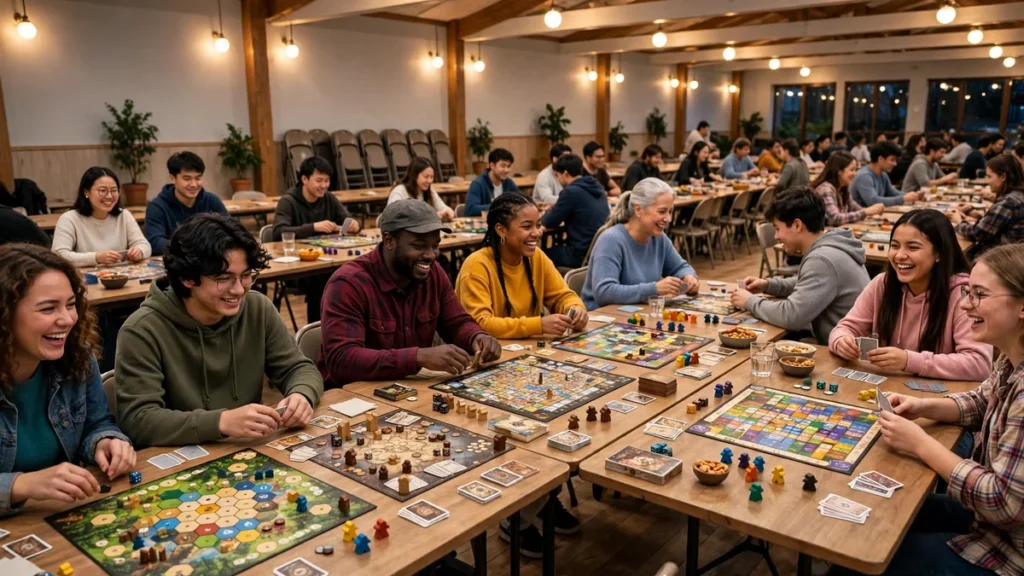
Finding the best party games for 78 players takes a different kind of planning from an ordinary game night. No single board game, card game, or party game is built to seat 78 people around one table, and pretending otherwise is the fastest way to end up with 60 bored guests watching 18 people play. The good news is that 78 players is a wonderful number for a party: it is large enough for real teams, real tournaments, and real noise, but still small enough that one host with a microphone and a clear plan can keep everyone in the game.
The secret to the best party games for 78 players is structure, not a single magic game. Split the room into teams of six, run several games at once across stations, or play whole-room games where everyone answers, votes, or performs at the same time. When every guest has a role in every round, a 78-player party feels fast, loud, and inclusive instead of slow and crowded. The games below are chosen because they scale honestly to a group this size.
This guide covers the formats that actually work for 78 players, twelve games that suit a crowd of this size, a comparison table to help you choose, a setup checklist, and answers to the questions hosts ask most. Every game here works with simple supplies, a clear host, and teams that keep the energy moving.
Key takeaways
- No single game seats 78 players, so split the group into teams of six or run whole-room games where everyone plays at once.
- Team trivia, relay races, and scavenger hunts are the most reliable formats for a group of 78.
- Give every team a captain, a scorecard, and a fixed rotation so nobody waits more than a few minutes between turns.
- Plan for about 90 minutes of games, with three to five different games in the schedule.
- One host with a microphone and a visible scoreboard keeps a 78-player party moving and fair.

How Party Games Work for 78 Players
A group of 78 players needs a format before it needs a game. The format decides whether guests play or watch, and that decision matters more than which game you pick. Three formats carry almost every successful large party: teams, stations, and whole-room play. Most great 78-player parties use at least two of them in one evening.
The team format is the simplest place to start. Divide 78 guests into 13 teams of six. Six is small enough that everyone in a team talks, argues, and contributes, and 13 teams is a lively number for a leaderboard without becoming impossible to track. Each team picks a name, a captain, and a table. Every game then becomes a contest between the 13 teams, and the running score gives the whole evening a story.
The station format works best when you have space and several games you want to feature. Set up five or six game stations around the room, and rotate teams through them on a timer. A station might hold a dice game, a word game, a building challenge, or a guessing game. Teams spend ten minutes at each station, earn points, and move on when the whistle blows. Nobody waits long, and guests who dislike one game know another is only ten minutes away.
Whole-room games are the glue that holds the evening together. In a whole-room game, all 78 players take part at the same time: everyone answers a trivia question on a card, everyone votes in a poll, or everyone joins a relay. These games are perfect for opening the night, because they break the ice for the whole room at once, and for the finale, because they let every team fight for the win in front of everyone.
The Best Party Games for 78 Players
The twelve games below are the strongest choices for a 78-player party. Each one is described with its format, its player setup, and the reason it works at this scale. Mix team games, station games, and whole-room games so the pace never drops.
1. Team Trivia Championship
Team trivia is the most dependable large-group party game ever created, and it fits 78 players perfectly. Split the room into 13 teams of six, hand each team an answer sheet, and ask six rounds of ten questions covering music, movies, food, sport, general knowledge, and a picture round. Teams discuss each question quietly, write one answer, and swap sheets for marking between rounds. A good trivia night for 78 players takes about 45 minutes and needs nothing more than printed sheets, pens, and a host with a microphone. The team format keeps every guest involved, because even a guest who knows nothing about sport can still answer the music round. If you want ready-made question ideas, our guide to the best trivia games for 76 players shows how trivia scales to very large groups.
2. Giant Scavenger Hunt
A scavenger hunt turns a whole venue into a game board. Give each team of six a list of 20 items to find or photograph within a set area, with points for each find and bonus points for the funniest photo. Items can be simple, such as a red shoe, a menu, a left-handed glove, or a stranger wearing a hat, and photo tasks like a team pyramid or a recreation of a famous painting add laughter. Set a 30-minute time limit, a clear boundary, and a meeting point. Scavenger hunts work brilliantly for 78 players because teams spread out, so crowding disappears, and the photo tasks give every team a story to share when they return.
3. Relay Race Tournament
Relay races bring physical energy to a party that trivia alone cannot. Set up a course with six short challenges: a sack hop, a balloon carry, a spoon-and-egg walk, a hula-hoop pass, a three-legged sprint, and a puzzle piece collection. Each team of six sends one player per leg, and teams race head to head in heats of three or four teams. A relay tournament for 13 teams takes about 30 minutes, and the crowd noise from the watching teams is half the fun. Keep the course short, the rules simple, and the challenges safe for all ages and abilities.
4. Bingo With a Twist
Bingo scales to any number of players, which makes it ideal for 78 guests. Print 78 unique cards, call numbers from a cage or an app, and let everyone play at once. Add a twist to keep it lively: themed cards for a birthday or holiday, picture bingo for mixed-age groups, or a rule that the first team to get three bingos wins a bonus prize. Run three short games of about 15 minutes each rather than one long game, and give small prizes for each round. Bingo is also the perfect quiet game to slot between louder activities.
5. Charades Championship
Charades works for 78 players when it becomes a team championship rather than a single circle. Each team of six takes turns sending one actor to the front, where they act out a movie, song, or phrase while their own team guesses within 60 seconds. Teams earn points for correct guesses, and bonus points if the opposing teams fail to steal the answer. A charades championship with 13 teams takes about 40 minutes if each team gets four turns. Prepare cards in advance, sort them into easy, medium, and hard, and let teams choose their difficulty for different point values.
6. Minute to Win It Challenges
Minute to Win It games are short, silly, and perfect for large groups. Each challenge takes 60 seconds and uses household items: stacking cups, moving cookies from forehead to mouth, bouncing ping-pong balls into cups, or sorting sweets by colour. Run them as a station rotation, with one challenge per station, or as a stage show where each team sends a champion to compete in front of the room. The one-minute limit keeps the pace fast, and the simple props mean you can run six challenges at once with almost no setup cost.
7. Murder Mystery in Teams
A murder mystery sounds like a small-group game, but it adapts well to 78 players when each team becomes a detective squad. Give every team the same case file: a story, a list of suspects, and a set of clues released in three rounds. Teams discuss the evidence, question actors playing the suspects, and submit their final accusation before the reveal. The host plays the lead detective, releasing clues on a schedule and keeping the tension high. A team murder mystery takes about an hour and suits evening parties where guests enjoy talking, thinking, and debating.
8. Pictionary Relay
Pictionary is a natural fit for teams of six. Each team forms a line, the first player sees a word, draws it for the next player, and the drawing passes down the line until the last player guesses the word. Compare the final guess with the original word for guaranteed laughter. Run it as a relay race between teams, with each team completing five words, and award points for speed and accuracy. Pictionary relay needs only paper, markers, and a word list, and it works for guests of all ages.
9. Word Game Showdown
Word games shine in large groups because they need no equipment beyond a timer and a word list. Run a showdown with rounds of word chain, category lists, and anagrams, where each team writes as many valid words as possible in two minutes. Teams earn a point per valid word, with bonus points for the longest word in each round. The format is easy to host, easy to score, and easy to adjust for different ages. For more word game ideas that suit big groups, see our roundup of the best word games for 77 players, which covers formats that translate well to a 78-player party.
10. Dice Game Stations
Dice games are fast, fair, and simple to run at stations. Set up three dice stations with games like Farkle, Yahtzee-style scoring, and a high-low dice duel, and let teams rotate through them earning points at each stop. Dice games suit a station format because each round takes only a few minutes, the rules are quick to explain, and luck keeps the scores close even when teams differ in skill. Keep scorecards at every station so teams carry their totals with them. Our guide to the best dice games for 76 players has more dice game options that work at this scale.
11. Karaoke Battle
A karaoke battle turns 78 guests into 13 competing acts. Each team picks a song, rehearses for ten minutes, and performs it while the other teams score the performance on energy, creativity, and courage rather than singing ability. Award bonus points for costumes, choreography, and audience participation. A karaoke battle takes about 45 minutes and works best as the finale, when guests are relaxed and the room is loud. Keep the song list short and familiar so every team can join in.
12. Human Bingo and Icebreaker Mixer
Human bingo is the best opening game for 78 players because it gets strangers talking within minutes. Give every guest a bingo card filled with prompts such as has been to three countries, can juggle, owns a dog, or has met a celebrity. Guests mingle, find people who match each square, and collect signatures. The first guests to complete a row win a small prize. Human bingo takes about 20 minutes, needs no teams, and leaves the room warmed up and chatty before the team games begin.
Comparison Table: Best Party Games for 78 Players
Use this table to choose the right mix for your party. A good schedule pairs one quiet game, one active game, and one whole-room game.
| Game | Format | Time | Energy | Best For |
|---|---|---|---|---|
| Team Trivia Championship | Teams | 45 minutes | Medium | Evening parties, mixed ages |
| Giant Scavenger Hunt | Teams | 30 minutes | High | Large venues, outdoor space |
| Relay Race Tournament | Teams | 30 minutes | High | Active groups, daytime parties |
| Bingo With a Twist | Whole room | 15 minutes per game | Low | Quiet breaks, mixed ages |
| Charades Championship | Teams | 40 minutes | Medium | Creative groups, evenings |
| Minute to Win It | Stations | 30 minutes | High | Fast pace, small budgets |
| Murder Mystery in Teams | Teams | 60 minutes | Low | Evening parties, puzzle lovers |
| Pictionary Relay | Teams | 25 minutes | Medium | Families, all ages |
| Word Game Showdown | Teams | 30 minutes | Medium | Quiet rooms, quick setup |
| Dice Game Stations | Stations | 30 minutes | Medium | Casual parties, mixed skill |
| Karaoke Battle | Teams | 45 minutes | High | Finale, confident groups |
| Human Bingo Mixer | Whole room | 20 minutes | Low | Opening game, strangers |
How to Plan a 78-Player Party in Six Steps
Planning matters more than picking games. A clear schedule, clear teams, and clear scoring turn a chaotic crowd into a great party. Work through this checklist in order.
- Split 78 guests into 13 teams of six before the party starts. Pre-assign teams on a printed list at the door so nobody wastes the first twenty minutes choosing sides, and mix ages and friend groups in every team.
- Appoint a captain for each team. The captain collects the scorecard, keeps the team together, and speaks for the team when the host asks for an answer or a volunteer.
- Build a 90-minute schedule with three to five games. Open with human bingo, play two team games in the middle, and close with a whole-room finale such as karaoke or trivia.
- Prepare all supplies the day before. Print answer sheets, scorecards, bingo cards, and word lists, pack pens, dice, timers, and prizes in one box per station, and test the microphone and speaker before guests arrive.
- Set up a visible scoreboard. A whiteboard or a projected slide with all 13 team names lets everyone follow the race and keeps the competition friendly and honest.
- Buy small prizes for every team, not just the winners. A fun prize for the winning team, plus a silly prize for the most creative team and the loudest team, means every guest leaves with a good memory.
Frequently Asked Questions
Can one game really fit 78 players?
No single board or card game seats 78 players at once, and that is normal. The games in this guide work for 78 players because they use teams of six, station rotations, or whole-room formats where everyone plays at the same time. Choose the format first, then the game.
How many teams should 78 players form?
Thirteen teams of six is the best split for 78 players. Teams of six are small enough that every member contributes, and 13 teams make a lively leaderboard. Avoid teams of ten or more, because quieter guests stop taking part.
How long should party games last for 78 players?
Plan for about 90 minutes of games inside a two to three hour party. Three to five games is the right number. Fewer games feel thin, and more games leave the host rushing and the guests tired.
What is the best opening game for 78 players?
Human bingo is the best opener, because it gets all 78 guests talking within minutes and needs no teams, no equipment beyond printed cards, and no explanation longer than one minute. Follow it with a team game once the room is warmed up.
Do I need a microphone for 78 players?
Yes. A host cannot be heard clearly by 78 guests in a hall without a microphone and a speaker, especially once teams start cheering. A simple portable speaker with a wireless microphone is enough, and it also lets you play music between rounds.
What prizes work best for large party games?
Small, fun prizes work better than expensive ones: snack boxes, funny trophies, gift cards, or a silly team title. Give the main prize to the winning team and smaller prizes for the most creative team and the best team name, so several teams go home happy.
The Bottom Line
The best party games for 78 players are the ones that give every guest a role, a team, and a reason to cheer. Split the room into 13 teams of six, open with human bingo, mix trivia, relays, and station games through the middle of the evening, and close with a whole-room finale that lets every team fight for the win. With a clear schedule, a visible scoreboard, and a host who keeps the pace moving, 78 players is not a problem to solve. It is the perfect size for a party nobody forgets.