Finding the best trivia games for 84 players is a different kind of challenge from picking a quiz for a small group. A game that works beautifully for eight people can fall apart completely when eighty-four people are in the room, because no single table, buzzer set, or answer sheet is built for that many players at once. The good news is that trivia is one of the few game formats that scales well, provided you stop thinking of it as one game and start thinking of it as an event with teams, tables, and a clear system for scoring.
The best trivia games for 84 players are not single boxed games at all. They are formats that let a large crowd play at the same time without long waits, quiet corners, or confusion about who is winning. Team-based pub quizzes, picture rounds, music rounds, and whole-room relay games all work, because every player is involved in every round and the host controls the pace from the front of the room. With the right structure, eighty-four players can feel like one big, energetic game night rather than a crowd waiting for its turn.
This guide explains exactly how to make that happen. You will find the three formats that genuinely work for 84 players, a comparison table to help you choose, a shortlist of game styles that suit a crowd this size, a step-by-step plan for running the night, fair scoring rules, a preparation checklist, and answers to the questions organisers ask most often. Everything here is built around one honest premise: no single game seats 84 players, so the format has to do the work.
Key takeaways
- No single boxed trivia game seats 84 players, so plan for teams of six to eight players at separate tables, with a host running the whole room.
- Team pub quizzes, picture rounds, and music rounds work best for a crowd this size because every team plays every round at the same time.
- Divide 84 players into ten to fourteen teams, keep rounds to ten questions or fewer, and announce scores after every round to keep the energy high.
- Use one shared answer sheet per team, a single host with a microphone, and a simple scoring system that every team can follow.
- Test your sound, your screen, and your questions before the night starts, because a large room forgives nothing once eighty-four people are waiting.
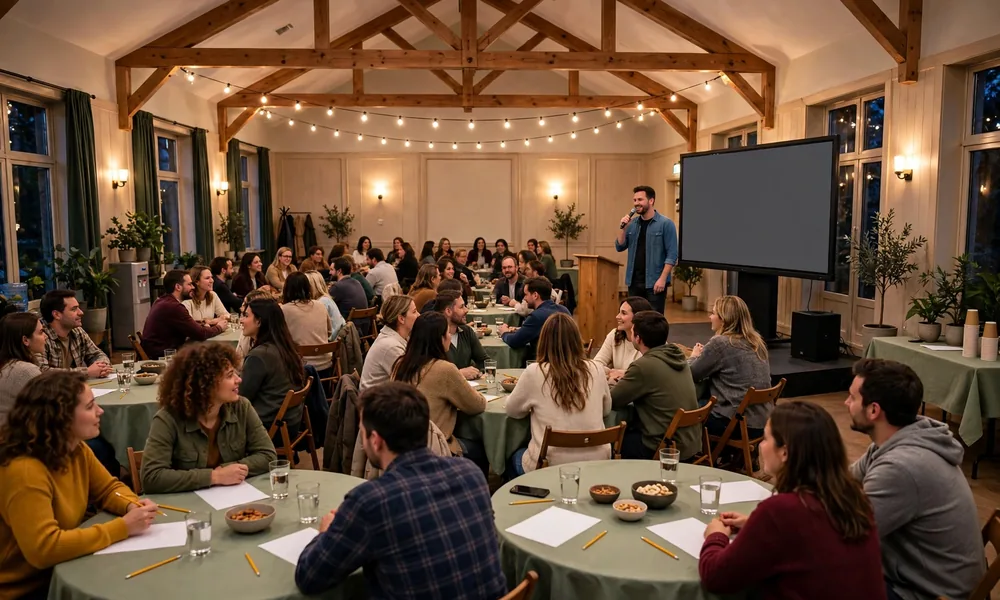
Why 84 Players Changes Everything
Most trivia games are designed for two to eight players. The box says so plainly, and the components reflect it: a handful of answer pads, one buzzer set, a single scorecard. When you try to stretch that design to eighty-four people, the problems appear quickly. Players at the back cannot hear the questions, teams argue over a single answer sheet, and the game slows to a crawl while one team takes its turn. The game itself is rarely the problem. The format is.
A group of eighty-four is really a small audience, not a table of players. That changes what the host has to do. Instead of dealing cards or passing a buzzer, the host has to run a room: keep the pace brisk, keep every team involved, and make the scoring visible so nobody wonders whether the game is fair. A good large-group trivia night feels like a show with audience participation, and the host is the difference between a buzzing room and a bored one.
The Three Formats That Actually Work
Once you accept that no single game seats eighty-four players, the choice becomes simpler. There are three formats that genuinely work, and each one suits a slightly different kind of event. Most successful large trivia nights use a mix of all three across the evening, so the pace never settles into a single rhythm for too long.
Team Tables With a Single Host
This is the classic pub quiz format, and it remains the most reliable option for a crowd of this size. Players sit in teams of six to eight at separate tables, each team has one answer sheet per round, and a host reads the questions aloud from the front of the room. Every team answers every question, so nobody sits out, and the host controls the timing of each round.
The format works because it scales cleanly. Whether there are four teams or fourteen, the host does exactly the same job: read a question, give teams thirty to sixty seconds to agree on an answer, then move on. The best trivia games for 84 players in this style use written rounds of ten questions, with a short break for marking between rounds. Teams swap answer sheets with a neighbouring table for marking, which keeps the scoring honest and adds a small social moment between rounds.
One detail matters more than any other: the host needs a microphone and a screen. A voice that carries to the front tables will not reach the back of a hall holding eighty-four people, and a question that is only spoken can be misheard. Put the questions on a screen as well, and every team gets the same wording. If you are choosing between this format and a smaller gathering, the comparison with the best trivia games for 82 players shows the same structure at a nearly identical scale, and the same hosting rules apply.
Tournament and Bracket Play
A tournament format works well when the event has a competitive edge, for example a company social, a school fundraiser, or a club championship. Teams play short head-to-head rounds against other teams, and winners advance while other teams move into consolation rounds or a parallel quiz so nobody is eliminated early and left with nothing to do.
The key to making a bracket work for eighty-four players is to keep the early rounds short. Ten questions per match is enough to separate teams without dragging the evening out, and a double-elimination or points-based structure is kinder than a single knockout, because a team that loses its first match still has games left. With twelve teams, a points league is often simpler than a bracket: every team plays the same number of rounds, and the highest total wins.
Bracket play also gives the event a natural climax. A final round between the top two teams, played in front of the whole room, is far more exciting than a quiet announcement of the winning score. If you run a final, give the finalists a buzzer round or a head-to-head question set, and let the rest of the room watch and cheer. It turns the end of the night into a moment rather than an administrative task.
Whole-Room Relay and Rotation Games
Whole-room games work when you want movement and energy rather than a sit-down quiz. In a relay format, teams rotate between stations, each with a different trivia challenge: a picture round at one table, a music round at another, a general knowledge round at a third. Teams spend ten minutes at each station, then move on, and the scores are added up at the end.
This format suits venues with several rooms or a large hall that can be divided into zones. It also suits groups that include people who do not want to sit still for two hours. The trade-off is complexity: you need a station host for each zone, a clear rotation signal, and a scoring system that travels with each team. A simple answer card that each team carries from station to station solves the scoring problem, and a bell or a whistle solves the rotation problem.
Relay games are the best choice when the trivia night is part of a larger event, such as a festival, a fair, or a team-building day. They let eighty-four players spread out, talk, and move around, and they make the trivia feel like an activity rather than an exam. Keep each station short and self-contained, and make sure every station has its own host so no group is left waiting for instructions.
Comparing the Best Trivia Games for 84 Players
The table below compares the main options side by side, so you can match the format to your venue, your audience, and the amount of preparation time you have. Every option here works for eighty-four players; the differences are in energy, complexity, and the kind of evening each one creates.
| Format | Best for | Teams | Preparation | Energy level |
|---|---|---|---|---|
| Team pub quiz | Evenings, pubs, halls | 10 to 14 | Low | Steady and social |
| Picture rounds | Mixed-age groups | 10 to 14 | Medium | Relaxed and visual |
| Music rounds | Parties and celebrations | 10 to 14 | Medium | High and lively |
| Buzzer tournament | Competitive events | 8 to 12 | High | Very high |
| Station relay | Festivals and team days | 12 to 14 | High | High and active |
| Whole-room quiz | Large halls, conferences | 10 to 14 | Low | Steady and inclusive |
The Shortlist: Game Styles That Suit a Crowd of 84
With the format decided, the next question is what kinds of questions and rounds to include. A good large-group trivia night uses four or five different round styles across the evening. Variety keeps the pace fresh, and it gives every player a round where they can contribute, because different people are strong in different areas.
Classic General Knowledge Rounds
General knowledge is the backbone of any trivia night, and it works at any scale. Ten questions covering geography, history, science, sport, food, and current affairs give every team a fair chance, because the range is wide enough that no single specialist dominates. The trick is to mix easy, medium, and hard questions in every round. If every question is hard, weaker teams stop trying. If every question is easy, strong teams get bored. A spread of three easy, four medium, and three hard questions keeps the round competitive for everyone.
Picture Rounds
Picture rounds are ideal for large groups because they solve the hearing problem completely. Print a picture sheet for each team, or show the pictures on a screen, and every team works from the same images at the same time. Famous landmarks, flags, animals, film stills, and close-up photographs of everyday objects all work well, and a picture round gives players who struggle with spoken questions a fair chance to contribute.
Music and Sound Rounds
Music rounds are the liveliest part of most trivia nights, and they scale well to eighty-four players because the whole room hears the same clip at the same moment. Play ten short clips of well-known songs, and ask teams to name the song, the artist, or both. Ten seconds per clip is enough, and a short pause between clips gives teams time to write down their answers.
Speed and Buzzer Rounds
Buzzer rounds are exciting, but they need care at this scale. A single buzzer set cannot serve fourteen teams, so run buzzer rounds as a final or as a showcase between the top teams rather than as the main format. Two teams on stage, a host with the questions, and the rest of the room watching creates a strong finish to the evening without the logistical problems of a full buzzer tournament.
If you do run a buzzer round, keep it short: ten questions, first team to answer correctly scores a point, and a wrong answer passes the question to the other team. A short buzzer final gives the evening a climax, and it lets the strongest teams compete directly in front of everyone. For a broader look at how large-group games are structured, the best party games for 82 players covers similar crowd-sized formats and the same team-size logic.
How to Run the Night, Step by Step
A large trivia night runs on a timetable, and the host should have it written down before the first guest arrives. A typical evening for eighty-four players lasts about two hours, including breaks, and it follows a simple rhythm: welcome, rounds, marking, a break, more rounds, a final, and results.
Start by welcoming the room and explaining the rules in under two minutes. Tell teams how many players are allowed per team, how the answer sheets work, how marking will happen, and what the prize is. Short, clear rules at the start prevent long arguments later, and a confident opening sets the tone for the whole evening.
Alternate the round types as the evening goes on: general knowledge, picture round, music round, themed round, general knowledge again. A break in the middle, around the halfway point, gives teams time to get a drink, stretch, and talk about the quiz. Use the break to mark the rounds so far and to prepare the second half, and keep the break to fifteen minutes so the energy does not fade.
Scoring That Stays Fair for 84 Players
Fair scoring matters more at this scale than at a small table, because eighty-four players will notice an inconsistency that eight players might overlook. Keep the system simple enough that every team can follow it: one point per correct answer, with a small bonus for a perfect round if you want to add excitement. Avoid complicated partial credit, because it slows marking and invites arguments.
Swap answer sheets between neighbouring tables for marking. This is the standard pub quiz method, and it works because it is transparent: every team marks another team’s sheet while the host reads the answers aloud, and the marked sheets go back to their owners. If a team disputes an answer, the host’s decision is final, and it should be given quickly and calmly so the evening does not stall.
For larger events, it helps to have one helper whose only job is scoring. The host runs the room, the scorer collects the sheets, adds the totals, and updates the board. Dividing the work this way keeps the pace brisk, because the host never has to stop the show to do arithmetic. The same division of labour applies to the game choices themselves: the best board games for 82 players faces the same scaling problem, and the solution is the same, which is to let the format, not the box, carry the crowd.
Preparation Checklist
Use this checklist in the week before the event, and again on the day itself. Most large trivia nights that go wrong do so because one of these items was left to the last minute.
- Confirm the venue holds 84 players comfortably, with twelve to fourteen tables and a clear view of the host and screen from every seat.
- Test the microphone, speakers, and screen in the actual room, with someone sitting at the farthest table to check the sound.
- Prepare at least five rounds of ten questions each, with a mix of easy, medium, and hard questions in every round.
- Print one answer sheet per team per round, plus spare pencils, and prepare a score sheet for the front of the room.
- Decide the team size in advance, either six or seven players, and announce it when teams are formed so nobody has to be split up at the door.
- Arrange a prize for the winning team and a small prize for the last-placed team, because a wooden spoon prize keeps the bottom of the table engaged.
Frequently Asked Questions
Can one boxed trivia game really seat 84 players?
No. No boxed trivia game is built for eighty-four players at one table. The games that work at this scale are formats, not boxes: team quizzes, picture rounds, music rounds, and relay games that let many teams play at the same time under one host.
How many teams should 84 players be split into?
Divide eighty-four players into twelve teams of seven or fourteen teams of six. Teams of six to eight work best, because smaller teams leave some players with nothing to do, while larger teams make it hard for everyone to be heard.
How long does a trivia night for 84 players take?
Plan for about two hours, including a fifteen-minute break. Five rounds of ten questions, with marking and score announcements between rounds, fill that time comfortably. A shorter event can use three rounds and finish in about ninety minutes.
What equipment do I need for a large trivia night?
You need a microphone, a speaker system, a screen or projector, printed answer sheets, pencils, and a score board. A laptop for music rounds and picture rounds is helpful, and a helper to manage scoring makes the evening run much more smoothly.
How do I keep the scoring fair with so many teams?
Use one point per correct answer, swap answer sheets between neighbouring tables for marking, and display the scores where everyone can see them. The host’s decision on disputed answers is final, and it should be given quickly so the game keeps moving.
What is the best round to start with?
Start with an easy general knowledge round of ten questions. It warms the room up, lets teams learn how to work together, and gives the host a chance to check the sound and the screen before the harder rounds begin.
The Bottom Line
The best trivia games for 84 players are not found in a single box. They are found in a format that treats eighty-four players as a room full of teams, gives every team the same questions at the same time, and keeps the scoring simple and visible. A team pub quiz with picture and music rounds, run by a confident host with a microphone and a screen, will give a crowd this size a genuinely great night. Plan the tables, test the sound, write fair questions, and let the format do the work.