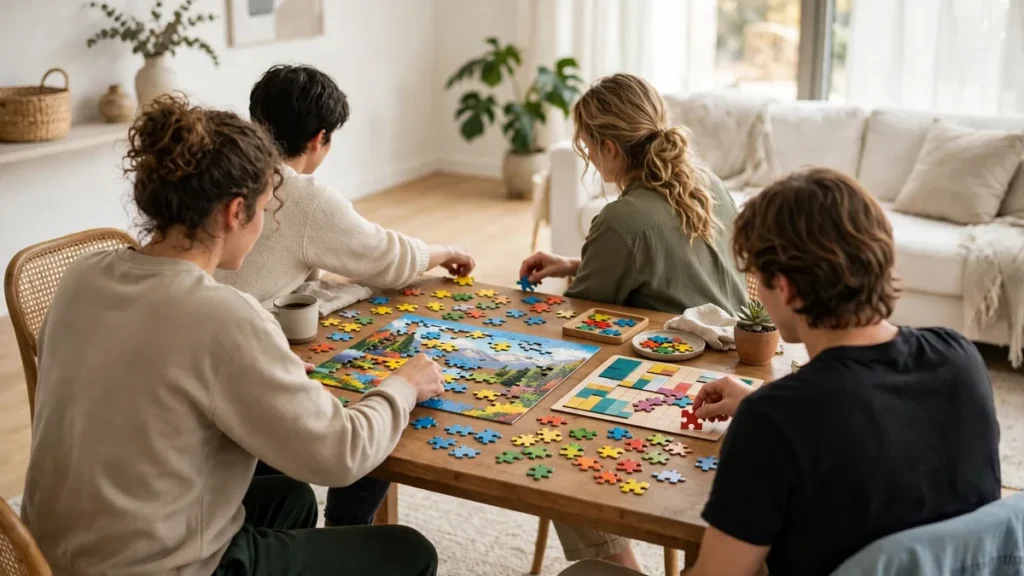
The best puzzle games for 4 players turn a quiet evening into a shared challenge, where four minds work on the same problem from four different angles. One person spots the pattern, another sees the missing piece, a third plans three moves ahead, and the fourth keeps the group laughing when a plan falls apart. That mix is what makes four the ideal number for puzzle play: enough players for real teamwork and friendly rivalry, but not so many that anyone sits waiting for a turn.
Finding the best puzzle games for 4 players is not just about picking a box that says 2 to 4 players on the lid. A good four-player puzzle game keeps everyone involved on every turn, gives each player a meaningful decision, and finishes in a satisfying length of time, usually 30 to 60 minutes. It should also be easy to teach in five minutes, because the best game nights start with playing, not with reading a rulebook for half an hour.
In this guide, we have gathered ten puzzle games that genuinely work well with exactly four players, from fast tile-laying games to cooperative escape-room puzzles and classic 1,000-piece jigsaws. Each one has been chosen for clear rules, strong replay value, and the way it makes four people think together. Whether you are planning a family game night, a rainy weekend with friends, or a regular puzzle evening, you will find a game here that fits your group, your table, and your patience level.
Key takeaways
- The best puzzle games for 4 players keep all four players active on every turn, with no long waits between moves.
- Azul, Sagrada, and Ubongo are the strongest starting points for most groups, because they are quick to learn and rewarding to master.
- Cooperative puzzle games such as Exit: The Game and The Crew suit groups that prefer solving together rather than competing.
- A 1,000-piece jigsaw puzzle is the most relaxed four-player option, and it works best when each player takes charge of one area of the picture.
- Choose by time first: allow 20 to 30 minutes for a light game, 45 to 60 minutes for a deeper puzzle game, and a full evening for a large jigsaw.

What Makes a Puzzle Game Great for 4 Players?
Not every puzzle game scales well to four players. Some games that are excellent with two players become slow and crowded with four, while others only come alive when the table is full. The difference usually comes down to three things: downtime, interaction, and balance. Downtime is the time a player spends waiting while others take their turns. In a good four-player puzzle game, downtime is short, because turns are quick or because players plan during other people’s turns. Interaction is how much players affect each other: the best games let you block a rival, draft a tile they wanted, or build on a clue they gave you. Balance means that no player is left behind after one bad move, and that the winner is rarely decided in the first ten minutes. Space matters too. Four players need a table large enough for a central board, four player areas, and a shared pool of pieces. A game like Blokus needs only a modest table, while a 1,000-piece jigsaw needs a large, flat surface that can be left undisturbed.
How We Chose These Games
We chose games that are widely available, genuinely support four players without a fiddly variant, and have stood the test of repeated play. Each game below can be learned in under ten minutes, plays in under an hour except for the jigsaw, and offers a different kind of puzzle: spatial reasoning, pattern building, wordplay, deduction, or teamwork. We avoided games that claim to support four players but are really designed for two, games with long periods of waiting, and games that depend heavily on luck rather than thinking. If you want a broader starting point, the best board games for 4 players are a useful comparison, because they show how puzzle games sit alongside strategy and party games at the same player count.
10 Best Puzzle Games for 4 Players
1. Azul
Azul is the first game we recommend to almost any group of four. Players draft coloured tiles from shared factory displays and place them on their own board to complete rows and columns, scoring points for finished lines and bonuses for complete sets. The rules take about three minutes to explain, yet the decisions are genuinely tense: take the tiles you need now, or take a different colour to stop the player after you from completing a row? With four players, the factory displays turn over quickly, so you cannot rely on a tile being there when your turn comes back around. A game lasts 30 to 45 minutes, and the tiles are beautiful to handle.
2. Sagrada
Sagrada asks four players to build a stained-glass window using coloured dice. Each player has a window grid with restrictions on colour and number, and on each turn they draft a die from a shared pool and place it according to the rules. The puzzle is in fitting the dice together: a red six cannot sit next to another red die, and every placement limits your future options. The game shines with four players because the dice pool is shared and competitive. If you pass on a die you need, the next player may take it. Sagrada plays in 30 to 45 minutes, looks stunning on the table, and offers a different puzzle every time because the dice are rolled fresh each game.
3. Ubongo
Ubongo is a fast, frantic spatial puzzle that turns four-player game night into a race. Each player gets a board and a set of polyomino pieces, and everyone tries to tile their board completely before the sand timer runs out. The first players to finish grab the best gems from the track, and the player with the most valuable gems at the end wins. What makes Ubongo special for four players is that everyone plays at the same time, so there is no waiting and no turn order to worry about. A full game takes 20 to 30 minutes, the rules are almost instant to learn, and the difficulty can be adjusted by choosing the easier or harder side of each board.
4. Qwirkle
Qwirkle is a simple tile game with surprising depth, and one of the most reliable four-player puzzle games ever made. Players place wooden tiles with six shapes in six colours, building lines that share either a shape or a colour, and scoring points for each tile in a line. A completed line of six, called a Qwirkle, scores a bonus. The rules can be taught in two minutes, and the game is easy enough for children while still rewarding careful play from adults. With four players, the shared board grows in every direction, and a single well-placed tile can score in two directions at once. Games last 30 to 45 minutes, and the pieces are sturdy and pleasant to handle.
5. Blokus
Blokus is a pure spatial puzzle played on a square board. Each of the four players has a set of 21 pieces in a single colour, made from squares joined in different shapes. On your turn, you place one piece so that it touches one of your own pieces at a corner, but never along an edge. The aim is to place as many of your pieces as possible while blocking your opponents from expanding. The four-player game is the definitive version, because the board is designed for four colours meeting in the middle. A game takes 20 to 30 minutes, there is no luck at all, and the rules are so simple that a new player can start in minutes.
6. Cascadia
Cascadia is a gentle tile-laying puzzle about building a habitat of mountains, forests, rivers, and meadows, and placing animal tokens in patterns that score points. On each turn, a player takes a habitat tile and an animal token from a shared market, adds them to their own growing landscape, and tries to satisfy the scoring cards for bears, elk, salmon, hawks, and foxes. With four players, everyone builds their own landscape at the same time, yet the shared market creates real competition. If you take the combination another player wanted, their plan changes. Games last 30 to 45 minutes, the artwork is lovely, and the game is easy to teach.
7. Codenames
Codenames is a word puzzle played in two teams of two, which makes it a natural fit for four players. A grid of 25 word cards is laid out, and each team’s spymaster gives a one-word clue that links several of their team’s words together. The team discusses the clue, debates the possibilities, and guesses. A wrong guess can help the other team, and the assassin card ends the game instantly if it is chosen. The four-player version is tight and conversational, because each team has only one guesser and one clue-giver. Games take 15 to 30 minutes, and no two games are alike because the word grid changes every time. For a lighter evening after a long puzzle session, the best party games for 4 players offer a good follow-up, because they keep the same four people playing together without the same mental effort.
8. Exit: The Game
Exit: The Game brings the escape-room experience to your table, and it is at its best with four players. Each box contains a self-contained puzzle adventure, such as escaping a cabin, a laboratory, or a haunted house. Players work together to solve riddles, decode clues, and unlock the next stage, using the cards, booklets, and unusual components in the box. Most scenarios take 60 to 90 minutes, and the game is designed to be played once, because some components are cut, folded, or written on. Four players are ideal because the puzzles often need parallel thinking: one person decodes a sequence while another searches for a hidden number, a third keeps track of the clues, and a fourth checks the solution.
9. 1,000-Piece Jigsaw Puzzle
A 1,000-piece jigsaw puzzle is the most relaxed and most social option for four players. Unlike a board game with a winner, a jigsaw is a shared project: everyone works on the same picture, at their own pace, and the finished puzzle is a reward in itself. Choose a clear, colourful image with distinct areas, such as a landscape or a city scene, so that each player can take charge of one part of the picture. Sort the edge pieces first and build the border together, then divide the remaining pieces by colour or area. A 1,000-piece puzzle usually takes three to five hours spread over an evening or a weekend, so treat it as an ongoing activity rather than a timed game.
10. The Crew: Mission Deep Sea
The Crew: Mission Deep Sea is a cooperative trick-taking game with a puzzle at its heart. Four players work together through a series of 50 missions, each with a specific goal, such as winning certain cards in a certain order or avoiding a particular trick. Players cannot show their cards, but they can communicate limited information using a token system, and the group must plan carefully to succeed. The game works beautifully with four players because the missions are designed around that player count, and the shared goal keeps everyone engaged even when it is not their turn. Missions take 10 to 20 minutes each, and you can play two or three in an evening and return to the next ones later.
Comparison Table: Best Puzzle Games for 4 Players at a Glance
| Game | Type | Time | Best for | Difficulty |
|---|---|---|---|---|
| Azul | Tile drafting | 30-45 min | Most groups | Easy |
| Sagrada | Dice drafting | 30-45 min | Pattern lovers | Easy-medium |
| Ubongo | Spatial race | 20-30 min | Fast, lively groups | Easy |
| Qwirkle | Tile matching | 30-45 min | Families | Easy |
| Blokus | Abstract spatial | 20-30 min | Competitive players | Easy |
| Cascadia | Tile laying | 30-45 min | Relaxed evenings | Easy |
| Codenames | Word puzzle | 15-30 min | Talkative groups | Easy |
| Exit: The Game | Escape room | 60-90 min | Team problem solvers | Medium |
| 1,000-piece jigsaw | Jigsaw | 3-5 hours | Slow, social puzzling | Easy-medium |
| The Crew: Mission Deep Sea | Cooperative cards | 10-20 min per mission | Team players | Medium |
How to Choose the Right Puzzle Game for Your Group
Start with time. If you have 30 minutes, choose Ubongo, Blokus, or Codenames. If you have an hour, Azul, Sagrada, Cascadia, or Qwirkle will fill the evening nicely. If you have a whole evening, an Exit scenario or a jigsaw session will feel unhurried. Next, think about mood. A competitive group will enjoy Azul, Blokus, and Qwirkle, where blocking and scoring matter. A cooperative group will prefer Exit, The Crew, or a jigsaw, where the group wins or finishes together. For a table that includes children, Qwirkle, Ubongo, and Blokus are the most accessible, because the rules are visual and the turns are quick. For adults who enjoy a deeper puzzle, Sagrada, Azul, and The Crew offer more to think about. Finally, think about replay value: games with random setups, such as Sagrada and Codenames, play differently every time, while a single Exit box is a one-time experience.
Tips for a Better 4-Player Puzzle Night
Set up the table before everyone arrives, with the game, the pieces sorted, and space for drinks and snacks away from the board. Explain the rules with a short example round rather than a long speech, and let new players ask questions during the first few turns. Agree on the pace before you start, and for a longer session, plan two games rather than one long one. Start with a quick, energetic game such as Ubongo or Codenames to warm the group up, then move to a deeper game such as Azul or Sagrada for the main event.
Checklist: Setting Up Your 4-Player Puzzle Game Night
- Pick the game by time first, then by mood: 30 minutes for a light game, 45 to 60 minutes for a deeper puzzle, a full evening for a jigsaw.
- Check that the box genuinely supports four players, and read the four-player rules before the night starts.
- Clear a table large enough for a central board, four player areas, and a shared pool of pieces.
- Sort pieces, dice, or tiles before players arrive, and keep snacks and drinks away from the board.
- Teach the game with a short example round, and let new players ask questions during the first few turns.
- Plan a second, shorter game as a follow-up, so the evening does not end on a single result.
Frequently Asked Questions
What is the best puzzle game for 4 players for beginners?
Azul is the best starting point for most beginners, because the rules take three minutes to learn and the game is satisfying from the first round. Qwirkle and Ubongo are close behind: Qwirkle for a calm, family-friendly game, and Ubongo for a fast, energetic one.
Which puzzle game is best for 4 adults?
For four adults, Sagrada and Azul offer the most satisfying depth without a long learning curve, while The Crew and Exit suit adults who enjoy a shared challenge. If the group prefers a talkative evening, Codenames is the best adult choice, because the wordplay and discussion are the heart of the game.
Are puzzle games good for family game night with 4 players?
Yes, puzzle games are among the best choices for a family game night with four players, because they are easy to learn, keep everyone involved, and do not depend on trivia knowledge or fast reflexes. Qwirkle, Blokus, and Ubongo work well across ages, and a 1,000-piece jigsaw is ideal when the family wants a relaxed activity that can stretch over a weekend.
How long does a 4-player puzzle game usually take?
Most four-player puzzle board games take 20 to 45 minutes, including teaching time. Ubongo and Blokus finish in 20 to 30 minutes, Azul, Sagrada, Cascadia, and Qwirkle take 30 to 45 minutes, and an Exit scenario takes 60 to 90 minutes. A 1,000-piece jigsaw usually takes three to five hours.
What is the best cooperative puzzle game for 4 players?
Exit: The Game is the best cooperative puzzle game for four players if you want a single immersive adventure, while The Crew: Mission Deep Sea is the best choice if you want a game you can return to again and again. A 1,000-piece jigsaw is the most relaxed cooperative option, because there is no time pressure and no losing.
Can you play puzzle games with 4 players online?
Yes, several of these games have digital versions, and they are a good option when the four players are in different places. Azul, Sagrada, Codenames, and Blokus all have well-regarded digital versions, and many jigsaw puzzle apps let four people work on the same puzzle together. For more ideas in the same spirit, the best trivia games for 4 players are a useful next read, because they show how a different kind of four-player game can round out a game night.
The Bottom Line
The best puzzle games for 4 players are the ones that make four people think together, whether that means drafting tiles in Azul, building a stained-glass window in Sagrada, racing the timer in Ubongo, or working through an escape-room box as a team. Start with Azul or Qwirkle if you are new to puzzle games, choose Sagrada or Cascadia for a calm, thoughtful evening, pick Codenames or Ubongo for energy and laughter, and save Exit or a 1,000-piece jigsaw for a night when the group wants a shared project. Pick one game, clear the table, and let the puzzle do what it does best: bring four players together around a single, satisfying challenge.


