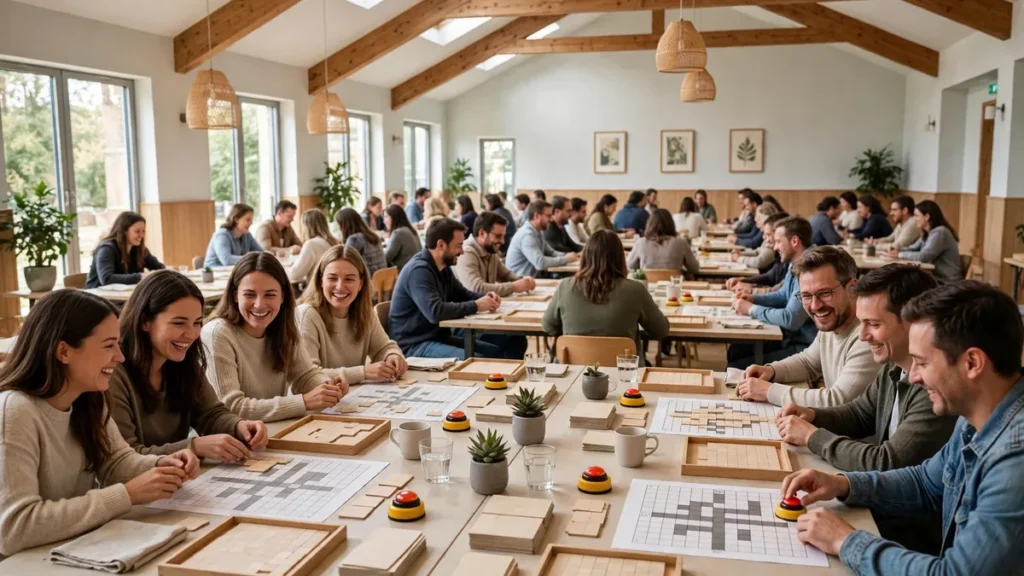
Finding the best puzzle games for 155 players starts with an honest fact: no single puzzle game seats 155 people around one table. A jigsaw puzzle built for a family of four does not magically stretch to fit a whole school year group, a company offsite, or a community hall packed with neighbours. The best puzzle games for 155 players are therefore not one giant box but a smart system of team play, multiple tables, relays, and tournaments that lets every single person take part at the same time.
That scale changes everything about how you choose. A puzzle that is perfect for a quiet evening with six friends can fall flat when thirty teams are racing the clock in the same room. The games that work for 155 players share a few qualities: they split neatly into identical rounds, they need little explaining, they keep every team busy rather than leaving half the room watching, and they produce a clear winner without an argument about the rules. This guide focuses on exactly those games.
Whether you are planning a school puzzle day, a corporate team-building event, or a community gathering, the eight games below have been chosen because they scale. Each one works with teams of five or six, runs in parallel across many tables, and can be scored fairly across the whole room. You will also find a tournament plan, a comparison table, and a checklist so that nothing is left to chance on the day.
Key takeaways
- No single puzzle game seats 155 players, so the winning approach is team play with multiple tables running the same puzzle at the same time.
- Teams of five or six work best, giving you about 26 to 31 teams and keeping every player involved in every round.
- Jigsaw races, puzzle hunts, and escape-room style challenges scale best because every team gets an identical task and a fair finish line.
- Plan one table per team, one identical puzzle set per table, and a visible central scoreboard so the whole room can follow the race.
- Keep rounds short, score simply, and finish with a whole-room final so all 155 players share one ending.

How We Picked the Best Puzzle Games for 155 Players
The first test every game had to pass was simple: can 155 people genuinely play it at once? A game that only works when one person solves and everyone else watches failed immediately. The winners all let every team work on the same challenge in parallel, so nobody sits idle while a handful of confident players take over.
The second test was fairness. When thirty teams compete, each team must face the same puzzle, the same rules, and the same time limit. Games that depend on luck of the draw or on one team getting an easier set were ruled out. Identical puzzle sets, matched piece counts, and clear scoring matter far more at this scale than they do at a kitchen table, because a single unfair round can sour the whole event.
The third test was setup. Organising for 155 players is already a large job, so games that need rare equipment, hours of preparation, or a specialist host did not make the list. Everything here can be prepared with ordinary supplies, printed materials, and puzzles you can buy in bulk or borrow from a library. Readers who enjoyed our earlier large-group roundup will find the same practical approach in our guide to puzzle games for 153 players, which covers many of the same formats at a very similar scale.
The 8 Best Puzzle Games for 155 Players
1. Identical Jigsaw Race
The identical jigsaw race is the most reliable large-group puzzle game ever devised, and it is the natural headline event for 155 players. Every team receives the same 500-piece jigsaw, the same table space, and the same start signal. The first team to finish wins, and because every puzzle is identical, the result is beyond dispute. Teams of five or six are ideal: enough hands to sort edges and colours, small enough that everyone can reach the table.
Buy puzzles in bulk from the same print run so that piece cuts match, and test one box yourself before ordering thirty of them. A 500-piece puzzle takes a practised team about 45 to 60 minutes; for a shorter evening, choose 300-piece puzzles and expect a 25 to 35 minute race. Keep one spare puzzle per five tables in case a box arrives with a missing piece.
2. Puzzle Relay Race
A puzzle relay turns solving into a sport. Each team lines up beside its table, and only one player at a time may touch the puzzle. Players run to the table, place a set number of pieces, tag the next teammate, and rotate until the puzzle is complete. With 155 players, the relay format solves the biggest problem of big groups: the quiet players who would otherwise be crowded out by faster teammates.
The relay works best with 300-piece puzzles and a rule of five pieces per turn, which keeps rotations fast and the energy high. Every player is guaranteed a turn, and spectators love the constant movement. Run heats of ten teams at a time if floor space is tight, then a grand final between the heat winners.
3. Escape Room Challenge
Escape room challenges translate beautifully to 155 players when you run them as identical room stations rather than one shared room. Set up six to ten puzzle stations around the hall, each with a different lock, code, or riddle to crack. Teams rotate through the stations in order, earning points or clues at each one, and the team with the most solved stations when time expires takes the title.
Use combination padlocks, coded messages, and simple logic puzzles so stations can be reset in seconds for the next team. A 60-minute session with ten-minute slots gives every team a taste of each challenge without long queues. This format suits mixed-age groups well because different stations reward different skills, from wordplay to pattern spotting to simple maths.
4. Giant Crossword Tournament
A giant crossword tournament is one of the cheapest ways to entertain 155 players at once. Print the same large crossword for every team, project the grid on a screen, and award points for each correct answer. Teams work together, argue over clues, and shout out answers as the grid fills in. The shared screen means the whole room follows the same game, which creates a wonderful sense of occasion.
Choose a crossword with a mix of easy and hard clues so that every team scores something in the first few minutes, and award bonus points for completing a full row or column. Theme the crossword around the event itself, using clues about the school, the company, or the local area, which always gets a bigger reaction than a generic puzzle.
5. Puzzle Scavenger Hunt
A puzzle scavenger hunt sends all 155 players moving through the venue solving clues to find the next location. Each team receives a clue sheet, and each solved clue reveals the next stop. Hide small puzzle pieces or code words at every station, and the first team to collect the full set and assemble the final answer wins. This game uses the whole building, which makes it ideal for schools, hotels, and community centres with several rooms.
Keep the route to eight or ten stops so that the hunt lasts 45 to 60 minutes, and stagger the start order so teams do not bunch up at the first clue. Station a volunteer at each stop to check answers and hand out the next clue. This is the best choice when your group has lots of energy and you want the event to feel like an adventure rather than a sit-down contest.
6. Sudoku Team Sprint
Sudoku is often seen as a solo puzzle, but as a team sprint it becomes a fast and fiercely competitive group game. Every team receives the same set of five Sudoku grids, graded from easy to hard. Teams divide the grids between members, solve them in parallel, and earn points for each completed grid. A team that finishes all five first wins, but partial points for each finished grid keep slower teams in the contest.
Print the grids large enough to read from across a table, and give each team a different coloured pen so answers are easy to check. The winning move is to assign the hardest grid to the strongest solver and let everyone else clear the easy ones. Allow 30 minutes for the full set, with a tie-breaker grid for early finishers.
7. Riddle Relay
A riddle relay combines quick thinking with teamwork. The host reads a riddle to the whole room, and teams race to write down the answer and hold it up. Correct answers earn points, and the first team to reach an agreed target wins the round. With 155 players, the shared question format works brilliantly because everyone hears the same riddle at the same moment, and the room erupts every time a tricky one is solved.
Prepare at least 40 riddles, graded from easy warm-ups to genuinely hard closers, mixing wordplay, logic, and lateral thinking. Award two points for an answer in the first ten seconds and one point after that. Use large answer cards so the host can spot correct answers from the front, and use the relay as an opening or closing event: it needs no tables, just chairs and a good host.
8. Build-It Puzzle Challenge
The build-it challenge asks teams to construct something from puzzle pieces, blocks, or tangram sets against the clock. Give every team an identical set of tangram pieces and a series of silhouette cards to complete, or identical building blocks and a model to copy. Teams score points for each completed shape, and the team with the most completed shapes when time expires wins. The hands-on nature of this game makes it a hit with younger players and with groups that have already spent an hour sitting down.
Tangram sets are cheap, reusable, and easy to buy in bulk, which makes this one of the most budget-friendly games on the list. Laminate the silhouette cards so they survive repeated use, and keep a master solution sheet for quick scoring. Run three rounds of increasing difficulty, and use it as a side event alongside a jigsaw race so early finishers stay busy.
Best Puzzle Games for 155 Players Compared
| Game | Best For | Time Needed | Setup Effort | Equipment |
|---|---|---|---|---|
| Identical Jigsaw Race | Main event | 45 to 60 minutes | Medium | Identical 500-piece puzzles |
| Puzzle Relay Race | High energy | 30 to 40 minutes | Medium | 300-piece puzzles, floor space |
| Escape Room Challenge | Mixed ages | 60 minutes | High | Padlocks, clue sheets, stations |
| Giant Crossword Tournament | Low budget | 30 to 45 minutes | Low | Printed grids, projector |
| Puzzle Scavenger Hunt | Active groups | 45 to 60 minutes | High | Clue sheets, hidden pieces |
| Sudoku Team Sprint | Small spaces | 30 minutes | Low | Printed grids, pens |
| Riddle Relay | Opening or closing | 20 to 30 minutes | Low | Riddle list, answer cards |
| Build-It Puzzle Challenge | Younger players | 30 to 45 minutes | Low | Tangram sets, silhouette cards |
How to Run a Puzzle Tournament for 155 Players
Start by dividing 155 players into teams of five or six. Five-player teams give you exactly 31 teams, while six-player teams give you 25 teams with five players left over, so plan for a mix: 25 teams of six and one team of five uses all 155 players neatly. Let friends and colleagues choose their own teams where possible, because a team that already gets along will solve faster and enjoy the day far more than a randomly assigned group.
Next, plan the room. You need one table per team, with enough space around each table for players to stand and move, plus walkways for the host, the scorers, and trips to the refreshment table. Visit the venue in advance, tape out the table positions, and check that every team can see the central scoreboard and hear the host. The same table-per-team layout works well for other large-group formats, including the board games for 154 players setup many organisers use as a companion event.
Score simply and visibly, using a large whiteboard or a projected spreadsheet with one row per team, updated after every round. Award points per round rather than one winner-takes-all score, so a team with a bad first round can still fight back. Announce the top five teams after each round to keep the room buzzing.
Finally, build in a whole-room final. After the heats, bring the top six teams to the front for a head-to-head puzzle while the rest of the room watches and cheers. Give the remaining teams a simultaneous audience puzzle, such as a riddle relay, so that nobody is left sitting idle during the finale. A shared ending is what turns a good puzzle event into a memorable one, and it gives all 155 players a story to take home.
Team Formats That Actually Work at This Scale
The most common mistake at this scale is letting one confident player dominate a team. The formats that work best build sharing into the rules. In a jigsaw race, assign roles: two players sort edges, two sort by colour, and one assembles the border. Rotate roles between rounds so that everyone tries each job. In a Sudoku sprint, split the grids between players rather than letting the strongest solver take them all.
Relay formats are the simplest fix for dominant players, because the rules themselves force rotation: if every player must take a turn, nobody can sit out the whole game. Require a different team member to hold up the answer card each round in a riddle relay. These small rules feel like part of the game, and they make the event far more enjoyable for quieter players.
For very large venues, consider a league format instead of a single knockout. Every team plays every other format once, earning league points, and the top teams advance to a final. Leagues take longer to run but they guarantee every team several games, which matters when people have travelled a long way to attend. If your event is a party as much as a contest, pair the puzzle rounds with lighter games between them, and our roundup of party games for 154 players is a useful companion when you want the room laughing between the serious solving.
Checklist: Setting Up Your 155-Player Puzzle Event
- Confirm the venue holds 31 tables with walkways, a visible scoreboard, and space for a host at the front.
- Order identical puzzle sets in bulk and test one box yourself, keeping spare puzzles for missing pieces.
- Divide 155 players into teams of five or six in advance and print team lists, table numbers, and name badges.
- Prepare a simple scoring sheet and a visible scoreboard, and brief two volunteers to update scores after each round.
- Print all clue sheets, grids, and answer cards in bulk, and keep a master answer sheet with the host at all times.
- Plan a whole-room final and an audience puzzle so that every player shares the ending, not just the finalists.
Frequently Asked Questions
Can one puzzle game really seat 155 players?
No single boxed game seats 155 players at one table. The honest answer is that 155-player puzzle events work through team play: about 26 to 31 teams of five or six, each working on an identical puzzle at its own table, with a shared scoreboard and a whole-room final. Every game in this guide is designed to run that way.
How many teams should 155 players form?
Teams of five give you exactly 31 teams, which is the tidiest split. Teams of six give you 25 teams of six plus one team of five, which also works well. Avoid teams larger than six, because players at the far end of the table stop being able to reach the puzzle and drift out of the game.
What is the cheapest puzzle game for 155 players?
The giant crossword tournament and the Sudoku team sprint are the cheapest, because they need only printed sheets and pens. A riddle relay is nearly as cheap, needing only a prepared question list and answer cards. The most expensive option is the identical jigsaw race, because you need one puzzle per team, so buy in bulk and borrow where you can.
How long should a 155-player puzzle event last?
Plan for two to three hours including welcome, rules, and the final. A single game takes 30 to 60 minutes, so a good schedule is one short warm-up game, one main event, and a whole-room final, with breaks between rounds. Longer events work if you add food and a mix of sitting and moving games.
Do all teams need identical puzzles?
Yes, for any competitive round. Identical puzzles are the only way to make a race fair when thirty teams compete at once. Buy puzzles from the same print run, check piece counts before the day, and keep spares. For non-competitive fun rounds, mixed puzzles are fine and can add variety.
What age groups suit these puzzle games?
All eight games suit mixed-age groups with small adjustments. Use 300-piece puzzles and simpler riddles for younger players, and add harder grids and trickier clues for adults. Escape room stations and scavenger hunts work especially well across ages because different stations reward different skills, so every team member can shine at something.
The Bottom Line
The best puzzle games for 155 players treat 155 as a strength rather than a problem. Split the room into teams of five or six, give every team the same puzzle, keep the scoring simple and visible, and finish with a whole-room final that everyone shares. Start with the identical jigsaw race as your main event, add a riddle relay to open the day, and use the checklist above to cover the practical details.