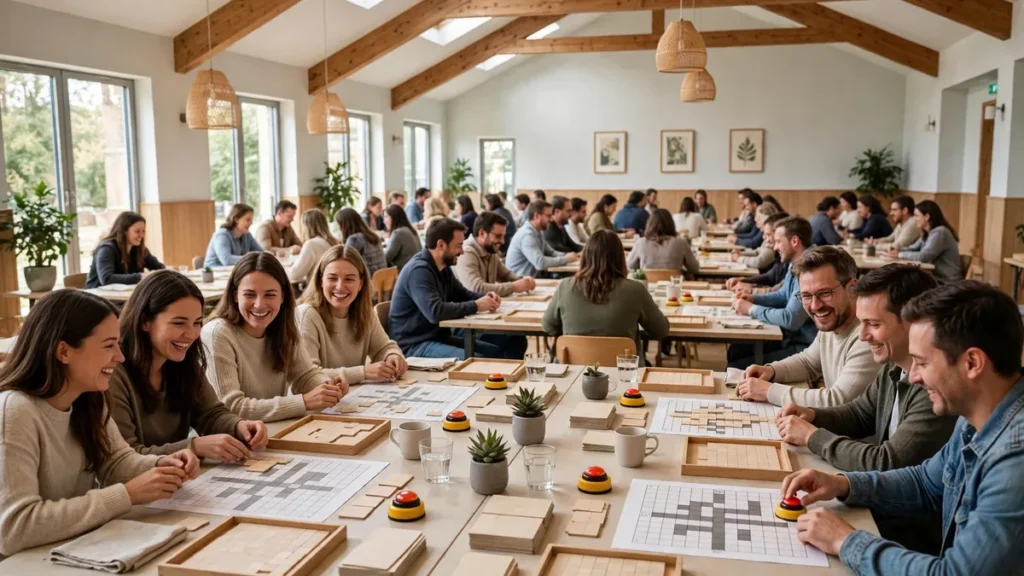
Finding the best word games for 162 players starts with an honest fact: no single word game seats 162 people around one table. A board, a card deck, or a single crossword grid is built for a handful of players, not a hall full of them. That does not mean a group of 162 cannot play word games together. It means the format has to change, from one game for everyone to one event made of many small games running at the same time.
The best word games for 162 players work because they split a huge group into teams, tables, or rounds that all play the same game in parallel. Eighteen teams of nine, twenty-seven tables of six, or nine teams of eighteen can all compete in the same crossword race, the same word bingo round, or the same anagram tournament. Scores are collected centrally, a host keeps the pace, and the whole room shares one leaderboard. Everyone plays, nobody waits long for a turn, and the winning team is decided by points, not by who happens to sit nearest the board.
This guide covers the formats that actually work at this scale, how to set them up, and what to avoid. Every game below has been chosen because it scales cleanly, needs little or no special equipment, and keeps all 162 players involved from the first clue to the final score. Whether you are planning a school event, a company gathering, a community night, or a large family reunion, these are the word games that make a crowd of 162 feel like one game, not 162 separate ones.
Key takeaways
- No single word game seats 162 players, so split the group into teams or tables that play the same game in parallel.
- Whole-room games, team table games, and tournaments are the three formats that work best for 162 players.
- Keep rounds short, score centrally, and use one host or one screen so every team stays in step.
- Choose games that need only paper, pens, and printed sheets, because 162 sets of special equipment are costly and slow to hand out.
- Mix quick rounds with longer team challenges so fast thinkers and careful solvers both get a chance to shine.

How 162 Players Can Play Word Games Together
A group of 162 works best when it is divided into clear, even units. Eighteen teams of nine give every team enough people to share ideas without letting anyone hide at the back. Twenty-seven tables of six suit games that need a board or a set of cards at each table. Nine teams of eighteen work for whole-room games where each team answers together and only one answer per team is counted. Pick the split before you pick the game, because the split decides how many copies, sheets, and scorecards you need.
The host matters more at this scale than the game itself. One confident host with a microphone, a timer, and a visible scoreboard keeps 162 people moving together. Without a host, tables finish at different times, questions get repeated, and the room drifts into separate conversations. With a host, every round starts and ends together, scores are announced after each round, and the energy stays high. If a microphone is not available, use two or three co-hosts stationed around the room and a large printed scoreboard everyone can see.
Scoring should be simple enough to add up quickly. Award points per correct answer, per completed word, or per round won, and keep the numbers small. A team that earns three points for a hard word and one point for an easy word is easy to track on a single sheet. Avoid scoring systems that need a judge to debate every answer, because 162 players will produce far more borderline answers than one judge can settle fairly. Decide the tie-breaker before play starts, such as a sudden-death word round between the tied teams.
Word games at this size also reward variety. A night of only crosswords favours the same few strong solvers, while a night of only fast guessing games favours the loudest voices. The strongest events mix a quiet written round, a fast spoken round, and a team-building round where players must agree on one answer. That mix is also why many organisers look beyond a single format: the best word games for 161 players use the same team and tournament structures, and they show how small changes in team size can suit a slightly smaller crowd.
Whole-Room Word Games for 162 Players
Whole-room games are the simplest way to start, because every player hears the same clue at the same time and every team answers at the same time. They need the least equipment, they are the easiest to explain, and they warm up a large room quickly. They also give the host the most control, since the pace is set from the front of the room and no table can race ahead or fall behind. Use one or two whole-room games at the start of the night, then move to table games once everyone is comfortable.
Word Bingo
Word bingo works for 162 players because each person gets a different card and the whole room plays one shared draw. The host calls out definitions, synonyms, or letters, and players mark the matching word on their card. Print the cards in advance in at least twenty different layouts so neighbours cannot simply copy each other. A full game takes about fifteen minutes, and a small prize for the first completed row and the first full card keeps the room focused. It suits mixed ages well, because players can help each other within a team while still marking their own card.
Giant Hangman
Giant hangman turns a familiar small game into a whole-room contest. The host draws the gallows on a large board or screen, and each team takes turns suggesting a letter. A correct letter earns the team a point, a wrong letter adds a part to the drawing, and the team that completes the word earns a bonus. Use words suited to the group, such as themed words for a school event or workplace words for a company night. Keep each word to no more than ten letters so rounds stay short, and rotate the guessing team after every letter so no single team dominates.
Team Table Word Games for 162 Players
Table games suit the middle of the night, when the room is warm and teams have settled into their groups. Each table plays the same game with its own set of materials, and scores are compared across tables at the end of each round. This format gives every player a hands-on role, which whole-room games cannot always do. It also lets quieter players contribute, because a table of six is a much safer place to suggest a word than a hall of 162.
Team Crossword Race
A team crossword race gives every table the same printed crossword and the same time limit, usually fifteen minutes. Teams work together to fill as many answers as they can, and the table with the most correct answers wins the round. Print the crossword large enough to share, and give each table two pens so two people can write at once. Choose a crossword with a clear theme, such as animals, food, or travel, so teams can use general knowledge as well as word skill. Check answers against a single answer key after the round, and read out the trickiest clues so everyone learns something.
Anagram Tournament
An anagram tournament gives each table a set of scrambled words to unscramble against the clock. Start with short words of four or five letters, then move to longer words of seven or eight letters as the rounds progress. Each correct anagram earns one point, and a bonus point goes to the first table to finish a full set. The game is easy to prepare, because a single printed sheet can hold a whole round, and it is easy to score, because every answer is either right or wrong. It works well as a quiet round between louder games, giving the room a short rest without losing momentum.
Scattergories-Style Team Lists
In this team version, the host names a letter and a set of categories, such as a fruit, a place, and a job, and each table has three minutes to write one answer per category starting with that letter. Teams earn a point for each valid answer and a bonus point for any answer no other table wrote. The bonus for unique answers is what makes the game work at scale, because it rewards creative thinking rather than the most obvious word. Use ten categories per round and three rounds in total, and collect the sheets after each round so scoring stays honest and quick.
Tournament and Relay Word Games for 162 Players
Tournament formats suit the second half of a large event, when teams have a score to defend and the room wants a clear winner. They take more organising than a single round, but they give the night a shape: early rounds, semi-finals, and a final that the whole room can watch. Keep the tournament simple, with no more than three stages, so it finishes on time and every team gets at least two games before elimination.
Spelling Bee Tournament
A spelling bee tournament for 162 players works as a series of short heats, not as one long line of spellers. Each team sends one speller per heat, and the speller who spells the most words correctly in their heat earns points for their team. Use words of increasing difficulty, and give each speller fifteen seconds per word so heats stay brisk. The top teams from the heats meet in a final round in front of the whole room. This structure keeps everyone involved through their team, even though only one person spells at a time.
Planning a tournament also means planning what happens to teams that are knocked out early. Give eliminated teams a side game, such as a word search or an anagram sheet, so they stay in the room and keep playing while the finalists compete. A good large-group event keeps every player busy until the end, and the best board games for 162 players follow the same principle, using parallel tables and shared scoring so a crowd of exactly 162 can play together without long waits.
Word Ladder Relay
A word ladder relay asks teams to change one word into another by changing one letter at a time, with each step forming a real word. One player writes the first step, passes the pen to the next player, and the chain continues until the team reaches the target word. The relay format suits 162 players because every team member has a turn, and the physical act of passing the pen keeps the game moving. Prepare three ladders of increasing difficulty, and award the round to the first team to finish a ladder correctly, with a point for every other team that finishes within one minute of the winner.
Word Games for 162 Players Comparison Table
The table below compares the games in this guide by format, group size, equipment, and playing time. Use it to build a schedule that mixes whole-room games, table games, and tournament rounds, rather than running the same format all night.
| Game | Format | Best team size | Equipment needed | Round length |
|---|---|---|---|---|
| Word Bingo | Whole room | Individual within teams | Printed cards, pens | 15 minutes |
| Giant Hangman | Whole room | Teams of 9 | Board or screen | 10 minutes |
| Team Crossword Race | Table game | Tables of 6 | Printed crosswords, pens | 15 minutes |
| Anagram Tournament | Table game | Tables of 6 | Printed sheets, pens | 10 minutes |
| Scattergories-Style Team Lists | Table game | Tables of 6 | Printed sheets, pens | 10 minutes |
| Spelling Bee Tournament | Tournament | Teams of 9 | Word lists, timer | 20 minutes |
| Word Ladder Relay | Relay | Teams of 9 | Printed ladders, pens | 10 minutes |
How to Set Up a 162-Player Word Game Night
Start with the room. Arrange tables for six where possible, leave clear walkways between them, and place the host where every table can see and hear. Test the microphone and the screen before anyone arrives, and print a simple schedule on each table so teams know what comes next. Prepare one set of materials per table, plus a few spares, and label each set with a table number so lost sheets can be returned quickly. A tidy room with a clear layout saves more time than any single game choice.
Finally, think about the players themselves. A group of 162 will include strong spellers, quick thinkers, quiet solvers, and people who simply came to enjoy the evening. Mix the games so each of those players has a round that suits them, and keep the tone friendly rather than fiercely competitive. Small prizes for the winning team, the most creative answer, and the best team name give more people a reason to celebrate. The best party games for 161 players offer the same large-group planning ideas, and they are a useful next read if your event also needs music, movement, and party rounds alongside the word games.
Checklist for 162-Player Word Games
- Split 162 players into even teams or tables before the event, and print a team list for every table.
- Choose a mix of whole-room, table, and tournament games so every player has a round that suits them.
- Print one set of materials per table, plus spares, and keep answer keys with the host and scorers only.
- Appoint one host, two or three scorers, and one or two runners, and brief them on the rules in advance.
- Keep rounds short, score centrally, and announce the leaderboard after every round.
- Plan a side game for eliminated teams so nobody sits idle while the finalists play.
Frequently Asked Questions
Can 162 people really play a word game together?
Yes, if the game is run as an event rather than as a single table game. Split the group into teams or tables, give every team the same game at the same time, and compare scores centrally. Whole-room games, team table games, and tournaments all use this structure, and it is the only practical way to keep 162 players involved at once.
What is the best word game for 162 players?
Word bingo is the best opener, because it needs little explanation and every player has their own card. For the main part of the night, a team crossword race or an anagram tournament works best, because they reward teamwork and are easy to score across many tables. The best choice depends on the group, but a mix of one whole-room game and two table games suits most events.
How many teams should 162 players form?
Eighteen teams of nine suit whole-room and tournament games, while twenty-seven tables of six suit table games that need a board or a set of cards. Either split works, and some events use both: teams of nine for the opening rounds, then tables of six for the middle rounds. Pick the split that fits the room and the games you have chosen, and keep it consistent within each round.
How long does a 162-player word game night take?
Plan for two to three hours, including setup, breaks, and results. Each round takes five to twenty minutes, and scoring between rounds takes a few minutes more. A schedule of five or six rounds, with a short break in the middle, fits comfortably into an evening. Avoid planning more than eight rounds, because attention drops and scoring starts to take longer than play.
What equipment do you need for 162 players?
Most of the games in this guide need only printed sheets, pens, and a timer. Word bingo needs printed cards, crosswords and word searches need printed grids, and anagram and list games need printed sheets. A microphone, a large board or screen, and a visible scoreboard help the host, but no special board game sets are needed for a full night of play.
Do word games work for mixed ages at this scale?
Yes, if the words are chosen carefully and teams mix ages and abilities. Use familiar words for whole-room rounds, themed words that children and adults both know, and team formats where players can help each other. Avoid games that depend on obscure vocabulary, and give bonus points for creative answers so younger players can contribute even when they do not know the hardest words.
The Bottom Line
The best word games for 162 players are not the games with the biggest boards or the most pieces. They are the games that split a huge group into teams, give every team the same challenge at the same time, and bring the scores together on one leaderboard. Word bingo warms the room up, team crosswords and anagrams reward careful thinking, and a spelling bee or word ladder tournament gives the night a clear finish. Plan the split, the host, and the scoring before you choose the games, keep the rounds short, and mix quiet and lively formats so every player has a moment to shine. Done that way, 162 players is not a problem to solve. It is the reason the night works.


