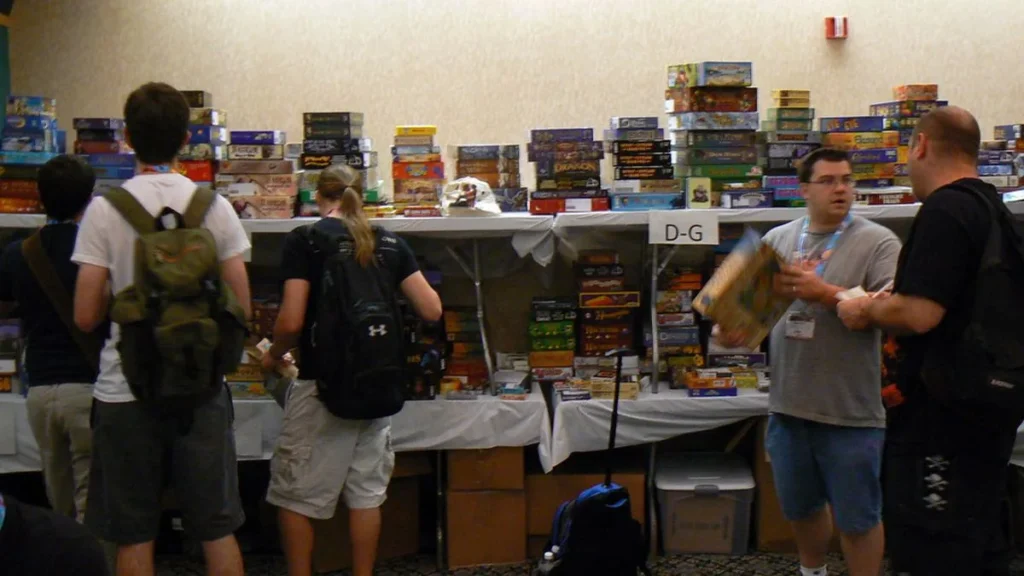
Four hundred and sixty-nine players is not a quiz night. It is a small festival with answer sheets. At that size, the usual pub quiz format breaks down fast: one host with a microphone cannot hear sixty-odd teams, a single answer sheet per table turns into a scrum, and a slow round can drain the energy out of a whole hall before the scores are even read out. The trick is to plan for the crowd you actually have, not the crowd you wish you had.
This guide gives you nine complete trivia rounds that work for a group of 469 players. Every round follows the same simple pattern, so teams can settle into a rhythm instead of learning new rules every ten minutes. Each round has a single clear theme, three sample questions to show the level, and a note on how to run it when dozens of teams are playing at once. The themes are all built around famous people and places, which means every team has a fair chance: nobody needs specialist knowledge, and the answers are the kind of facts people half-remember and love to argue about.
The nine rounds below are designed to be played in order, with a short break after round five. They take about two hours in total, including scoring time, and they scale cleanly from a village hall to a conference centre. If you are short on time, you can drop any single round and still have a complete night, because no round depends on the one before it.
Key takeaways
- Nine themed rounds, each with three sample questions, keep 469 players moving at the same pace.
- Teams of six or seven work best, giving you around seventy teams to score.
- One answer sheet per team, collected after every round, keeps scoring fair and fast.
- Picture and answer-sheet rounds beat spoken rounds for a crowd this size.
- A ten-minute break after round five stops energy from dipping in the second half.

How a 469-Player Trivia Night Works
Start with teams of six or seven. With 469 players, that gives you roughly seventy teams, which sounds like a lot until you realise it is the number that makes everything else work. Teams of six or seven are big enough that everyone can contribute, small enough that nobody hides at the back, and easy to seat around one table. Ask teams to pick a name and write it at the top of every answer sheet, in the same handwriting, so your scorers can read it at speed.
Run each round the same way. The host reads or shows ten questions, teams write their answers on a single sheet, and a runner collects the sheets while the next round is being set up. Do not read the answers out loud between rounds: with seventy teams, that eats ten minutes every time. Instead, put the answers on a screen or a printed sheet at the break, and let teams mark their own neighbours. You only need to collect the scores, not run a full ceremony after every round. Good general knowledge trivia questions work well as warm-ups while late teams are still finding their seats.
Sound is the part most hosts get wrong. One speaker at the front will not reach the back of a hall holding 469 people, so use at least two speaker stacks, one halfway down the room, and keep the host’s voice steady rather than loud. Put the questions on a screen as well as reading them aloud, because half the room will miss a spoken question at least once. A printed question sheet on each table is the cheapest insurance you can buy, and it doubles as a souvenir.
The Nine Rounds at a Glance
| Round | Category | Best format |
|---|---|---|
| 1 | Famous Florists | Answer sheet |
| 2 | Famous Fishermen | Answer sheet |
| 3 | Famous Jugglers | Picture round |
| 4 | Famous Quilters | Answer sheet |
| 5 | Famous Printers | Answer sheet |
| 6 | Famous Harpists | Music round |
| 7 | Famous Vineyards | Picture round |
| 8 | Famous Astronomers | Answer sheet |
| 9 | Famous Bell Ringers | Answer sheet |
The Rounds in Detail
Each round below has ten questions in play, but only three are shown here as samples. Use the samples to judge the level, then write your other seven questions to match: one easy, five medium, and two hard is a good balance for a mixed crowd. Keep every question to one clear fact, and avoid questions with two acceptable answers.
Round 1: Famous Florists
Flowers are a friendlier opening round than most hosts expect. Almost everyone has bought a bouquet, watched a wedding, or walked past a florist, so the questions feel familiar even when the names are new. Start here and the room relaxes, which is exactly what you want in round one.
Sample questions: Which British florist created the floral displays for the coronation of Queen Elizabeth II in 1953? Constance Spry. Which German master florist has written many books on floral design and taught students around the world? Gregor Lersch. Which London florist is famous for loose, garden-style bouquets and a shop full of seasonal flowers? Paula Pryke.
How it works for a huge group: this is a straight answer-sheet round. Read each question twice, give teams thirty seconds per question, and collect the sheets at the end. Ten questions, five minutes, no fuss.
Round 2: Famous Fishermen
Fishing has produced some of the most famous writers, artists, and adventurers in history, which gives this round a wide range of questions. You can ask about books, about records, and about the people themselves, so no single team can dominate just because one member once owned a rod.
Sample questions: Which author wrote The Compleat Angler, the classic book about fishing, in 1653? Izaak Walton. Which novelist fished for marlin off the coast of Cuba and wrote The Old Man and the Sea? Ernest Hemingway. Which American president was a keen fly fisherman who built a presidential fishing retreat, Camp Rapidan, in Virginia? Herbert Hoover.
How it works for a huge group: keep this round on paper too. Two paper rounds in a row sound dull, but they build a rhythm, and the variety of the questions keeps teams talking. Mark it during the break after round five if you are short on runners.
Round 3: Famous Jugglers
Jugglers make a wonderful picture round. Show a photograph of a juggler on screen and ask teams to name the person, the act, or the place. Pictures change the pace after two written rounds, and they give the teams that struggle with names a different way to score.
Sample questions: Which Italian juggler, active in the early twentieth century, is often called the greatest juggler of all time? Enrico Rastelli. Which German juggler was famous for his fast, elegant club juggling on stage? Francis Brunn. Which American juggler set world records for juggling balls and clubs in the 1990s and 2000s? Anthony Gatto.
How it works for a huge group: put one picture on the screen for forty seconds, then move on. Ten pictures take about seven minutes. Make sure the screen is big enough for the back rows, or print the pictures on the answer sheet as a backup.
Round 4: Famous Quilters
Quilting is one of the oldest crafts in the world, and its history is full of remarkable people and communities. This round works well because the answers are stories as much as names: a quilt made by an enslaved woman, a whole village of quilters in Alabama, and a tradition passed down through families.
Sample questions: Which formerly enslaved woman made the famous Bible Quilt in 1886, telling stories from the Bible in fabric? Harriet Powers. Which Alabama community is famous for its bold, improvised quilts, now shown in museums around the world? Gee’s Bend. Which quilter from Gee’s Bend became one of the best-known names in American folk art? Mary Lee Bendolph.
How it works for a huge group: back to answer sheets, and this is a good round for a bonus point. Offer one extra point to any team that can name the state where Gee’s Bend is found, and watch the room light up when the answers come in.
Round 5: Famous Printers
Printers changed the world, and their names turn up in questions about books, money, and maps. This is a good mid-point round because it rewards general knowledge rather than specialist memory: most teams will know at least one answer, and the harder questions separate the leaders from the pack.
Sample questions: Which German printer produced the first major book printed with movable type, the Gutenberg Bible, around 1455? Johannes Gutenberg. Which printer brought printing to England and printed the first book in English in the 1470s? William Caxton. Which Venetian printer invented the italic typeface and the small pocket-sized book? Aldus Manutius.
How it works for a huge group: this is the last round before the break, so keep it tight. Collect the sheets, announce the half-time leaders, and send everyone for a ten-minute break. A short leaderboard update at half time keeps the second half competitive.
Round 6: Famous Harpists
After the break, a music round wakes the room up. Play a short clip of harp music and ask teams to name the harpist, the piece, or the story behind it. You do not need long clips: fifteen seconds is enough for a team to recognise a famous player, and short clips keep the round moving.
Sample questions: Which comedian and actor was also a talented self-taught harpist who played the instrument in his films? Harpo Marx. Which Welsh harpist has performed at royal events and recorded many albums of classical and folk music? Catrin Finch. Which Spanish harpist was famous for bringing the harp to concert halls around the world in the twentieth century? Nicanor Zabaleta.
How it works for a huge group: play each clip twice, with a short pause between playings. Teams write their answers on the sheet, and the host moves on. The best way to enjoy the earlier trivia games for 467 players is to borrow their music-round timing, because it was built for a crowd of almost the same size.
Round 7: Famous Vineyards
Vineyards give you a picture round with a difference: rolling hills, old stone buildings, and labels that half the room will recognise. Ask teams to name the vineyard, the region, or the wine it is famous for, and you will get a lively round that even non-drinkers can enjoy.
Sample questions: Which Bordeaux vineyard is one of the five First Growths and famous for its elegant red wine? Chateau Margaux. Which Burgundy vineyard produces the wine Romanée-Conti, one of the most expensive wines in the world? Domaine de la Romanée-Conti. Which Tuscan estate created Sassicaia, the wine that helped launch the Super Tuscan style? Tenuta San Guido.
How it works for a huge group: pictures on screen, forty seconds each, same as round three. If you have a wine expert in the room, invite them to add one comment per picture after the round, but keep it to a minute so the night does not stall.
Round 8: Famous Astronomers
Everyone has looked at the stars, and the names of the great astronomers are among the most famous in science. This round is a strong late-night choice because the questions feel big and exciting, and the answers are the kind of facts people remember from school.
Sample questions: Which Italian astronomer first observed the four largest moons of Jupiter in 1610? Galileo Galilei. Which Polish astronomer proposed that the Earth moves around the Sun, in his book published in 1543? Nicolaus Copernicus. Which American astronomer discovered that the universe is expanding, and which famous space telescope bears his name? Edwin Hubble, and the Hubble Space Telescope.
How it works for a huge group: keep this round on paper, and read each question slowly. Astronomy questions invite debate, so give teams a full thirty seconds and do not rush the sheet collection at the end.
Round 9: Famous Bell Ringers
Bells are a fitting final round. They are loud, they are public, and they mark occasions that whole towns remember. End the night with something joyful, and teams will leave talking about the final round instead of the one they found hard.
Sample questions: Which London foundry cast the Liberty Bell in 1752 and many other famous bells? The Whitechapel Bell Foundry. Which great bell in London is housed in the Elizabeth Tower and struck on New Year’s Eve? Big Ben, the Great Bell. Which English tradition involves teams of ringers playing patterns on tower bells, called change ringing? The art and science of change ringing, practised in churches across England.
How it works for a huge group: finish with a flourish. Read the final answers, announce the winners, and hand out the prizes while the room is still buzzing. Keep the prize-giving to five minutes, and thank the runners and scorers by name, because a night for 469 players runs on their work.
Your Night-Of Checklist
Print this list and hand it to your lead organiser. Everything on it has been tested at large quiz nights, and skipping any single item is the usual reason a big night runs late.
- Seat teams of six or seven, with one answer sheet and one pen per team per round.
- Test the speakers and the screen from the back row before the doors open.
- Give every runner a numbered zone, so no table is missed and none is visited twice.
- Put the questions on screen as well as reading them aloud.
- Score during the break and after round nine, not between every round.
- Keep a spare pack of answer sheets, pens, and a backup speaker cable in the host’s bag.
Frequently Asked Questions
How many teams will 469 players make?
With teams of six or seven, you will have about seventy teams. If you prefer teams of five, you will have about ninety-four teams, which is harder to score, so stick with six or seven unless your tables are small.
How long does a trivia night for 469 players take?
Plan for about two hours of play, plus a ten-minute break and fifteen minutes for arrivals and prize-giving. Nine rounds of ten questions, with scoring time, fit comfortably into that window if the host keeps a steady pace.
What is the best team size for a huge trivia night?
Six or seven players per team is the sweet spot. Smaller teams mean more teams to score, and larger teams mean some players stop contributing. Six or seven keeps everyone involved and keeps scoring manageable.
How do you stop cheating in a room of 469 players?
Ask teams to put phones face down on the table, and have runners walk the zones during each round. The best defence is pace: thirty seconds per question leaves little time to search, and picture and music rounds are hard to look up quickly. The format in our trivia games for 466 players guide uses the same approach, and it works because the whole room can see the runners moving.
Can one host manage 469 players alone?
One host can run the microphone, but not the whole night. You need at least four runners, two scorers, and one person on sound and screen. With that team in place, one host is plenty, and the night will feel calm instead of chaotic.
What makes a good final round for a huge group?
A good final round is joyful, visual, and fair. Bells work because the answers are famous, the subject is cheerful, and no team feels the round was written for someone else. End on a high note, announce the winners quickly, and let people celebrate.
The Bottom Line
A trivia night for 469 players works when the format is simple, the rounds are varied, and the scoring stays out of the way. Nine rounds, teams of six or seven, answer sheets collected after every round, and a break after round five will carry you through the night. Pick your nine categories, print your sheets, test your speakers from the back row, and enjoy the sound of seventy teams arguing happily about florists, fishermen, and bell ringers.