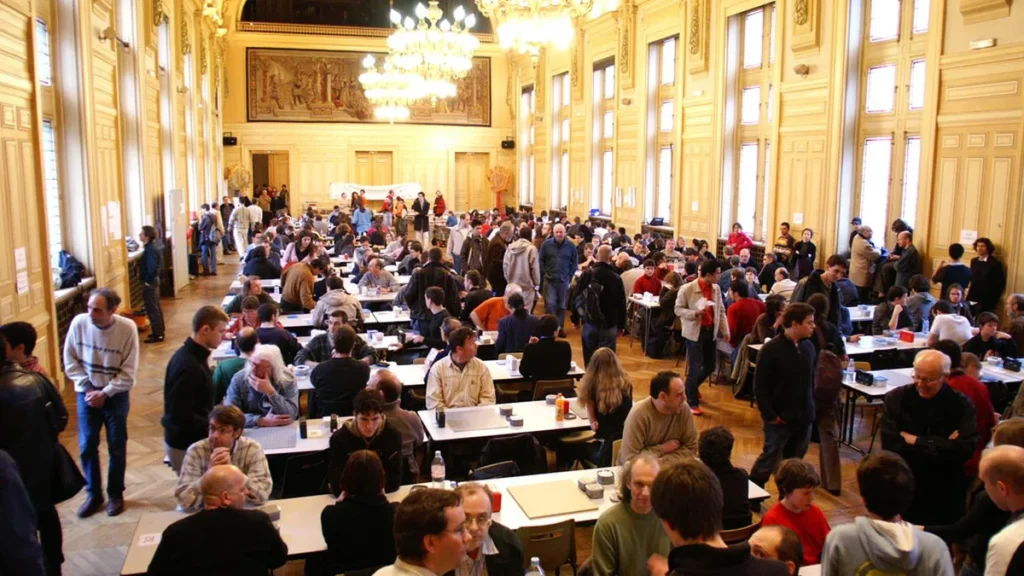
Four hundred and seventy-six players is not a party. It is a small village gathered on one field, and it changes every rule you thought you knew about party games. A game that works beautifully for twenty people can collapse when half the guests are standing around wondering what to do while the other half plays. The difference between a legendary day and a long afternoon of waiting is not the budget or the venue. It is the structure you build before the first whistle blows.
The good news is that huge groups are easier to entertain than small ones, once you stop thinking in single games and start thinking in waves. With 476 players you never need everyone doing the same thing at the same moment. You need nine strong games, played in rotation, with clear stations, simple rules that can be explained in one minute, and results that everyone can see from across the field.
This guide gives you nine games designed for exactly that scale, plus the schedule, the station plan, and the checklist that keep 476 players moving all day. Every game below works with big teams, needs only basic equipment, and can be run by a small crew of organisers. If you have ever wondered how the best party games for 472 players keep a crowd of nearly five hundred engaged, the answer is the same system you will find here: short rounds, visible scores, and games that let everyone play at once.
Key Takeaways
- Split 476 players into nine teams of about fifty and rotate them through nine game stations, so nobody waits more than a few minutes for a turn.
- Choose games with one-minute rules and visible results, because long explanations lose a huge crowd before the game even starts.
- Give every station a captain, a whistle, and a scoreboard, so each game runs itself while the organisers watch the whole field.
- Mix fast racket games with calm skill games, so players of every age and energy level have a game where they can shine.
- Keep rounds short, around ten to fifteen minutes, and finish the day with one whole-group finale that brings all nine teams together.

The Nine Games at a Glance
| Game | Players per Round | Setup Time | Best Moment |
|---|---|---|---|
| Giant Badminton Smash Rally | 48 per court | 20 minutes | The rally that refuses to end |
| Mega Pillow Fight Tournament | All 476 at once | 10 minutes | The feather storm finale |
| Giant Horseshoe Pitch Championship | 36 per pit | 15 minutes | The ringing ringer |
| Giant Water Slide Relay Race | 40 per slide | 30 minutes | The splash finish |
| Giant Dodgeball Arena Battle | 60 per arena | 15 minutes | The last player standing |
| Giant Tetherball Spin Challenge | 24 per pole | 10 minutes | The winning wrap |
| Giant Basketball Shootout Challenge | 44 per court | 15 minutes | The buzzer beater |
| Giant Pickleball Court Rally | 40 per court | 20 minutes | The longest rally |
| Giant Kick the Can Chase | All 476 at once | 10 minutes | The can rescue sprint |
The Nine Games in Detail
1. Giant Badminton Smash Rally
Badminton is one of the friendliest racket games ever invented, and it scales beautifully when you stop thinking of it as a two-player duel. Set up six full-size courts side by side on a flat field or a sports ground, and run a smash rally where each team sends four players onto a court at a time. The shuttlecock moves slowly enough for beginners to reach it, and the rallies last long enough for the crowd to get involved, which is exactly what you want when fifty people are watching each court.
Score the game by rally length rather than by points alone. Each team earns one point for every five shots in a rally, and a bonus of ten points for a rally that passes twenty shots. This keeps even the weakest teams scoring, and it turns every long rally into a shared event, with the watching team counting out loud. Rotate the four players on court every three minutes, so everyone on the team gets a turn with a racket in the first half hour. Use light plastic rackets and slow shuttlecocks, because fast feather shuttles fly too far on a windy field and frustrate new players.
2. Mega Pillow Fight Tournament
Nothing breaks the ice at a huge party faster than a pillow fight, and with 476 players it becomes a spectacle. Mark out a soft grass arena with rope and cones, hand every player a soft pillow, and run the tournament in waves of sixty players at a time. Each wave lasts five minutes, and players score points by tapping opponents gently on the shoulder or back with a pillow. A tap means the other player sits down, and the last players standing in each wave win points for their team.
The rules must be simple and strict: pillows only, no pushing, no grabbing, and no hitting above the shoulders. One referee per wave watches for rough play, and any player who breaks a rule sits out the rest of the wave. This keeps the game safe and friendly, even when the arena is full of laughing players. Use light pillows with soft filling, and keep spare pillows ready, because seams do split when the fighting gets enthusiastic. A few feathers in the air are part of the fun, and they make the photographs unforgettable.
3. Giant Horseshoe Pitch Championship
Horseshoes is a calm, old-fashioned skill game, and that is exactly why it belongs in a day full of running and shouting. Dig or mark six pitching pits in a row on level ground, with the stakes set about twelve metres apart, and let teams of six pitch in turn. Each player throws two horseshoes at the far stake, and points are scored for ringers, leaners, and the closest shoe to the stake. A ringer earns three points, a leaner earns two, and the closest shoe earns one.
The beauty of horseshoes is that it rewards a steady hand rather than speed or strength, so older players and younger players can compete on equal terms with the fastest runners on the field. Give each team a practice round before the scoring starts, and let the captain decide the throwing order, so the steadiest player throws last when the pressure is highest. Keep the pits clear of spectators, mark a safe standing line well behind the throwers, and use rubber or plastic horseshoes for younger players if real steel shoes feel too heavy.
4. Giant Water Slide Relay Race
A water slide relay is the game that saves a hot afternoon. Lay out three long plastic slides on a gentle slope, with a hose running at the top of each one and a splash pool or a marked finish zone at the bottom. Teams of ten line up at the top, and each player slides down, runs back up the side path with a sponge or a small bucket, and tags the next player. The team that finishes all ten slides first wins the heat, and the fastest teams from the heats meet in a final.
Safety comes first at this station, so keep the rules clear. One slider at a time, feet first, sitting down, and no diving. Station a helper at the top to space the sliders out, and another at the bottom to keep the finish zone clear. Use a gentle slope rather than a steep one, and check the slide surface for stones or rough patches before the first heat. Players should wear shoes for the run back up the slope, and the side path should be kept clear of the slide itself, so nobody crosses a sliding player. The party games for 474 players use the same idea of one big water station to cool a huge crowd.
5. Giant Dodgeball Arena Battle
Dodgeball is a classic for a reason: the rules take thirty seconds to explain, and the game creates drama from the first throw. Mark out a large arena with cones, split it into two halves, and place six soft foam balls along the centre line. Two teams of thirty face each other, and on the whistle they rush for the balls. A player hit by a live ball is out, a caught ball brings a team mate back in, and the team that clears the other side first wins the round.
With sixty players in the arena, the game needs firm refereeing. Use soft foam balls only, ban head shots completely, and give each side two referees who watch for catches and hits. Rotate the teams in short rounds of about eight minutes, so no team sits out for long, and keep a waiting zone with spare balls and water beside the arena. The best tactic at this scale is simple: spread out, keep moving, and throw together on a count of three, because a single throw is easy to dodge and a volley is not.
6. Giant Tetherball Spin Challenge
Tetherball is a small game with a big heart, and it scales well when you run several poles at once. Set up six tetherball poles in a circle on firm, level ground, with a clear ring marked around each one. Two players face off at a pole, and each tries to wind the ball all the way around in their direction. The winner stays on, the loser joins the back of the queue, and every player earns a point for their team for each win.
The queue is the secret of this station. With twenty-four players assigned to each pole area, the waiting line moves fast, and every player gets several turns in a fifteen-minute round. The captain keeps the order, calls the next two players forward, and makes sure nobody plays twice in a row while others wait. Use a soft tetherball rather than a hard one, and check the rope and the pole before the station opens, because a frayed rope snaps at the worst moment.
7. Giant Basketball Shootout Challenge
A basketball shootout turns a familiar sport into a fair contest for a huge crowd. Set up four hoops on a hard court or a flat stretch of ground, and run a shootout where each team sends players forward one at a time to take five shots from marked spots. A basket from close range earns one point, a basket from the free-throw line earns two, and a basket from behind the arc earns three. Every player shoots, every shot counts, and the team total decides the winner.
The shootout works because it gives everyone the same chance. Tall players have no real advantage from the marked spots, and the three-point shots reward the brave. Let each team choose its shooting order, and let the captain save the best shooters for the long shots at the end, when the crowd is watching and the pressure is highest. Keep spare balls at each hoop, and station a rebounder behind each basket to return the ball quickly, because waiting for a rolling ball is what slows a shootout down.
8. Giant Pickleball Court Rally
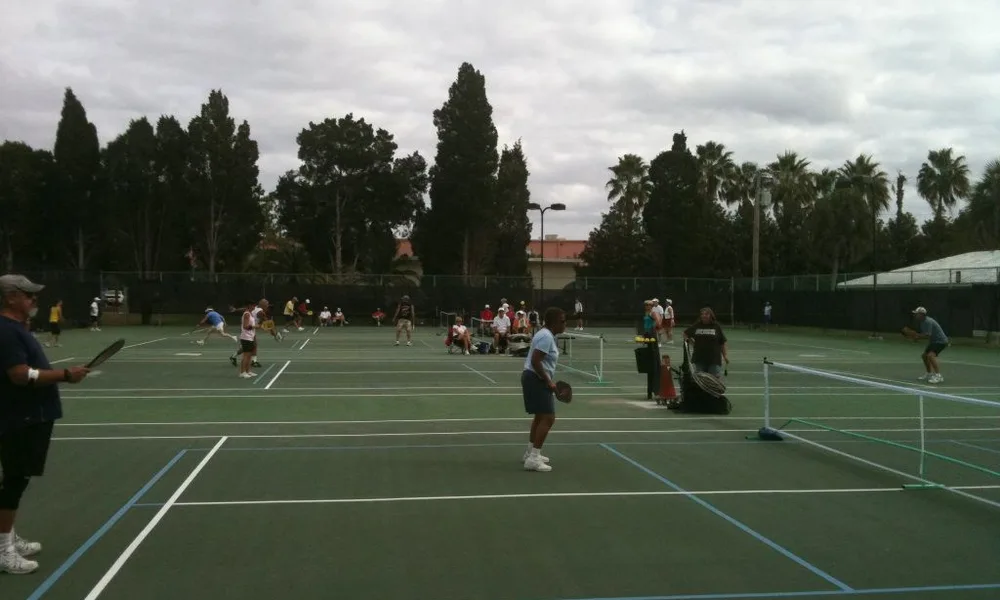
Pickleball is one of the fastest growing party sports, and it is ideal for a huge group because the court is small, the ball moves slowly, and beginners can rally within minutes. Set up six pickleball courts on a flat surface, with a low net across each one and paddles and plastic balls ready at the side. Teams send pairs onto the courts, and each pair plays a short rally game to eleven points, with the winning pair staying on and the losing pair rotating out.
Score the station by total rally points rather than by games won, so every pair contributes to the team score even if they lose their match. Each point scored in a rally earns one team point, and a win earns a bonus of five. This keeps the station fair for new players, because a long rally against a strong pair still earns points. Use light paddles, keep spare balls in a bucket at each court, and mark the court lines clearly, because the small court is what makes the game work and a faded line causes arguments.
9. Giant Kick the Can Chase
Kick the can is a childhood classic that becomes epic with 476 players. Place a large metal can on a marked spot in the middle of a wide field, choose a team of seekers, and let the other players scatter and hide. The seekers count to fifty while everyone finds a hiding place, then they search. Any player who reaches the can unseen and kicks it frees every captured player at once, so the game turns on one brave sprint.
The scale is what makes this version special. With hundreds of players hiding, the seekers cannot watch everywhere, and the field feels alive with movement. Divide the field into zones, and give each zone a seeker captain, so the search stays organised and no area is left unchecked. Set clear boundaries before the game starts, and ban hiding in cars, buildings, or anywhere unsafe. Captured players wait in a marked jail zone beside the can, where they can cheer on the players still free.
How to Run All Nine Games in One Day
Start the day with a short welcome at nine in the morning, explain the rotation, and send each team to its first station. Run nine rounds of fifteen minutes, with five minutes between rounds for teams to walk to the next station, drink water, and rest. That gives every team a turn at every station before lunch, with time to spare for the morning games to run long if they need to.
After lunch, run the championship rounds. The top two teams at each station play a short final, while the other teams watch, cheer, and play friendly matches. Finish the day with kick the can at four in the afternoon, then gather everyone for the results and the prizes. The party games for 470 players follow the same rhythm of short rounds and a shared finale, and that rhythm is what keeps a crowd of nearly five hundred moving without confusion.
Party Day Checklist
- Mark all nine stations with signs, cones, and rope before the first team arrives, and walk the whole field once to check for hazards.
- Give every station a captain, a whistle, a scoreboard, and a first aid kit, and make sure each captain knows the rules by heart.
- Set up water points at every station, plus a shaded rest area with seats for players between rounds.
- Prepare spare equipment for every game, including extra shuttlecocks, pickleballs, pillows, and foam dodgeballs.
- Charge the speaker, print the score sheets, and test the whistle and the megaphone before the welcome speech.
- Plan a wet weather version of the day, with the calm games moved under cover and a shortened finale ready to go.
Frequently Asked Questions
Can 476 players really play the same nine games?
Yes, because no game asks all 476 players to play at the same moment, except for the pillow fight waves and the final game of kick the can. The nine teams rotate through nine stations, so each station hosts about fifty players at a time, and every player gets a turn at every game during the day.
What is the best team size for 476 players?
Nine teams of about fifty players work best, because nine teams match nine stations and the rotation stays simple.
How much space do we need for 476 players?
A full-size sports field, or about two hectares of flat open ground, gives every station room to breathe. The water slide and the dodgeball arena need the most space, while tetherball and horseshoes fit into small corners, so plan the layout with the big stations at the edges and the small ones in the middle.
How long does a full day of nine games take?
About seven hours, including a welcome, nine fifteen-minute rounds, a lunch break, championship finals, and the closing game of kick the can.
What equipment should we buy first?
Start with cones, whistles, scorecards, and signs, then buy or hire the game equipment for your stations. Badminton rackets, pickleball paddles, tetherball poles, horseshoe sets, and foam dodgeballs are cheap to buy outright, while the water slides and basketball hoops can be hired from party suppliers.
Can younger children and older guests play all nine games?
Yes, because the nine games mix active races with calm skill games, so every player has games where they can shine. Captains can adjust roles, for example by letting younger players pitch horseshoes from closer to the stake or older players take the strategy roles in the badminton rally and the pickleball pairs.
The Bottom Line
Party games for 476 players work when the day is built around nine strong games, nine clear stations, and nine captains who keep their teams moving. Choose games with simple rules and visible scores, mix fast racket games with calm skill games, keep the rounds short, and finish with one moment that brings everyone together. Do that, and a crowd of 476 stops feeling like a problem to manage and starts feeling like the best part of the party.