Four hundred and seventy-two players is not a party crowd. It is a small town gathered in one field, and most party games collapse long before the first whistle. A game that works for twelve people can turn into a long queue, a confused crowd, and a lot of standing around when the guest list grows into the hundreds.
The nine games in this list were picked for a crowd of exactly that size. Each one scales to hundreds of players without long waits, each one keeps most of the group moving at the same time, and each one runs on simple rules that a host can explain in under a minute. Nobody needs special skill, expensive kit, or a rehearsal to join in.
Run them in the order given and the day builds naturally, from a fast warm-up that settles the crowd to a big team finale that everyone remembers. The same plan explains why party games work for huge groups, and it works just as well for a school festival, a company day out, or a community fair.
Key takeaways
- Nine games cover a full day for 472 players, with no game leaving most of the crowd standing idle.
- Every game uses simple rules, cheap equipment, and stations or heats so hundreds can play at once.
- Mix fast sprints, skill games, and team builds so energy stays high and different players shine.
- Split the crowd into colour-coded teams of about fifty to keep scoring, rotation, and safety simple.
- Plan two hours per block of three games, with water, shade, and a rest station between blocks.

The table below gives the quick view of the day. Read it once, then use the game sections that follow for the full rules, setup, and scoring for each one.
| Game | Players at once | Time | Space needed | Best for |
|---|---|---|---|---|
| Red Light Green Light Grand Sprint | All 472 | 25 minutes | Open field | Warm-up |
| Giant Bowling Pin Knockdown Rally | 120 | 40 minutes | Four lanes | Skill and cheering |
| Giant Checkers Board Battle | 80 | 45 minutes | Flat ground | Strategy and calm |
| Giant Dartboard Toss Challenge | 100 | 35 minutes | Four targets | Aim and focus |
| Giant Spelling Bee Relay | 150 | 40 minutes | Stage and lanes | Word lovers |
| Human Pyramid Build-Off | 120 | 30 minutes | Soft grass | Teamwork |
| Giant Slingshot Target Rally | 100 | 35 minutes | Long clear field | Aim and laughter |
| Giant Hide and Seek Mega Search | All 472 | 45 minutes | Whole venue | Exploration |
| Giant Balloon Volleyball Rally | 200 | 40 minutes | Two big courts | Grand finale |
The Nine Games
Each game below includes the setup, the rules, and the scoring. Set up all nine stations before the first guest arrives, mark each one with a big coloured sign, and hand every team a simple map of the field so nobody wastes the day looking for their next game.
1. Red Light Green Light Grand Sprint
One caller stands at the far end of the field with their back to the crowd. When they call green light, all 472 players run forward. When they call red light and turn around, everyone must freeze. Anyone caught moving walks back to the start line and tries again.
Split the field into four wide lanes with rope or cones so the crowd spreads out instead of bunching in the middle. Give each lane its own caller and its own whistle, and run the lanes at the same time. The first ten players in each lane to cross the finish line earn points for their team, which keeps the race moving even after the early finishers are done.
Keep rounds short. A round should last about five minutes, and three rounds fill the slot nicely. Players who are sent back to the start get a fresh chance in the next round, so nobody sits out for long. This game works best as the opener because it burns off excitement, teaches the crowd to listen for calls, and needs nothing more than open grass and a loud voice.
2. Giant Bowling Pin Knockdown Rally
Set up four lanes, each with ten oversized plastic pins at the far end and a soft foam ball at the start. Teams take turns rolling, and every pin knocked down scores a point. A lane holds about thirty players at a time, so four lanes keep 120 players busy while the rest of the crowd watches, cheers, and waits for their turn.
Give each player two rolls per visit, then send them to the back of the queue so the line keeps moving. Appoint one pin setter per lane and one scorer with a clipboard. The scorer writes the team total on a big board at the side of the lane so everyone can see the running score without asking.
Use soft balls and light pins so a stray roll never hurts anyone, and keep a clear space behind the pins for the pin setter. For a fun twist, paint one pin gold in each lane. Knocking down the gold pin doubles the points for that roll, which gives trailing teams a real chance to catch up late in the round.
3. Giant Checkers Board Battle
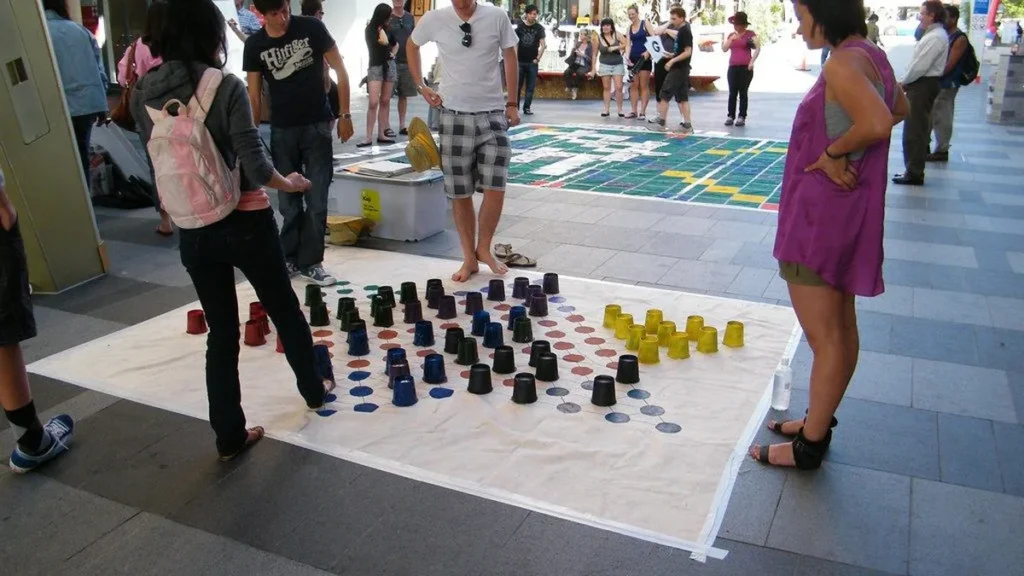
Paint or tape a giant checkers board on flat ground, about eight metres across, and use large discs or coloured cups as pieces. Two teams face each other across the board, and each team picks its moves by group vote. A captain stands at the edge of the board and moves the piece the team chooses.
Run four boards at once so eighty players are involved in a game at any moment, with the rest of the team gathered around the edges calling out moves. Give each team thirty seconds per move, timed by a volunteer with a stopwatch. The limit keeps the game brisk and stops long debates from eating the schedule.
Checkers is the calm game in the middle of a loud day, and that is exactly why it belongs here. It gives older guests and quieter players a game where thinking beats speed, and it gives tired legs a rest without pulling anyone out of the party. A short game takes about fifteen minutes, so each board can host three full games in the slot.
4. Giant Dartboard Toss Challenge
Hang four large dartboards made of soft foam or fabric on sturdy stands, and give players beanbags instead of darts. Each player throws three beanbags from a marked line, and the rings on the board set the points. A bullseye earns fifty points, the middle ring earns twenty-five, and the outer ring earns ten.
Mark the throwing line clearly and keep a volunteer behind each board to collect beanbags and call the score. Players throw in groups of five, which keeps the queue short and the throwing safe. Nobody walks past the line while throws are in flight, and the volunteer is the only person allowed near the board during play.
Score the best throw of each player rather than the total of three, so one lucky throw can put a quiet player on the leaderboard. This game suits mixed ages well, since a steady underarm throw beats a hard fast one. It also works in a smaller corner of the field, which leaves the big open space free for the running games.
5. Giant Spelling Bee Relay
Set up a stage with a microphone and four spelling lanes marked on the ground. Each team sends one speller at a time to the stage. The host reads a word, the speller spells it aloud, and a correct answer sends the next teammate running up while the speller jogs back to the team. A wrong answer costs the team ten seconds on the clock.
Choose words in three rounds of difficulty, starting with everyday words and finishing with long tricky ones. Keep a printed word list with the host and a second volunteer checking spellings against it, so disputes are settled in seconds. Run the lanes side by side so four teams spell at once, and let the crowd hear every word through a speaker.
This game is a crowd favourite because the whole team shouts encouragement and the stage gives it a show feel. It also proves that party games are not only about running and throwing, and the format is close in spirit to the best party games for 468 players, where word games sit happily beside physical ones. Keep each spelling turn under twenty seconds so the relay never stalls.

6. Human Pyramid Build-Off
Each team builds the tallest safe human pyramid it can on soft grass. Start with a wide base of kneeling players, add a second layer sitting on their shoulders, and finish with one climber on top. A pyramid only counts if it holds steady for a full ten seconds while the judge counts aloud.
Safety comes first with this game, so keep pyramids to three layers and no more, and place thick gym mats under every team. Every pyramid needs a trained spotter at each corner, and the base players must be the strongest members of the team. Children and lighter players go on the upper layers only, never at the base.
Score by height first, then by steadiness, with bonus points for the fastest build. Give each team three attempts in the slot and count only the best one. The build-off is pure teamwork, and the photos it produces are some of the best of the whole day, because every pyramid ends with a team cheering together whether it stands or wobbles.
7. Giant Slingshot Target Rally
Build four large slingshots from sturdy frames and strong elastic, aimed down a long clear field at rows of foam targets. Teams take turns launching soft balls at the targets, and each target shows its points clearly on its face. A hit knocks the target flat, and the volunteer at the far end stands it back up between rounds.
Give each player two shots per turn and keep a strict firing line. Only the shooter stands at the slingshot, everyone else waits behind a rope barrier, and nobody walks down the field until the volunteer blows the whistle to signal the range is clear. This rule is the whole game, so repeat it before every round.
The rally works because the slingshot itself is the attraction. Players who never win a race can still hit a distant target, and the big elastic launch makes every shot feel dramatic. Score the team total across all four slingshots, and add a far bonus target worth a hundred points for the bravest shooters.
8. Giant Hide and Seek Mega Search
Hide and seek sounds impossible for 472 players, but it works when the roles are flipped. Twenty seekers wait at the centre of the venue while the rest of the crowd hides across the marked play area. Seekers have ten minutes to find as many hiders as they can, and every hider found joins the seeker team for the next round.
Mark the boundaries with flags and rope, and ban hiding in cars, toilets, kitchens, and anywhere behind a locked door. Give every hider a coloured wristband so seekers can spot a found player at a glance, and give seekers whistles so a found hider can be logged quickly without an argument about who saw whom first.
Run three rounds with a fresh set of seekers each time, and let the team that finds the most hiders take the points. The game turns the whole venue into a playground, and it gives players a reason to explore corners of the site they never visited. End the round with a whistle blast and a meeting point, so nobody is still hiding when the next game starts.
9. Giant Balloon Volleyball Rally
Finish the day with two giant courts, a low net across each one, and one huge balloon per court. Teams of up to a hundred players stand on each side and bat the balloon back over the net. The balloon moves slowly, so everyone can reach it, and the rally can last for minutes without a single player touching the ground with it.
Score a point each time the balloon touches the ground on the other side, and swap the balloon for a fresh one if it pops. Keep the net low enough that shorter players can reach over it, and mark a centre line so the crowd does not drift across during a long rally. A referee on a chair at the side of each court calls the score loudly.
This is the right finale because every player is in the game at the same time, the slow balloon keeps the action safe, and the whole crowd can see the score from anywhere in the field. When the final whistle blows, the team with the most points takes the day, and the balloon is usually chased across the field by a laughing crowd before anyone thinks about going home.
How to Run All Nine Games in One Day
Start with the warm-up sprint, then run the next three games in stations so teams rotate every forty minutes. After lunch, run the pyramid, the slingshot, and the hide and seek game, and save the balloon volleyball for the last hour when the whole crowd comes back together. This order keeps the loud running games apart and gives the strategy games a quiet slot in the middle.
Give each team a captain, a colour, and a printed rotation card. The captain keeps the team together, the colour marks the team on the scoreboard, and the rotation card tells the team where to go next without asking a volunteer. Put a big clock and a whistle at the centre of the field so every station starts and stops together.
Staff each station with at least two volunteers, one to run the game and one to keep score and watch safety. Brief all volunteers together before the gates open, walk them around every station, and hand each one a one-page sheet with the rules and the scoring. A short briefing in the morning saves a dozen confused questions in the afternoon.
Party Day Checklist
Work through this list the day before the party, and tick each item off as it is packed or set up.
- Mark all nine stations with big coloured signs and rope off the lanes, courts, and throwing lines.
- Pack water, cups, shade tents, and a first aid kit, and place a water station near every block of games.
- Print team rotation cards, score sheets, and the rules sheet for every volunteer station.
- Test the microphone, speaker, whistles, and stopwatches, and charge spare batteries for the speaker.
- Check the field for holes, glass, and wet patches, and lay mats under the pyramid and bowling stations.
- Confirm the meeting point and the final whistle signal, and tell every team captain where it is.
Frequently Asked Questions
Can 472 players really play the same nine games? Yes, because every game runs in lanes, stations, or heats. No game asks all 472 players to take turns one by one, so the crowd stays active instead of queuing. The whole plan is built around parallel play, which is the same idea behind other party games for 466 players that run at this scale.
How much space do we need for a 472-player party? A full sports field plus a grass area of similar size is a good guide. The running and hiding games need the open field, while the board, dartboard, and spelling games fit along the edges and in the corners.
How long does a full day of nine games take? Plan for about six hours of play, plus an hour for lunch and breaks. Each game slot runs for thirty to forty-five minutes, and teams rotate between stations without long gaps.
What if it rains halfway through the day? Move the checkers, dartboard, and spelling games under cover first, since they need the least space. Keep the running games going in light rain, and pause the pyramid and slingshot games until the ground is safe again.
What equipment should we buy first? Start with rope, cones, whistles, and a scoreboard, because every game uses them. Then buy the game kit in order: foam balls and pins, giant board pieces, beanbags and boards, balloons, and mats.
Can younger children and older guests play all nine games? Most of them, yes, and teams can choose lighter roles in the physical games. Children do well in the spelling relay and the dartboard game, while older guests often lead the checkers board and keep score for their team.
The Bottom Line
Nine games, 472 players, and one field is a big day, but it stays simple when every game runs in parallel, every team has a captain and a rotation card, and every station has a volunteer who knows the rules. Start with the sprint, build through skill and teamwork, and finish with the balloon rally while the whole crowd is together. That is the whole plan, and it is enough.