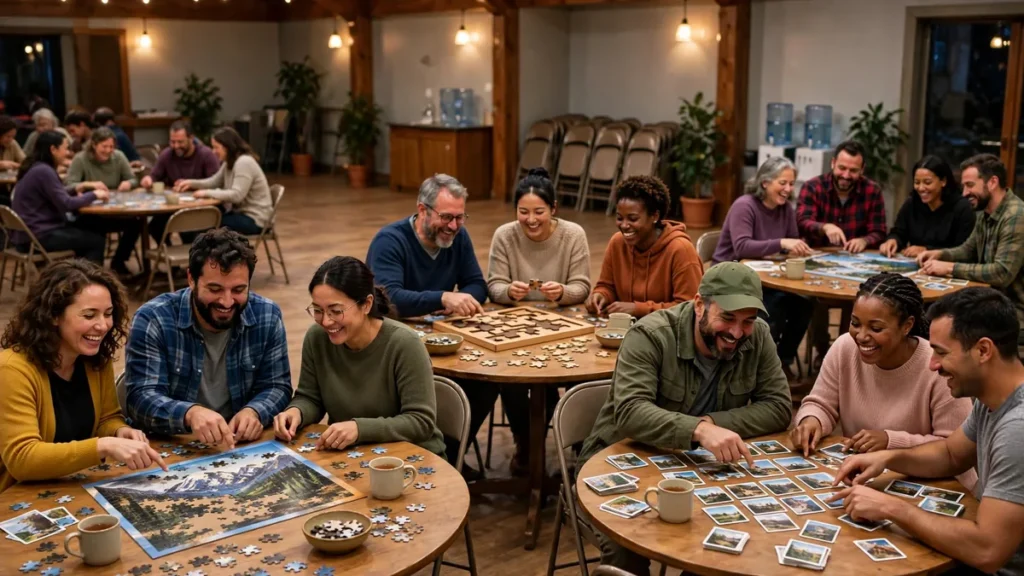
The best dice games for 136 players are not games that seat 136 people around a single table. No dice game does that, and no set of dice is made for a crowd that large. The best dice games for 136 players work because they turn one very large group into many small, lively tables, all rolling the same game at the same time, with a shared scoreboard and a clear winner at the end. When that structure is in place, 136 players stop being a logistical problem and start being the point of the night.
Planning for 136 players means planning for 17 teams of eight, or 34 teams of four, rather than planning for one giant game. Each team needs its own table, its own set of dice, its own scorecard, and a team captain who keeps the game moving, while the host needs a visible scoreboard, a clear rotation plan, and rounds short enough that no team waits long between turns. Dice are ideal for this format because they are cheap, portable, and easy to learn, so a whole hall can be playing within minutes of the first roll.
This guide covers the 10 best dice games for 136 players, how to set each one up for a crowd this size, what supplies you need, and how to run the whole event without confusion. Every game here scales cleanly to 17 teams of eight or 34 teams of four and keeps all 136 players involved from the first roll to the final score.
Key takeaways
- No single dice game seats 136 players, so the best format is many tables playing the same game at once, organised into teams.
- Split 136 players into 17 teams of eight or 34 teams of four, and give every team its own table, dice, and scorecard.
- Choose fast, simple games with short turns, such as Tenzi, Bunco, and Farkle, so nobody waits long between rolls.
- Run a tournament or relay format with a shared scoreboard so every table is competing toward one winner.
- Buy dice in bulk, print scorecards in advance, and appoint a team captain at every table to keep the night moving.

How Dice Games Work for 136 Players
A 136-player dice night is a tournament, not a single game. Every table plays the same game at the same time, each team records its own score, and the host collects the scores after every round. After three or four rounds, the top teams meet in a final, or the highest cumulative score wins.
The team size matters more than the game itself. Teams of four are the easiest to manage because everyone rolls often and nobody hides at the back of a big group. Teams of eight work well for games like Bunco and Tenzi, where several people can roll at once or take turns quickly. The same team-table format works for slightly smaller crowds too, and our guide to dice games for 135 players shows how the numbers shift when one team drops out.
Dice games suit a crowd of this size better than most other games. A set of dice costs very little, a full set for 34 tables fits in a single box, and the rules of most dice games can be explained in under two minutes. There is no board to pass around, no cards to shuffle between rounds, and no long wait while one player takes a turn. The game moves as fast as the dice do, which is exactly what a room of 136 people needs.
The 10 Best Dice Games for 136 Players
Every game below was chosen because it is fast to learn, cheap to supply for dozens of tables, and fun when played as a team. Each one includes the setup for 136 players, so you can see at a glance how many dice, cups, and scorecards you will need.
1. Yahtzee Tournament
Yahtzee is a natural fit for a large group because every player uses the same scorecard and the same five dice, and the whole game is a race to fill thirteen boxes. For 136 players, set up 34 tables of four, give each table five dice, a dice cup, and one scorecard per player, and run three full games. The top scorer at each table advances to a semi-final table, and the winners of those tables meet in a final round while the rest of the room watches and cheers.
The strength of Yahtzee is that it rewards both luck and judgement, since players must decide when to chase a full house and when to settle for a safe score. A single game takes about thirty minutes, so three rounds plus a final fits comfortably into a two-hour evening.
2. Bunco
Bunco is the classic large-group dice game, and it was practically made for a room of 136 people. Players sit in teams of four at each table, roll three dice, and try to match the number of the current round. After each round, the winning team moves up a table and the losing team moves down, so everyone meets new opponents through the night. With 34 tables, the rotation runs itself once the host calls the rounds.
Bunco needs three dice, a scorecard, and a pencil per player, plus one bell or whistle for the host to signal the end of each round. If your group also likes boards, our guide to board games for 136 players uses the same team-table layout with a different kind of game.
3. Farkle
Farkle is a push-your-luck game in which players roll six dice, bank scoring combinations, and decide whether to risk another roll or stop while they are ahead. It works brilliantly for 136 players because turns are short, the scoring is easy to learn, and the tension of a risky final roll gets a whole table shouting at once. Set up 34 tables of four, give each table six dice and a score pad, and play to 10,000 points.
The host should set a firm time limit for each round, since a cautious player can slow a Farkle table down. A simple rule solves this: each player gets one minute per turn, timed by the team captain, and the highest team total after three rounds takes the prize.
4. Tenzi
Tenzi is the fastest game on this list and the easiest to explain. Every player gets ten dice and races to roll the same number on all ten, setting aside matching dice and re-rolling the rest as quickly as possible. For 136 players, run it as a relay: each table of four plays head to head, the winner of each table advances, and the final is a race between the 34 table winners in front of the whole room.
Tenzi needs ten dice per player, which sounds like a lot until you remember that bulk dice are cheap. A bag of 500 dice covers the whole room with spares to spare. Each round takes less than a minute, so Tenzi is the perfect warm-up game or tie-breaker between longer games.
5. Liar’s Dice
Liar’s Dice, also known as Perudo, is a bluffing game in which each player hides five dice under a cup, peeks at them, and bids on how many of a certain number are showing across the whole table. It suits a 136-player event because it is social, noisy, and full of bluffing, and because a table of four or five plays a complete game in about twenty minutes. Set up 34 tables, give each player five dice and a cup, and run a knockout in which the last player standing at each table advances.
The only skill Liar’s Dice needs is a straight face, which makes it a great equaliser between ages and experience levels. The host should demonstrate one round at the front of the room before the tables start, because the bidding takes one example to click.
6. Left Center Right
Left Center Right, or LCR, is a pure luck game played with three dice marked L, C, and R and a small pile of chips. Players roll, pass chips left, right, or to the centre, and the last player holding chips wins the table. It is the simplest game on this list, which is exactly why it works for 136 players: anyone can learn it in thirty seconds, including guests who have never played a dice game before.
For a large group, give each table of four three LCR dice and twelve chips, and run it as a quick knockout between rounds of longer games. A single LCR game takes about ten minutes, so it is ideal as a filler while the host adds up scores, or as a late-night closer when energy is fading.
7. Dice Bingo
Dice Bingo turns a familiar game into a whole-room event. Each player gets a bingo card with numbers on it, the host rolls two large dice at the front of the room, and everyone marks the matching total on their card. With 136 players, this is the only game on the list where the whole room genuinely plays together at the same moment, because one roll at the front drives every card in the hall.
The host needs two oversized dice, a microphone, and a projector or whiteboard to show the running totals. A game of Dice Bingo takes about twenty minutes, and it is the best choice on this list for mixed-age groups, since even the youngest players can follow the numbers.
8. Shut the Box Team Challenge
Shut the Box is a classic pub game in which players roll two dice and flip down numbered tiles that add up to the roll, trying to shut the whole box. For 136 players, run it as a team challenge: each table of four shares one box, players take turns rolling, and the team score is the total of the tiles left standing after everyone has had a turn. The lowest team total after three rounds wins.
Shut the Box needs one box and two dice per table, so it is one of the cheapest games on this list to supply. Wooden boxes are sturdier than cardboard ones, so buy or borrow real boxes if you plan to run this game more than once.
9. Pig Relay
Pig is a simple push-your-luck game with a single die: roll, add the number to your turn total, and stop before you roll a one, which wipes the turn out. For 136 players, turn it into a relay. Each team of four stands in a line, the first player rolls until they choose to stop or roll a one, then tags the next player, and the team total is the sum of all four turns. The first team to 100 points wins the round.
The relay format is what makes Pig work for a crowd, because it turns a quiet two-player game into a noisy team race with cheering at every roll. Pig needs only one die and a score sheet per table, so it is the cheapest game here, and it is the best warm-up for younger players who are new to dice.
10. Roll and Write Relay
Roll and write games are dice games in which a shared roll is written onto a personal sheet, and everyone plays at the same time from the same dice. For 136 players, run a homemade roll and write: the host rolls three dice at the front, calls the numbers, and every player writes them into a grid on their sheet, trying to complete rows, columns, or patterns. The best sheet after ten rounds wins the table, and the table winners meet in a final.
This format scales perfectly because the host does all the rolling and the whole room plays simultaneously, so adding more players costs nothing but extra printed sheets. Print the sheets in advance, bring plenty of pencils, and keep the rules to one page so that nobody is still reading when the first roll is called.
Dice Games for 136 Players at a Glance
| Game | Players per Table | Dice per Table | Round Length | Best For |
|---|---|---|---|---|
| Yahtzee Tournament | 4 | 5 | 30 minutes | Strategy and scoring |
| Bunco | 4 | 3 per player | 20 minutes | Classic large-group play |
| Farkle | 4 | 6 | 15 minutes | Push-your-luck tension |
| Tenzi | 4 | 10 per player | 1 minute | Fast warm-ups and finals |
| Liar’s Dice | 4 to 5 | 5 per player | 20 minutes | Bluffing and social play |
| Left Center Right | 4 | 3 | 10 minutes | Beginners and fillers |
| Dice Bingo | Whole room | 2 large dice | 20 minutes | Mixed ages, one-room play |
| Shut the Box | 4 | 2 | 15 minutes | Quick maths and family nights |
| Pig Relay | 4 | 1 | 15 minutes | Team races and young players |
| Roll and Write Relay | Whole room | 3 at the front | 20 minutes | Quiet groups, easy scaling |
How to Set Up the Room for 136 Players
Start with the room layout. You need 34 tables for teams of four, or 17 tables for teams of eight, with enough space between them for the host to walk around and collect scores. Put a scoreboard at the front of the room where everyone can see it, and give every table a number so that teams know where to sit and the host knows where to send them after each round. A numbered table also makes it easy to run a Bunco-style rotation, where winners move up and losers move down.
Supplies are simple but they must be counted in advance. For 34 tables you need roughly 500 dice, 40 dice cups, 150 pencils, and a printed scorecard for every player, plus spares of everything. Dice are only one part of a big game night, and our guide to party games for 135 players has more large-group formats that pair well with a dice tournament.
Appoint a team captain at every table and give them one job: keep the game moving and report the score. The captain collects the scorecard, settles rules questions, and walks the score to the host at the end of each round. A short briefing for captains before the guests arrive is the single best way to keep a 136-player night on schedule.
Checklist for Your 136-Player Dice Night
- Split 136 players into 17 teams of eight or 34 teams of four, and number every table before guests arrive.
- Buy dice in bulk, at least 500 dice for the whole room, plus spare dice, cups, pencils, and scorecards.
- Print a scorecard for every player and a one-page rules sheet for each game you plan to run.
- Appoint a team captain at every table and brief them on scoring, timing, and where to hand in scores.
- Set up a visible scoreboard at the front of the room and update it after every round.
- Plan the timing in advance: short rounds, a break in the middle, and a final that the whole room can watch.
Frequently Asked Questions
Can one dice game really handle 136 players?
Yes, but not around one table. No dice game seats 136 players, so the format is always many tables playing the same game at once, organised into teams of four or eight, with a shared scoreboard and a final round to decide the winner.
How many dice do I need for 136 players?
Plan for about 500 dice across the room. Tenzi needs ten dice per player, Bunco and Liar’s Dice need three to five per player, and games like Pig and Shut the Box need only one or two dice per table. Buying in bulk is far cheaper than buying small boxes, and you should always bring spares, since dice roll off tables and under chairs.
How long does a 136-player dice night take?
Most formats fit into two to three hours. A Bunco night takes about two hours for six rounds, and a Yahtzee tournament takes about two hours for three games plus a final. Keep rounds short and set a firm time limit per turn so that no table falls behind the rest of the room.
What is the best dice game for a large group of mixed ages?
Dice Bingo is the safest choice for mixed ages, because everyone follows the same two dice and marks the same kind of card. Tenzi is the best choice for energy, since even young children can race to match ten dice. Left Center Right is the best choice for guests who have never played a dice game, because the rules take thirty seconds to explain.
Do I need a separate host for each table?
No. You need one host for the whole room and one team captain at each table. The host calls the rounds, keeps the time, and updates the scoreboard, while each captain keeps their own table moving, settles small rules questions, and hands in the score. This keeps the staffing simple and the night running on schedule.
Can I run a dice tournament with prizes?
Yes, and prizes make a 136-player night much more exciting. Offer a prize for the winning team, a prize for the best team name, and a small prize for the highest single roll of the night. Keep the prizes simple and fun rather than expensive.
The Bottom Line
The best dice games for 136 players are the ones that turn a crowd into teams, keep every table rolling at the same time, and end with a final the whole room can watch. Yahtzee and Farkle reward smart choices, Bunco and Tenzi bring the energy, and Dice Bingo lets all 136 players share a single roll. Pick two or three games from this list, split the room into teams of four or eight, put a captain at every table, and the dice will do the rest.