Puzzle games for 392 players sound impossible until you stop picturing one table and start picturing a hall full of tables. No single jigsaw puzzle seats 392 people, and no crossword grid fits a crowd that size, but a well-run puzzle night can hold anywhere from three players to 392 without anyone standing around bored. The secret is not a bigger puzzle. It is a better structure, with teams, stations and tournaments doing the work that one table cannot.
The range matters more than the top number. Most hosts do not wake up with exactly 392 players. They get a headcount that keeps changing: 40 people confirm, then 90, then a whole school year group signs up. A format that only works at one size will break the moment the numbers move. The formats in this guide scale smoothly from a living-room trio to a 392-player hall, so the same plan works whether twelve people show up or twelve times that many.
This guide shows you how to run puzzle games for groups of any size, how to pick the format that fits your headcount, and how to keep the night moving when the room is full. You will find team formats, station layouts, tournament brackets, a supply checklist and answers to the questions every first-time host asks. Everything here has been kept practical: timings, team sizes and table counts you can use tonight.
Key takeaways
- Think in the 3-to-392 range, not one fixed headcount: teams, stations and tournaments are what let the same plan scale up or down.
- Teams of four to six players are the sweet spot, because everyone can reach the puzzle and speak up without shouting across a table.
- Stations beat one giant puzzle for large groups, since every player is solving something at the same time instead of watching.
- Keep each round short, between 15 and 30 minutes, so energy stays high and late arrivals can still join the next round.
- Score on accuracy first and speed second, so careful teams are never punished for taking an extra minute to check their work.
How the 3-to-392 Range Actually Works
The first thing to accept is that a puzzle night for 392 players is really many small puzzle games running side by side. One table of six solves one puzzle, another table of six solves the same puzzle, and a scoreboard ties them together. Nobody needs to see the whole room. Each player only needs their own table, their own pieces and a clear goal for the round.
That is why the same event works at three players and at 392. At three players, the whole group is one team around one puzzle. At 392, the group is roughly 65 teams of six, each working on an identical puzzle at the same time. The puzzle changes, the table count changes, but the experience at each table stays the same: a small group, a shared task and a ticking clock.
Small Groups: 3 to 12 Players
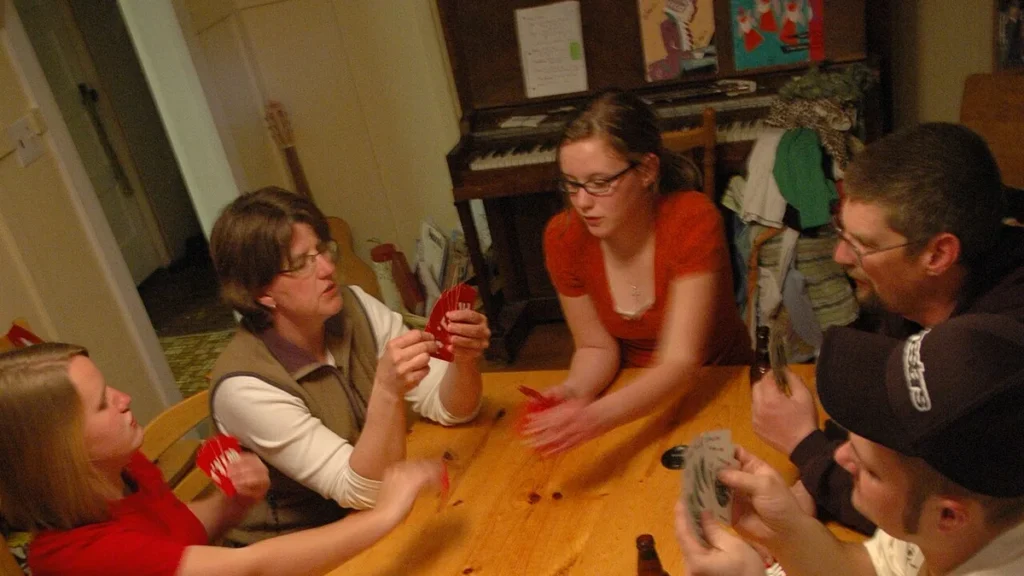
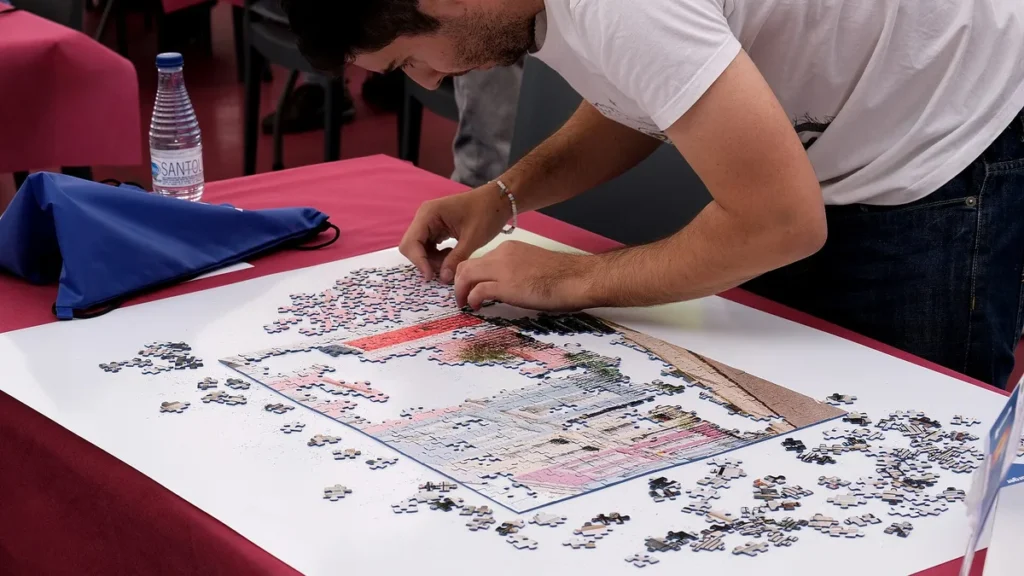
With three to twelve players, keep it simple. One or two tables is enough, and the best format is a straight race or a cooperative solve. Give each team the same puzzle, set a timer, and let the natural chatter do the work. At this size, everyone can see every piece, and the host can watch the whole room at a glance.
Small groups are also the best place to test new formats before a big night. Try a 500-piece puzzle with four players and time it. Try a crossword relay with eight. What you learn in an hour with twelve people will save you real trouble when the room holds two hundred, because the weak spots in your rules show up fast at a small table.
Mid-Size Groups: 13 to 60 Players
Between 13 and 60 players, teams become essential. Split the room into teams of four to six, give every team the same puzzle, and run two or three rounds with a break between them. Three rounds of 25 minutes fit neatly into a two-hour evening, and the break gives the host time to reset tables and update the scoreboard.
This is the size where stations start to shine. Instead of every team doing the same puzzle at the same time, set up four or five different puzzle stations and rotate teams through them. One station can be a jigsaw, the next a logic puzzle, the next a word puzzle. Rotation keeps the night fresh, and it stops one slow puzzle from holding up the whole evening.
Large Groups: 61 to 392 Players
Past 60 players, the host stops being a referee and becomes a floor manager. You need helpers, a printed schedule, labelled tables and a scoring system that works without you standing over every team. Plan one helper for every eight to ten teams, and give each helper a zone of the room to watch.
Large groups also need identical puzzles in bulk. If 65 teams are racing the same 500-piece puzzle, you need 65 copies of that puzzle, plus spares for damaged boxes. Order early, count pieces before the night, and keep two spare puzzles per ten teams. A missing piece in a race puzzle is not a small problem when sixty teams are waiting on the same clock.
Teams, Stations and Tournaments: The Three Scaling Methods
Every large puzzle event uses one of three scaling methods, and most good events mix all three. Teams split the crowd into small working groups. Stations split the puzzles into parallel activities. Tournaments split the evening into rounds that narrow the field. Used together, they turn a chaotic crowd into an organised competition that still feels like a game night.
The method you lean on most depends on your goal. If you want everyone playing the whole night, lean on teams and stations. If you want a clear winner and a big finish, lean on tournaments. The sections below explain each method, when it works best, and the mistakes that catch out first-time hosts.
Teams: The Building Block of Every Big Puzzle Night
Teams are the unit that makes everything else possible. A team of four to six players can share one puzzle without crowding, and six is the practical maximum for a standard table. Smaller teams of three work well for fast puzzles, while teams of seven or eight start to split into side conversations, with two or three players doing the work and the rest watching.
Mix abilities when you form teams. Put a fast puzzler, a careful sorter and a word-puzzle fan on each team rather than stacking all the experts together. Mixed teams finish closer together, which keeps the scoreboard interesting, and weaker players learn from stronger ones instead of sitting out. If you are planning a series of puzzle nights, the guide to puzzle games for 391 players shows how the same team sizes hold up when the headcount shifts by one.
Give every team a name, a table number and a captain. The captain collects the puzzle, reports the finish time and settles small disputes inside the team. That one role saves the host dozens of interruptions, because teams solve their own problems instead of waving for help every five minutes.
Stations: Parallel Play for Crowds
Stations are the answer when one puzzle cannot hold a crowd. Set up a ring of stations around the room, each with a different puzzle type, and rotate teams every 20 minutes. A team might start at a jigsaw station, move to a logic-grid station, then to a word-ladder station, then to a tangram table. Every team plays the whole night, and no team waits for another team to finish.
Stations also solve the bulk-buying problem. Instead of 65 copies of one puzzle, you need ten copies of six different puzzles, which is often cheaper and easier to source. It also means a damaged puzzle only affects one station, not the whole event. The station approach in puzzle games for 390 players uses the same rotation pattern, and it works just as well when two more players join the room.
Keep station instructions short and printed. Each station needs a card that says what to do, how it is scored and how long the team has. A station that needs a five-minute explanation is a station that will jam the rotation, because every team arrives needing the same explanation at the same time.
Tournaments: Rounds That Narrow the Field
Tournaments give a big night its shape. Start with heats where every team plays, take the top teams from each heat into semi-finals, and finish with a small final that the whole room can watch. Heats keep everyone involved early, and the final gives the night a moment of drama that a simple points tally never delivers.
The key number is how many teams advance from each heat. Advancing the top two from each heat is safe and easy to explain. Advancing only the winner is faster but harsher, and it can leave good teams out on a single unlucky round. For a friendly night, advance two teams per heat and let the semi-final sort out the rest. The bracket format in puzzle games for 389 players follows the same heats-to-final structure, and it scales cleanly across the whole 3-to-392 range.
Run the final on a stage or in the centre of the room, with the audience watching. Give the finalists the same puzzle, put the clock where everyone can see it, and let the room cheer. A final that only the finalists can see wastes the best moment of the night.
Picking the Right Puzzle Format for Your Headcount
Not every puzzle type survives contact with a large group. Jigsaws are the classic team puzzle, but they need table space and identical copies. Word puzzles and logic puzzles are cheap to print in bulk, and they score cleanly. Physical puzzles like tangrams and cube puzzles are great at stations but poor as a main race, because pieces go missing fast.
Use the table below as a starting point, then adjust for your room, your budget and your players. A school hall with long tables suits jigsaws. A community room with small tables suits printed puzzles. A group of children suits big-piece puzzles and picture rounds. The format should fit the room you actually have, not the room you wish you had.
| Format | Best headcount | Players per puzzle | Round length | Cost per team |
|---|---|---|---|---|
| Team jigsaw race | 3 to 120 | 4 to 6 | 30 minutes | Medium |
| Puzzle stations | 24 to 392 | 4 to 6 | 20 minutes | Low to medium |
| Printed logic rounds | 3 to 392 | 1 to 6 | 15 minutes | Low |
| Crossword relay | 12 to 200 | 4 to 6 | 20 minutes | Low |
| Tournament heats | 60 to 392 | 4 to 6 | 25 minutes | Medium |
| Cooperative mega-puzzle | 12 to 100 | Whole room | 60 minutes | High |
Printed logic rounds deserve a special mention for the largest groups. A logic puzzle costs almost nothing to photocopy, every player gets the same sheet, and scoring is a simple count of correct answers. When the headcount is past 200 and the budget is tight, printed rounds are the format that keeps the night affordable without making it dull.
What You Need: Supplies, Space and Helpers
Big puzzle nights fail on logistics more often than on puzzles. The puzzle itself is rarely the problem. The problems are missing pieces, too few tables, no printed scorecards and a host trying to do five jobs at once. The checklist below covers the supplies that matter most, and it is worth printing and ticking off the day before the event.
- Identical puzzles in bulk, plus two spares per ten teams, with pieces counted before the night.
- One table per team, with room for six chairs and space to spread puzzle pieces.
- Printed scorecards, station cards and answer sheets, with pens for every table.
- A loud timer or bell the whole room can hear, plus a visible clock for finals.
- One helper for every eight to ten teams, each with a labelled zone of the room.
- A scoreboard, a first-aid kit, drinking water and a box for lost puzzle pieces.
Space is the supply hosts underestimate most. A team of six needs a table of at least 150 centimetres by 90 centimetres to work a 500-piece puzzle comfortably, and the room needs walkways wide enough for helpers to pass without knocking tables. Measure the room, draw the table plan on paper, and count the tables before you promise a headcount. A hall that holds 40 tables holds about 240 players, not 392, and it is far better to learn that from a drawing than from a crowd at the door.
Common Mistakes That Slow a Big Puzzle Night Down
The first mistake is starting late because the puzzles were not sorted. Sorting 65 identical puzzles takes longer than anyone expects, and it cannot be done while players are arriving. Arrive an hour early, lay out the puzzles, and put a table number on every table before the doors open. The first ten minutes of the night set the tone for the next two hours.
The second mistake is scoring by speed alone. Speed scoring rewards the fastest team and punishes every other team for being careful, which means most teams stop trying once they fall behind. Score on accuracy first, with speed as the tiebreaker, and the whole room keeps playing until the final round. A team in tenth place should still have a reason to finish its puzzle.
The third mistake is forgetting the late arrivals. Someone always arrives twenty minutes late, and a good host has a plan for them: a spare team, a station they can join mid-round, or a printed puzzle they can solve while waiting for the next round. A late player who is turned away tells ten people about it, and a late player who is welcomed tells ten people about that instead.
Frequently Asked Questions
Can puzzle games really work for 392 players?
Yes, if you use teams, stations or tournaments instead of one shared puzzle. With teams of six, 392 players become about 65 teams, and each team only needs its own table and puzzle. The event is really 65 small games running at once, tied together by one scoreboard and one schedule.
How many puzzles do I need for 392 players?
For a team race, one identical puzzle per team, so about 65 copies, plus spares. For stations, ten copies of each station puzzle, so about 60 puzzles across six stations. For printed rounds, one sheet per player, so 392 sheets per round plus spares for mistakes.
What is the best team size for a puzzle race?
Four to six players is the best size for most puzzle races. Everyone can reach the puzzle, everyone can be heard, and no one player can carry the whole team. Teams of three work for fast puzzles, but teams larger than six start to crowd the table and leave quieter players out.
How long should a puzzle night for a large group last?
Two to three hours is the right length, including a welcome, three or four rounds, a break and a final. Shorter nights feel rushed, and longer nights lose players to tiredness. Keep each round between 15 and 30 minutes, and protect the break, because players need time to stretch, talk and reset.
Do I need identical puzzles for every team?
Yes, for any race or tournament round where teams are compared. Different puzzles have different difficulties, and teams will notice immediately if one table got an easier picture. For stations, each station can use a different puzzle, as long as every team faces the same station puzzles in rotation.
What if the headcount changes on the day?
Build the plan around ranges, not exact numbers. Keep two spare puzzles and two spare tables ready, keep a few flexible teams that can absorb extra players, and keep one printed round in reserve that works for any number. A plan built for 350 to 392 players absorbs surprises; a plan built for exactly 392 does not.
Bottom Line
Puzzle games for 392 players work when the structure does the heavy lifting. Teams of four to six keep every player involved, stations keep every team busy at the same time, and tournaments give the night a finish worth watching. Pick the format that fits your headcount, print the scorecards before the doors open, and score accuracy before speed so the whole room keeps playing.
Start small if this is your first big night. Run the format with twelve players, learn where the timing slips, and then scale the same plan up. The puzzle at the table never changes. Only the number of tables does, and that is a problem a good plan can solve.