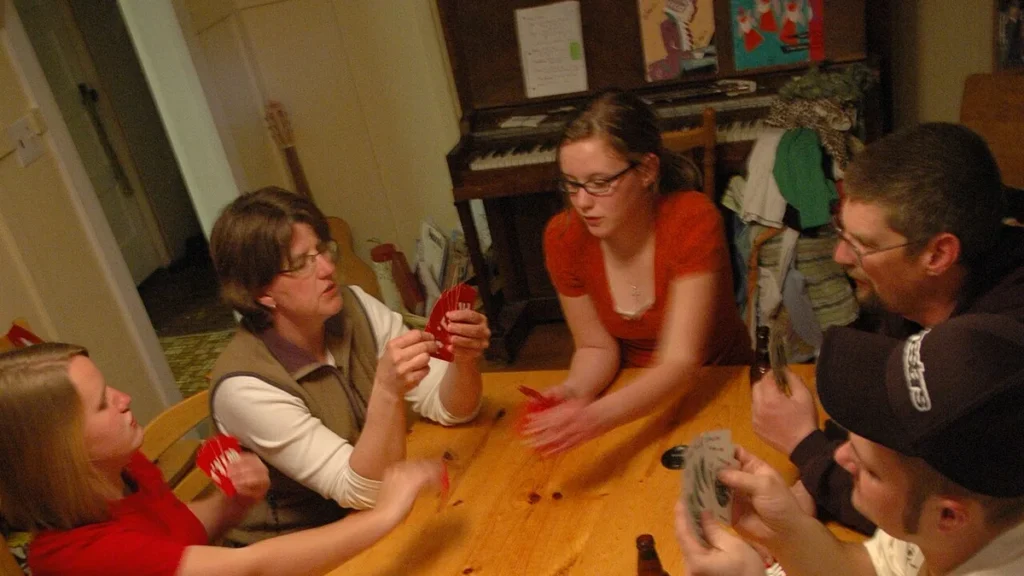
Card games for 394 players sound impossible until you stop picturing one table. Nobody seats 394 people around a single deck and expects a fair game, and nobody should try. The phrase works because it describes a range, not a single table: card games for 394 players means games that scale from a quiet table of three all the way up to a hall of 394, using the same decks, the same rules, and the same energy at every size in between.
That range is exactly why card games are the most practical choice for a huge group. A deck of cards costs almost nothing, fits in a pocket, needs no screen, no power, and no special equipment, and a game can start in under a minute. When the group grows, you do not need a bigger game. You need more tables, more decks, and a simple plan for moving people between them, and the game itself barely changes.
This guide explains how card games for 394 players actually work in real rooms, which formats scale cleanly, how to split 394 people into tables, teams, and stations without chaos, and which games to choose when the headcount is enormous. The examples use real numbers for 394 people, so you can copy the splits, the deck counts, and the timing straight into your own event.
Key takeaways
- Think of 394 as a range from 3 to 394, not one giant table — the same game scales by adding tables, teams, and stations.
- Split 394 into 197 pairs, 98 tables of four plus two hosts, or 65 tables of six plus four floaters, and every table plays the same game at the same time.
- Choose games with short rounds, simple rules, and simultaneous play, so no table waits for another table to finish.
- Use one deck per table, plus spares, and appoint one table captain per table to handle rules, scoring, and rotation.
- Run the event as a tournament or a station rotation, with a clear clock, a visible scoreboard, and a short final round for the top tables.

What Card Games for 394 Players Really Means
The number 394 is a planning number, not a table size. It tells the organiser how many chairs, decks, and score sheets to prepare, and it sets the scale of the room. A card game that works for 394 players is a game that still works when only three people turn up for a practice round, and still works when the full hall fills up on the night.
Most card games already work this way. A game built for four players works for 394 people when you run 98 copies of it at once. A game built for six works when you run 65 copies. The skill is not finding a magical 394-player game. The skill is choosing a game whose round is short enough, whose rules are simple enough, and whose scoring is clear enough that 98 tables can play it in step.
The 3-to-394 Range
At the small end of the range, three players learn the rules, test the pace, and find the rough edges. At the large end, 394 players need structure: a start time, a table number, a captain, and a clock. The game in the middle does not change. What changes is the organisation around it, and that organisation is the whole subject of this guide.
Think of it like a recipe that serves three or 394. The ingredients stay the same. You multiply the quantities, you use more pots, and you need more people serving. Nobody expects one pot to feed 394 people, and nobody should expect one deck to entertain them either.
How to Split 394 Players Into Tables That Work
The first decision is the table size, and the table size decides everything else: how many decks you need, how many captains you need, and how long each round takes. Smaller tables are faster and friendlier, because everyone gets more turns. Larger tables are livelier, because more people are reacting to the same hand. For 394 players, tables of four to six are the sweet spot.
Here are the cleanest splits for exactly 394 people. Pick one before the event, print the table list, and stick to it. Changing the split halfway through the night is how a smooth event turns into a queue.
Tables of Four: 98 Tables Plus Two Hosts
Ninety-eight tables of four gives you 392 players, with two people left over to host, keep score, and float between tables. Four-player tables are fast, because the turn comes round quickly, and they suit games where each player needs a hand of cards and a clear view of the table. If your chosen game is built for four, this is the split to use.
The two hosts matter more than they look. They answer rules questions, settle disputes, replace a damaged deck, and keep the clock visible. Without them, every small question becomes a table-wide argument, and the schedule slips by ten minutes a round.
Tables of Six: 65 Tables Plus Four Floaters
Sixty-five tables of six gives you 390 players, with four floaters who can fill in for anyone who steps away. Six-player tables suit louder, faster games where the fun comes from trading, shouting, and watching other people. The rounds take slightly longer than four-player tables, because more hands need to be played, but the energy is higher.
The Scaling Methods: Tables, Teams, Stations, and Tournaments
There are four ways to scale a card game to 394 players, and the best events use more than one. Tables split the group. Teams give the group an identity. Stations keep the group moving. Tournaments give the group a finish. Used together, they turn a crowd into a competition.
The method you choose should match the mood you want. A quiet evening suits tables. A loud social night suits stations. A competitive night suits a tournament. A mixed crowd, which most huge groups are, suits a tournament built from stations, so everyone plays several different games and nobody is stuck at one table all night.
Station Rotation: Everyone Plays Everything
In a station rotation, the room holds several different card games at once, and each table plays one game for a fixed time before moving to the next station. With 394 players, you might run ten stations, each with room for about 40 people, and rotate every 20 minutes. By the end of the night, every player has tried several games.
Tournaments: From 394 to One Winner
A tournament sounds complicated for 394 people, but it is only a series of short rounds with a clear rule for who advances. In the first round, every table plays, and the top player or team from each table moves on. In the second round, the winners play each other. After three or four rounds, you have a final table, and the room has a winner to cheer for.
For a flavour of how these huge-group lists are built, the companion guide to card games for 392 players uses the same table-and-tournament thinking, with splits that work for a crowd only two people smaller.
Choosing Games That Scale to 394 Players
Not every card game scales. A game with long turns, hidden information that takes minutes to explain, or scoring that needs a calculator will collapse at 394 players, because every small delay is multiplied by 98 tables. The games that scale share four traits: short rounds, simple rules, simultaneous action, and scoring that a table captain can do in seconds.
Test any game with three players first. If three people cannot learn it in five minutes, 394 people will not learn it in an evening. If a round takes more than 15 minutes with three players, it will take longer with six. The small test tells you everything you need to know about the large event.
Fast Trading Games
Trading games are the natural stars of huge groups. Players swap cards quickly, shout for the set they need, and finish a round in minutes. Pit is the classic example: players trade cards at speed, trying to collect a matching set, and the table erupts when someone wins. The noise is the point, and in a hall of 394 people, that noise is the atmosphere.
Matching and Set-Collection Games
Matching games, where players collect sets of the same rank, colour, or picture, are the easiest games to run at scale. The goal is visible, the rules fit on one card, and a table captain can check a winning hand at a glance. Games in this family suit mixed ages, because a child and a grandparent can play the same hand on equal terms.
Party Card Games for Big Rooms
Party card games, where players match a prompt card with a funny answer card, scale well because the whole table plays at once and the judging rotates. Nobody waits for a turn, and the fun comes from the answers, not from the rules. These games suit the station format, because a table can join mid-round without needing a full explanation.
Decks, Captains, Clocks, and Score Sheets
The unglamorous supplies decide whether a 394-player card night works. You need one deck per table, plus spares, plus a printed rules card per table, plus a score sheet per table, plus a pen per table. That is 98 decks for four-player tables, or 65 decks for six-player tables, and at least ten spare decks for the ones that get bent, spilled on, or lost.
Buy identical decks. When every table uses the same design, a stray card can be returned to any deck, and a table that loses a card can borrow from a spare without confusion. Mixed decks, with different backs and sizes, cause arguments that identical decks never do.
One Captain Per Table
Every table needs a captain, and the captain needs exactly three jobs: read the rules card aloud, keep the score, and call the table to order when the clock sounds. Captains are not referees and they are not expected to know every rule. They are the person who holds the pen and the rules card, and that is enough.
Pick captains in advance, give them the rules card a day early, and let them play one practice round. A captain who has played the game once is worth ten captains who have only read about it. In a group of 394, your captains are the difference between a smooth night and a noisy mess.
The Clock Is the Real Host
A visible clock, or a loud timer that the whole room can hear, does more work than any host. When the timer sounds, tables stop, captains write the score, and the room moves to the next round. Without a timer, some tables play three rounds while others are still on their first, and the schedule falls apart.
Keep rounds short and the breaks shorter. Fifteen minutes of play and five minutes to rotate, score, and stretch is a rhythm that a hall of 394 people can follow all evening. Long breaks let the energy leak out of the room, and it is hard to get it back.
Comparison Table: Which Format Fits Your 394-Player Night
| Format | Best for | Round length | Scoring | Energy |
|---|---|---|---|---|
| Tables of four | Fast, fair games | 10–15 minutes | Simple, per table | Steady |
| Tables of six | Loud trading games | 15–20 minutes | Simple, per table | High |
| Pairs (197 pairs) | Mixed ages and skill | 10–15 minutes | Pair totals | Friendly |
| Teams of five | Competitive nights | 15–20 minutes | Team leaderboard | High |
| Station rotation | Mixed crowds | 20 minutes per station | Points per station | Moving, social |
| Tournament bracket | Finding one winner | 15 minutes per round | Winners advance | Rising to a final |
| Simultaneous play | Simplest huge night | 15 minutes | Best score wins | Even, room-wide |
| Party card stations | Social, funny nights | 20 minutes | Votes, not points | Relaxed, loud |
Planning the Room for 394 Card Players
A room for 394 card players needs more space than a room for 394 people sitting in rows. Each table needs chairs on all sides, elbow room for dealing, and a gap behind each chair so players can stand up without bumping the next table. Plan for at least two metres between tables, and walk the room yourself before the event to check that the gaps are real.
Seating That Mixes People Up
Seat people deliberately, or they will sit with the same five friends all night. A simple way to mix a huge group is to hand out table numbers at the door, in a shuffled order, so each table holds a mix of ages, groups, and experience levels. The first round is always slightly awkward, and that awkwardness is the point: strangers become tablemates, and tablemates become the story of the night.
If the group includes children, seat families together for the first round, then mix the tables for the second. Children play better when they start beside someone they trust, and they mix better once they have won a round.
When the format is settled, the next useful comparison is the guide to card games for 390 players, which breaks down the same tournament and station ideas for a crowd four people smaller, with splits you can adapt directly.
Checklist: Your 394-Player Card Night in Six Steps
- Pick one game that three people can learn in five minutes, and test it at a small table before the event.
- Choose your split — 98 tables of four, 65 tables of six, 197 pairs, or 78 teams of five — and print the table list.
- Buy one identical deck per table plus at least ten spares, with a printed rules card, score sheet, and pen for every table.
- Appoint one captain per table, give them the rules a day early, and let them play one practice round.
- Set a visible clock with 15-minute rounds and five-minute rotations, and use a bell or whistle the whole room can hear.
- Plan the finish first: a short final round for the top tables, a visible leaderboard, and a prize worth playing for.
Frequently Asked Questions
Can 394 people really play card games at the same time?
Yes, if they play at separate tables. Ninety-eight tables of four, or 65 tables of six, let all 394 people play at once, each table running its own copy of the same game. Nobody waits, nobody watches from the sidelines, and the room plays as one event even though the tables are separate.
How many decks do you need for 394 players?
One deck per table, plus spares. That is 98 decks for tables of four, or 65 decks for tables of six, plus at least ten spare decks. Buy identical decks so a stray card can go back into any deck, and keep the spares with the hosts, not in a cupboard at the back of the room.
What is the best table size for 394 players?
Tables of four are the fastest and fairest, because turns come round quickly and everyone can see the table. Tables of six are livelier and suit trading games. If you are unsure, start with tables of four: they are easier to run, easier to score, and easier to fix when something goes wrong.
How long should a 394-player card night last?
Two to three hours works well, built from 15-minute rounds with five-minute breaks. That gives the group time for four or five rounds, a station rotation, and a final round, without the evening dragging. A night longer than three hours needs a proper meal break, not just a pause.
Do you need a tournament, or can everyone just play?
Everyone can just play, and for a social night that is often the better choice. A tournament adds excitement and a finish, but it also adds pressure and a schedule to protect. If the group is mixed and mostly social, run simultaneous play or stations. If the group is competitive, add a short tournament on top.
What if some players have never played a card game before?
Seat them with a patient captain, give the table a practice hand before scoring starts, and choose a game whose rules fit on one card. New players learn fastest by playing, not by listening, so start the first round quickly and let the table teach itself. Pairing a new player with an experienced partner also helps, and it is one reason pairs work so well for huge groups.
For a broader party-night plan that mixes card tables with other games, the guide to party games for 392 players shows how to run stations and rotations for a crowd almost exactly this size.
Bottom Line
Card games for 394 players work because the game never has to grow. The room grows, the number of tables grows, and the number of decks grows, but the game at each table stays small, fast, and friendly. Pick a game three people can learn in five minutes, split 394 into tables of four or six, appoint a captain per table, and let a visible clock run the night. Do that, and 394 people will not feel like a crowd. They will feel like 98 tables of friends, all playing the same game at the same time.