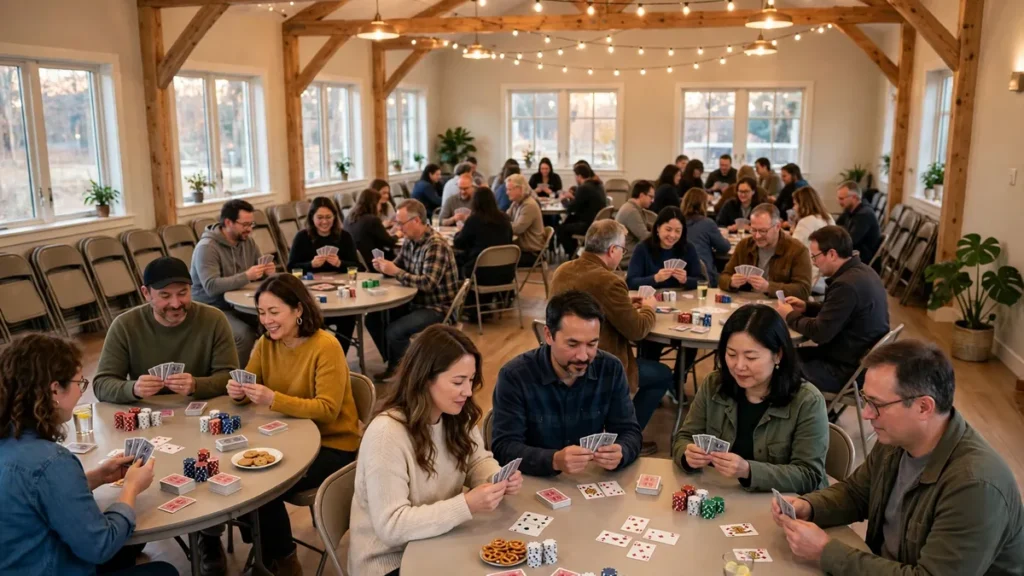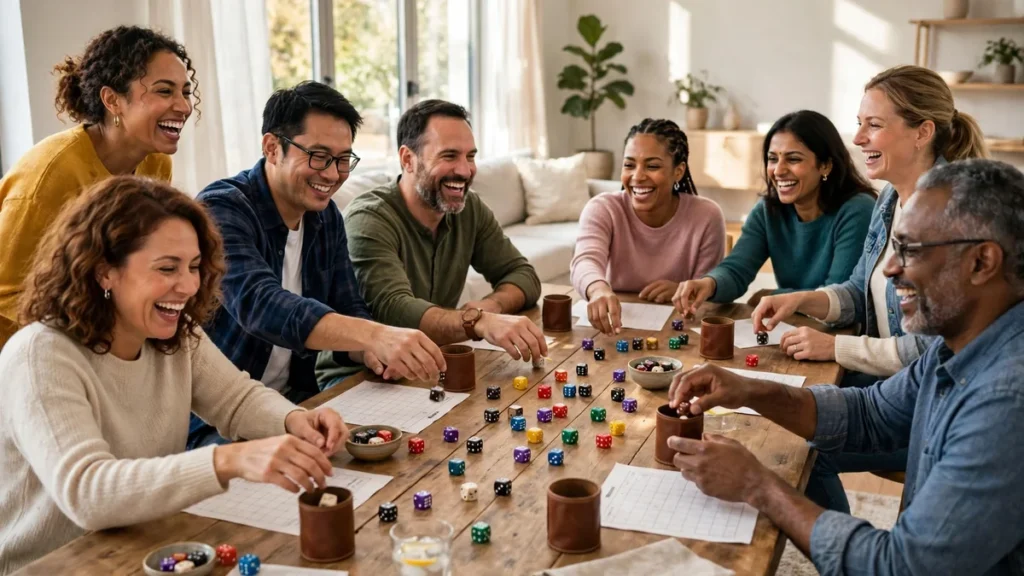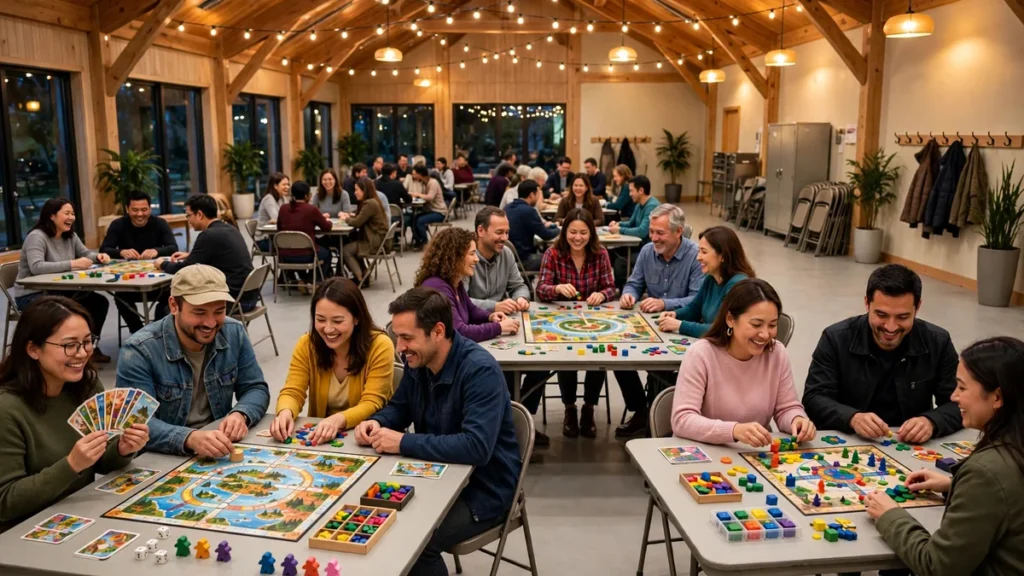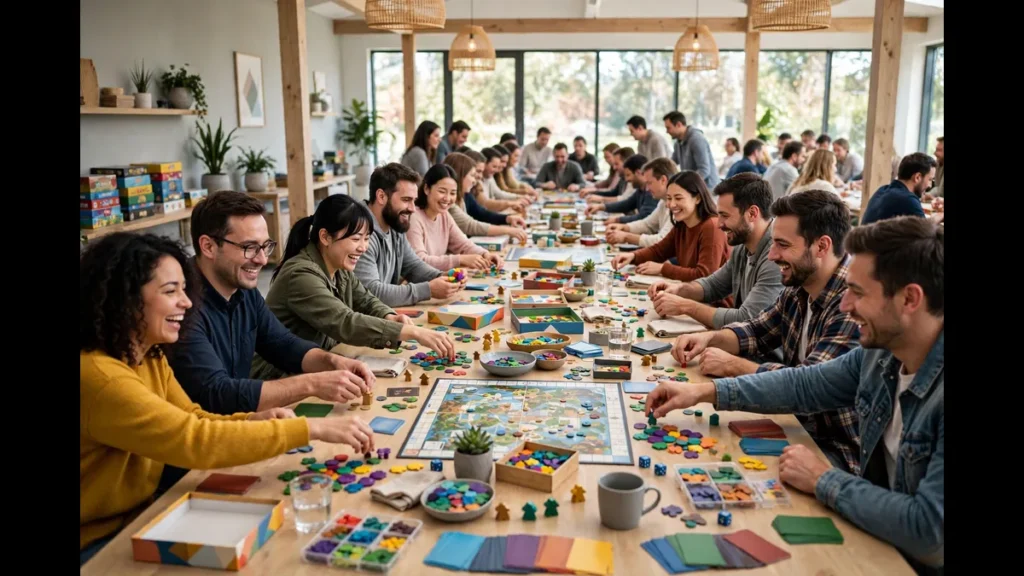
Finding the best board games for 48 players starts with one honest fact: no single board game seats 48 people around one table. The games that work for a crowd this size do it differently. They use teams, multiple copies, parallel tables, or one giant shared game where everyone plays at once. Once you understand those four formats, a 48-player game night becomes easy to plan.
A group of 48 is a wedding reception, a company offsite, a school reunion, or a very large family gathering. The mistake most hosts make is buying one big box and expecting it to carry the whole evening. The hosts who get it right plan several stations, clear teams, a simple rotation, and one big finale. The games in this guide were chosen because they actually work at that scale.
This guide covers the eight games that handle 48 players best, the exact number of copies you need for each one, a ready-made station plan for the night, and the practical details that keep a huge group moving instead of standing around waiting. Every recommendation below uses real player counts, setup times, and the format that makes it work for 48.
Key takeaways
- Ultimate Werewolf is the only game in this guide that genuinely plays 48 people in a single game, with the box supporting up to 75 players.
- Most of the best board games for 48 players work through teams or parallel tables, so plan on two to six copies of each title.
- Codenames, Wavelength, and Monikers are the strongest team games for a crowd, because every player is involved on every turn.
- Split 48 guests into six teams of eight and rotate them through stations to keep waiting time under ten minutes.
- Budget about three hours, including a 15-minute welcome round and a big group finale.
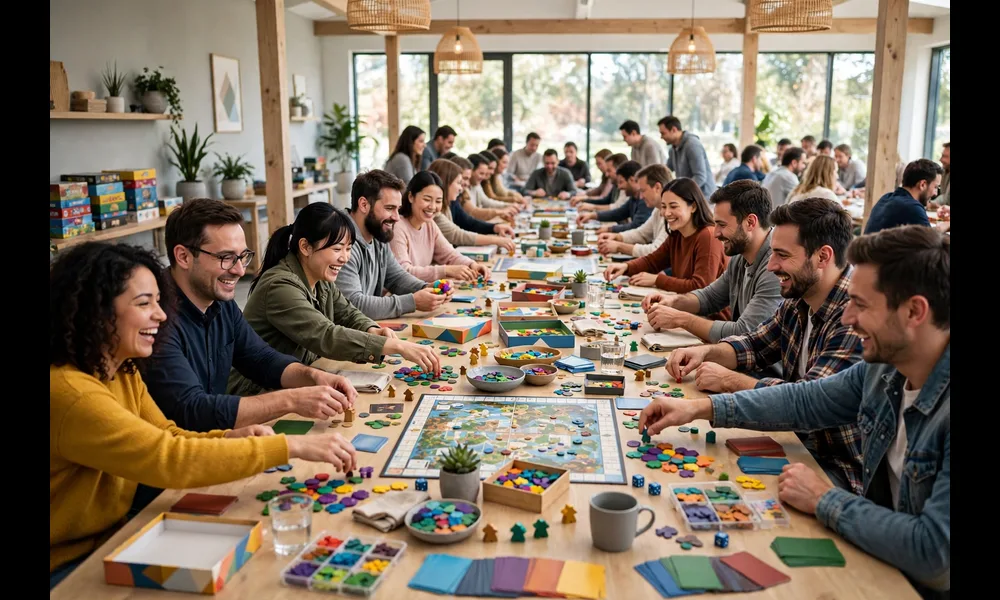
Why 48 Players Changes Everything
Most board games are designed for two to six players. That range is not an accident. It is the size of a family around a dining table, and almost every classic game is built for it. At 48 players, the math changes completely. A game with 30-second turns would need 24 minutes for one round. That is why turn-based games fail at this scale, no matter how good they are for a small group.
The games that survive the jump to 48 share three traits. First, everyone acts at the same time, or in teams, so nobody sits idle. Second, the rules can be explained in under five minutes, because you cannot spend half an hour teaching 48 people a complex game. Third, the game creates conversation and laughter, because the social energy is the whole point of a crowd this size. The same team and station formats work for slightly smaller crowds too, and the best board games for 47 players use nearly identical planning.
There are four formats that make a 48-player night work. The single giant game puts everyone in one game, and only a handful of titles can do it. The team tournament splits the group into teams that compete across several games. The station rotation runs five or six different games at different tables and rotates teams through them. The parallel copies format buys several copies of one game and runs them side by side. The best nights combine two of these formats, usually stations for the first two hours and one giant game as the finale.
The Best Board Games for 48 Players Compared
The table below gives you the short version: real player counts, the format that makes each game work for 48, and setup times. Detailed reviews follow.
| Game | Players per copy | Best format for 48 | Setup time | Why it works |
|---|---|---|---|---|
| Codenames | 2 or more | Team tournament | 5 minutes | Whole teams guess together on every turn |
| Ultimate Werewolf | 5 to 75 | One giant game | 10 minutes | The only title here that seats all 48 at once |
| Two Rooms and a Boom | 6 to 30 | Two parallel games | 10 minutes | Built for big groups and hidden roles |
| Wavelength | 2 to 12 | Team play, four copies | 5 minutes | Constant debate keeps everyone talking |
| Telestrations | 4 to 8 | Six tables of eight | 2 minutes | Drawing game with instant laughs |
| Herd Mentality | 4 to 20 | Three tables of sixteen | 2 minutes | Everyone answers at the same time |
| 6 Nimmt! | 2 to 10 | Five tables of ten | 2 minutes | Fast, cheap, and easy to teach |
| Monikers | 4 to 16 | Team play, three copies | 5 minutes | Gets funnier every round |
1. Codenames
Codenames is the safest pick on this list, and it is the first game to buy if you are starting from nothing. Two teams hunt for secret words on a grid of 25 cards, guided by one-word clues from their spymaster. Because the whole team discusses every clue together, a team of 24 works just as well as a team of four. Buy three copies for a tournament with six teams of eight.
For a 48-player night, split the group into six teams of eight and run three Codenames games at once, then rotate the winners into a final. Each round takes about 15 minutes, and the clue-giving role should rotate so the same person is not stuck as spymaster all night. The game needs almost no table space.
2. Ultimate Werewolf
Ultimate Werewolf is the only game in this guide that genuinely plays 48 people in one single game. The box supports five to 75 players, and the format is built for it: villagers try to find the werewolves hiding among them, while the werewolves try to survive the vote. A game master runs the night phase, and the day phase is pure debate and laughter. For a crowd of 48, this is your finale game, the one moment when everyone plays together.
Running Werewolf for 48 takes a confident host and a large open space where everyone can sit in a circle or in rows facing the front. Plan on 45 minutes for a full game, including role assignment. Use the standard role set plus a seer and a doctor to keep the game balanced, and skip the exotic roles on your first night.
3. Two Rooms and a Boom
Two Rooms and a Boom was designed for large groups and conferences, and it shows. Players split between two rooms, each with a hidden role, and get five timed rounds to find teammates and complete their objective. The game supports six to 30 players per game, so for 48 you run two parallel games of 24 and compare results at the end. It is loud and memorable, and works best with two separate spaces or a dividable room.
The game needs a host for each room and a timer everyone can hear. Each game takes about 20 minutes including setup, making it a strong choice for the middle of the night. The rules take about five minutes to explain, and the game includes a simple set of roles for beginners.
4. Wavelength
Wavelength asks teams to guess where a hidden target sits on a scale between two opposites, like hot and cold or boring and exciting. One player gives a clue, and the whole team debates where the target falls. Because the debate is the game, a team of eight or twelve stays engaged the entire time. Buy four copies for four tables of twelve, or run a team tournament with two copies and a scoreboard.
Wavelength shines in the first hour of the night because it gets strangers talking to each other fast. The clues are personal and funny, and the arguments about whether a burrito is more hot or more cold break the ice better than any planned icebreaker. Each round takes about 20 minutes.
5. Telestrations
Telestrations is the telephone game as a drawing game: one player writes a word, the next draws it, the next guesses the drawing, and the results get funnier with every pass. Each copy supports four to eight players, or twelve with the party pack, so six copies cover 48 players. Setup takes about two minutes, and the game explains itself the moment the first drawing is revealed.
This is the best game on the list for mixed groups where some guests are shy or have never played a board game. Drawing badly is part of the fun, and nobody needs to know any rules beyond sketch and pass. Plan on 20 minutes per round.
6. Herd Mentality
Herd Mentality asks every player the same question, and the goal is to write down the same answer as the majority. Everyone answers at the same time, so there is no waiting and no downtime, which is exactly what a 48-player night needs. Each copy supports four to 20 players, so three copies cover the whole group. The game takes two minutes to set up and about 20 minutes to play.
The questions are simple and funny, which makes Herd Mentality a strong warm-up game for the first station rotation. It works for a wide age range, and children and grandparents can play it together.
7. 6 Nimmt!
6 Nimmt!, also sold as Take 6!, is a small card game with a big reputation. Each player secretly picks a card, everyone reveals at once, and the cards are placed in rows where the sixth card takes the whole row as penalty points. Each copy supports two to ten players, so five copies cover 48 players. The game costs very little, fits in a pocket, and takes two minutes to teach.
This is the workhorse of a 48-player night. It is fast, it is cheap, and it fills a table while other stations reset. A full game takes about 30 minutes, and you can play multiple short rounds within one station rotation. Buy five copies and keep one in reserve.
8. Monikers
Monikers is a team guessing game played in three rounds with the same set of cards: describe the card, then describe it in one word, then act it out without speaking. Each copy supports four to 16 players, so three copies cover 48 players in teams of sixteen or eight. The game gets funnier every round because the same cards come back with shared jokes attached.
Monikers is the best choice for the last station before the finale, because by then the teams have inside jokes and the acting round turns the room into a comedy show. Plan on 30 minutes per game including setup, and use the standard card set on your first night.
How to Run a 48-Player Board Game Night
Start by splitting your 48 guests into six teams of eight. Eight is the right team size because it fills a table, keeps every team competitive, and means you only need six team captains. Ask for RSVPs two weeks ahead, and mix friend groups deliberately so strangers meet each other. Name the teams after colours or animals so the scoreboard is easy to follow.
Set up six stations with one game at each table, and give every station a simple printed sign with the game name, the player count, and the three most important rules. Teams rotate every 25 minutes, which gives 20 minutes of play and five minutes to move, refill drinks, and settle in. A host with a loud timer keeps rotations on schedule, and the scoreboard should be visible from every table. If your group prefers faster, lighter titles between rounds, the best party games for 46 players work as fillers at the same crowd size.
End the night with one game that brings everyone together. Ultimate Werewolf is the natural finale because it plays all 48 at once, but a Codenames championship between the two best teams works too. The finale should start no later than 45 minutes before the venue closes, because a big-group game always runs longer than planned.
How Many Copies Do You Need?
Count copies before you buy anything. The station plan above needs three copies of Codenames, one copy of Ultimate Werewolf, two copies of Two Rooms and a Boom, four copies of Wavelength, six copies of Telestrations, three copies of Herd Mentality, five copies of 6 Nimmt!, and three copies of Monikers if you run every game at once. You do not need all of them. Pick four games and buy the copies those four need.
If your budget is tight, start with Codenames, 6 Nimmt!, and Ultimate Werewolf. Three copies of Codenames, five copies of 6 Nimmt!, and one copy of Ultimate Werewolf cover a full night for under the cost of a single large board game, and you can add the other titles later. Borrow copies from friends, and check your local game cafe, since many rent party games by the night.
Venue, Tables, and Timing
A 48-player game night needs about six tables that seat eight, plus one large open area for the finale. A community hall, a company break room, or a large living room with folding tables all work. Avoid restaurants and bars unless you have booked the whole space, because a loud game night will disturb other guests. Check the lighting, since drawing and card games need bright light.
Plan the evening on a simple timeline. Doors open 30 minutes before the first game so guests can arrive, find their team, and get a drink. The welcome round takes 15 minutes and covers the team list, the rotation schedule, and one practice game of Herd Mentality. Four station rotations take about 100 minutes, a 15-minute break lets people eat, and the 45-minute finale closes the night.
What to Buy First
If you are buying games for a 48-player night for the first time, buy in this order. Ultimate Werewolf first, because it is the only game that plays everyone at once and it anchors the finale. Codenames second, because it is cheap, reliable, and works in every format here. Herd Mentality third, because it is the fastest warm-up game and the easiest to teach. 6 Nimmt! fourth, because five copies cost very little and fill every spare table.
When choosing between similar games, pick the one your group will actually play again. A group that loves arguing will play Wavelength every week, while a group that loves drawing will reach for Telestrations. If you want to go deeper on the classic side of the list, the best board games for 46 players include several of the same team formats with a different mix of games, and reading that guide will help you build a shelf that covers any group from 40 to 50 players.
Checklist: Your 48-Player Game Night
- Confirm the headcount with RSVPs two weeks ahead, and build six teams of eight with a mix of friend groups on each team.
- Book a venue with six tables for eight plus one open area for the finale, and check the lighting and noise rules before the night.
- Buy or borrow the copies you need for your four chosen games, and test every copy at home to make sure no cards or pieces are missing.
- Assign one team captain per team and one host per station, and give each host a printed card with the rules and the rotation times.
- Print a scoreboard, team signs, and station signs, and bring a loud timer so rotations start and end on schedule.
- Plan snacks, drinks, and a small prize for the winning team, and confirm the finale game and its start time with your hosts before the doors open.
Frequently Asked Questions
Can 48 people really play one board game together?
Yes, but only a few games support it. Ultimate Werewolf plays up to 75 people in a single game, which makes it the only title in this guide that seats all 48 at once. Every other game works through teams, parallel tables, or station rotations.
How many copies of each game do I need for 48 players?
It depends on the game. Codenames needs three copies for six teams of eight, Telestrations needs six copies, 6 Nimmt! needs five, and Herd Mentality needs three. Check the comparison table above and buy for the format you plan to run rather than for the box player count.
How long does a 48-player game night last?
Plan on about three hours. That covers a 15-minute welcome round, four station rotations of 25 minutes each, a 15-minute break, and a 45-minute finale. Shorter nights feel rushed, and longer nights lose players to tiredness before the finale.
What is the best board game for 48 players if I can only buy one?
Ultimate Werewolf, because it is the only game that plays all 48 people together and it costs less than most board games. If your group does not enjoy social deduction games, buy Codenames instead: it works in team tournaments and station rotations and is easy to teach.
Do I need a host or game master for 48 players?
Yes. One main host runs the schedule, the timer, and the scoreboard, and each station needs a host who knows the rules of that game. Without hosts, rotations slip, rules arguments drag on, and quiet tables get forgotten. Ask six confident friends to host and give them the rules a week ahead.
What if some guests have never played board games?
Start the night with Herd Mentality or Telestrations, because both explain themselves in two minutes and reward new players immediately. Avoid complex strategy games, keep rules teaching under five minutes per game, and put experienced players on every team.
Forty-eight players sounds like a logistics problem, but it is really a chance to run the kind of game night most people only talk about. Pick four games from this guide, split the room into six teams of eight, and let the stations do the work. The games will take care of the fun, and the finale will give the room one shared story to talk about on the way home.