Planning party games for 392 players sounds impossible until you change the way you think about the number. Nobody expects 392 people to stand in one circle and play one small game at the same time. Instead, the best party games for 392 players work because they treat 392 as a range, from a table of three friends up to a hall, a field, or a whole school full of guests, and they scale with teams, stations, and tournaments. When the format fits the crowd, a huge party feels lively rather than chaotic, and every guest gets a real part to play.
The secret is to stop looking for a single game that holds 392 people at once and start looking for games that split cleanly. A quiz becomes 28 teams of 14. A relay becomes 14 lanes running at the same time. A scavenger hunt becomes 49 teams of eight, each with a different route. The game stays the same at its heart, but the structure around it grows. That is how a birthday party, a school festival, a company day, or a community fair can include everyone without long queues, bored spectators, or a host shouting over a crowd that cannot hear the rules.
This guide gives you the games that actually work at that scale, plus the practical system for running them. You will find eight tested games, a comparison table to help you choose in minutes, a planning checklist, and answers to the questions every organiser asks first. Each game includes the group size it suits best, what you need, and how to run it so that 392 players stay involved from the first minute to the final score.
Key takeaways
- Think of 392 as a range from 3 to 392 players, not as one giant group playing a single round.
- Teams, stations, and tournaments are the three ways every large party game scales.
- Choose games where most players are active at the same time, not waiting for a turn.
- One clear host, a loud sound system, and visible scoring keep a huge crowd together.
- Run short rounds of 10 to 15 minutes so energy stays high and no team falls too far behind.
Why 392 Players Changes Everything
Most party games are written for eight to twelve people. At that size, everyone can hear the host, see the board, and take a turn within a few minutes. Multiply the crowd by thirty and every one of those assumptions breaks. Sound does not carry, turns take forever, and a single mistake in the rules spreads through the room before the host can correct it. That is why large parties need a different plan, not just a bigger version of a small game.
The first change is space. A group of 392 needs zones, not one circle. Split the room or field into clear areas with signs, and give each area a name, a colour, or a number that guests can find without asking. When people know where to go, the party starts on time and the host spends the day running games instead of directing traffic. A simple map on the welcome board, plus a volunteer at each zone, prevents most of the confusion that ruins big events.
Finally, remember that a crowd of 392 includes many different ages, abilities, and energy levels. The best games offer more than one way to contribute. A quiz team needs a reader, a writer, and a thinker. A relay team needs runners, cheerers, and a strategist. A scavenger hunt needs walkers, photographers, and puzzle solvers. When every role matters, nobody feels like a spare player, and the party feels welcoming instead of competitive in a harsh way. For a closer look at how a slightly smaller crowd is handled, see these party games for 390 players, which use the same team and station system.
How to Scale Any Party Game to 392 Players
Method 1: Split Into Teams
Teams are the simplest way to scale. Divide 392 players into teams of eight to fourteen, and let every team play the same game at the same time. A quiz with 28 teams of 14 works well, as does a bingo game with 49 teams of eight. Each team needs a table or a marked spot, a captain, and a score sheet. The host reads the questions or calls the numbers once, and every team answers together. This method suits indoor venues, quiet games, and mixed-age groups because it needs little space and no special equipment beyond paper, pens, and a microphone.
Method 2: Run Stations in Rotation
Stations suit outdoor parties, school fairs, and events with plenty of space. Set up eight to twelve game stations, such as ring toss, bean bag throw, a puzzle table, a photo challenge, and a short quiz corner. Divide the 392 players into groups of about 30 to 50, and give each group a timetable that moves them from station to station every 12 to 15 minutes. Every station runs the same short game again and again, so a volunteer only needs to learn one set of rules.
Method 3: Run a Tournament
A tournament suits competitive groups and sports-style games. Start with many small matches running at the same time, then narrow the field through quarter-finals, semi-finals, and a final. With 392 players, you might start with 28 teams of 14 in a quiz league, or 56 teams of seven in a relay knockout. The early rounds are short and friendly, and the final rounds become the main event that everyone watches together.
The Best Party Games for 392 Players
1. Giant Team Quiz
A team quiz is the most reliable large party game ever invented. Split the crowd into teams of ten to fourteen, give each team an answer sheet, and read out rounds on music, food, sport, animals, and general knowledge. Mix easy questions with a few hard ones so every team scores something, and add a picture round and a music round to keep the energy up. A quiz needs only a host, a microphone, and printed sheets, yet it can fill an hour with laughter and friendly rivalry.
For 392 players, run six rounds of eight questions, with a short break after round three. Score each round as you go, and read out the top five teams after every round so the contest stays close. Add a bonus round where teams can double their points, and finish with a quick tie-break question if two teams are level. The quiz works indoors and outdoors, in the daytime or the evening, and it suits guests who prefer thinking to running. If you want more quiz ideas for a crowd almost this size, these trivia games for 391 players show how quiz rounds are built for very large groups.
2. Karaoke Battle
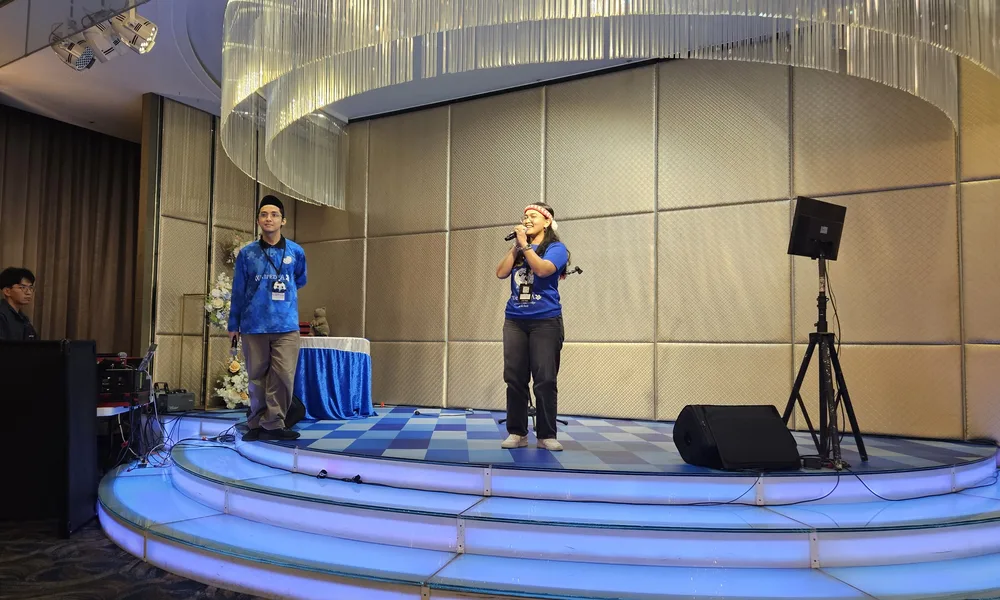
Karaoke turns a crowd into an audience and a stage into the centre of the party. In a large version, teams take turns sending a singer or a small group to the stage, while the rest of the crowd scores them with cards, applause, or a phone vote. Choose well-known songs with easy choruses so the audience can join in, and keep each performance to two minutes so many teams get a turn. A karaoke battle needs a speaker, a screen with lyrics, and a confident host who can keep the show moving.
3. Scavenger Hunt
A scavenger hunt is ideal for a large venue because it spreads players out instead of crowding them together. Give each team a list of 20 items or tasks to find, photograph, or complete, and set a time limit of 30 to 45 minutes. Include easy items, such as a red leaf or a funny sign, and harder tasks, such as a team photo with a stranger in a hat or a short video of the team singing. Teams return to base to have their lists checked and their points counted.
4. Relay Races
Relay races bring energy and noise to any outdoor party. Set up lanes for sack races, egg-and-spoon races, three-legged races, and balloon relays, and let teams race side by side. Each race takes only a few minutes, so you can run many heats in an hour. A relay needs a flat field, simple props, and a starter with a whistle, yet it creates some of the best photos and loudest cheering of the whole day.
5. Human Bingo
Human bingo is a brilliant icebreaker for a crowd where many guests do not know each other. Each player gets a bingo card with descriptions such as someone who has been to another country, someone who can whistle, or someone who owns a dog. Players walk around, talk to each other, and get a signature in each square from a person who matches the description. The first player to complete a row, a column, or the full card wins.
For 392 players, print cards in several versions so neighbours do not have identical grids, and set a time limit of 20 minutes. Human bingo works as an opening game because it gets people moving and talking before the main events begin. It needs no equipment beyond printed cards and pens, and it suits mixed-age groups because the descriptions can be adjusted for children, teenagers, or adults. Offer a small prize for the first full house and another for the most interesting person found.
6. Charades Tournament
Charades is a classic party game that becomes a show when played in front of a crowd. One player acts out a film, a book, a song, or an animal without speaking, while their team guesses within a time limit. In a large version, teams take turns on a stage or in front of their group, and the host keeps score on a board. Charades needs only a list of prompts, a timer, and a space where everyone can see the actor.
7. Dance-Off and Conga Line
A dance-off needs little more than music and space, yet it can involve a whole crowd at once. Play a series of short songs, and let teams show their best moves, copy the leader, or freeze when the music stops. A conga line is the simplest version of all: players join a line, hold the shoulders of the person in front, and follow the leader around the room or field. Both games work because everyone can join in at their own level.
8. Giant Pictionary
Giant Pictionary turns drawing into a team sport. One player draws a word or phrase on a large board, a flip chart, or a projected screen, while their team guesses what it is. In a large version, teams play in parallel at their own tables, with a host calling out the time and the scores. The game needs paper, markers, and a list of words, yet it produces constant laughter, especially when the drawings go wrong.
Party Games for 392 Players at a Glance
| Game | Best for | Space needed | Time per round | Energy level |
|---|---|---|---|---|
| Giant Team Quiz | Indoor, mixed ages | Hall or large room | 45 to 60 minutes | Low |
| Karaoke Battle | Evening party, stage | Stage and seating | 30 to 60 minutes | Medium |
| Scavenger Hunt | Large venue, outdoors | Park or school grounds | 30 to 45 minutes | High |
| Relay Races | Outdoor, active groups | Flat field | 20 to 30 minutes | High |
| Human Bingo | Icebreaker, new guests | Open room | 20 minutes | Low |
| Charades Tournament | Indoor, all ages | Hall with stage | 30 to 45 minutes | Medium |
| Dance-Off and Conga | Party finale | Open floor | 20 to 30 minutes | High |
| Giant Pictionary | Indoor, creative groups | Tables in a hall | 30 minutes | Low |
Planning Checklist for 392 Players
- Confirm the venue, the space for each zone, and the number of guests, then divide 392 players into teams of eight to fourteen and prepare a team list.
- Book a sound system, a microphone, and a projector or large screen, and test them at the venue before the guests arrive.
- Prepare printed score sheets, team lists, timetables, and rule cards, plus spare pens, paper, and a visible scoreboard.
- Recruit at least one volunteer per station or zone, brief them on the rules, and give each volunteer a badge and a copy of the timetable.
- Buy or gather all props, prizes, and first-aid supplies, and pack a spare set of the most-used items, such as balloons, markers, and answer sheets.
- Plan food, water, shade, seating, and toilets for 392 people, and share a simple map and timetable with every guest on arrival.
Mistakes to Avoid With a Huge Crowd
The most common mistake is choosing a game that only a few people can play at once. A single board game, a single card table, or a game with long turns will leave most of the crowd watching. Always ask how many people are active at the same time, and choose games where the answer is most of the room, not a handful of players. If a game cannot be split into teams or stations, save it for a smaller party.
The third mistake is running out of time. Large parties always take longer than planned, because moving 392 people between zones, counting scores, and starting each round all take time. Build in buffer time between rounds, and cut a game short rather than letting the whole schedule slip. It is better to finish with a short, happy finale than to end with a rushed game that nobody enjoys. A related guide to party games for 388 players follows the same planning rules and shows how the same mistakes are avoided at a similar scale.
Frequently Asked Questions
Can one game really work for 392 players?
Yes, if you use teams, stations, or a tournament. No single small game works for 392 people at once, but a quiz with 28 teams, a scavenger hunt with 49 teams, or a relay with many heats all work well. The game stays the same, and the structure around it grows to fit the crowd.
How many teams should I make for 392 players?
Teams of eight to fourteen work best. That gives you 28 to 49 teams, which is easy to manage with a printed list and a scoreboard. Smaller teams mean more teams to manage, while larger teams mean some players get left out, so stay in the eight to fourteen range.
How long should a party for 392 players last?
Plan for two to four hours of games, plus time for food, breaks, and arrival. A two-hour party can fit four or five short games, while a full day can fit eight games with lunch and rest in the middle. Keep each round to 10 to 15 minutes so energy stays high.
What equipment do I need for 392 players?
You need a sound system, a microphone, printed score sheets, team lists, and the props for your chosen games. Most games in this guide need only paper, pens, balls, balloons, or a speaker. Borrow or hire the sound system if you do not own one, because a host without a microphone cannot reach 392 people.
What if it rains on an outdoor party?
Have an indoor plan ready before the day. Move the quiz, charades, Pictionary, and karaoke games indoors, and save the relays for a dry day. A large hall, a school gym, or a covered area can hold most of the games in this guide.
How do I keep 392 players safe?
Set clear boundaries, mark hazards, keep walkways clear, and put a volunteer at each zone. Check the ground for outdoor games, keep a first-aid kit nearby, and make sure every guest knows where to go if they need help. Keep the games friendly, avoid rough contact, and give guests a quiet area to rest.
Bottom Line
The best party games for 392 players are not the biggest or the loudest games. They are the games that split cleanly into teams, run in parallel at stations, or narrow fairly through a tournament, so every guest plays, scores, and laughs. Choose four or five games that fit your space and your guests, prepare the teams and the timetable in advance, and keep the rounds short and the scoring visible. Do that, and 392 players will feel like one big party, not a crowd waiting for a turn.