Finding the best puzzle games for 55 players is a very different challenge from picking a puzzle for a quiet evening at home. With fifty-five people in the room, you are not choosing a single game. You are designing an event where every person has something to solve, a team to belong to, and a reason to stay engaged from the first clue to the final reveal.
The trick is to think in teams, stations, and rounds rather than one giant board. Split fifty-five players into eleven teams of five, or five teams of eleven, and suddenly the problem becomes manageable. Each team works on its own puzzle at its own table, while a shared scoreboard and a ticking clock keep the whole room connected. The games in this guide all work in that format, and most of them need nothing more than printed sheets, a few puzzle sets, and a host who keeps the energy up.
This guide covers the formats that actually work at this scale, from giant jigsaw races and escape-room style clue chains to trivia puzzles, word hunts, and logic challenges. You will find a comparison table to help you choose, a setup plan for the room, a scoring system that keeps every team in the hunt, and a checklist so nothing gets forgotten on the day.
Key takeaways
- Split 55 players into 11 teams of 5 for the best balance of teamwork and speed.
- Choose puzzle games that run in parallel stations so nobody waits around.
- Mix puzzle types — jigsaw, word, logic, trivia, and physical clues — so every player has a strength to use.
- Use a shared scoreboard and timed rounds to keep the whole room connected.
- Plan one puzzle per team plus one big shared finale that everyone solves together.

How to Run Puzzle Games for 55 Players
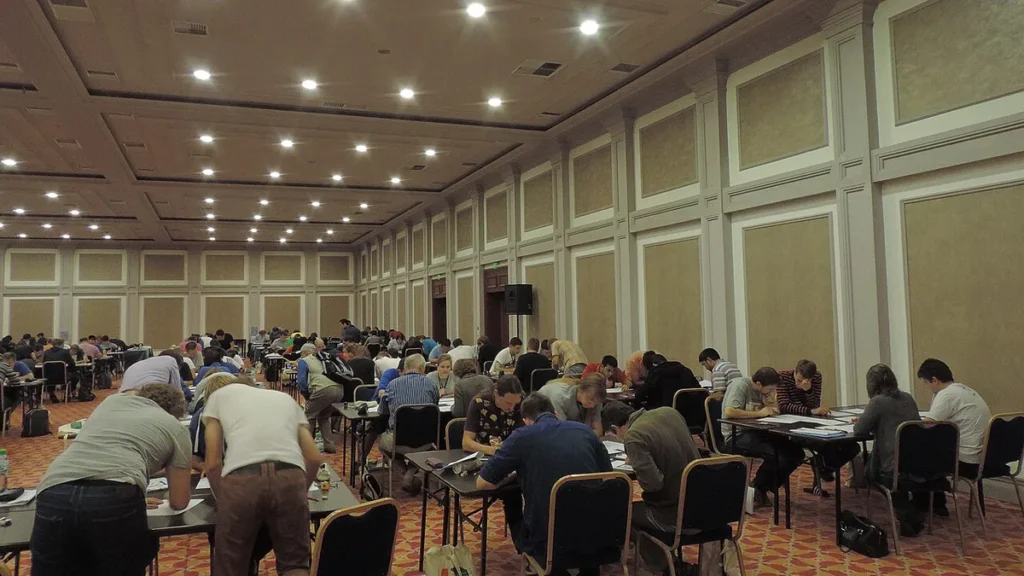
The single biggest mistake hosts make with a group this large is choosing a game built for six people and hoping it stretches. It will not stretch. A single puzzle passed around fifty-five hands means fifty people watching and five people playing. The format that works is parallel play: every team solves at the same time, and the competition comes from comparing results, not from taking turns.
Start by deciding your team size. Teams of five are the sweet spot. Five people can gather around one table, hear each other without shouting, and divide a puzzle into real jobs: one person sorts edge pieces, one scans the picture, one reads the clues, one keeps time, and one assembles. Teams of eleven work too, but only if each team splits into smaller working pairs inside the team.
Next, decide your rhythm. A good 55-player puzzle event runs for ninety minutes to two hours and follows a simple shape: a warm-up round everyone plays at once, two or three station rounds where teams rotate or compete in parallel, and one shared finale. The warm-up should take ten minutes and need no materials beyond a printed sheet or a screen. It wakes the room up and teaches people how your scoring works before anything serious is at stake.
Your role as host matters as much as the games. You are the clock, the scoreboard, and the energy in the room. Announce the time remaining every ten minutes, read out the top three teams after each round, and give a small bonus point for the best team name or the loudest cheer.
The Best Puzzle Games for 55 Players Compared
Use this table to pick the right mix for your group. The best events combine two or three formats from different rows.
| Game | Players per team | Time per round | Materials needed | Best for |
|---|---|---|---|---|
| Giant jigsaw race | 5 | 30 minutes | 11 identical 500-piece puzzles | Relaxed, visual groups |
| Escape-room clue chain | 5 | 25 minutes | Printed clue envelopes, locks or codes | Competitive, clever groups |
| Trivia puzzle rounds | 5 | 20 minutes | Question sheets, answer cards | Mixed-age crowds |
| Word hunt relay | 5 | 15 minutes | Word grids, pens, timers | Fast, energetic groups |
| Logic grid challenge | 5 | 20 minutes | Printed logic grids | Quiet, analytical groups |
| Picture puzzle hunt | 5 | 25 minutes | Printed images, hidden clues | Families and school events |
| Build-and-solve challenge | 5 | 30 minutes | Blocks, cards, building sets | Hands-on, creative groups |
| Grand finale meta-puzzle | All 55 together | 15 minutes | One big puzzle or code sheet | Closing the night together |
1. Giant Jigsaw Race
The giant jigsaw race is the simplest large-group puzzle game, and it works because everyone understands it instantly. Buy or borrow eleven identical 500-piece jigsaw puzzles, one per team. At the starting signal, every team opens its box and races to finish. The first team to complete the puzzle wins the round, but award points for second and third place too, and give a small bonus to any team that finishes within five minutes of the winner.
Choose a puzzle image with clear regions of colour, and tell teams to sort edge pieces first, then sort by colour. A 500-piece puzzle takes a focused team of five about thirty minutes, which is exactly the right length for one round.
For a similar large-group setup with a slightly smaller crowd, the Best Puzzle Games for 54 Players guide uses the same team structure and works well as a companion plan.
2. Escape-Room Clue Chain
An escape-room clue chain brings the excitement of a locked-room game to a hall full of people without needing a single locked door. Each team receives a sealed envelope containing its first clue. Solving the clue reveals a code, a word, or a location that leads to the next envelope, which the host hands over or which is hidden at a marked station around the room. The first team to complete the full chain of five or six clues wins.
Design the chain so that different clue types appear in order: a riddle that gives a number, a word puzzle that gives a colour, a logic grid that gives a name, a picture puzzle that gives a place, and a final code that combines all four answers. This variety means every team member gets a clue that plays to a strength. Keep each clue solvable in three to four minutes, and include a hint card with each envelope that teams can trade for two points.
Prepare eleven identical sets of envelopes, one per team, and test the full chain yourself with a stopwatch before the event. If it takes you twelve minutes alone, it will take a team about twenty-five, which is the right length for a round.
3. Trivia Puzzle Rounds
Trivia is the easiest puzzle game to scale to fifty-five players because it needs no special equipment and every team plays at the same time. Prepare three rounds of ten questions, with each round built around a puzzle twist rather than plain facts. One round can be picture puzzles, where teams identify a place or object from a cropped photo. Another can be word puzzles, where teams unscramble answers or solve anagrams. A third can be logic questions, where each answer is a number that feeds into a final code.
Read each question aloud, give teams sixty seconds to agree on an answer, then reveal the correct one. Scoring is simple: one point per correct answer, with a bonus point for any team that gets all ten in a round. Announce the running totals between rounds so teams know where they stand. Trivia also makes a perfect warm-up, because it needs no setup and gets the whole room thinking together within the first five minutes.
Write your questions for a mixed crowd, mixing easy questions with harder ones that reward specialists. A good test is that the strongest team should score about eight out of ten and the weakest about four.
4. Word Hunt Relay
A word hunt relay adds movement and speed to a puzzle night. Give each team a large word search grid with twenty hidden words on a theme, such as animals, cities, or movies. Team members take turns at the table: one person searches for one minute, then tags the next person, who continues where the last one stopped. The team that finds all twenty words first wins, and teams earn a point per word found if nobody finishes in the time limit.
Because only one person searches at a time, the other four can call out suggestions and plan the next move, so nobody stands idle. Run the relay in two heats if your tables are small, with six teams competing while five watch and cheer, then swap. The watching teams make the room louder and more fun, and a fifteen-minute round keeps the pace high.
Print the grids large, at least A3 size, so they can be read from across a table. Word hunts also pair well with party-style games for big crowds, and the Best Party Games for 54 Players guide has more high-energy formats that fit the same team layout.
5. Logic Grid Challenge
The logic grid challenge is the quiet, brain-burning round that balances a loud evening. Each team receives a printed logic puzzle, the kind where clues like “the teacher does not live in the blue house” must be combined to match people with houses, pets, and drinks. The first team to complete the grid correctly wins, with points for each correct row even if the grid is unfinished when time runs out.
Give teams a grid that takes about twenty minutes, not a monster that takes an hour. A five-by-five grid with ten clues is about right for a team of five. Encourage teams to divide the work: one person reads clues aloud, one marks the grid, one tracks what is ruled out, and the others test combinations.
Logic rounds are ideal as the second round of the evening, after the noisy warm-up and before the physical finale, because they let the room settle and focus. Print a worked example on the back of each sheet so teams that have never seen a logic grid can learn the method in two minutes.
6. Picture Puzzle Hunt
A picture puzzle hunt sends teams around the room solving visual clues. Before the event, take close-up photos of ten ordinary objects in the venue: a door handle, a corner of a painting, a pattern on the floor, a light switch, a book spine. Print each photo on a card with a question on the back. Teams must find the object in the room, then answer the question to earn a point and receive the next card.
This game works beautifully for fifty-five players because the room itself becomes the puzzle. Teams spread out, search together, and return to their table to check in, so the energy stays high without any team blocking another. Set clear boundaries for the search area and ask a volunteer to watch the busiest spots.
Make the photos challenging but fair: a close-up showing a distinctive colour or shape, with a little context around the edges, is the right difficulty. Ten identical cards per team and a twenty-five-minute limit keep the hunt moving.
7. Build-and-Solve Challenge
The build-and-solve challenge is the most hands-on game on this list. Each team receives a set of building blocks, a deck of puzzle cards, or a construction set, plus a printed goal such as building the tallest free-standing tower that can hold a book, or recreating a shape from a diagram using only the pieces provided. Teams earn points for completing the build and bonus points for solving the puzzle card that unlocks an extra piece.
This game suits creative groups and mixed-age events, because there is no single right answer and teams can show off very different ideas. Judge the builds on height or accuracy, stability, and creativity, with a panel of two or three judges or a vote by the other teams. Give teams thirty minutes, with a five-minute warning so they can finish and tidy their build for judging.
If your group prefers board games to building challenges, the Best Board Games for 53 Players guide covers large-group board game formats that use the same team sizes.
8. The Grand Finale Meta-Puzzle
End the night with one puzzle that all fifty-five players solve together. The meta-puzzle takes the answers from every earlier round and combines them into a final code, phrase, or location. For example, the first letter of each round’s winning answer might spell a word, or the numbers from each round might form a combination that opens a box containing the prizes.
Reveal the meta-puzzle only after the last round, and give the whole room fifteen minutes to crack it together. Teams can share answers and work as one giant team, which creates a wonderful closing moment.
Keep the finale simple: a four-word phrase or a four-digit code is about right. Test it on two friends before the event. If they solve it in five minutes, your room will solve it in fifteen. When the code clicks and the box opens, the whole room celebrates together, and that shared moment is what people will talk about the next day.
How to Set Up the Room and the Teams
Room layout decides whether a 55-player puzzle night feels smooth or chaotic. Arrange eleven tables with five chairs each, spaced far enough apart that teams can talk without hearing the next table’s answers. Put the scoreboard where everyone can see it, either a large whiteboard or a projected screen, and keep a central host table with spare pens, extra puzzle sheets, timers, and the prize box.
Form teams before the event when you can. Mixed teams work best: blend ages, backgrounds, and strengths so no single team is stacked with puzzle experts. If you form teams on the night, hand out coloured wristbands or numbered cards at the door and group people by colour or number.
Plan for sound: fifty-five people talking at once is loud, so use a small speaker and microphone for announcements, and put the instructions on a printed card at each table so teams can check the rules without shouting across the room.
Scoring That Keeps Everyone Involved
Good scoring keeps all eleven teams in the hunt until the final round. Award points on a sliding scale rather than winner-takes-all: ten points for first place in a round, eight for second, six for third, four for fourth, and two points for every other team that completes the round. Add small bonuses for the best team name and the fastest correct answer.
Publish the scores after every round. Teams that sit in the middle of the table stay motivated when they can see that a strong final round could lift them into the top three, while teams at the bottom keep playing when they know a bonus point is always within reach. Avoid a scoring system where one early win decides the night, and never let a team fall so far behind that finishing feels pointless.
Keep a simple paper score sheet as a backup to any digital scoreboard, and hand out prizes everyone can share, such as a puzzle set for each member of the winning team.
Checklist: Your 55-Player Puzzle Night
- Confirm the venue, tables, and chairs for 55 players, with space for 11 teams of 5.
- Print 11 identical sets of every puzzle, clue envelope, and answer sheet, plus spares.
- Prepare the scoreboard, timers, pens, and a host microphone before guests arrive.
- Form the 11 teams in advance or with coloured wristbands at the door.
- Test every puzzle and the finale meta-puzzle with a stopwatch before the event.
- Pack the prizes, the finale box, and a backup paper score sheet for the night.
Frequently Asked Questions
How long does a 55-player puzzle night take?
Plan for ninety minutes to two hours. A ten-minute warm-up, two or three rounds of twenty to thirty minutes each, and a fifteen-minute shared finale fit comfortably inside two hours.
What is the best team size for 55 players?
Teams of five are the best size, giving you eleven teams. Five people can gather around one table, hear each other, and divide a puzzle into real jobs.
Do we need to buy eleven copies of every puzzle?
For a jigsaw race, yes, each team needs an identical puzzle to keep the race fair. For printed games such as trivia, word hunts, and logic grids, you only need eleven printed sets, which costs very little.
Can children and adults play together in a 55-player puzzle event?
Yes, and mixed-age teams often do best. Choose a mix of puzzle types so every age has a strength: picture hunts and jigsaws suit younger players, while logic grids and trivia suit older ones.
What if one team finishes far ahead of the others?
Use sliding-scale scoring so every team earns points for completing a round, and add bonus points for teamwork and creativity. A team that finishes first still wins the round, but the other teams stay in the overall competition, and the finale gives everyone a fresh chance to shine.
What prizes work best for a 55-player puzzle night?
Small puzzle sets, bookshop vouchers, or a shared box of treats for each member of the winning team all work well. Avoid a single large prize that only one person can enjoy. A prize the whole winning table can share keeps the team spirit that made the night fun.
The Bottom Line
The best puzzle games for 55 players are the ones that let everyone play at the same time. Split the room into eleven teams of five, run puzzle rounds in parallel, mix jigsaw, word, logic, trivia, and picture formats, and close with a shared finale that brings all fifty-five players together. With a clear scoreboard and a tested set of puzzles, a group of fifty-five becomes eleven teams and then, for the final fifteen minutes, one room solving one puzzle together.