Running puzzle games for 393 players sounds impossible until you stop picturing one room, one puzzle, and one winner. Nobody hands a single jigsaw to 393 people and expects a good afternoon. The trick is to think in ranges: the same plan that works for three friends at a kitchen table also works for 393 players, as long as you scale it with teams, stations, and tournaments instead of simply adding more people to the same activity. Once you make that shift, 393 stops being a crowd problem and becomes a design problem, and design problems have answers.
This guide gives you a complete step-by-step plan for puzzle games for 393 players, from the first headcount to the final scores. You will learn how to split a huge group into teams that actually play, how to set up stations so nobody stands around waiting, how to run brackets that keep every team in the game, and how to staff, time, and score an event of this size without chaos. The plan works for school festivals, company days, youth camps, community fairs, and family reunions, and every step has been sized for a group that runs from as few as three players up to the full 393.
You do not need a stadium, a big budget, or professional equipment. You need a clear format, enough copies of a few good puzzles, a simple scoring sheet, and a team of helpers who each know one job. Most of the formats in this plan use materials you can buy, borrow, or print for very little money, and several of them need nothing more than paper, pens, and a timer. Follow the steps in order, run the checklist the night before, and your 393-player event will feel organised instead of overwhelming.
Key takeaways
- Frame 393 as a range, not a fixed headcount: the plan works for 3 to 393 players, scaling through teams, stations, and tournaments.
- Split players into teams of 3 to 6, then run parallel stations so every team is always playing, never queuing.
- Use a mix of fast rounds, station rotations, and a short final so the event finishes on time and every team gets a result.
- Score with simple points per station, not complicated formulas, and post a live leaderboard everyone can see.
- Staff one helper per station plus a host, a scorekeeper, and two runners, and rehearse the rotation once before players arrive.

Why 393 Players Changes Everything
The good news is that puzzles scale better than almost any other kind of game. A quiz needs one question at a time for the whole room, and a board game needs a table per group with no easy way to compare results across tables. Puzzles, by contrast, can run in parallel: ten teams can solve ten different puzzles at the same time, and their scores can still be compared fairly. That is why the station model sits at the heart of this plan. If you have organised puzzle games for 391 players before, the structure will look familiar, because the same station logic works at any size, and you only change the number of stations and the length of each round.
The Range, Not the Number
Treat 393 as the top of a range that starts at three. At the small end, three players form one team and play the formats in sequence. At thirty players, you have six teams of five rotating through six stations. At 393, you have somewhere between 65 and 131 teams, depending on team size, rotating through as many stations as your space allows. The rules, the puzzles, and the scoring stay the same at every size. Only the logistics change, which means you can rehearse the whole event with a small group and trust it to work when the full crowd arrives.
This range thinking also protects you from the most common planning mistake: designing for exactly 393 and then panicking when 340 turn up, or 410. Build your plan in blocks of teams rather than individual players. If each station handles one team at a time and each round lasts ten minutes, then six stations serve six teams per round, and the total time depends on the number of teams divided by the number of stations. Add a station and the event gets shorter. Lose a station and it gets longer. The maths stays simple, and you can adjust on the day without rewriting anything.
The Core Plan in Five Steps
Step 1: Confirm the Headcount and the Space
Start with the real numbers. Confirm how many players are coming, how many are children and how many are adults, and how much floor space and how many tables you actually have. A hall with twenty tables supports about twenty stations; a classroom with six tables supports six. Count power sockets if any of your formats need a screen or a timer display, and check the acoustics: a hall with a bad echo needs a microphone and a whistle, not just a loud host. Write the confirmed numbers down, because every later step depends on them.
Step 2: Choose Your Team Size
Teams of four or five work best for puzzle games. Three is the minimum for real teamwork, and six is the maximum before quieter players stop contributing. With 393 players, teams of five give you 78 teams with three players left over, and teams of four give you 98 teams with one left over. Either works. Let the leftovers join as a small team of three, or ask for volunteers to balance the numbers. Name the teams by colour or by puzzle piece, not by number alone, because colour names are easier to shout across a hall than numbers.
Step 3: Pick Six Formats
Choose six puzzle formats from the list later in this guide, and make sure they cover different skills: one speed format, one word format, one logic format, one physical format, one team-knowledge format, and one creative format. Variety matters more than difficulty. A team that is slow at cubes may be brilliant at word ladders, and the event should reward breadth. Avoid formats that need rare equipment or long explanations, and test every format yourself before the day, timing how long a typical team takes.
Step 4: Set the Rotation and the Timer
Give every team a rotation card showing which station they visit in each round, and run every round on the same timer: ten minutes of play, two minutes to move and reset. With six stations and six rounds, every team visits every station in about seventy-two minutes. If you have more teams than stations, run two waves: while half the teams play stations, the other half plays a big-room round, then swap. A visible countdown timer, or a host with a whistle and a microphone, keeps the whole hall moving together.
Step 5: Run a Short Final and Close Well
Take the top four or eight teams into a short final in front of everyone: one puzzle, one timer, one winner per format, or a single mixed relay. Keep the final under twenty minutes, because a long final bores the teams that are already out. Announce the winners, hand out simple prizes, and thank the helpers by name. Then collect the materials, count what is missing, and write down what to change next time while it is still fresh.
Six Puzzle Formats That Scale
The formats below are chosen because they work with three players and with 393, they need little equipment, and they produce a clear score in under ten minutes. Mix and match them to build your six stations, and keep at least one format that favours speed, one that favours careful thinking, and one that favours teamwork over individual talent.
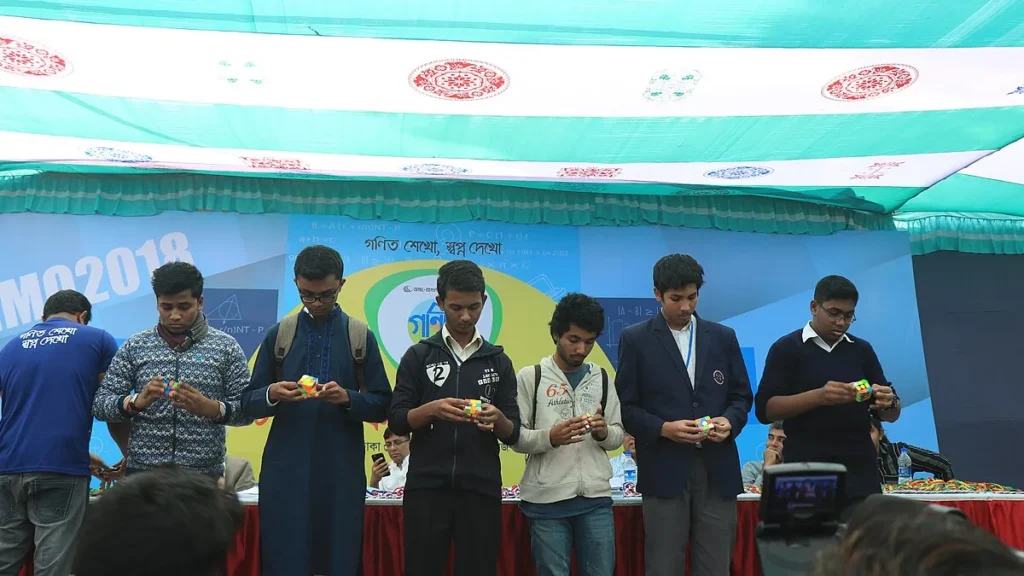
Speed Cube Relay
Each team gets one scrambled cube and a timer. Players take turns making moves, one move per turn, and the team is scored on how close the cube is to solved when the time runs out. You do not need expert cubers: a beginner-friendly scramble with only a few moves undone keeps it fair. Score by the number of finished faces, with a bonus for a full solve. This is the loudest station, so place it near the edge of the hall.
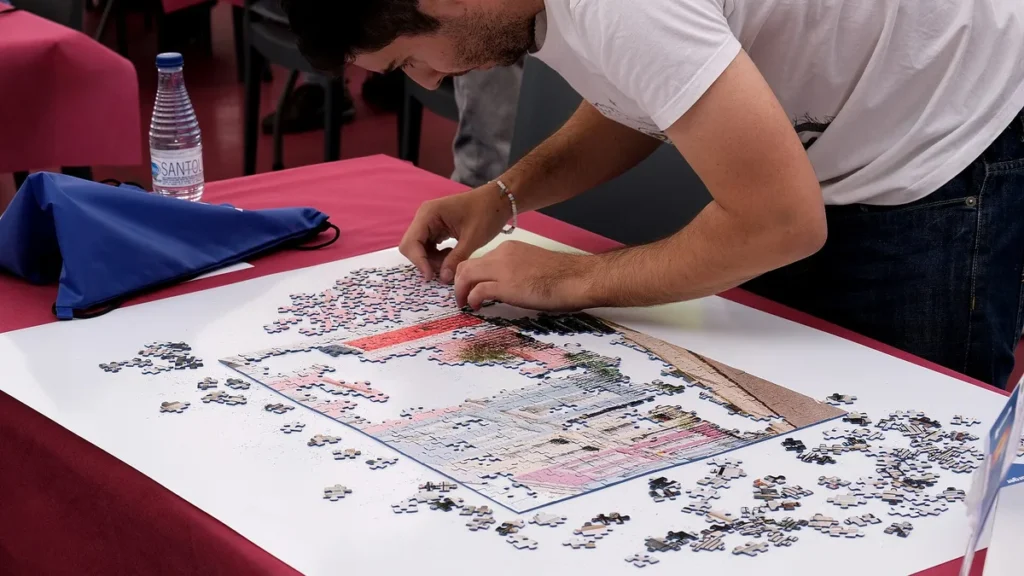
Jigsaw Sprint
Give each team the same 100-piece puzzle in a tray and ten minutes on the clock. Score by the number of pieces placed, not just by finishing, so every team earns points. Use puzzles with a clear picture and chunky pieces, and keep the piece count low enough that a fast team can actually finish. Bag and label each puzzle so the pieces never mix between stations, and count the pieces back into the bag before the next team sits down.
Word Ladder Race
Teams get a start word and a target word and must change one letter at a time, making a real word at every step. The shortest valid ladder wins the most points, and teams can submit more than one ladder if they finish early. This format needs only printed sheets and pens, which makes it the cheapest station to duplicate. If you have already run puzzle games for 390 players with a word station, you will know how popular this one is with mixed-age teams.
Logic Grid Challenge
A classic logic grid, such as matching five people to five colours, five pets, and five hobbies from a set of clues, works beautifully as a team puzzle. Print the grid large enough for the whole team to see, and give them a fresh copy each round so nothing is pre-filled. Score by the number of correct matches, with a bonus for a fully correct grid. This is the quiet station, so place it far from the cube relay.
Murder Mystery Puzzle Trail
Set out a short mystery in five clue envelopes around the station, and let the team work out who did it, where, and with what. Each envelope contains one clue, and teams may open them in any order, but they may only submit one final answer. The format rewards discussion, which makes it a great leveller for teams with mixed ages and abilities. For a longer version, build the mystery around the murder mystery puzzles your group already enjoys, and keep the story to one page so teams can read it in under a minute.
Riddle Relay
Teams answer a set of ten riddles, one at a time, with each correct answer earning the next riddle. The relay structure stops teams from skipping ahead to the easy ones and keeps the station moving at a steady pace. Use riddles of mixed difficulty so every team gets some right, and write the answers on a sealed card the helper can check quickly. This station needs no equipment at all, which makes it the easiest one to set up twice if demand is high.
How the Formats Compare
Use this table to pick your six stations. It shows what each format needs, how it is scored, and which kind of team it suits, so you can build a balanced set instead of accidentally choosing five word games.
| Format | Equipment needed | Scoring (out of 10) | Best for |
|---|---|---|---|
| Speed cube relay | 1 cube and timer per team | Finished faces plus solve bonus | Fast, confident teams |
| Jigsaw sprint | 100-piece puzzle per team | Pieces placed in 10 minutes | Patient, careful teams |
| Word ladder race | Printed sheets and pens | Shortest valid ladder | Word lovers of all ages |
| Logic grid challenge | Printed grids | Correct matches, full-grid bonus | Careful, methodical teams |
| Murder mystery trail | Five clue envelopes | Correct suspect, place, and item | Mixed-age discussion teams |
| Riddle relay | Printed riddles, sealed answers | One point per correct riddle | Quick-thinking teams |