Running puzzle games for 395 players sounds impossible until you stop picturing one giant game and start picturing a system. Nobody expects 395 people to gather around a single table, share one crossword, or wait in one line for a single Rubik’s cube. The number is not the game. The number is the crowd, and a crowd needs stations, teams, rounds, and a clock that keeps everyone moving. Once you build that structure, 395 players becomes a logistics problem with a clear answer, not a puzzle that cannot be solved.
The trick is to frame the event as a range rather than a fixed headcount. A plan that works for three players in a living room will not work for 395 in a hall, but a plan built around teams of five, stations that run in parallel, and short timed rounds works for three players, thirty players, and 395 players with only small changes. You add more tables, more copies of each puzzle, and more rounds. You do not invent a new kind of game. That is the whole idea behind this guide: one flexible system, scaled up step by step.
This article gives you that system in full. You will learn how to split 395 players into teams, how to choose puzzle formats that survive a crowd, how to lay out a room so nobody queues for long, how to run timed rounds and a fair final, and how to staff the event with a small crew instead of an army. Every step is practical and written for a real organiser with a real budget, a real venue, and a real deadline. If you follow the plan, your players will spend their time solving puzzles, not waiting around.
Key takeaways
- Split 395 players into 79 teams of five, then run parallel stations so every team plays at once.
- Use short timed rounds of ten to fifteen minutes, with teams rotating between stations on a bell.
- Pick puzzle formats that need no waiting: speedcubing, jigsaw relays, crosswords, word searches, and logic grids.
- Score with simple points per station, and settle ties with a short head-to-head final on stage.
- One organiser, one scorekeeper, and one helper per six stations is enough crew for the whole hall.

Why 395 Players Changes the Puzzle
Most puzzle games are designed for a small group. A jigsaw puzzle wants four hands, not four hundred. A crossword wants one solver with a pencil, not a crowd shouting answers. A Rubik’s cube wants one pair of hands and a timer. Scale any of those up without changing the format and the game breaks: most people watch, a few people play, and the rest check their phones. The first job of an organiser is to accept that truth and design around it, rather than pretending a big crowd can play a small game.
The 3-to-395 Range: How the Plan Scales
Think of your event as a ladder with four rungs. At the bottom, three to ten players form one or two teams and play every format in turn around a single table. Nobody needs a schedule, a bell, or a scoreboard. The host explains each puzzle, starts a timer, and keeps score on a sheet of paper. This is the simplest version of the plan, and it works because the group is small enough to share everything.
At fifty-one to two hundred players, the event becomes a tournament in miniature. You need ten to fifteen stations, a printed rotation sheet for every team captain, and a scorekeeper who does nothing but collect and add up scores. Teams of five work best at this size, because five people can split a puzzle without tripping over each other. At two hundred and one to 395 players, you run the full system in this guide: 79 teams of five, twenty stations, four rotation blocks, and a final for the top eight teams. Nothing about the games changes. Only the number of copies, tables, and helpers grows. That is the point of the range: learn the system once, then scale it by adding tables.
Choose Puzzle Formats That Survive a Crowd
Not every puzzle survives contact with 395 players. The best formats share four qualities. They start fast, with rules anyone can learn in under a minute. They finish in ten to fifteen minutes, so a rotation stays on schedule. They need little equipment, so you can run many copies at once. And they produce a clear score, so a team knows whether it won the round. If a format fails any of those tests, save it for a small game night and pick something else for the big day.
Speedcubing Stations
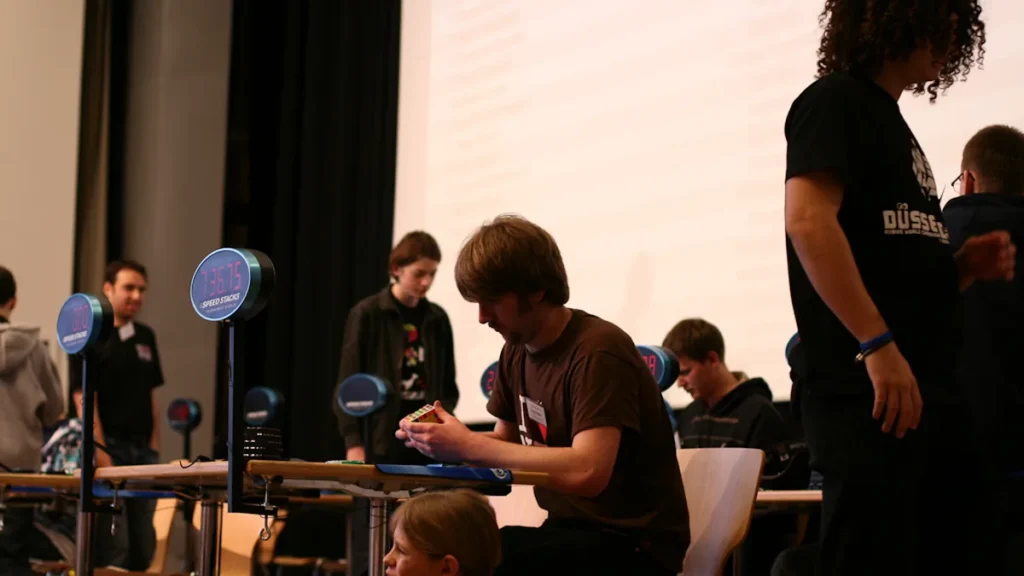
Speedcubing is the natural headline act for a large puzzle event. A cube is cheap, a timer is simple, and the format is already built for competition: solve the cube, stop the clock, record the time. At a station, each team member takes one timed solve, and the team score is the total or the average of the five times. Beginners can take part with a simplified scramble, while experienced cubers chase fast times on the same table. Keep three cubes and two timers at every speedcubing station so a dropped cube never stops the round.
Jigsaw Relays
Jigsaw relays turn a slow solo hobby into a team race. Give each team the same 100-piece puzzle, start the clock, and award points for the number of pieces placed when time runs out, with a bonus for a finished puzzle. One hundred pieces is the right size: a team of five can finish it in ten to fifteen minutes with good teamwork, but a disorganised team will not. Use the same picture for every team so the results are fair, and bag each puzzle separately so pieces never mix. A relay works because every hand is busy at once, and because the picture grows visibly, which keeps spectators interested too.
Crosswords, Word Searches, and Logic Grids
Paper puzzles are the cheapest stations you will ever run. A crossword, a word search, and a logic grid cost almost nothing to print, need no equipment, and can be scored in seconds by counting correct answers. They also suit players who do not want a physical race: the quiet solvers, the word lovers, and the careful thinkers. Print each puzzle in large type, give every team one copy and five pencils, and let the team work together on a single sheet so answers are argued over, not guessed alone. For a fresh angle on paper puzzles at a similar scale, see the plan for puzzle games for 393 players, which uses the same station-and-rotation idea with a different mix of rounds.
Comparing the Best Formats for 395 Players
| Format | Round length | Equipment per station | Players at once | Scoring |
|---|---|---|---|---|
| Speedcubing | 10 minutes | 3 cubes, 2 timers | 5 | Total or average time |
| Jigsaw relay | 15 minutes | 1 puzzle, 1 table | 5 | Pieces placed, bonus for finish |
| Crossword | 15 minutes | Printed sheets, pencils | 5 | Correct answers counted |
| Picture puzzles | 5 minutes | Laminated sheets, markers | 5 | Correct finds counted |
The Step-by-Step Plan
Step 1: Fix the Teams Before Anything Else
Decide the team size first, because every other number follows from it. Teams of five are the sweet spot for 395 players: 79 teams, no leftovers, and five people can share a table without crowding. Invite players to register as teams of five, and build mixed teams from solo sign-ups at the door. Give every team a number and a colour, print the list, and post it at the entrance. When players arrive, they should find their team in under a minute.
Step 2: Book a Hall With Room to Breathe
You need roughly one table per station, plus a stage or raised area for the welcome and the final, plus space for teams to move between stations without blocking each other. Twenty stations at two tables each is forty tables, and each table needs chairs for five players plus a helper’s chair. Walk the hall before you book it and count the tables yourself. A hall that looks big when empty shrinks fast once forty tables, 395 chairs, and a scoreboard go in.
Step 3: Build Twenty Stations in Four Groups
Divide your twenty stations into four groups of five, one group for each puzzle family: cubes, jigsaws, paper puzzles, and picture puzzles. Each group sits in one corner of the hall, so teams rotate inside a group for a few rounds and then move to the next corner. This keeps movement short and prevents 395 people from crossing the hall at the same time. Label every station with a large number and a colour that matches its group.
Step 4: Print Everything Twice
Print the rotation sheets, the puzzles, the scorecards, and the rules twice: once for use and once as a spare. Paper is cheap and a missing puzzle sheet can stop a station for a whole round. Put each station’s materials in a labelled box the night before, and check every box against a list. On the day, a helper can carry a spare box to a station in two minutes, while a missing sheet discovered mid-round costs you ten minutes and a room full of waiting players.
Step 5: Rehearse the Rotation With Your Crew
The day before the event, walk your crew through one full rotation with empty tables. Ring the bell, move to the next station, hand over the scorecard, and start the timer. Time the changeover. If it takes more than three minutes, your stations are too far apart or your instructions are unclear. Fix it now, while the hall is empty. A rehearsal also shows your crew how to score a crossword quickly and what to do when a team argues about an answer.
Step 6: Run Four Blocks, Then a Final
On the day, run four blocks of five rounds, with a ten-minute break between blocks. Each team visits five stations per block, which means every team plays twenty rounds across the day. Use the breaks for the leaderboard: announce the top ten teams and hand out a small prize for the best single round. After the fourth block, the top eight teams go to the stage for a head-to-head final: one cube race, one jigsaw sprint, and one paper puzzle, all in front of the hall. The final should last twenty minutes and end with a trophy, a photograph, and applause.
Running the Day: A Sample Schedule
A schedule is a promise to 395 people, so write it down and keep it. Doors open one hour before the first round, and the welcome starts on time even if a few teams are still arriving. Late teams join the second round, not the first, because holding the whole hall for a handful of people punishes the teams who arrived on time. Announce every changeover with a bell and a clear voice, and put the schedule on a large board where everyone can read it without asking.
Scoring That Feels Fair
Fair scoring is what turns a fun day into a competition players trust. Keep the system simple enough to explain in one minute: every station awards up to ten points, first place on a station gets ten, and every other team gets points based on how close it came. A team that finishes a jigsaw gets ten points. A team that places eighty of one hundred pieces gets eight. A team that solves a crossword with eighteen of twenty answers right gets nine. Nobody needs a calculator, and nobody can argue that the system favours one kind of puzzle over another. Ties are inevitable with 395 players, so decide the tiebreak before the event starts and print it on every scorecard: most station wins, then fastest total time on the timed stations, then a one-minute tiebreak puzzle on stage. Publish the leaderboard after every block, not just at the end, so a team in twentieth place after block one can watch itself climb. A similar approach to fair, simple scoring at a nearby scale is used in the guide to puzzle games for 392 players, where the same ten-point station system keeps a large field honest.
Checklist: Running Puzzle Games for 395 Players
- Teams fixed at 79 teams of five, with numbers, colours, and a printed list at the door.
- Hall booked with forty tables, 395 chairs, a stage area, and reliable power for the projector.
- Twenty stations built in four colour-coded groups, each with a labelled box of materials.
- Every puzzle tested with a team of five and timed at fifteen minutes or less.
- Rotation sheets, scorecards, and rule cards printed twice, with spares in every station box.
- Crew briefed and rehearsed: one organiser, one scorekeeper, helpers, and two at the door.
Frequently Asked Questions
How long does an event for 395 players take?
A full event with four blocks of five rounds takes about seven hours including registration, breaks, and the final. A shorter event with two blocks takes about four hours. The number of players does not change the length much, because the stations run in parallel. What changes the length is the number of rounds you choose to run, so pick the number of blocks that fits your venue booking and your players’ energy.
What if fewer than 395 players turn up?
The plan still works. If 350 players arrive, you have seventy teams and the stations run exactly as planned. If only 300 arrive, you have sixty teams and can close four stations to save helpers. The system is built on teams of five and parallel stations, so any number that divides into teams of five works. Do not panic about empty places; a hall with a little space feels better than a hall packed to the walls.
Do players need to be good at puzzles to enjoy the day?
No. The mix of formats is the answer. A team needs one fast cuber, one careful jigsaw builder, one word lover, and two all-rounders, but no single player needs to be good at everything. Teams win by combining strengths, and the ten-point scoring system rewards a team that is steady across all stations more than a team that is brilliant at one format and weak at the rest. Beginners should be told this in the welcome, so they arrive at their first station confident instead of nervous.
How much does it cost to run puzzle games for 395 players?
The venue is the biggest cost and varies widely by city, so get a quote before you promise a ticket price. Materials cost far less than most organisers expect: cubes and timers are bought once and reused, paper puzzles cost pennies per team, and jigsaws can be bought in bulk. Prizes can be modest. A realistic budget for a first event is a hall, a set of reusable cubes and timers, printed puzzles, and simple trophies, with the ticket price set to cover the hall first and everything else second.
Can children take part alongside adults?
Yes, with mixed-age teams. Children are often the fastest cubers and the most patient jigsaw builders in the hall, and a team with a child in it usually does better than a team of five adults who all think alike. Keep the puzzles family-friendly, keep the rounds short, and seat younger players where a helper can see them. The final should be open to every team, whatever its age mix, because a mixed-age team winning the trophy is the story everyone will tell afterwards.
What happens if a puzzle is missing pieces or a timer breaks?
Use the spare box. Every station has a spare puzzle, spare pencils, and spare scorecards, and the score table holds spare cubes and timers. A helper swaps the broken item in under a minute and the round continues. If a jigsaw is found to be missing pieces before the event, remove that set from play and use a spare set. Never run a station with a known fault and hope nobody notices. Players notice, and a faulty station undermines trust in the whole day. A related note on keeping spare sets ready at a similar scale appears in the plan for puzzle games for 391 players, which uses the same labelled-box system.
Bottom Line
Running puzzle games for 395 players is a planning job with a puzzle at its heart. Split the crowd into 79 teams of five, build twenty stations in four groups, run short timed rounds on a bell, and finish with a final the whole hall can watch. Keep the scoring simple, print everything twice, rehearse the rotation, and staff the hall with a small crew who each know one job well. Do those things and the number stops being frightening. Three hundred and ninety-five players becomes twenty stations, four blocks, and one great day of puzzles.