Finding the best trivia games for 395 players starts with a simple truth: no single table, buzzer, or answer sheet can hold a crowd that big. A game built for six friends around a kitchen table breaks the moment you try to stretch it across a hall full of teams, and a game built for a hall feels empty with only a handful of players. The sweet spot is a format that works for as few as three players and scales cleanly all the way to 395, so the same night can welcome a small group of regulars and a packed room of newcomers without changing the rules halfway through.
That is why the strongest trivia games for 395 players are a system, not a single game: teams of four to six, rounds that test different skills, and scoring that stays fair whether ten teams or sixty are playing. When the structure is right, a crowd of 395 feels like a festival, with every table cheering its own answers and staying for the final round.
This guide covers the formats that work at that scale, the question mix that keeps beginners and veterans happy, and the setup that stops a big night turning into chaos. It includes a format comparison, a setup checklist, a running order, and answers to the questions every large-group host asks first.
Key takeaways
- Trivia games for 395 players work best as a team system, not a single-table game: teams of four to six keep every player involved.
- Scale with teams, stations, and tournaments. The same format should run cleanly for 3 players and for 395.
- Mix five or six round types, including picture, music, and buzzer rounds, so different strengths get a turn to shine.
- Keep questions fair across a mixed crowd by balancing easy, medium, and hard questions in every round.
- Score simply and visibly. One clear scoreboard and a steady host matter more than fancy equipment.
What Trivia Games for 395 Players Actually Look Like
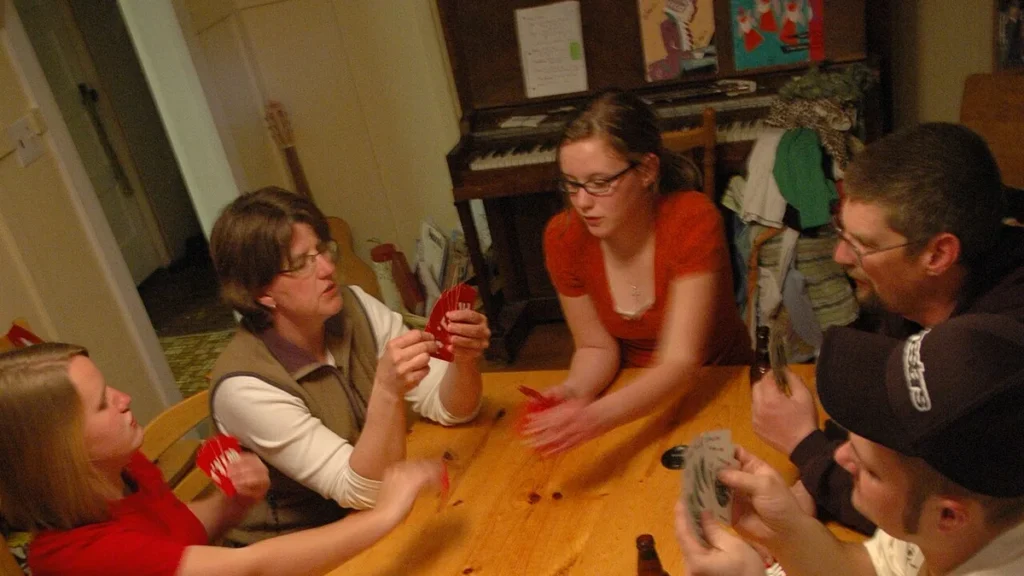
Picture a hall with sixty or more teams, each around a table with an answer sheet, a pen, and a team name they are slightly too proud of. A host stands on a small stage with a microphone and a timer, and a screen shows the round title and the scoreboard. That is the basic picture, and it works because every part of it has been tested by hosts who learned what fails at scale.
The number 395 sounds extreme, but it is simply the top end of a range. The same night might draw 40 players one week and 395 the next, and the format should not need rebuilding each time. Teams absorb the difference: three players form one small team, and 395 players form roughly sixty-five teams of six.
What changes at the top end is logistics, not the game itself. Answer sheets must be collected and marked quickly, or the gaps between rounds stretch and the room loses energy. A second marker solves that, and a proper speaker setup matters too: one small speaker is fine for thirty people and useless for four hundred.
Why Team Play Beats Individual Play at Scale
Individual play sounds fair, but it collapses with a big crowd. Marking 395 separate answer sheets takes forever, shy players stop answering, and one or two strong players dominate every round. Teams fix all three problems at once. Marking drops to sixty or so sheets. Quiet players contribute the one answer only they know. Strong players still shine, but they need their teammates for the rounds outside their comfort zone.
The 3-to-395 Range in Practice
Think of the range as three modes of the same game. With 3 to 12 players, you have one or two teams and the host can chat with everyone. With 13 to 80, you have a proper pub quiz night. With 81 to 395, you have a tournament: the same rounds, with stations, heats, or a buzzer stage for the final.
How to Scale Trivia from 3 Players to 395
Scaling trivia is mostly a matter of dividing the crowd into units you can manage. Teams are the first division. Rounds are the second. Time is the third. Get those three right and the rest is detail. A host who tries to manage 395 individuals will drown; a host who manages sixty teams, six rounds, and a two-hour clock will stay in control all night.
Start by capping team size at six and encouraging teams of four or five. Six is the point where people at the ends of the table stop talking to each other. When players arrive as a group of eight or ten, split them into two teams and let them compete against each other.
For a crowd near the top of the range, add stations or heats. In a station setup, teams rotate between tables running different short rounds. In a heat setup, teams play the same written rounds and only the top teams advance to a buzzer final on stage. The earlier trivia games for 393 players guide uses the same idea: the final should feel like an event, not an admin task.
Teams, Stations, and Tournaments
Teams are the default for any size. Stations suit halls where teams can move without blocking each other, and they are excellent for mixed-age crowds because each station can be tuned to a different strength. Tournaments suit competitive crowds and charity nights, where a clear winner matters and the audience enjoys watching a final.
Keeping the Pace for a Big Room
Pace is the hidden skill of big-room trivia. Read each question twice, then move on. Give teams thirty seconds for a standard question and sixty for a picture or music round. Announce the time clearly and stick to it. The moment a host waits for the slowest table, the fastest tables start checking their phones, and the room never quite comes back.
The Best Trivia Game Formats for Huge Groups
Not every trivia format survives contact with 395 players. The formats below have all been used at large scale, and each one suits a slightly different crowd. The best nights usually combine two or three of them: written rounds for the bulk of the game, plus one live format for the finish.
Team-Based Pub Quiz
The pub quiz is the workhorse. Teams answer written questions in rounds of ten, hand in their sheets, and the host reads the answers while the next round begins. It needs almost no equipment, scales to any number of teams, and lets the host control the difficulty precisely. Its only weakness is energy, so the strongest nights break it up with a live round.
Buzzer Tournament on Stage
A buzzer tournament turns the final into theatre. Two teams stand at a table on stage, hands over buzzers, while the host reads questions and the crowd reacts. It is fast, loud, and exciting to watch, and it works as a tie-breaker when two teams finish level on points.
Station Rotation Rounds
Stations turn a big hall into several small games: a picture round at one table, a music round at another, a quick-fire round at a third. Teams rotate every ten minutes. The format suits family nights and school events, because players who are weak in one area are strong in another.
Picture and Music Rounds
Picture and music rounds are the great equalisers of big trivia. A player who has never read a history book can still name a film from a still, a city from a skyline, or a song from its first three seconds. These rounds also change the texture of the night: the room goes quiet for a music clip in a way it never does for a spoken question.
Speed Rounds and Tie-Breakers
A speed round asks ten quick questions in three minutes, with one point each and no conferring time beyond a whisper. It is a useful tool near the end of the night, when energy dips and the leaderboard needs shaking up. Decide tie-breakers in advance: closest-number questions settle ties fairly and quickly.
| Format | Best crowd size | Equipment needed | Energy level | Best for |
|---|---|---|---|---|
| Team pub quiz | 3 to 395 | Answer sheets, pens, speaker | Steady | Every large night |
| Buzzer tournament | Final of 2 teams | Buzzers, stage, microphone | Very high | Finals and tie-breakers |
| Station rotation | 40 to 395 | Station tables, helpers | High | Family and school nights |
| Picture round | 3 to 395 | Screen or printed sheets | Medium | Mixed-ability crowds |
| Music round | 3 to 395 | Speaker, playlist | High | Breaking up written rounds |
| Speed round | 3 to 395 | Timer, answer sheets | Very high | Late-night energy boost |
Picking Questions for 395 Players
Question choice is where big trivia nights are won or lost. With 395 players, the room holds complete beginners, casual fans, and a few people who take trivia very seriously. A set written for only one of those groups will bore or frustrate the other two, so aim for a set where every team can answer roughly half the questions.
A reliable balance is three easy, five medium, and two hard questions in every round of ten. Easy questions should be answerable by most adults without specialist knowledge. Hard questions should be genuinely hard, but fair: a well-known fact from an unfamiliar angle, not an obscure detail only the writer could know.
Categories That Work for Everyone
General knowledge, food and drink, film and television, music, sport, geography, and science cover most rooms well. Add one themed round per night, such as the decade the audience grew up in, and the night gains a local flavour a generic set never has.
Difficulty, Fairness, and Fun
Fairness is not the same as easiness. A fair hard question is one a knowledgeable team can work out, even if most teams cannot. An unfair question depends on a fact only the writer happened to know. Keep the first kind and cut the second.
Fun is the other half of the equation. The best questions make teams laugh, argue, or groan when the answer is revealed. A question about a famous film quote, a surprising food fact, or a record that sounds impossible will do more for the night than five technically perfect but dull questions. The trivia games for 392 players guide makes the same point: variety keeps a long night feeling short.
Equipment and Setup for a 395-Player Night
Equipment for a big trivia night is simple, but it must all be tested before the doors open. A speaker that crackles, a projector that will not connect, or buzzers with flat batteries will each cost more time than the quiz is worth. Arrive early, test everything from the back of the room, and keep spare pens, sheets, and batteries by the stage.
Scoring is the part hosts underestimate most. With sixty or more teams, hand-marking every sheet between rounds is slow, so use two markers working together and a simple spreadsheet with team names entered in advance. Announce the top five teams after each round.
Your Big-Night Checklist
Use this checklist the day before the event, and again on the night itself. Every item on it has caused a real delay at a real trivia night, and each one takes only a few minutes to fix in advance.
- Questions ready and tested: six rounds of ten, balanced easy, medium, and hard, every answer checked twice.
- Answer sheets printed: one sheet per team per round, plus spares, with the team name space at the top.
- Sound and screen tested: microphone, speakers, and projector checked from the furthest seat in the room.
- Buzzers and timer working: batteries fresh, buzzers tested, and a visible timer the host can trust.
- Markers and scoreboard ready: two markers briefed, a spreadsheet or board set up, and a tie-breaker question prepared.
- Prizes and closing planned: prizes for the winners, a small prize for the best team name, and a clear ending time.
Running the Night: A Minute-by-Minute Plan
A two-hour night usually runs like this. Doors open thirty minutes before the start, teams form and find tables, and answer sheets for round one are already waiting. The host welcomes everyone, explains the rules in under two minutes, and reads the first question within five minutes of the advertised start.
Rounds one and two run back to back, about twenty minutes each including marking. The host reads ten questions, teams hand in their sheets, and the answers are read while the next round begins. Round three is a picture or music round, which changes the pace and gives the markers time to catch up. A short break follows, with the leaderboard announced. After the break, the final rounds run the same way, ending with a buzzer final between the top two teams and prizes within ten minutes of the last question.
Hosts who want a fuller walkthrough of the setup side should read the guide on how to run a pub quiz, which covers the room layout, the host script, and the scoring routine in detail. The principles are the same at any size; only the number of sheets changes.
Common Mistakes That Sink Big Trivia Nights
The most common mistake is writing questions for the host’s friends rather than for the room. A set full of in-jokes, niche hobbies, and questions only the writer can answer will empty a hall faster than bad sound. Write for the strangers in the room, not for the people you already know.
Finally, do not let the ending drag. Decide the tie-breaker in advance, announce the winners, hand out the prizes, and let people go home happy while they are still happy.
Frequently Asked Questions
Can trivia games for 395 players work with only three players?
Yes. The same formats work at the bottom of the range, because a team of three plays the same rounds as a team of six. With three players, use written rounds and a picture round, skip the buzzer final, and let the host keep the pace relaxed. The 3-to-395 range is a design promise: one format, any headcount.
How many teams should 395 players form?
With teams of five, 395 players form 79 teams. With teams of six, they form about 66 teams. Aim for teams of four to six and let the exact number fall where it falls. Capping team size matters more than hitting a round number of teams, because oversized teams leave players out of the discussion.
How long should a trivia night for 395 players last?
Plan for about two hours of play, plus thirty minutes for arrival and settling in. Six rounds of ten questions, a picture or music round, a short break, and a buzzer final fit comfortably inside that window. Nights longer than two and a half hours lose players to tiredness, whatever the format.
Do we need buzzers for a big trivia night?
No. Buzzers are a bonus, not a requirement. Written rounds carry the whole night, and a buzzer final is only one way to end it. If you do use buzzers, hire or borrow a proper set and test it before the event. A raised hand and a fair host settle a tie just as well for a small final.
What prizes work best for a large trivia crowd?
Keep prizes simple and shared: a trophy or a hamper for the winning team, a small prize for the best team name, and a fun prize for the team that finishes last but played every round. Prizes the whole team can share work better than one expensive prize that only one player takes home.
How do we stop cheating in a room of 395 players?
Make cheating pointless rather than policing it. Phones face down during rounds, answers are collected before the answers are read, and the questions are written so that a quick search does not help much. A friendly reminder at the start, plus a host who walks the room between rounds, is enough for almost every crowd.
Bottom Line
The best trivia games for 395 players are not the most complicated ones. They are the ones built on teams, balanced questions, a steady host, and a pace that never lets the room cool down. Start with a written team quiz, add a picture or music round, and finish with a buzzer final that gives the night a proper ending.
Get the logistics right, keep the questions fair, and let the teams do the rest. A room of 395 players, sixty-odd teams, and one good host is not a crowd to manage. It is the best kind of trivia night there is.