The best puzzle games for 96 players start with an honest fact: no single puzzle game seats 96 people at one table, and no puzzle box is designed for 96 players in a single round. That does not make a 96-player puzzle night impossible. It means the format has to change. Instead, a 96-player event works as many tables playing at the same time, tied together by teams, rotations, and a shared scoreboard.
The best puzzle games for 96 players are therefore the games that scale well across tables, use rules new players can learn in a few minutes, and finish each round in a predictable amount of time. Team jigsaw races, Rubik’s Cube relays, escape-room-in-a-box tournaments, and logic puzzle stations all work well when several copies run at once, because each table plays the same puzzle and the results are compared or added together.
This guide explains exactly how to run a puzzle night for 96 players, which games to choose, how many tables and puzzle sets you need, and how to keep the whole room connected. Divide the group into teams, pick puzzles with short rounds and clear scoring, and use a tournament, relay, station, or whole-room format so that all 96 players feel part of one shared game.
Key takeaways
- No single puzzle game seats 96 players, so run the night as teams at multiple tables, in relay or tournament formats, or as one whole-room game.
- Choose puzzles with simple rules, short rounds, and clear scoring so every table finishes at roughly the same time.
- Divide 96 players into 12 teams of 8 or 16 teams of 6, and give every team the same puzzle so results can be compared fairly.
- Buy or borrow enough identical puzzle sets for every table, plus spares, and test every puzzle before the event starts.
- Use a visible scoreboard and a host who calls out progress, because a shared score is what turns many separate tables into one event.

How Puzzle Games Work for 96 Players
A puzzle night for 96 players is a logistics puzzle before it is a games night. Ninety-six people cannot gather around one jigsaw, and a single escape room box cannot hold them all. The event works when the organiser stops thinking about one game and starts thinking about one system: identical puzzles, teams, a timetable, and a scoreboard that connects them.
The simplest system is the parallel table format. Set up 12 tables with 8 players each, or 16 tables with 6 players each, and give every table the same puzzle. Each table works as one team, and the team that finishes first, or scores highest, wins the round. Because every table has the same puzzle, the results are directly comparable.
The second system is the relay format. Each team lines up and sends one player at a time to the puzzle table, where that player makes a fixed number of moves or places a fixed number of pieces before tagging the next player. Rubik’s Cube relays and pattern-matching relays work well here, because the relay keeps every player involved in short bursts and builds excitement as the queue moves.
The third system is the station format. Set up six to eight puzzle stations around the room, each with a different puzzle, and rotate the teams every ten or fifteen minutes. Each station has its own score, and the team with the highest total at the end wins. Stations suit mixed groups well, because a team that is weak at jigsaws may be strong at word puzzles or logic grids,
The fourth system is the whole-room format. Every player works on the same puzzle at the same time, usually through a big screen, a printed puzzle sheet, or a trail of clues hidden around the venue. A giant crossword, a room-wide puzzle hunt, or a projected logic puzzle can involve all 96 players at once, and the shared experience makes the night feel like one event rather than twelve separate games.
The Best Puzzle Games for 96 Players
Each game below works for 96 players in at least one of the four formats above. The notes explain the format, the equipment, and the scoring, so you can pick the games that fit your room, your budget, and your group.
1. Giant Jigsaw Puzzle Race
The jigsaw race is the classic large-group puzzle game, and it is the easiest to run for 96 players. Divide the group into 12 teams of 8, give every team an identical 500-piece jigsaw, and start the clock. The first team to complete its puzzle wins, and the rest are ranked by pieces placed when time ends. Use the same picture and piece count for every team so the race is fair, and choose images with clear colour blocks, because large areas of plain sky slow every team down.
2. Rubik’s Cube Relay
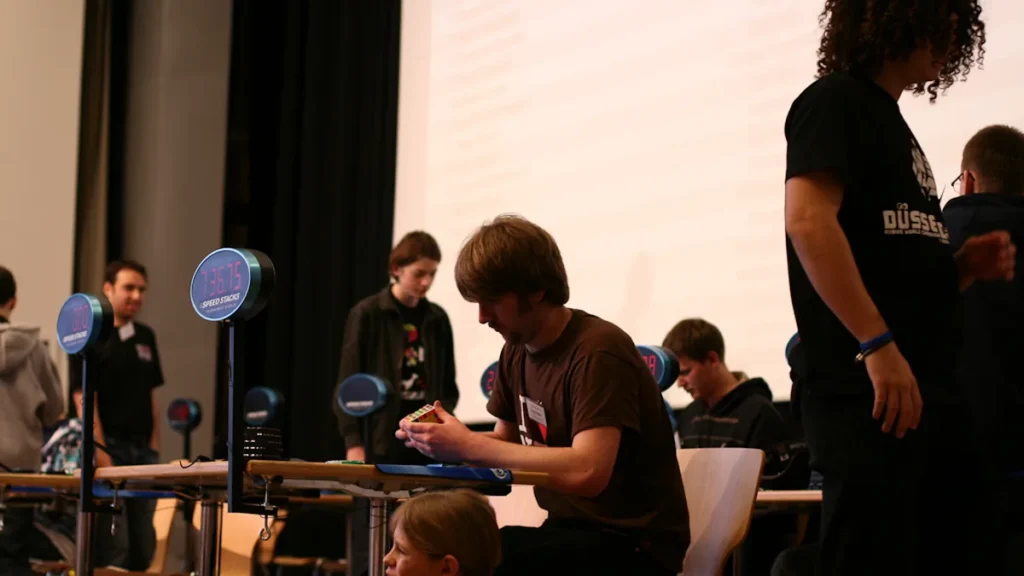
The Rubik’s Cube relay turns a solo puzzle into a team sport. Each team lines up beside a table with one scrambled cube, and players take turns making a set number of moves, usually five, before tagging the next player. The team that solves its cube first wins. Because nobody must solve a cube alone, beginners can join without fear, and experienced cubers become coaches rather than solo stars. Scramble every cube with the same sequence of moves so all teams face the same puzzle, and test each cube before the night, because a stiff cube frustrates a whole team.
3. Escape-Room-in-a-Box Tournament
Escape-room-in-a-box games pack a full escape room into a box of puzzles, locks, and clues, and they scale well to 96 players when several copies run at the same time. Give each team the same box, start the clock, and rank teams by escape time or by puzzles solved when time ends. Most boxed escape games suit four to six players and take about an hour, so teams of six work best, which means 16 teams and 16 boxes for a full room. Boxes are the most expensive option here, so borrow sets from friends or local game groups, or run the tournament in heats with the fastest teams advancing to a final.
4. Logic Puzzle Stations
Logic puzzle stations use printed puzzles such as Sudoku, nonograms, logic grids, and Kakuro, and they suit the station format perfectly. Set up six stations, each with a different puzzle type, and rotate the teams every fifteen minutes. Each station awards points for correct answers, with bonus points for finishing early, and the team with the highest total wins. Printed puzzles are cheap, easy to replace, and simple to score, which makes this the most practical choice on a tight budget. Offer three difficulty levels at each station, easy, medium, and hard, with harder puzzles worth more points, so strong teams stay challenged and weaker teams stay engaged.
5. Tangram and Pattern-Building Challenge
Tangram sets are seven flat shapes that players arrange into pictures, and they make a fast, visual team game for 96 players. Give each team a tangram set and a series of silhouette cards, and award points for each silhouette completed before time runs out. Silhouettes range from simple animals to complex buildings, so teams can choose easy cards for safe points or hard cards for bigger rewards, and that choice becomes part of the strategy. Tangram sets are cheap, durable, and easy to store, so buying 12 or 16 sets is realistic. Use sets with pieces in a single colour, because coloured pieces make silhouettes too easy to solve by colour matching.
6. Whole-Room Puzzle Hunt
A puzzle hunt sends teams around the venue following a trail of clues, and it is the best way to use a large space for 96 players. Hide clue stations around the building, each with a small puzzle, and give every team a clue sheet leading them from station to station. Solving a puzzle reveals the next location, and the first team to reach the final station wins. A hunt uses the whole venue, gets people moving, and creates the sense of adventure table games cannot match. Plan the route so teams spread out rather than bunching at the first station, stagger start times by two minutes, and keep each puzzle solvable in about three minutes, because long puzzles turn a hunt into a queue.
7. Giant Crossword Race
The giant crossword race projects a large crossword grid onto a screen or prints it on a wall chart, and teams race to fill in the answers. The host reads clues one at a time, and teams write answers on a shared sheet or send a runner to write an answer on the big grid. Points go to the first team with the correct answer, with bonus points for completing a full row or column. The format suits a whole-room round because every team hears the same clues at the same time. Build the crossword around a theme your group knows well, such as travel, food, films, or the hosting organisation, and mix easy clues with harder ones so every team scores something.
8. Collaborative Mural Puzzle
The collaborative mural puzzle gives every team a section of one large picture, and the sections join together at the end to reveal the full image. Print a large picture, cut it into 12 or 16 sections, and give each team one section as a jigsaw or colouring challenge. When every team finishes, the sections are assembled on a wall or a big table, and the whole room sees the picture complete. The mural is the most visual game on this list, and the reveal gives the night a natural finale. Choose a picture with strong colours and clear sections, and make each section roughly the same difficulty, because a team with a plain section will finish long before a team with a detailed one.
Formats That Make 96 Players Work
Choosing the right game matters less than choosing the right format. A good game in the wrong format will fail, while an average game in the right format will succeed. Use the parallel table format when you have enough identical puzzle sets and a room full of tables. It is the simplest to explain, the easiest to score, and the fairest, because every team faces the same puzzle.
Use the relay format when equipment is limited or when you want short, high-energy rounds. Relays need only one puzzle set per team and keep most players watching and cheering, which builds atmosphere. Their weakness is waiting time, since only one player per team is active at any moment, so keep each turn short and give waiting players a job, such as planning the next move or tracking the score. A group that enjoys card games will recognise the same team energy in the best card games for 96 players, which use the same relay and tournament ideas with decks instead of puzzles.
Use the station format when the group has mixed ages or mixed abilities, or when you want variety. Stations let every team try several puzzle types, and the rotation keeps the evening moving. Their weakness is staffing, since each station needs a host, and their weakness is timing, since a slow team can hold up the rotation.
Use the whole-room format for the opening and closing rounds, when you want all 96 players doing the same thing at the same time. Whole-room games need the least equipment and create the strongest shared feeling, but they cannot fill a whole evening alone, because the group will tire of listening to one host.
What You Need: Equipment and Setup for 96 Players
Plan the equipment before you plan the games. Count the teams first, then multiply the puzzle sets, and add spares. For 12 teams of 8, you need 12 identical jigsaw puzzles, 12 tangram sets, or 12 copies of an escape box, plus at least two spares of each. For 16 teams of 6, you need 16 of each.
Tables and chairs matter as much as puzzles. Each team needs a table large enough to spread out a puzzle, with chairs for every player, and enough space between tables for the host and volunteers to walk around. A hall with 12 to 16 tables, good lighting, and a sound system for the host is ideal. Put the scoreboard where everyone can see it, on a whiteboard or a projected screen, and update it after every round. When the evening also includes lighter party rounds, the best party games for 95 players show how the same table and rotation setup carries over to non-puzzle games.
Comparison Table: Best Puzzle Games for 96 Players
| Game | Best Format | Players Per Team | Round Length | Equipment Cost | Best For |
|---|---|---|---|---|---|
| Giant Jigsaw Puzzle Race | Parallel tables | 8 | 60–120 minutes | Medium | Teamwork and patience |
| Rubik’s Cube Relay | Relay | 6–8 | 10 minutes | Low | Quick energy bursts |
| Escape-Room-in-a-Box Tournament | Parallel tables | 6 | 60 minutes | High | Main event, story and teamwork |
| Logic Puzzle Stations | Stations | 6–8 | 15 minutes per station | Low | Mixed abilities, low budget |
| Tangram and Pattern-Building Challenge | Parallel tables | 6–8 | 20 minutes | Low | All ages, visual thinking |
| Whole-Room Puzzle Hunt | Whole room | 6–8 | 45–60 minutes | Low | Adventure, using the whole venue |
| Giant Crossword Race | Whole room | 6–8 | 30 minutes | Low | Opening or closing round |
| Collaborative Mural Puzzle | Parallel tables | 6–8 | 45 minutes | Low | Finale, celebrations, keepsake |
Checklist: Running a 96-Player Puzzle Night
- Divide 96 players into 12 teams of 8 or 16 teams of 6, and give every team a name, a table, and a printed timetable.
- Buy, borrow, or print enough identical puzzle sets for every table, plus at least two spares of each game.
- Test every puzzle, cube, box, and printed sheet before the event, and keep the answer keys with the host.
- Set up a visible scoreboard, test the sound system, and brief the station hosts and volunteers before players arrive.
- Run an opening whole-room game, then table games and stations, and close with a mural reveal or final quiz.
- Update the scoreboard after every round, announce the leaders, and award a small prize to the winning team.
Frequently Asked Questions
Can one puzzle game really hold 96 players?
No single puzzle game seats 96 people at one table, and no honest guide should claim otherwise. A 96-player puzzle night works by splitting the group into teams at multiple tables, by running relays and stations, or by playing a whole-room game such as a puzzle hunt or a giant crossword.
How many teams should 96 players form?
Twelve teams of 8 or 16 teams of 6 both work well. Teams of 8 suit jigsaw races and table games, where many hands help. Teams of 6 suit escape boxes and relay games, where smaller groups keep everyone involved. Avoid teams larger than 8, because players at the edges of a big team will have nothing to do.
How much does a 96-player puzzle night cost?
A printed-puzzle night with logic stations, a crossword, and a puzzle hunt can cost very little beyond printing and a few tangram sets. A night built on jigsaw races and escape boxes costs more, because you need one set per table.
How long should the evening last?
Three hours suits most groups: a short welcome and opening game, two longer table rounds, a station rotation, and a closing reveal with prizes.
What if some players have never played these puzzles?
Choose games with rules that take less than five minutes to explain, and print a short how-to sheet for each table. Word-based rounds are a good leveller for mixed groups, and the best word games for 95 players use the same large-group formats with vocabulary puzzles instead of jigsaws.
Do I need a professional host?
A confident volunteer host works well, provided they prepare the timetable, test the sound system, and practise the opening explanation. The host’s real job is keeping time, updating the scoreboard, and keeping the energy up between rounds, rather than knowing every puzzle answer.
Bottom Line
The best puzzle games for 96 players are the ones that turn a crowd into teams and teams into one event. Pick a mix of table games, relays, stations, and one whole-room game, give every team the same puzzle, keep the rounds short and the scoring visible, and let the shared scoreboard do the work of holding the room together.