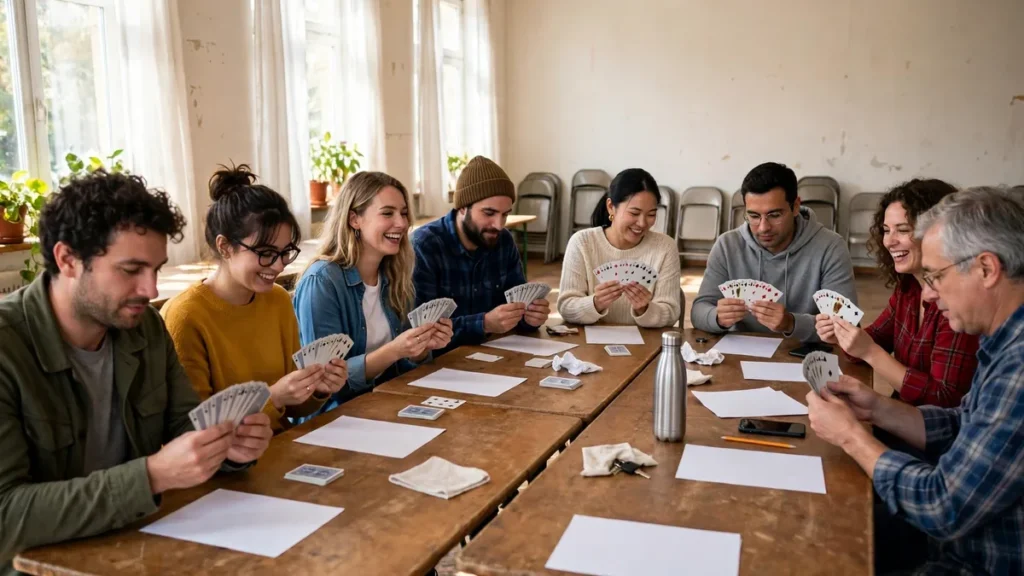
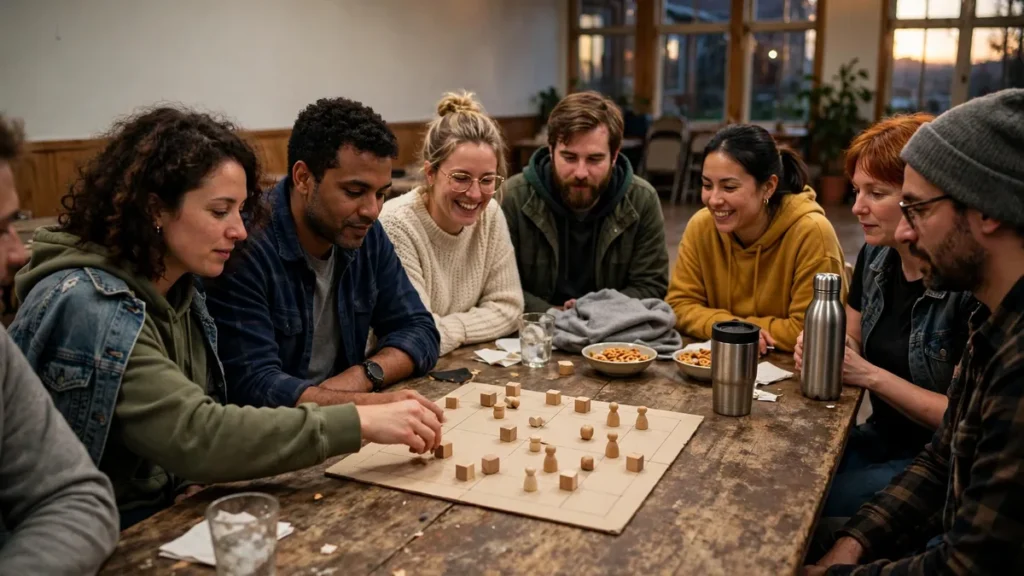
Five hundred and forty-five people in one hall, all playing with words at the same time, sounds like a recipe for noise. It works, though, when the games are built for a crowd and every team has something to do in every round. This evening uses verse as its raw material: the sound of words, the shape of lines, and the way a short saying can land with a laugh. Nine games carry the night, each one simple enough to explain in a minute and lively enough to hold a hall full of people.
The format is honest about the numbers. One hundred and nine teams of five make five hundred and forty-five players, and the evening is planned around that exact count. Nine rounds follow in order, each one built on a different verse idea, and every team plays every round at the same time. Nobody waits on the side, and nobody needs to know a single poem in advance to take part. The lido games in our word games for 543 players use the same idea in a different setting, with teams moving through rounds together rather than sitting out.
What follows is the full plan: how the hall is arranged, the nine games in order, how points are counted, and a few jobs that keep the night moving. Read it once, copy the sheets, and the evening largely looks after itself. The games reward listening, quick thinking, and a willingness to try a line aloud, and the best moments usually come from the teams who laugh at their own answers.
Key takeaways
- 545 players means 109 teams of five, all playing at once.
- Nine verse games, each one explained in under a minute.
- Every round is worth ten points, so the highest score is ninety.
- No team needs poetry knowledge in advance; listening and quick thinking carry the night.
- One host, one scorer, and two sheet collectors keep 109 teams moving.
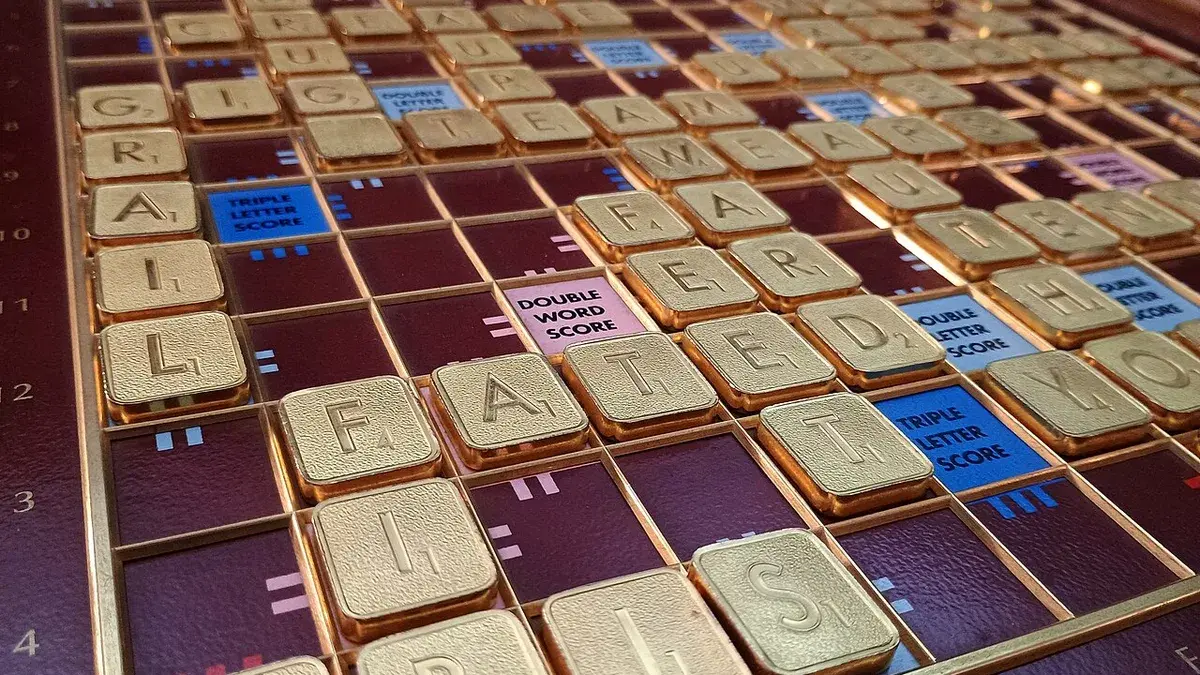
How 545 Players Fit Into One Evening
The hall holds 109 tables, one per team, with five chairs at each. A long table at the front holds the host, the scorer, and the extra sheets, and a clear walkway down the middle lets the host reach every part of the room. Teams sit with their backs to the next table, so nobody can read another team’s sheet by accident. The host reads each round aloud, the teams write, and the sheets are collected before the next round begins.
Timing is fixed in advance and written on the wall sheet, so teams always know what comes next. Each round lasts ten minutes of play, with two minutes to move sheets and settle before the next round. Nine rounds take one hundred and eight minutes, and with a short welcome and a short closing the whole evening fits inside two and a half hours. The host keeps the pace with a raised hand and a clear voice, and the scorer updates the score on the front sheet after every round.
| Round | Game | What teams do | Minutes | Points |
|---|---|---|---|---|
| 1 | Heteronym Hunt | Find two meanings for one word | 10 | 10 |
| 2 | Holonym Match | Name the whole from its part | 10 | 10 |
| 3 | Enjambment Run | Complete a line that flows on | 10 | 10 |
| 4 | Caesura Pause | Place the pause in the middle of a line | 10 | 10 |
| 5 | Anapaest Act | Write a line in da-da-DUM | 10 | 10 |
| 6 | Trochee Trot | Write a line in DUM-da | 10 | 10 |
| 7 | Epigram Essence | Shrink a thought to one line | 10 | 10 |
| 8 | Maxim Match | Complete a well-known saying | 10 | 10 |
| 9 | Bathos Build | Move from grand to ordinary | 10 | 10 |
The Nine Verse Games
Each game below gives the host a short plan: what to say, what the teams do, and how the points are given. Read the plan aloud, let the teams write, and collect the sheets. The example words make the idea clear, and hosts are welcome to use fresh examples of their own.
1. Heteronym Hunt
One word, two sounds, two meanings. The host reads out a word that is spelled one way and spoken two ways, and each team writes down both meanings. TEAR can mean a drop from the eye or a rip in cloth. CLOSE can mean near or to shut a door. OBJECT can mean a thing or to protest. RECORD can mean a document or to capture sound. PRESENT can mean a gift or to give something. REFUSE can mean rubbish or to decline. ROW can mean a line of seats or a noisy argument. WOUND can mean an injury or a coiled spring. SEWER can mean a drain or one who sews. Each team gains a point for each correct meaning, up to ten points for five words done well. The host reads one word at a time and gives teams thirty seconds to write both meanings before moving on.
2. Holonym Match
A part points to a whole. The host names a part, and each team writes down the whole it belongs to. A petal belongs to a plant. A page belongs to a book. A branch belongs to an oak. A sleeve belongs to a shirt. A chapter belongs to a long tale. A wheel belongs to a car. A room belongs to a house. A handle belongs to a door. A finger belongs to a hand. A toe belongs to a foot. Teams gain a point for each correct whole, and the host reads the answers aloud at the end so every team can see how the parts come together.
3. Enjambment Run
Some lines end with a full stop. Others keep going, and the sense carries over the line ending into the next line. That carry-over is enjambment, and this game asks teams to complete a half-written line so that it flows into the next one. The host reads the opening half of a line aloud, and each team writes a closing half that keeps the sense moving. A good ending keeps the thought whole across the break and lands on a word that feels right for the line. The host gives an opening half such as “The hall was full, the lamps were lit, and every team…” and teams complete it. One team might write “…leaned in to hear the opening word.” Another might write “…held its breath for the host to begin.” The host reads the best endings aloud, and teams gain a point for each ending that flows cleanly into the next line.
4. Caesura Pause
Every line has a natural resting place in the middle, a small silence where a reader can breathe. That resting place is a caesura, and this game asks teams to find it. The host reads a line aloud with no break at all, and each team writes the line again with a slash where the pause belongs. “The crowd went quiet then laughed again” needs its pause after “quiet”. “We came for the words and stayed for the laughter” needs its pause after “words”. “Five hundred voices rose as one and fell quiet together” needs its pause after “one”. Teams gain a point for each pause in the right place, and the host reads the lines aloud with the pauses in, so the room can hear how much a small silence changes a line.
5. Anapaest Act
An anapaest is a beat of three: two short beats and one long one, da-da-DUM. The host reads a line in that beat, and each team writes a new line that follows it. “In the night” follows it. “On the hill” follows it. “With a grin” follows it. “By the sea” follows it. “In the dark” follows it. Teams gain a point for each line that keeps the beat from the opening word to the closing word, and the host reads the strongest lines aloud so the room can hear the beat clearly. Lines that lose the beat gain nothing, so teams read their lines aloud to each other before handing the sheet in.
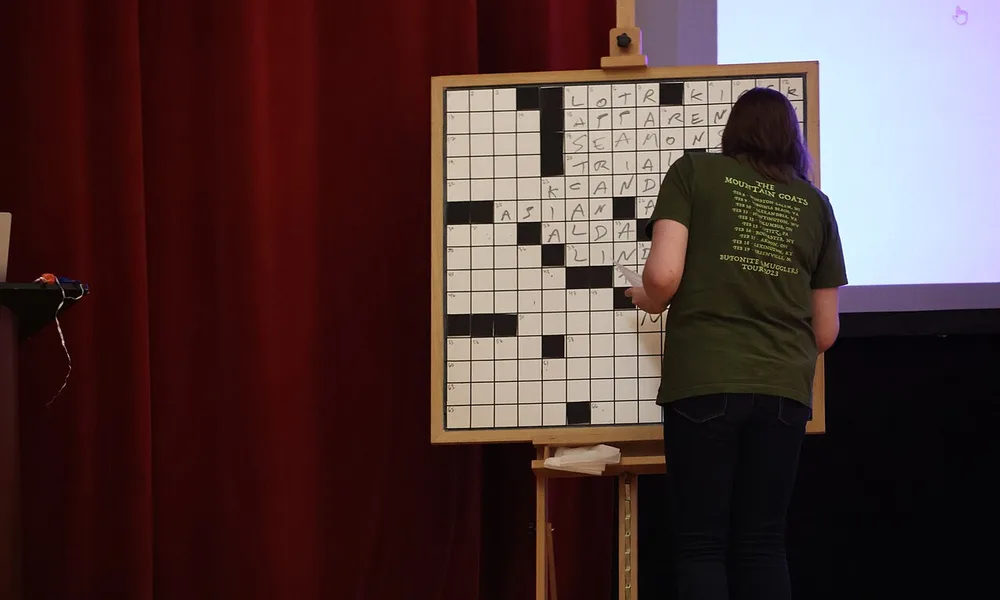
6. Trochee Trot
A trochee is a beat of two: one long beat and one short one, DUM-da. The host reads a line in that beat, and each team writes a new line that follows it. HAPPY follows it. CLEVER follows it. GENTLE follows it. PURPLE follows it. SILVER follows it. CRIMSON follows it. VELVET follows it. TENDER follows it. MELLOW follows it. Each team writes a full line using words in that beat, and the host reads the lines aloud to hear which ones hold the beat from start to end. Teams gain a point for each line that holds the beat, and a team that writes three good lines in the round gains six points.
7. Epigram Essence
An epigram is a short saying with a sharp edge, a whole thought pressed into one line. The host gives each team a plain thought, and the teams must shrink it into a single line that keeps the meaning and adds a little wit. “A room of five hundred voices, one shared love of words” is an epigram. “The host reads, the hall listens, the words do the work” is an epigram. “Nine rounds, one evening, and no team left behind” is an epigram. Teams gain two points for a line that is short, clear, and true to the thought, and the host reads the best lines aloud at the end of the round.
8. Maxim Match
A maxim is a saying that has survived because it is true. The host reads the opening half of a well-known saying, and each team writes the ending. “Honesty is the best…” ends with “policy”. “Better late than…” ends with “never”. “Actions speak louder than…” ends with “words”. “Look before you…” ends with “leap”. “A friend in need is a friend…” ends with “indeed”. “Two heads are better than…” ends with “one”. “The pen is mightier than the…” ends with “sword”. “Knowledge is…” ends with “power”. Teams gain a point for each correct ending, and the host reads the full sayings aloud so the room can hear how the old words still land.
9. Bathos Build
Bathos is a deliberate drop from grand to ordinary, and the laugh comes from the size of the fall. The host gives each team a grand opening, and the teams must end it with something small and everyday. “We sailed far, sang loud, and then queued for tea” is bathos. “He faced giants, solved riddles, and then lost his pen” is bathos. “She wore silk, spoke Latin, and then asked for directions” is bathos. Teams gain two points for an ending that drops the tone without breaking the sense, and the host reads the best endings aloud to close the round with a laugh.
How Scoring Works
Each round is worth ten points, and the points come from the work the teams do, not from quickness alone. A team that writes five good answers in Heteronym Hunt gains ten points, and a team that writes three good answers gains six. The same scale runs through every game: each good answer is worth two points, and a round with five answers is worth ten. The scorer adds the round points to a standing total for each team, and the sheet at the front names the leading ten teams after every round. The physic-garden games in our word games for 541 players use the same honest scale, with points for good answers rather than for being quickest.
Ties are settled by a single extra line. If two teams end level on points, the host reads one fresh line and both teams write an ending for it, and the better ending takes the higher place. If three or more teams end level, the same extra line is used for all of them, and the host reads the endings aloud before choosing. Nobody loses a place by chance, and every tie is settled by words.
Running the Room on the Night
The host is the evening. A clear voice, a steady pace, and a smile that reaches the back rows will carry 109 teams through nine rounds without a single team losing the way. The host reads every instruction twice, waits for the room to settle, and only then starts the time. Between rounds the host reads two or three good answers aloud, names the teams who wrote them, and keeps the mood light. The coastal games in our word games for 539 players work on the same host-led idea, with the host holding the room together while the teams do the thinking.
Two sheet collectors walk the room between rounds, one down each side, taking in sheets and handing out fresh ones. The scorer sits at the front table with a pencil and a clear head, adding points as the sheets come in. If a sheet is hard to read, the scorer asks the host to read the answer aloud and agree the points with the team. Nothing is hurried, and nothing is decided in a corner.
Before the evening begins, work through these six jobs.
- Have 109 answer sheets ready before the evening begins, one per team.
- Give every team a pen, a pencil, and a firm place to write.
- Keep the host microphone on a long cable so the host can walk the room.
- Keep the time on a plain sheet at the front of the hall.
- Ask two friends to take in sheets and add up scores while the host reads the next round.
- End with the leading team reading its best line aloud.
Frequently Asked Questions
Do teams need to know poetry to play?
No. Every game is explained in under a minute, and the examples make the idea clear. Teams who have never read a poem do just as well as teams who read one every week, because the games reward listening and quick thinking, not prior knowledge.
How long does the evening take?
About two and a half hours from the welcome to the closing line. Nine rounds take one hundred and eight minutes, and the welcome, the tie-breaker, and the closing take the rest. Teams are free to leave between rounds if they need air, and the host keeps the time on the front sheet.
What if a team has only four players?
Play with four. The games work with four or five to a team, and a team of four simply writes one fewer answer in the rounds that ask for five. The host treats the team as a full team, and its points are worth the same as any other team.
Can children join in?
Yes, with an adult on the team. Children are often the quickest at Heteronym Hunt and Trochee Trot, because they hear the sounds before the meanings. Keep one adult per team with children in it, and keep the rounds friendly.
What do we need to buy?
Answer sheets, pens, and pencils. Everything else is already in the hall: tables, chairs, and a voice that can reach the back rows. A printed copy of the nine game plans helps the host, and a plain sheet at the front holds the time and the leading teams.
How do we keep answers honest?
Teams write on paper, sheets are taken in after every round, and the host reads good answers aloud with the team name attached. Phones stay in pockets during rounds, and any team caught looking up answers loses the round. The rule is read aloud at the start, so nobody can say they did not hear it.
The Bottom Line
Word games for 545 players work when the games are simple, the rounds are short, and every team plays every round. Nine verse games, 109 teams of five, ten points a round, and one host holding the room together: that is the whole evening. Copy the sheets, read the plans aloud, and let the words do the rest.