These word games for 539 players make a cliff-top path above the sea into a playing field for a whole morning. Fifty-nine teams of nine walk out along the path, each with an answer sheet and a steward, and the caller keeps the whole group moving from one contest to the next. Every contest below works for a large group, needs no special kit, and gives every team a fair chance to earn points.
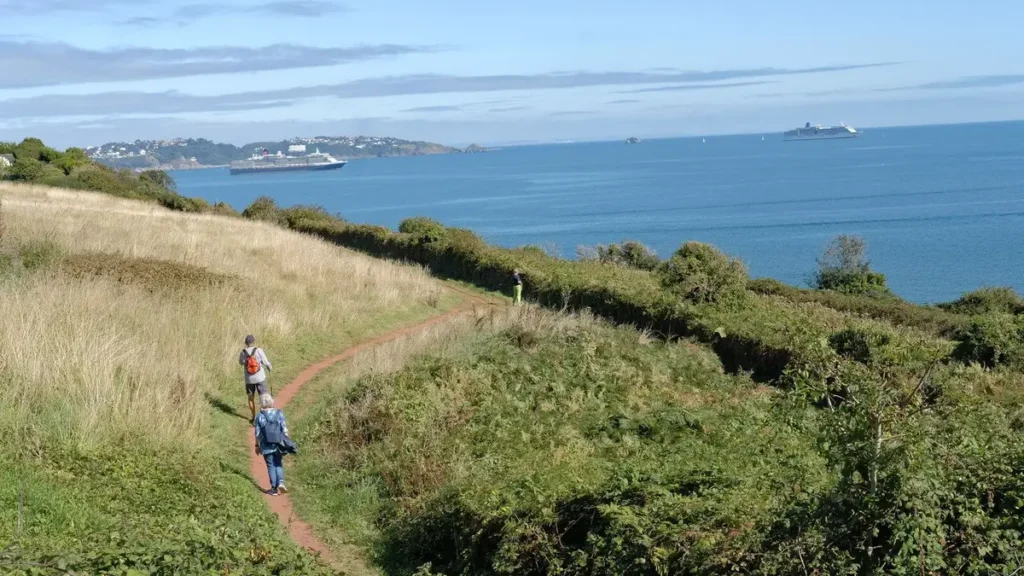
The path gives the day its shape. Teams walk from one waymarker to the next, and each waymarker holds a new contest. The cliff runs along one side and the sea along the other, so every team remains in sight of the group, and the stewards can see every team at a glance. The contests below use the path, the gorse and bracken beside it, and the words teams already know — nothing else is needed.
Nine contests fill the morning, and each one takes ten to fifteen minutes. Teams earn two or three points for a good answer, and the caller works out the points at the end of each contest. The top team at the end of the morning is the one with the most points — and every team plays at every waymarker, so no one is left out.
Key takeaways
- Fifty-nine teams of nine, plus one caller and seven stewards, make 539 players on one cliff-top path.
- Nine contests, each ten to fifteen minutes, use only words, an answer sheet, and the path itself.
- Every contest gives two or three points for a good answer, and the caller works out the points after each one.
- No team needs to bring anything except a pen — the stewards carry the answer sheets and the words for each contest.
- The contests work in any order, so teams can start at any waymarker and still play every one.

The nine games at a glance
| Game | What teams do | Minutes |
|---|---|---|
| Stile Word Stride | Give a word that sits between two given words from A to Z | 10 |
| Waymarker Word Peer | Give a word whose letters run from A to Z | 10 |
| Gorse Word Snag | Give a word where Q is not followed by U | 15 |
| Thrift Word Tuft | Give a word holding a, e, i, o, u in that order | 15 |
| Samphire Word Nibble | Nibble one letter away at a time and keep a real word | 10 |
| Sea Campion Word Halve | Give a word using only letters from A to M | 10 |
| Cliff Path Word Amble | Give a word whose letters at each end sit next to each other | 10 |
| Downland Word Roam | Move the first letter to the end and make a new word | 15 |
| Bracken Word Rustle | Give a word that shares no letters with the word before it | 10 |
The nine games
1. Stile Word Stride
The stile is the step at the start of the path, and this contest asks teams to step from one word to another. The caller gives two words, and each team must give a word that sits between them from A to Z. The word must come after the opening word and before the later word when the words are lined up from A to Z. For example, the caller gives “cliff” and “crag”, and a team gives “cloak” — “cloak” comes after “cliff” and before “crag”. Or the caller gives “cliff” and “field”, and a team gives “dance”. Teams earn two points for each word that sits between the two words, and each team may give up to three words. The caller gives two new words after every team has had a chance to answer. A word that falls outside the two words earns no points, but the team may try again with the next two words. The best way to play is to look at the next letter of each word first, and find a letter that sits between them. Teams who work in couples do well here: one player looks at the opening word, and another looks at the later word, and together they find the word in the middle.
2. Waymarker Word Peer
A waymarker is a post that leads the way, and this contest asks teams to peer closely at the letters of a word. The caller gives a word, and each team must give a word whose letters run from A to Z in order. The letters must never move back: a letter may repeat or move forward, but never move back. For example, “almost” runs from A to Z — a, l, m, o, s, t — and so do “begin”, “below”, “film”, “first”, “flow”, “beef”, “hill”, and “bill”. “Chintz” also works — c, h, i, n, t, z. Teams earn two points for each word that runs from A to Z, and each team may give up to three words. The caller gives a new starting word after every team has had a chance to answer. A word whose letters run backwards earns no points — “above” fails, because v comes before e. The best way to play is to start with short words and work up to longer ones: “film” and “flow” are easy to see, and “chintz” is a good one to keep for the end.
3. Gorse Word Snag
Gorse is the prickly yellow shrub beside the path, and this contest has a snag in it. The caller asks for a word where Q is not followed by U. In most words, Q is followed by U — “queen”, “quick”, “quilt” — but a few words do not follow the rule, and those are the ones teams must find. For example, “qat” is a word, and so are “qi”, “qwerty”, “suq”, “qintar”, and “cinq”. “Qwerty” is the one most teams think of at once, because it sits on every keyboard. Teams earn three points for each word where Q is not followed by U, and each team may give up to three words. Each team must give a word no other team has given. A word where Q is followed by U earns no points. The best way to play is to think of short words first: “qi” and “qat” are easy to find, and “qintar” is a good one to keep for the end. Teams who know another language do well here, because many of these words come from other languages.
4. Thrift Word Tuft
Thrift is the low cushion that grows on the cliff top, and this contest asks teams to find a word that holds all five letters a, e, i, o, u in order. Think of each word as a tuft: five letters, a, e, i, o, u, held together in that order, with other letters in between. For example, “facetious” holds a, e, i, o, u in order, and so does “abstemious”. “Arsenious”, “caesious”, “annelidous”, and “abstentious” also work. These words are rare, so teams earn three points for each one, and each team may give up to two words. A word that holds the letters in the wrong order earns no points. The best way to play is to start with “facetious” and “abstemious”, because those are the two most teams know, and then look for longer words that hold the same five letters in the same order.
5. Samphire Word Nibble
Samphire is the green growth that grows below the path, and this contest asks teams to nibble a word down to nothing. The caller gives a long word, and each team must nibble one letter away at a time, so that each nibble leaves a real word. For example, “crane” becomes “cane”, then “can”, then “an”, then “a” — five words from one nibble. “Grade” becomes “grad”, then “gad”, then “ad”, then “a”. “Crate” becomes “rate”, then “rat”, then “at”, then “a”. “Smile” becomes “mile”, then “mil”, then “mi”. Teams earn one point for each word in the run, and the team with the longest run earns three extra points. The caller gives a new long word after every team has had a chance to answer. A nibble that leaves a word that is not a real word earns no points, and the run ends there. The best way to play is to nibble from the end of the word first, because the end is often the easiest place to lose a letter and keep a real word. Teams who enjoy listening closely to words will also enjoy the sound-and-spelling games in our word games for 537 players.

6. Sea Campion Word Halve
Sea campion is the white growth that nods on the cliff top, and this contest asks teams to halve the letters from A to Z and use only the first half. The caller asks for a word that uses only letters from A to M — the first half of the letters from A to Z. No letter after M may appear: no N, no P, no R, no S, no T. For example, “cliff”, “dance”, “magic”, “game”, “field”, “bead”, “cake”, “jam”, “kid”, “hill”, “deck”, “ache”, “fade”, “glad”, “hack”, “deal”, and “dead” all work, because every letter in each word comes from A to M. “Gorse” does not work, because O, R, and S come after M. Teams earn two points for each word that uses only letters from A to M, and each team may give up to three words. A word with a letter after M earns no points. The best way to play is to think of short words first: “jam”, “kid”, and “deck” are easy to find, and “magic” is a good one to keep for the end.
7. Cliff Path Word Amble
The cliff path runs from one end to the other, and this contest asks teams to amble from one end of a word to the other. The caller asks for a word whose letters at each end sit next to each other from A to Z. The two letters must be neighbours: A and B, B and C, C and D, and so on. For example, “open” works — O and N sit next to each other — and so do “wax”, “crab”, “fade”, “basic”, “cold”, “dance”, “dine”, “elf”, “frog”, “flag”, “gosh”, “graph”, “hi”, “lamb”, “loom”, “moon”, “main”, “mean”, “no”, “nano”, “op”, “quiver”, “quarter”, “runs”, “roads”, “street”, “soft”, “tutu”, “vow”, “view”, and “xray”. Teams earn two points for each word whose letters at each end sit next to each other, and each team may give up to three words. A word whose letters at each end do not sit next to each other earns no points. The best way to play is to think of the end letter to start with: choose a letter, then find a word that starts with its neighbour.
8. Downland Word Roam
Downland is the high grassy hill country behind the cliff, and this contest asks teams to let a letter roam. The caller gives a word, and each team must move the first letter to the end and make a new word. For example, “stab” becomes “tabs”, “strap” becomes “traps”, “stray” becomes “trays”, “stare” becomes “tares”, “snail” becomes “nails”, “spare” becomes “pares”, “still” becomes “tills”, “start” becomes “tarts”, “steam” becomes “teams”, “steal” becomes “teals”, “stiff” becomes “tiffs”, “stout” becomes “touts”, “stow” becomes “tows”, “stress” becomes “tress”, “strip” becomes “trips”, “eat” becomes “ate”, “tar” becomes “art”, “now” becomes “own”, and “evil” becomes “vile”. Teams earn two points for each move that makes a new word, and each team may give up to three moves. The caller gives a new word after every team has had a chance to answer. A move that does not make a real word earns no points. The best way to play is to start with words that begin with S, because S moves to the end most often and makes a new word. Teams who want to play inside another day will enjoy the coaching-inn games in our word games for 535 players.
9. Bracken Word Rustle
Bracken is the tall green growth that lines the path, and this contest asks teams to move through it without a rustle. The caller gives a word, and each team must give a word that shares no letters with it. For example, the caller gives “cliff”, and a team gives “gorse” — “cliff” and “gorse” share no letters. Then the next word must share no letters with “gorse”, so a team gives “dance”. Then the next word must share no letters with “dance”, so a team gives “glyph”. Then the next word must share no letters with “glyph”, so a team gives “tower”. Then the next word must share no letters with “tower”, so a team gives “cliff” again, and the run comes back to where it started. Teams earn one point for each word in the run, and the team with the longest run earns three extra points. The caller gives a new starting word after every team has had a chance to answer. A word that shares a letter with the word before it earns no points, and the run ends there. The best way to play is to use short words with uncommon letters, because short words are less likely to share a letter with the word before them.
How 539 players all play at once
Fifty-nine teams of nine walk the path, and the caller and seven stewards make the number up to 539. Each team starts at a different waymarker, so no waymarker holds more than one team at a time. The caller gives the words for the contest at each waymarker, and the stewards give out the answer sheets. Teams earn two or three points for a good answer, and the caller works out the points after each contest. After ten to fifteen minutes, the teams walk to the next waymarker, and the contests continue until every team has played all nine. The top team is the one with the most points at the end of the morning. For a seaside day that keeps close to the water, the rockpool games in our word games for 533 players keep teams playing at low water.
Checklist for the day
- One caller, seven stewards, and fifty-nine teams of nine — 539 players in all.
- An answer sheet for each team, and a pen for each player.
- The words for each contest, written out before the morning starts.
- A waymarker for each contest, placed along the path before the teams arrive.
- A clear plan for the points, so the caller can work out the top team at the end.
- A dry place indoors for the morning if it is wet, with room for all 59 teams.
Questions teams ask
How do 59 teams play nine contests at once?
The teams start at different waymarkers along the path, and each waymarker holds one contest. The caller gives the words for each contest, and the stewards give out the answer sheets and collect them at the end. Teams move from one waymarker to the next, so every team plays every contest, and no team waits long at a waymarker.
What does each team need to bring?
A pen. The stewards carry the answer sheets, and the caller carries the words for each contest.
How long does the morning take?
About two hours. The nine contests take 105 minutes, and the walk between waymarkers takes the rest of the time. Teams who want a longer morning can play each contest for fifteen minutes, and teams who want a shorter morning can play each contest for ten minutes.
What happens if two teams give the same word?
Both teams earn the points. A word slip with the same word on it earns points for both teams, and the caller works out the points the same way for every team.
Can a team play with fewer than nine players?
Yes. Teams of seven or eight work well, and the points are worked out the same way. A team with fewer players earns the same points for a good answer, so no team is at a disadvantage.
What if the morning is wet?
The contests work indoors as well as on the path. The caller gives the words, and teams write their answers on the answer sheets. The points work the same way, and the top team is still the one with the most points.
The Bottom Line
These nine contests give 539 players a full morning on a cliff-top path, with nothing more than words, answer sheets, and a pen. The contests are simple to run, fair to every team, and easy to play in any order. Walk the path, play the words, and let the points decide the top team.